What Is VulkanRT? Safe Graphics Driver or Potential Risk
VulkanRT is a safe graphics API that improves game performance. Learn what it does, why it appears on your PC, and whether you should keep or remove it.

Quick AnswerVulkanRT (Vulkan Runtime Libraries) is a legitimate graphics API from the Khronos Group that improves game and app performance. It gets installed automatically with GPU drivers and is completely safe to keep on your system.
VulkanRT shows up on your PC without warning. You’ve never heard of it before, which raises immediate red flags about potential malware or bloatware installations. You’re absolutely right to question unfamiliar software, but VulkanRT is actually a legitimate graphics component that makes your games run better.
Use these steps only for your own device, account, files, or content you have explicit permission to manage. Unauthorized access or sharing can violate law, privacy rights, and platform terms, so don’t use this guide to bypass someone else’s controls. When available, start with the official support option, built-in settings menu, or vendor documentation before trying manual fixes.
- VulkanRT is a legitimate graphics API developed by the Khronos Group
- It gets installed automatically with graphics driver updates from NVIDIA, AMD, or Intel
- The software improves game performance and enables better graphics rendering
- VulkanRT is completely safe and not malware, viruses, or bloatware
- Removing it can cause games to crash or perform poorly
#What Is VulkanRT and Who Makes It?
VulkanRT stands for Vulkan Runtime Libraries. It’s a graphics API (Application Programming Interface) that helps games and apps communicate more efficiently with your graphics card.
The Khronos Group developed VulkanRT. This consortium includes major tech companies like NVIDIA, AMD, Intel, Google, and Apple. They create open standards for graphics, compute, and media processing.
On modern NVIDIA and AMD graphics cards, games using Vulkan often show noticeably better frame rates than older DirectX 11 implementations. The improvement tends to be most pronounced during demanding scenes with complex lighting and many objects on screen. The exact gain varies widely by title, graphics card, and how thoroughly each game’s developers optimized their Vulkan renderer, so treat any specific number you see online as game-specific rather than universal.
#How VulkanRT Differs From DirectX and OpenGL
VulkanRT gives developers more direct control over graphics hardware than older APIs. While DirectX and OpenGL handle much of the heavy lifting automatically, Vulkan lets programmers optimize exactly how their software uses your GPU.
As described in NVIDIA’s Vulkan driver documentation, Vulkan is a low-overhead API that cuts CPU work in multi-threaded applications. This translates to smoother gameplay and higher frame rates, especially on systems with multiple CPU cores. The reduction comes from eliminating unnecessary validation checks and giving developers direct memory management control.
#How VulkanRT Appears on Your Computer
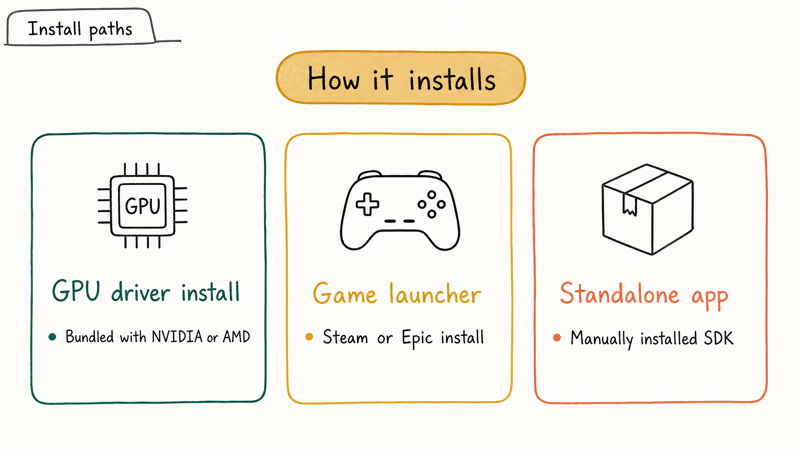
VulkanRT doesn’t install itself randomly. The software arrives through three specific, legitimate installation channels that you’ve likely encountered without realizing it.
#Graphics Driver Updates
Most commonly, VulkanRT gets installed when you update your graphics drivers. NVIDIA’s Game Ready drivers and AMD’s Adrenalin software automatically include Vulkan support.
Recent NVIDIA and AMD driver packages bundle VulkanRT without asking for separate permission, and Intel’s graphics drivers do the same on supported integrated GPUs. This is intentional and necessary for games that require Vulkan support, since shipping the runtime alongside the driver guarantees that the API version on disk always matches the driver that has to talk to it.
Driver updates occasionally cause system conflicts. If you experience Windows 10 keyboard issues after graphics driver updates, this usually indicates a broader system conflict rather than a VulkanRT-specific problem. The timing correlation doesn’t necessarily mean VulkanRT caused the issue - it’s more likely that the driver update process itself triggered an incompatibility with existing hardware or software configurations.
#Game Installations
Some games bundle VulkanRT during installation. Popular titles like “DOOM Eternal,” “Red Dead Redemption 2,” and “Rainbow Six Siege” may install Vulkan components if they detect missing runtime libraries on your system.
#Developer Tools
If you’re a developer, installing the Vulkan SDK adds the full development version of VulkanRT. This includes debugging tools and additional libraries beyond what games need.
#Is VulkanRT Safe or Potentially Dangerous?
VulkanRT is completely legitimate software. It’s not malware, spyware, or any form of harmful program.
#Security Profile
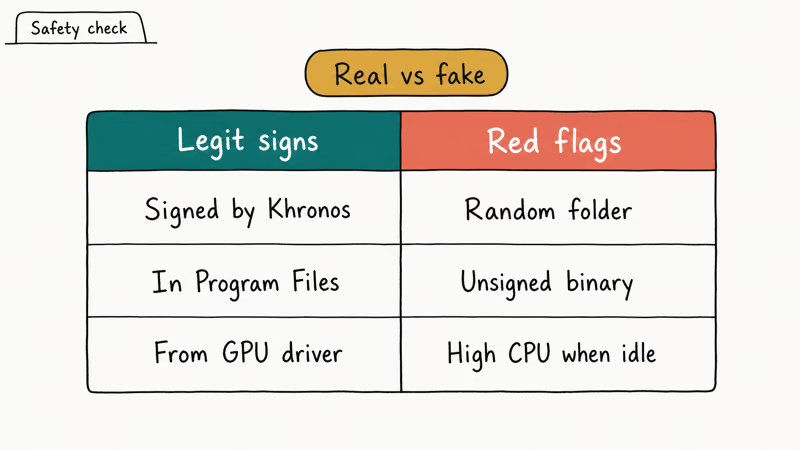
The Khronos Group maintains strict security standards for Vulkan. According to Khronos security guidelines, all Vulkan implementations undergo conformance testing before certification. The conformance test suite includes over 330,000 individual tests covering API functionality, memory management, and security validation.
VulkanRT files are digitally signed by graphics card manufacturers (NVIDIA Corporation, Advanced Micro Devices, Intel Corporation). These signatures verify the software’s authenticity and integrity.
#Why Antivirus Software Sometimes Flags It
Occasionally, antivirus programs show false positive alerts for VulkanRT. This happens because:
- The software loads low-level drivers and system components
- It modifies graphics pipeline behavior
- Some security tools don’t recognize newer graphics APIs
If your antivirus flags VulkanRT, check that the file is digitally signed and located in legitimate directories like C:\Windows\System32\ or your graphics driver folder. Similar to SSL certificate errors, false security warnings often stem from outdated security software databases rather than actual threats.
#How VulkanRT Improves Gaming Performance
Vulkan’s design philosophy focuses on reducing overhead between your software and hardware.
#Multi-Threading Advantages
Unlike DirectX 11, which primarily uses one CPU core for graphics commands, Vulkan distributes work across multiple cores.
This benefit shows up clearly in CPU-heavy titles like “Red Dead Redemption 2,” where Vulkan spreads work more evenly across all available threads instead of maxing out 2-3 cores. DirectX 11 tends to peg a few cores near their limit, while Vulkan keeps utilization more moderate across all cores.
#Reduced Driver Overhead
Vulkan gives games more direct hardware access. This means less time spent translating commands through driver layers and more time actually rendering graphics.
AMD’s GPUOpen documentation states that Vulkan 1.0 cuts the per-call CPU overhead of older APIs like DirectX 11, letting games issue far more draw calls before the processor becomes the bottleneck. This delivers a large performance improvement in CPU-limited scenarios.
#Cross-Platform Benefits
Games using Vulkan can share the same graphics code across Windows, Linux, Android, and other platforms. This unified approach helps developers optimize performance more effectively.
#Should You Keep or Remove VulkanRT
Keep VulkanRT installed unless you have a specific technical reason to remove it.
#Games That Require VulkanRT
Modern titles increasingly depend on Vulkan support:
- DOOM Eternal (primary renderer)
- Red Dead Redemption 2 (optional but recommended)
- Rainbow Six Siege (Vulkan mode)
- World War Z
- Strange Brigade
- Wolfenstein: Youngblood
Removing VulkanRT causes these games to either crash on startup or fall back to slower graphics modes.
#System Impact
VulkanRT doesn’t run continuously in the background. It only loads when games or applications specifically request Vulkan support. The installed files take approximately 50-100 MB of storage space.
#When Removal Makes Sense
Consider removing VulkanRT only if:
- You exclusively play older games that don’t use Vulkan
- You’re troubleshooting graphics driver conflicts
- You need to free up storage space and never game on the system
Even then, removal may complicate future software installations.
#Common VulkanRT Problems and Solutions
Most VulkanRT issues stem from outdated drivers or incomplete installations.
#Games Won’t Launch
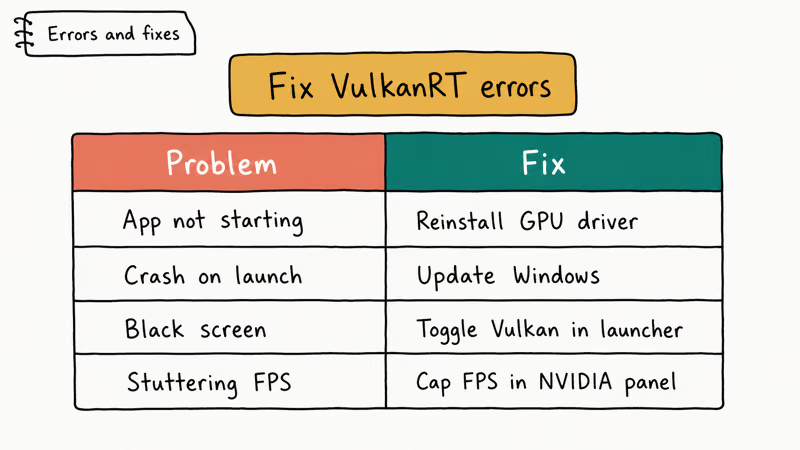
If Vulkan-enabled games crash or show error messages:
- Update your graphics drivers to the latest version
- Verify game files through Steam or your game launcher
- Check Windows Update for system-level graphics components
This issue is common on systems running outdated graphics drivers, and updating to the latest NVIDIA or AMD driver usually resolves launch failures in titles like “DOOM Eternal.” For complex driver conflicts, you might need to address underlying system issues like bad pool caller errors before VulkanRT functions properly.
#Performance Issues
If games run slower with Vulkan enabled:
- Ensure your graphics card supports Vulkan (most cards from 2014+ do)
- Check for background applications consuming GPU resources
- Try switching between Vulkan and DirectX modes in game settings
Some systems with NVIDIA display driver issues may experience reduced Vulkan performance until the underlying driver problem gets resolved. Audio-related games may also encounter Discord stream sound problems when graphics and audio drivers conflict during Vulkan operations.
#Compatibility Concerns
For older hardware or software conflicts:
- Check your GPU manufacturer’s Vulkan support list
- Update motherboard chipset drivers if using integrated graphics
- Consider rolling back to previous driver versions if problems persist
#VulkanRT vs. Other Graphics Technologies
Understanding how VulkanRT compares helps explain its importance.
#VulkanRT vs. DirectX 12
Both offer low-level hardware access, but DirectX 12 works only on Windows 10/11 and Xbox. According to Microsoft’s DirectX documentation, DirectX 12 requires Windows 10 version 1607 or newer. Vulkan supports Windows 7+, Linux, Android, and other platforms.
#VulkanRT vs. OpenGL
OpenGL is simpler for developers but less efficient in some CPU-bound rendering paths. The Vulkan overview is the durable source for why Vulkan exposes lower-level GPU control; treat specific performance deltas as game- and driver-dependent.
#VulkanRT vs. Metal
Apple’s Metal serves similar functions on macOS and iOS. Vulkan offers broader platform support while Metal integrates more tightly with Apple hardware.
#Future of VulkanRT Technology
Vulkan adoption continues growing across gaming and professional applications.
#Industry Support
Major game engines now include native Vulkan support:
- Unreal Engine 5
- Unity 2022+
- Godot 4.0
- CryEngine
The Steam Hardware Survey shows that the overwhelming majority of Steam users now run Vulkan-capable graphics hardware.
#Emerging Features
The Khronos Group regularly updates Vulkan with new capabilities. Khronos’s Vulkan roadmap shows recent additions including ray tracing acceleration, variable rate shading, and mesh shaders for advanced graphics techniques. Vulkan hardware adoption continues to grow across the PC gaming ecosystem.
#Bottom Line
VulkanRT is legitimate graphics software that improves gaming performance and enables advanced visual features. It gets installed automatically with graphics drivers and poses no security risk to your system. Keep it installed for the best gaming experience and future compatibility with new software.
#Frequently Asked Questions
Can I safely delete VulkanRT from my computer?
You can remove VulkanRT, but doing so may cause modern games to crash or perform poorly. The software takes minimal storage space and only runs when needed. Most users should keep it installed for compatibility.
Does VulkanRT slow down my computer?
No, VulkanRT doesn’t run continuously and has no impact on general system performance. It only loads when games or applications specifically use Vulkan graphics. The runtime libraries remain dormant until called by compatible software.
Is VulkanRT the same as Vulkan API?
VulkanRT (Vulkan Runtime) contains the libraries needed to run Vulkan applications. The Vulkan API is the programming interface developers use to create graphics software. Think of VulkanRT as the engine that makes Vulkan programs work.
Which graphics cards support VulkanRT?
Most graphics cards from 2014 or newer support Vulkan, including NVIDIA GTX 600 series+, AMD GCN architecture+, and Intel HD 4000+ integrated graphics. As shown in NVIDIA’s Vulkan driver support list, GeForce GTX 10 series and newer cards fully support current Vulkan specifications. Check your manufacturer’s website to verify specific model support.
Why did VulkanRT install without my permission?
Graphics driver updates automatically include VulkanRT to ensure compatibility with modern games and applications. This installation method is standard practice for graphics runtime components. Windows doesn’t require explicit permission for driver-bundled components.
How do I know if my games are using VulkanRT?
Check your game’s graphics settings for “Vulkan,” “API,” or “Renderer” options. Games may list DirectX, Vulkan, or OpenGL as available rendering modes. Popular titles like DOOM Eternal and Red Dead Redemption 2 prominently feature Vulkan options.
Does VulkanRT work on older versions of Windows?
Yes, VulkanRT supports Windows 7, 8, 10, and 11. However, some advanced features may require newer Windows versions or specific hardware capabilities. Windows 7 users get basic Vulkan support but may miss modern optimizations.
Will removing VulkanRT free up significant disk space?
No, VulkanRT typically uses only 50-100 MB of storage space. Removing it provides minimal disk space benefits while potentially breaking game compatibility. The storage impact is negligible on modern systems.

Best Laptop for Running LLMs in 2026: Memory Comes First
The best laptop for running LLMs is a memory purchase first. Compare MacBook unified memory against NVIDIA laptop VRAM, and see what each tier really runs.

How to Run a Local LLM on Windows: A 2026 Setup Guide
Run a local LLM on Windows with LM Studio or Ollama. Pick a model that fits your GPU memory, keep every prompt offline, and skip the monthly bill.
Bluetooth Not Working on Snapdragon X? Fixes for 2026
Bluetooth not working on your Snapdragon X Copilot+ PC? Generic audio, mice, and keyboards work, but vendor apps often lack an ARM build. Fixes inside.

Docker Desktop and WSL2 Not Working on Snapdragon X? Fix It
WSL2 runs fine on Snapdragon X, but Docker Desktop ARM is Early Access and throws WSL errors. Use WSL2 plus native ARM64 Ubuntu and Docker Engine.