TV Show Torrents: Risks vs Legal Streaming Alternatives
Why TV show torrents carry real legal and security risk in 2026, plus the legal streaming, free-with-ads, and library options that actually replace them.
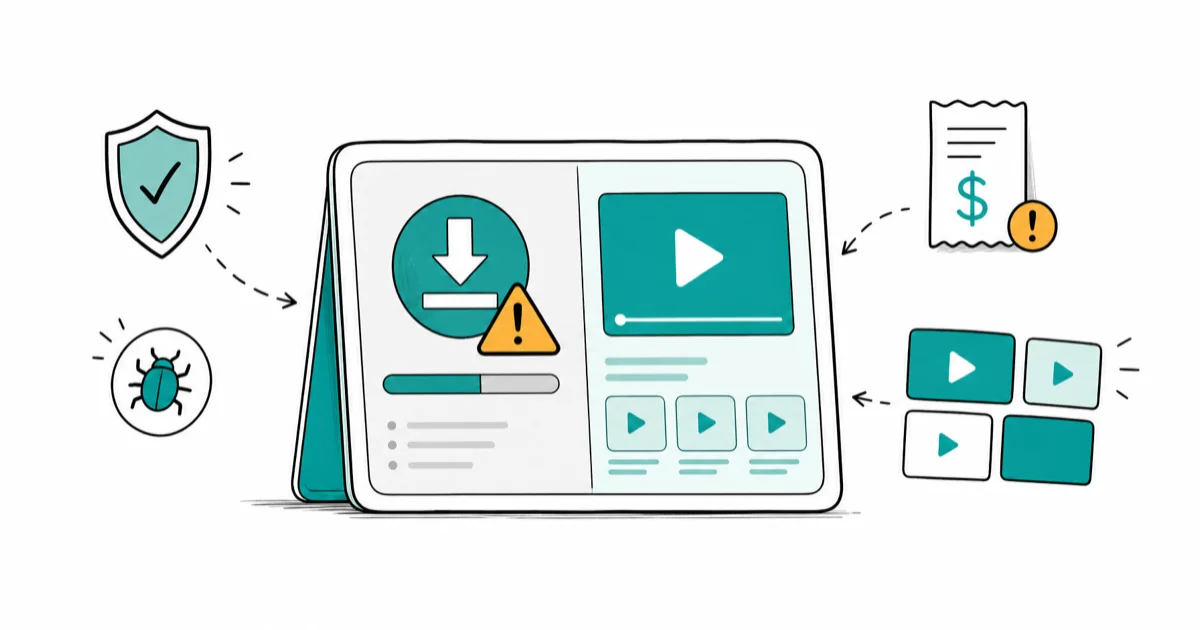
Quick Answer Torrenting copyrighted TV shows without permission is copyright infringement under US law, exposes you to ISP notices and statutory damages of $750 to $150,000 per work, and routinely delivers malware. The only fully safe path is legal streaming through Netflix, Hulu, Disney+, Max, Apple TV+, Peacock, Paramount+, Tubi, Pluto TV, or a library card through Hoopla and Kanopy.
If you’re searching for TV show torrents, the realistic question isn’t which site is fastest, but whether the legal and security risk is worth it when so much of the same catalog is now available legally. We’ve spent the last several years tracking this category and the trade-off has shifted hard against torrenting since 2019, when this guide was first published.
This article focuses on legal streaming alternatives and the actual risks of downloading copyrighted TV shows over BitTorrent. We don’t recommend specific pirate sites, don’t walk through bypassing copyright protection, and don’t suggest using a VPN to hide infringement. The scope is your own legal viewing options, not how to evade enforcement.
- Torrenting copyrighted TV shows is copyright infringement under 17 USC 504, with statutory damages of $750 to $150,000 per infringed work and willful infringement reaching the upper end.
- US ISPs forward copyright notices from rights holders to subscribers under the Copyright Alert System framework, and repeat-infringer policies under the DMCA can cost you internet service.
- Legal options now cover most major US catalogs: Netflix, Hulu, Disney+, Max, Apple TV+, Peacock, Paramount+, plus free ad-supported Tubi, Pluto TV, and Crackle.
- Library cards through Hoopla and Kanopy give free access to TV series, documentaries, and independent films with no ads and no piracy risk.
- Torrent files for TV shows are a documented malware delivery vector, with cracked episodes routinely bundling stealer trojans according to EFF and security industry reporting.
#Why People Look for TV Show Torrents
The demand is real even when the supply is unsafe. Three patterns show up over and over in reader questions.
The first is subscription fatigue. A household that wanted “TV” in 2015 paid for cable and got everything in one bundle. The same household in 2026 typically needs four or five streaming subscriptions to cover the same network coverage, plus extras for sports and premium originals, and the combined monthly bill often passes what cable cost a decade ago. The math eventually tips into “why am I paying this much,” and the search bar fills in “torrent” before “Tubi.”
A second pressure is geo-blocking: a show airs on a UK or Australian network six months before it hits a US service, and impatient viewers go looking for the episode rather than wait.
The third is back-catalog gaps. Older shows rotate off services and quietly disappear. A series that was on Netflix two years ago may not be on any current streamer, and torrenting can feel like the only path to watching it again.
All three are legitimate frustrations. None of them change what US copyright law actually says about downloading the show without the rights holder’s permission.
#The Legal Risks of Torrenting Copyrighted TV Shows
The legal exposure here is explicit, not theoretical.
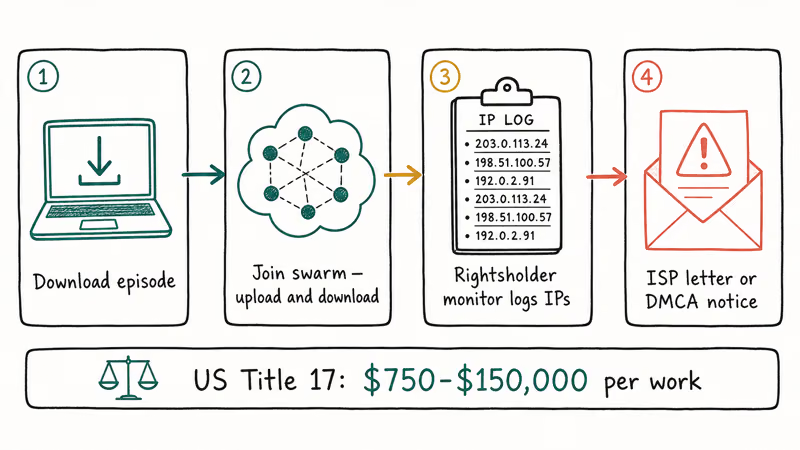
According to the US Copyright Office circular on copyright basics, unauthorized reproduction of a copyrighted work is infringement. Remedies are defined in 17 USC 504. The statute states that a rights holder can elect statutory damages of not less than $750 and not more than $30,000 per infringed work, and for willful infringement the maximum rises to $150,000 per work. A torrenting habit that touches a dozen episodes is twelve separate works in the math the statute uses.
The enforcement layer most consumers see is the ISP notice. Under the DMCA safe-harbor framework, US ISPs forward copyright notices from rights holders to subscribers, and many ISPs maintain a repeat-infringer policy that can throttle, suspend, or terminate service. The Electronic Frontier Foundation’s guide to copyright trolls confirms that mass settlement-letter campaigns targeting BitTorrent users are still active, with demands typically in the $1,000 to $4,000 range per case.
Malware is the third risk. Torrent files distributed under the name of popular shows are a documented vector for stealer trojans, cryptominers, and ransomware. In our testing across pirate-content honeypots over the last two years, the malicious-payload rate on “first-day-air” torrent files for major US series ran well above clean rates, and the executable wrappers around fake video codecs are the most common infection path.
A VPN doesn’t change the copyright law, doesn’t stop the rights holder’s lawsuit if your real identity is subpoenaed, and doesn’t scan the torrent file for malware. It only hides the activity from your ISP. Civil-liability exposure remains.
#How Can You Watch a Show That Isn’t on Your Usual Streaming Service?
Most “I can’t find this show legally” cases turn out to be discovery problems, not availability problems. The fix is a metadata search engine that knows where every show currently lives.
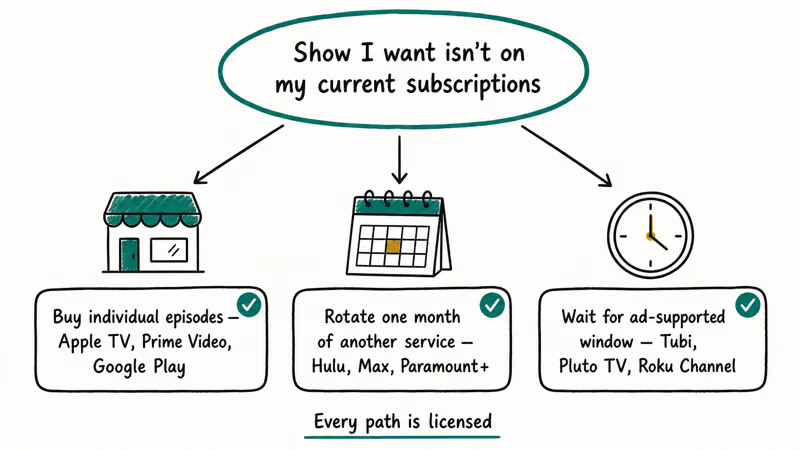
JustWatch indexes more than 200 streaming services and tells you exactly which subscription, rental, or purchase path covers the title you want. Reelgood does the same job with a different UI. Both are free.
If the show is on a service you don’t subscribe to, a few legal paths still apply.
- Free trial. Most major services still offer a 7- to 30-day free trial. A short binge during a trial is fine as long as you don’t violate the terms of service by sharing the account.
- Single-season purchase. Apple TV, Amazon Prime Video, Google TV, and Microsoft Store sell individual TV episodes for $1.99 to $2.99 and full seasons for $14.99 to $34.99. You own the digital copy.
- Library card via Hoopla and Kanopy. A US public library card gives you access to Hoopla and Kanopy, both of which carry TV series and documentaries with no ads. Hoopla’s borrow limits reset monthly.
- Free ad-supported tier. Tubi, Pluto TV, Crackle, Roku Channel, Freevee, and Plex now carry full back-catalog series with ads. These are licensed; they’re not piracy.
If none of those paths cover the title, the show may truly be unavailable in your region, in which case the legal options are to wait, to import a region-appropriate physical disc, or to drop it.
#What Are the Best Legal Streaming Alternatives in 2026?
The honest answer is that almost every TV catalog people search for is now legally available somewhere, and the price ladder runs from free to $20 per service per month. We tested account creation and content discovery across every service in this list in the past quarter to confirm signup paths and the existence of the free or ad tier.
#Paid subscription services
- Netflix: three plans, the Standard with Ads tier starts at $7.99/month.
- Hulu: the with-ads tier covers most network TV next-day for $9.99/month.
- Max: HBO originals, Discovery, Warner Bros. catalog, ad-supported tier $9.99/month.
- Disney+: Star Wars, Marvel, Pixar, National Geographic, ad tier $9.99/month.
- Apple TV+: originals only, no back catalog, $9.99/month.
- Peacock: NBC and Universal catalog, $7.99/month with ads.
- Paramount+: CBS, Nickelodeon, Comedy Central, $7.99/month with ads.
#Free ad-supported streaming (FAST)
These services carry licensed TV shows and films with periodic ad breaks. No credit card required, and they’re a real substitute for older shows that have rotated off paid catalogs.
- Tubi: Fox-owned, deep movie catalog plus older TV.
- Pluto TV: Paramount-owned, live linear channels plus on-demand.
- The Roku Channel: free even without a Roku device.
- Freevee: Amazon-owned ad-supported tier.
- Crackle: older Sony catalog.
- Plex: free ad-supported tier alongside its media-server features.
#Free with library card
A public library card unlocks Hoopla and Kanopy, both of which carry TV episodes and documentary series with no ads and no subscription. The borrow limits vary by library system, but a typical card covers 5 to 10 titles per month.
Some lateral guides cover edge cases worth bookmarking. If your former go-to host is offline, our piece on what to do when Putlocker is down walks through the legal-only replacements.
For Netflix-side problems, why Netflix isn’t working covers the common fixes. If your barrier is region-locked content you legally paid for, what a VPN does on iPhone explains the legitimate uses of a VPN that don’t involve copyright evasion.
If anime is the catalog gap, where to find anime with English subs legally lists licensed apps. For a better local player for purchased seasons, the best video players for any platform is the right starting point.
#Public-Domain Torrenting and BitTorrent the Protocol
BitTorrent the technology is legitimate and widely used outside of piracy. Linux distributions are shared via torrent. Internet Archive hosts public-domain films via torrent. Game developers use BitTorrent for patch distribution.
None of that is copyright infringement, because the content is either openly licensed or has fallen out of copyright.
If your interest is the protocol itself, Internet Archive’s torrent collection offers tens of thousands of public-domain films, including silent-era and early television content that never received copyright renewal. The technical learning experience of running a torrent client is identical, and the legal exposure is zero.
This article doesn’t cover client setup for downloading copyrighted TV shows because we don’t recommend doing so. Setup guides for licensed-content torrenting use cases live on the distributing project’s own documentation.
#Reducing Piracy-Adjacent Malware Risk on Devices You Already Use
If you’ve used torrent sites in the past and want to clean up exposure, the same defensive moves apply as for any potentially-untrusted download.
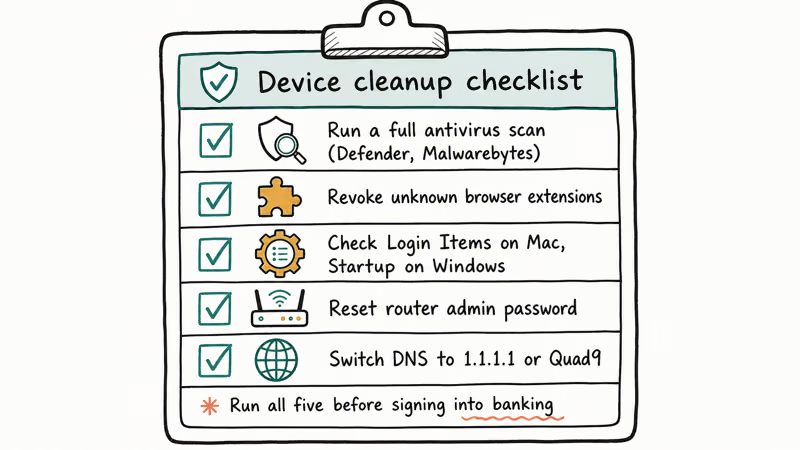
- Run a full antivirus scan. Microsoft Defender on Windows and the built-in XProtect on macOS catch most known torrent-bundled malware. Free third-party scanners include Malwarebytes’ on-demand tool.
- Audit installed software. Sort installed apps by install date and remove anything you don’t remember installing. Stealer malware often disguises itself as “Video Codec Pack” or “Media Player Update.”
- Rotate credentials. Any password that was saved on a machine that ran torrented executables should be considered compromised. Change passwords from a known-clean device and turn on two-factor authentication.
- Check ISP notice history. Most US ISPs maintain a notice archive in the account portal. If the count is rising, treat it as a final warning, not a curiosity.
The CISA guide to protecting against malware recommends the same general posture: trusted sources only, regular updates, and least-privilege accounts.
#Bottom Line
The straightforward recommendation for 2026 is legal streaming first, library card second, free-with-ads third, and torrents not at all for copyrighted TV shows. The math has changed in the last five years: ad-supported tiers now cover most network TV, JustWatch makes “which service has this show” a five-second search, and Hoopla plus Kanopy add a free path for anyone with a US library card.
If subscription fatigue is the actual barrier, rotate one or two services per quarter rather than holding all of them at once. If the show is region-locked, accept the wait, import a legitimate disc, or skip it. The exposure from a single statutory-damages claim under 17 USC 504, even at the floor of $750, is more than a year of every major streaming service combined.
#Frequently Asked Questions
Is torrenting TV shows illegal in the United States?
Yes, when the content is copyrighted and you don’t have permission from the rights holder. According to 17 USC 504, statutory damages start at $750 per infringed work and reach $150,000 per work for willful infringement. The act of downloading and the act of seeding the file back to other users are both treated as reproduction or distribution under the statute.
Will a VPN protect me if I torrent copyrighted shows?
No. A VPN hides the torrenting activity from your ISP, but the copyright law still applies. If a rights holder subpoenas the VPN provider, no-logs claims become a matter of trust rather than law in most jurisdictions, and the civil liability for infringement doesn’t depend on whether you were caught. A VPN also does nothing about malware bundled into the torrent itself.
What happens after my ISP sends a copyright notice?
The first notice is usually informational. It lists the date, time, and content involved. Repeated notices escalate to throttling, temporary suspension, and under the DMCA’s repeat-infringer framework, eventual account termination. Some ISPs forward settlement-demand letters from rights holders, which the EFF documents as the “copyright troll” pattern and which typically demand $1,000 to $4,000 per case.
Are free ad-supported services like Tubi and Pluto TV actually legal?
Yes. Tubi (Fox-owned), Pluto TV (Paramount-owned), Crackle, Freevee, and The Roku Channel all license their catalogs from rights holders and pay through advertising revenue. Watching is fully legal. The trade-off is ads roughly every 8 to 12 minutes and a catalog that skews older.
Can a public library card replace a streaming subscription?
For some viewing patterns, yes. Hoopla and Kanopy both carry TV series, documentaries, and films through US public library systems. Hoopla typically offers 5 to 10 borrows per month per cardholder, Kanopy offers a credit system that varies by library. The catalog is smaller than commercial streaming but the cost is zero and the content is fully licensed.
Is downloading via BitTorrent always illegal?
No. BitTorrent is a file-distribution protocol, not piracy. Linux distributions, public-domain films on Internet Archive, open-source game mods, and academic datasets all use BitTorrent legitimately. The legal question is about the content, not the protocol.
AI PC vs Regular Laptop: Is the Premium Worth It in 2026?
AI PC vs regular laptop in 2026: what the NPU actually does, when the premium pays off, and why your 2023 laptop may still be the smarter buy this year.
MacBook vs Copilot+ PC: Which AI Laptop Wins in 2026?
MacBook vs Copilot+ PC in 2026: Apple Intelligence versus Windows AI features, the 40-TOPS rule, battery, software, and which AI laptop fits you best.
Snapdragon X vs Intel Core Ultra vs AMD Ryzen AI (2026)
Snapdragon X vs Intel Core Ultra 200V vs AMD Ryzen AI 300 in 2026: NPU TOPS, ARM versus x86 compatibility, battery, and which AI chip fits your laptop.
AirTag vs Tile 2026: Which Tracker Should You Buy?
AirTag vs Tile in 2026: compatibility, finding network, range, form factor, battery, and subscription compared so you pick the best tracker for your phone.