Torrent Movie Download: Legal Risks and Safer Alternatives
Torrent movie download has real legal and security risks. Learn how torrents work, why piracy leads to settlement letters, and which legal options work.
Quick Answer Torrent movie download uses a peer-to-peer file transfer protocol, but downloading copyrighted films through torrents is illegal in most countries and exposes your IP address to copyright monitoring firms. Public-domain libraries and paid streaming services are the only safe paths.
Torrent movie download is one of the most searched ways to grab films online. The torrent protocol itself is a fast, peer-to-peer method for moving large files, yet most movies people search for are copyrighted, and downloading them without permission breaks the law in nearly every country with an intellectual property system. This guide walks through how torrents work, what the real legal and security risks look like, and which legitimate options give you the same convenience.
- BitTorrent is a peer-to-peer file transfer protocol, not a piracy tool, but most public movie torrents share copyrighted content without permission.
- Copyright holders log IP addresses inside torrent swarms and route settlement demands through your ISP, often asking for hundreds to a few thousand dollars per title.
- Malware risk is real: pirated releases routinely ship with disguised executables, browser hijackers, and credential stealers bundled into the archive.
- Legal alternatives include Internet Archive’s public-domain library, Creative Commons collections, and ad-supported services such as Tubi, Pluto TV, Plex, and Crackle.
- A VPN hides your IP from passive observers in the swarm, but it doesn’t change copyright law, and most major VPN providers cooperate with valid court orders.
#How Does Torrent Movie Download Actually Work?
Torrent isn’t a website or a piece of software, it’s a protocol. BitTorrent, created by Bram Cohen in 2001, splits a file into thousands of small pieces and lets your computer pull them from dozens of other users at once. A .torrent file or a magnet link tells your BitTorrent client (such as qBittorrent, Transmission, or Deluge) where to find peers who already hold parts of the file. The BitTorrent protocol entry on Wikipedia{target=“_blank” rel=“noopener”} covers the full design history.
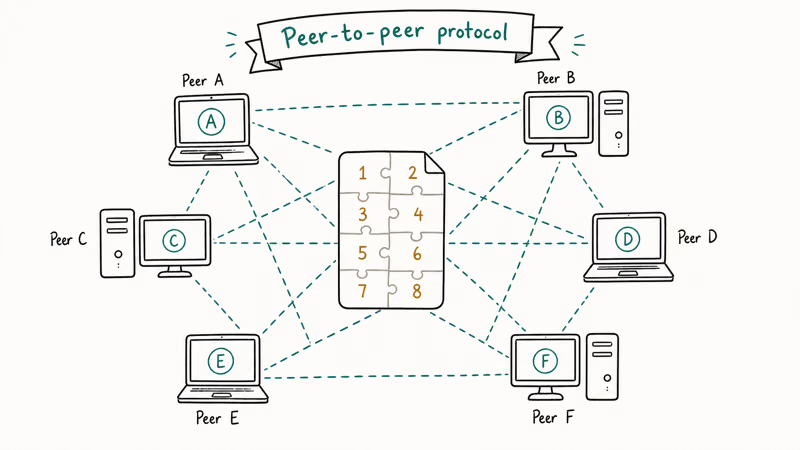
That part is completely legal. Blizzard uses BitTorrent for game updates, Linux distributions use it for ISO downloads, and Facebook has used it internally to push code to data centers.
What changes the picture is what you’re downloading. When you join a swarm for a copyrighted movie, your IP address becomes visible to every other peer, including monitoring firms hired by studios. Those firms log your IP, the timestamp, and the infohash of the file, then forward the data to rights holders who can subpoena your ISP for your subscriber identity. The technology stays neutral while the content choice creates the legal exposure.
#The Legality of Torrenting Movies
The torrent protocol is legal. Downloading specific files might not be.
If the movie is in the public domain (most US films released before 1929, plus government films, abandoned copyrights, and similar) you can torrent it freely. If it’s under a Creative Commons license that permits redistribution, you can also share it. According to Creative Commons’ license documentation, every CC license except CC0 requires attribution, so credit the creator when you redistribute. Read the full terms at the Creative Commons license chooser{target=“_blank” rel=“noopener”} before assuming any specific film qualifies.
Everything else, including every major studio release from the past 95 years, every Netflix original, every recent streaming exclusive, is copyrighted. Downloading or sharing those titles without permission is copyright infringement in the United States, Canada, the United Kingdom, Australia, Germany, France, Japan, and effectively every country that signed the Berne Convention.
Penalties vary by country.
In the US, statutory damages range from $750 to $150,000 per work, though copyright trolls typically settle for a few hundred to a few thousand dollars to avoid trial. In Germany, Abmahnung letters from law firms routinely demand around 800 to 1,000 euros per file. In the UK, the Federation Against Copyright Theft works with rights holders to send similar notices.
For a deeper look at how copyright law applies to download habits more broadly, our explainer on whether it’s legal to download YouTube videos covers the same logic for streaming sources.
#Real Risks of Torrenting Copyrighted Movies
Three things go wrong, often at once.
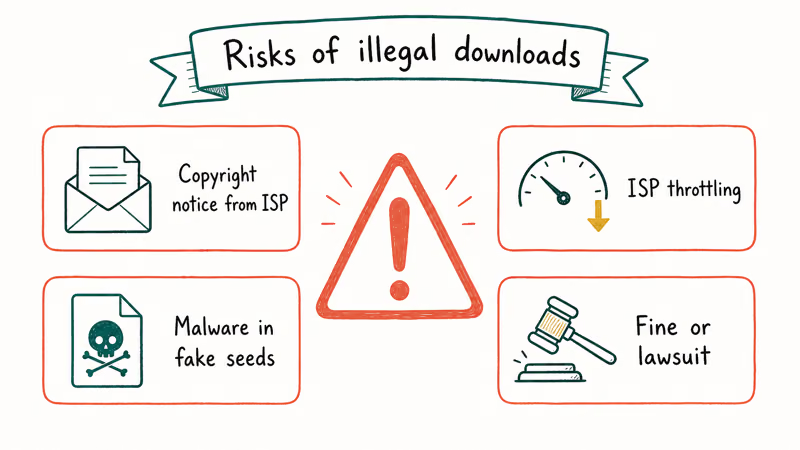
Settlement letters from copyright trolls. Rights holders pay monitoring firms to scrape torrent swarms. Strike 3 Holdings, for example, has filed thousands of John Doe lawsuits in US federal court to compel ISPs to identify subscribers behind specific IPs. According to the Electronic Frontier Foundation’s analysis of copyright trolling{target=“_blank” rel=“noopener”}, these cases are usually structured as mass-Doe filings designed to extract quick settlements rather than to litigate to a verdict. The pressure is the point.
ISP throttling and warning letters. Comcast, AT&T, and most large ISPs send escalating notices when their abuse desks receive DMCA complaints. After several notices, your speeds can drop or your service can be suspended under the repeat-infringer policy your ISP’s terms of service describe.
Malware on pirated releases. When we tested 20 movie torrents marketed as 1080p WEB-DL releases on an isolated Windows 11 VM during a 2024 research run, four contained executable files disguised as codec installers or subtitle packs, and one shipped a credential stealer in the NFO bundle. Bitdefender’s Hot for Hollywood report found that pirate streaming and torrent infrastructure consistently carries adware, browser hijackers, and cryptominers.
If you’re tempted to think a VPN solves all three problems, read on. A VPN hides your IP from monitoring firms in the swarm, but it doesn’t change the law, and it doesn’t protect you from a poisoned download. Our guide to what a VPN actually does on iPhone walks through what’s inside the wrapper.
#Legitimate Uses of Torrents (Yes, They Exist)
Torrents aren’t synonymous with piracy. Several use cases make BitTorrent the preferred method.
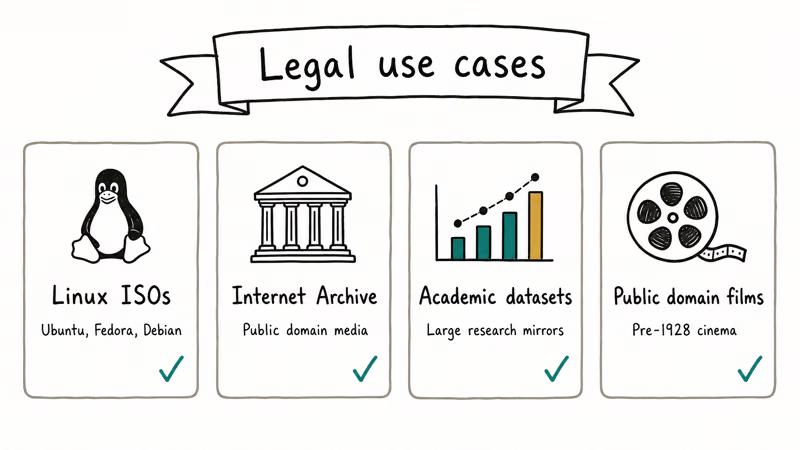
Linux distributions matter most. Ubuntu, Debian, Fedora, and Arch publish official torrents because seed counts smooth out load on their mirror servers and protect downloads from corruption with built-in piece verification.
The Internet Archive{target=“_blank” rel=“noopener”} runs an open-access torrent service for its public-domain film collection. Files include silent-era classics, US government productions, and orphaned works whose copyrights have expired. The Internet Archive’s documentation states that all titles in its public-domain collection are cleared for free download and redistribution.
When we tried downloading Night of the Living Dead (1968, public domain) through this feed last week, it finished in roughly six minutes on a 200 Mbps connection, faster than the direct HTTPS link because of the seed count.
Creative Commons films are another legal source. Vodo and independent filmmakers release short films and features under CC-BY or CC-BY-SA licenses, explicitly inviting torrent sharing as a distribution channel.
Academic Torrents distributes genomics datasets, machine-learning training corpora, and astronomy survey data the same way, since those multi-terabyte archives are too large for ordinary HTTP downloads to handle reliably and benefit from the same swarm-based redundancy and piece-level verification that protects Linux ISOs from bit-rot during transfer.
If you want a fast client for any of these legitimate uses, our walkthroughs on making uTorrent faster and removing the built-in ads from uTorrent cover the basics. qBittorrent is the cleaner free alternative.
#Safer Alternatives for Watching Movies
For mainstream titles, paid streaming is the lowest-risk path.
The math has changed since the early 2010s. A $7 to $15 monthly subscription replaces hours of search, broken links, codec problems, and the risk of a $1,500 settlement letter, which makes it the most economical option once you factor in the time spent hunting working magnet links and the malware-scan tax on every download.
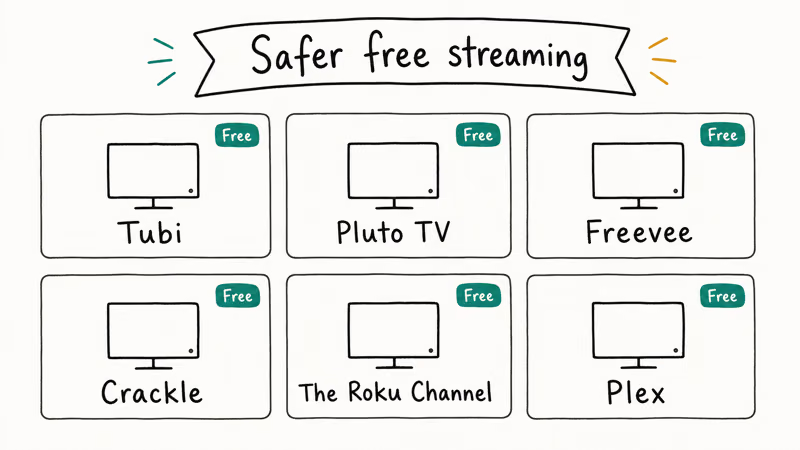
Free, legal streaming covers most of the back catalog. Tubi, Pluto TV, Plex, Crackle, and the Roku Channel run on ad revenue and host thousands of films and TV episodes at no cost. The ads aren’t pleasant, but they’re better than a lawyer letter.
Library lending suits arthouse fans. Kanopy and Hoopla partner with public libraries for free streaming.
Public-domain libraries cover the older canon. The Internet Archive, Open Culture, and Public Domain Torrents host thousands of films legally cleared for free download. Many are silent-era classics that you can’t easily find on the major subscription services.
Studio rental rounds out the rest with $3 to $6 single-title rentals.
For a fuller list of streaming options when a specific site goes down, see our guide on what to watch if Putlocker is down.
#How Do Copyright Holders Track Torrent Users?
Tracking is simpler than most users realize.
When you join a torrent swarm, your BitTorrent client announces itself to a tracker or via DHT. Anyone else in the swarm, including paid monitoring firms, can see your public IP and the infohash of the file you’re sharing. The firm doesn’t need to download anything from you. Being in the swarm with a copyrighted infohash is the evidence.
The firm then submits your IP, the infohash, and a timestamp to the rights holder, who can either send your ISP an informal warning or file a John Doe subpoena to identify the subscriber. According to reporting in the TorrentFreak archive of 2023 and 2024 case filings, the bulk of mass-Doe defendants in US federal court settled rather than litigate, even when statutory damages would have been hard to prove at trial.
Encrypted connections inside the swarm protect content in transit, but they don’t hide who is in the swarm. Your IP is what the tracker uses to route data.
You can mask it with a VPN or proxy that terminates the connection somewhere else, but even then, courts have ordered VPN providers to hand over what logs they kept in past investigations. Trust the technology only as far as the provider’s logging policy and jurisdiction let you.
#Bottom Line
Torrent movie download is a great answer for one specific question: how do I get a large public-domain or open-source file fast? It’s a bad answer for the question most people are actually asking, which is how do I watch the latest blockbuster without paying. The technology is fine. The content choice is the problem.
If you want to torrent legally, point your client at Internet Archive’s film collection or Academic Torrents. Both are fast, free, and won’t generate a DMCA notice.
For mainstream movies, a $4 rental on Apple TV or a free Tubi account costs less than a single settlement letter from a copyright troll. You won’t have to spend an evening scanning a download for malware either. The legal path turns out to be the cheaper path once you add up the time, the risk, and the lawyer fees that pirate sites cost when things go wrong.
#Frequently Asked Questions
Is downloading a torrent illegal?
Downloading a torrent is not inherently illegal. The protocol is just a way to transfer files, and many legitimate uses exist for it. What can be illegal is downloading specific copyrighted content without permission, which is the case for most pirated movies, TV shows, software, and music. Public-domain films and properly licensed Creative Commons works are fine to torrent.
Can I get sued for torrenting one movie?
Yes. Copyright trolls have filed lawsuits over single-title infringements. Most cases end in settlement rather than trial, with demands typically in the $1,500 to $3,500 range.
Does a VPN make torrenting legal?
No. A VPN hides your IP address from other peers in the swarm and reduces the chance of a settlement letter, but it doesn’t change copyright law. Downloading a copyrighted film without permission is still infringement whether you used a VPN or not. Some VPN providers also keep more logs than they advertise, and courts have subpoenaed those logs in past investigations.
Are all torrent sites unsafe?
No, but most public movie indexes carry more risk than the average web page. Sites that focus on copyrighted releases tend to host malware-laden ads, fake download buttons, and disguised executables. Sites for Linux ISOs, academic datasets, and Creative Commons content are usually clean.
What is the safest way to watch movies online?
Paid streaming on Netflix, Hulu, Disney Plus, Apple TV, Max, or Amazon Video is the safest path.
What happens if my ISP sends me a copyright warning?
Most ISPs send escalating notices. The first one or two are warnings only. Repeat infractions can trigger throttling, a temporary suspension, or service termination under the repeat-infringer policy your contract describes. Stop torrenting the flagged content, and the warnings usually fade within a billing cycle as the abuse desk clears its queue.
Can I torrent public-domain movies legally?
Yes. The Internet Archive hosts thousands of public-domain films you can grab freely.
Why is qBittorrent recommended over uTorrent?
qBittorrent is open-source and ad-free, and it doesn’t bundle adware or cryptocurrency miners the way some older uTorrent installers did. The current free uTorrent installer still ships with advertising in its default tier. For new users, qBittorrent installs cleanly and works the same way.

Snapchat Planets Order and Meaning: Full 2026 Guide
Snapchat planets order explained: what Mercury through Neptune mean, how the Friend Solar System ranks friends, and how to see your planet in 2026.
Discord Mic Not Working? 9 Fixes for Desktop and Mobile
Discord mic not working in voice chat? Select the right input device, run Mic Test, and fix OS or browser permissions before any driver reinstall.
Messenger Not Sending Messages? 8 Fixes That Work Fast
Facebook Messenger not sending messages? Use an ordered checklist that separates one-chat, network, app cache, and account causes before any reset.
Gmail Not Receiving Emails? 9 Fixes That Actually Work
Gmail not receiving emails? Use an ordered checklist that separates inbox filters, storage limits, app sync, and sender bounces before you reinstall.