Fix PS4 USB Storage Device Not Connected: 6 Methods
Fix the PS4 USB storage device not connected error in under 10 minutes. Reformat to exFAT, swap ports, or rebuild the database from Safe Mode.
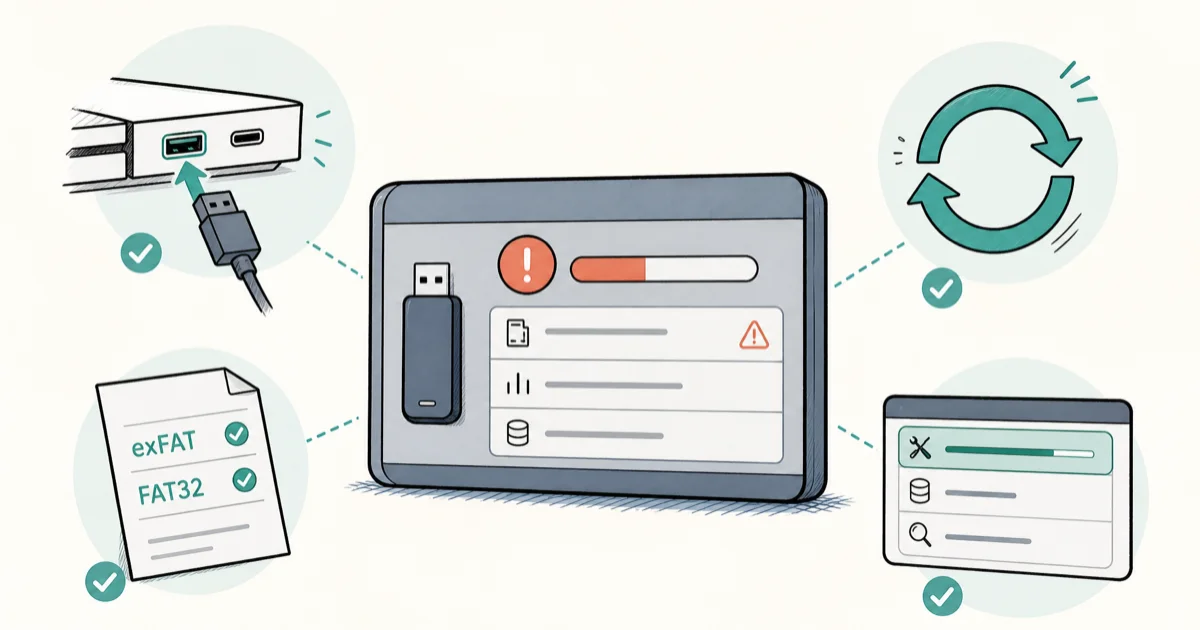
Quick AnswerReformat your USB drive to exFAT or FAT32, plug it into a different USB 3.0 port on your PS4, then rebuild the PS4 database from Safe Mode if the error continues.
The “USB storage device is not connected” error on PS4 almost always traces back to one of three things: a wrong file system, a bad USB port, or a corrupted PS4 database. Start with the file system, then move through ports, firmware, and the database rebuild.
- PS4 only mounts FAT32 and exFAT drives. NTFS, APFS, and HFS+ formatted drives are invisible to the console
- Extended storage requires a USB 3.0 connection and a drive between 250 GB and 8 TB
- FAT32 caps individual files at 4 GB, which forces single-file backups bigger than that onto exFAT instead
- Holding the PS4 power button for two beeps (about 7 seconds) opens Safe Mode without erasing game data
- Rebuilding the PS4 database scans every file on the internal drive and rebuilds the file index, which fixes most “not connected” errors caused by stale references
#Why Does Your PS4 Show “USB Storage Device Is Not Connected”?
The error is almost always a handshake failure, not a hardware death. Your PS4 sees power on the USB line but can’t read a valid partition table or file system. According to Sony’s PS4 extended storage support page, the console only recognizes drives that are formatted as exFAT or FAT32 over a USB 3.0 connection, with a capacity between 250 GB and 8 TB.
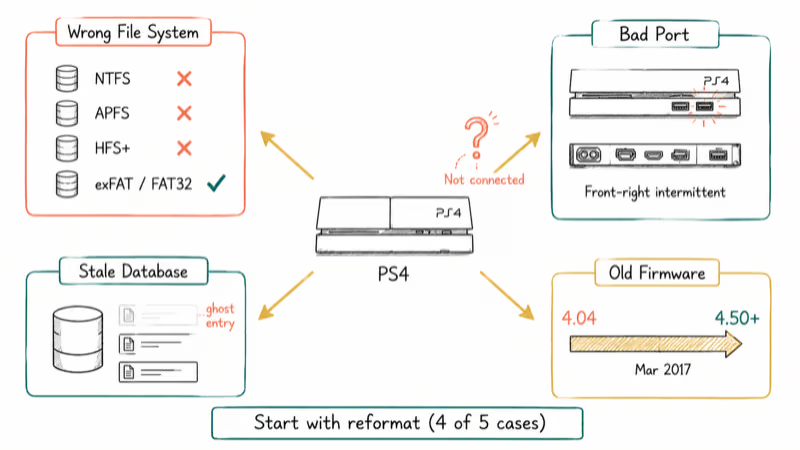
Four root causes account for most reports on Reddit’s r/PS4 and the official PlayStation Community forums:
- Wrong file system. Drives shipped by Western Digital, Seagate, and SanDisk default to NTFS for Windows compatibility. PS4 can’t read NTFS at all.
- Port hardware fault. The PS4 Pro and Slim have two front-facing USB 3.0 ports and one rear port. A single port can fail without affecting the others, especially after years of cable wiggle.
- Outdated firmware. Sony added external storage support in PS4 firmware 4.50 (March 2017). Any console still on 4.04 or earlier can’t mount extended storage at all.
- Corrupted database entry. When you eject a drive without using
Settings>Devices>USB Storage Devices, the PS4 sometimes keeps a ghost entry that blocks future mounts.
The methods below address each cause in the order most users actually need them. Start with reformatting because it fixes the file-system mismatch behind many cases.
#Reformat Your USB Drive to exFAT or FAT32
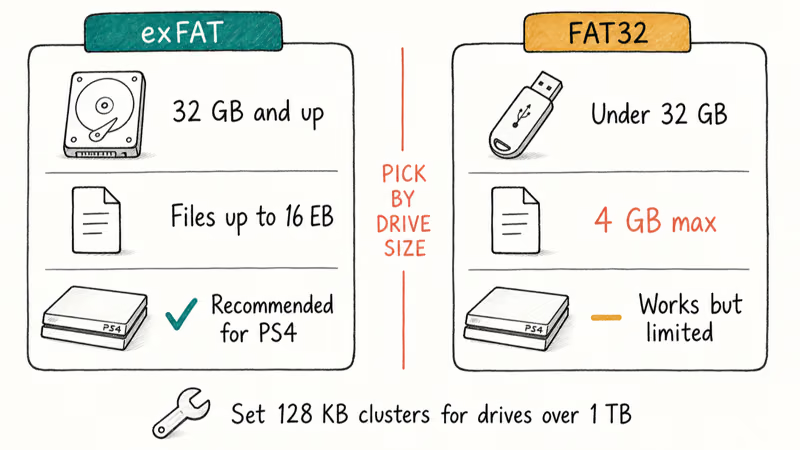
Reformatting wipes everything on the drive, so move any data you want to keep onto another disk first. Use exFAT for any drive over 32 GB. Microsoft’s exFAT specification confirms that exFAT supports individual files up to 16 exabytes, which is large enough for any PS4 game backup. FAT32 is fine for thumb drives under 32 GB but caps single files at 4 GB.
On Windows 10 or 11:
- Plug the USB drive into your PC.
- Open File Explorer, right-click the drive under “This PC,” and select Format.
- In the File system dropdown, choose exFAT.
- Set Allocation unit size to 128 kilobytes for drives over 1 TB. The PS4 reads 128 KB clusters faster than the default 32 KB.
- Tick Quick Format and click Start.
- Eject the drive cleanly with the system tray “Safely Remove Hardware” option before unplugging.
On macOS Ventura or later:
- Open Disk Utility from
Applications>Utilities. Click View>Show All Devicesin the top-left corner.- Select the parent drive (not just the volume) in the sidebar.
- Click Erase, set Format to ExFAT and Scheme to GUID Partition Map, then click Erase.
If you need to convert a large drive that Windows refuses to format as FAT32 through File Explorer, the walkthrough on how to change exFAT to FAT32 covers the command-line and free tool options. Plug the freshly formatted drive into your PS4’s rear USB 3.0 port and check Settings > Devices > USB Storage Devices. The drive should appear after the console reads the partition.
#Test a Different USB Port and Cable
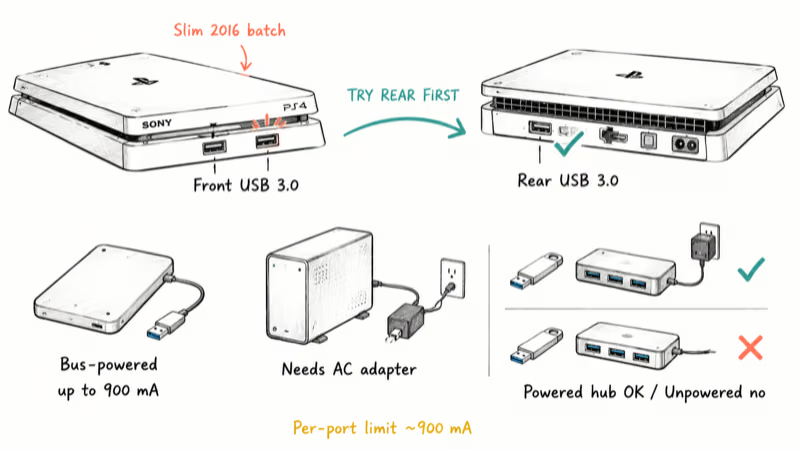
If the drive is correctly formatted but still throws the error, the issue is almost certainly physical. The first PS4 Slim units shipped in late 2016 had a front-port grounding issue that Sony quietly revised in mid-2017 production runs. Intermittent front-port failure is possible, and the rear port can still work when a front port doesn’t.
Run this port and cable check:
- Power off the PS4 fully and unplug the drive.
- Inspect both the USB-A connector on the cable and the port on the PS4 with a flashlight. Bent pins inside the port are obvious once you look.
- Reconnect the drive to the rear USB port using the original manufacturer cable.
- If you have a second cable available, swap it in. Many “drive failures” are actually cable shorts after pets or chairs flex the wire.
- Plug the drive into a Windows or Mac computer. If it mounts there, the drive is healthy and the PS4 port is the suspect.
External enclosures sometimes need their own power. Bus-powered 2.5-inch drives draw up to 900 milliamps, right at the PS4’s per-port limit. A 3.5-inch desktop drive must use its own AC adapter, since the console can’t supply enough current. If you’re juggling multiple peripherals on a single console, a powered PS4 USB hub keeps the storage drive on its own dedicated rail.
If swapping ports and cables both fail, the issue lives somewhere else. Move on to the firmware update next, then the database rebuild.
#Update Your PS4 System Software via Safe Mode
A console stuck on firmware 4.04 or earlier physically can’t mount extended storage. Even systems on 7.x firmware sometimes have a stuck update queue that breaks USB enumeration. The cleanest fix is a manual update through Safe Mode.
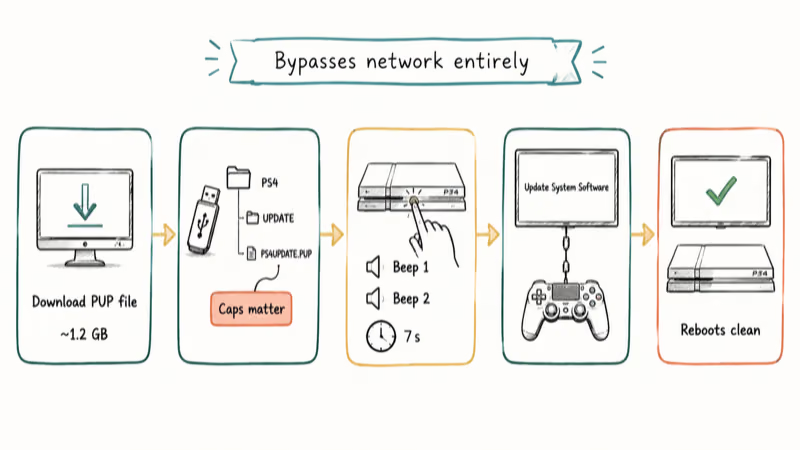
- From a PC with internet, download the latest PS4 update file from Sony’s download page. The current file is around 1.2 GB.
- Format a USB stick (1 GB or larger, FAT32 or exFAT) and create the folder path
PS4>UPDATEin the root. - Save the update file as PS4UPDATE.PUP inside the UPDATE folder. Capitalization matters.
- Plug the stick into your PS4, power down completely (not Rest Mode), then hold the power button until you hear two beeps.
- Connect a controller via USB cable and select
Update System Software>Updatefrom USB Storage Device. - Choose Update via Storage Media and follow the prompts.
The update writes to a recovery partition first, then commits on reboot. PlayStation’s Safe Mode guide states that this method also fixes most update loops because it bypasses the network entirely. After the system reboots to the home screen, plug in your storage drive again; if the error came from a stuck firmware or update state, the manual update is the fix.
#Rebuild the PS4 Database to Clear Stale References
If hardware and firmware both check out, the PS4 itself has likely cached a corrupted reference to a previous USB device. The Rebuild Database option scans every file on the internal drive and reconstructs the file index. PlayStation’s Safe Mode documentation confirms that Rebuild Database does not delete saved games, screenshots, or game files. Only the database that points to them is rebuilt.
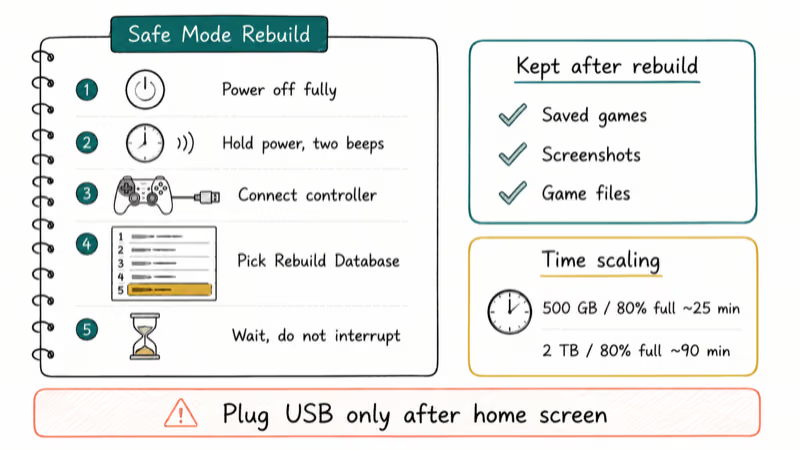
To rebuild:
- Power off the PS4 completely. Don’t use Rest Mode.
- Hold the power button until you hear two beeps (about 7 seconds). Release on the second beep.
- Connect your controller with a USB cable and press the PS button to pair.
- Select Rebuild Database from the Safe Mode menu (option 5).
- Wait. Time scales with how full your internal drive is. A 500 GB drive that’s 80 percent full takes around 25 minutes.
The system reboots automatically when the rebuild finishes. Plug your USB drive in only after you reach the home screen. If a PS4 database is corrupted error appears during the rebuild itself, follow the dedicated guide for that condition before continuing here.
One related symptom: if your PS4 also shows the “a device attached to the system is not functioning” error, the cause is almost certainly a partition table mismatch on the external drive. Reformat using GUID Partition Map on Mac, or GPT on Windows. Master Boot Record won’t work.
#What If a 4 TB SSD Still Won’t Connect?
Large SSDs and HDDs usually fail for one of three less-obvious reasons.
1. The drive is not USB 3.0. Check the connector. Blue plastic means USB 3.0; black means 2.0, which PS4 rejects.
2. The drive uses a USB hub or extension cable. Sony explicitly recommends a direct connection. Powered hubs sometimes work, but unpowered hubs commonly trigger the error because they add another failure point between the drive and console.
3. The drive partition is GPT but with EFI overhead. If you previously used the drive as a Mac Time Machine target or a Windows boot, residual partition entries can confuse the PS4 even after a reformat. Open Windows Disk Management, delete every existing volume until the disk reads as unallocated, then create one new exFAT partition. Disk Utility on macOS handles this through the Erase tab.
If a brand new SSD still fails after all three checks, the drive controller is probably defective.
Test it on a Windows or Mac machine first to confirm. The best SSD for PS4 roundup compares controller and enclosure combos that other PS4 owners have already verified.
#Bottom Line
Reformat first. Switching the drive from NTFS to exFAT fixes many file-system mismatch cases. If a fresh exFAT drive still doesn’t appear, swap to the rear USB 3.0 port and try a second cable before touching firmware or running a database rebuild. If none of the six methods work and the drive mounts on a PC, the PS4’s USB controller has likely failed.
#Frequently Asked Questions
Does PS4 work with NTFS drives?
No. The PS4 only reads exFAT and FAT32. NTFS drives appear as if they’re not connected at all, even when the cable, port, and firmware are all correct.
Will reformatting my USB drive delete game saves on the PS4 itself?
No. Reformatting only erases data on the USB drive itself. Game saves stored on the PS4’s internal drive or in the cloud through PlayStation Plus are untouched.
How long does Rebuild Database take on a PS4?
It depends on internal drive size and how full the drive is. A 500 GB drive at 80 percent capacity takes about 25 minutes. A 2 TB drive at the same fullness can run 90 minutes or more. Leave the console alone until it reboots itself.
Why does my brand new 4 TB drive show “not connected”?
Three usual causes: the drive is still formatted NTFS out of the box, the connection is going through an unpowered USB hub, or the cable is USB 2.0 even though the drive is 3.0. Reformat to exFAT, plug straight into the rear PS4 port, and confirm the cable has a blue plastic insert.
Can I use a USB 2.0 drive as PS4 extended storage?
No. Sony requires USB 3.0 minimum for extended storage. USB 2.0 drives are limited to manual save data backups and screenshot exports, not extended game storage.
Is it safe to unplug a USB drive from PS4 mid-game?
No. Always eject through Settings > Devices > USB Storage Devices > Stop Using This Extended Storage. Pulling the drive while a game is mid-write is the most common way to trigger the “not connected” error on subsequent reconnects.
Does the error mean my PS4 hardware is dying?
Usually not. Most cases come from file system, port, or database problems, with a failed USB controller as a last-resort diagnosis after the drive mounts on a computer and every software fix fails.
Can I use the same USB drive on PS4 and PS5?
Not as extended storage. PS5 stores its own games on internal SSD or its own M.2 expansion. A PS4 USB drive can hold playable PS4 games when used on a PS5 (the system reads them in PS4 mode), but PS5 native games can’t be moved to a USB stick for play. For the wider PS4-to-PC angle, the guide on how to connect PS4 to laptop covers display capture, not storage transfer.

Best Laptop for Running LLMs in 2026: Memory Comes First
The best laptop for running LLMs is a memory purchase first. Compare MacBook unified memory against NVIDIA laptop VRAM, and see what each tier really runs.
How to Run a Local LLM on Windows: A 2026 Setup Guide
Run a local LLM on Windows with LM Studio or Ollama. Pick a model that fits your GPU memory, keep every prompt offline, and skip the monthly bill.
Bluetooth Not Working on Snapdragon X? Fixes for 2026
Bluetooth not working on your Snapdragon X Copilot+ PC? Generic audio, mice, and keyboards work, but vendor apps often lack an ARM build. Fixes inside.
Docker Desktop and WSL2 Not Working on Snapdragon X? Fix It
WSL2 runs fine on Snapdragon X, but Docker Desktop ARM is Early Access and throws WSL errors. Use WSL2 plus native ARM64 Ubuntu and Docker Engine.