Spatial Audio Not Working on AirPods: 7 Fixes for 2026
Spatial Audio not working on your AirPods Pro or Max? Re-pair, update iOS and firmware, toggle ear detection, or reset the buds to fix the bug fast.
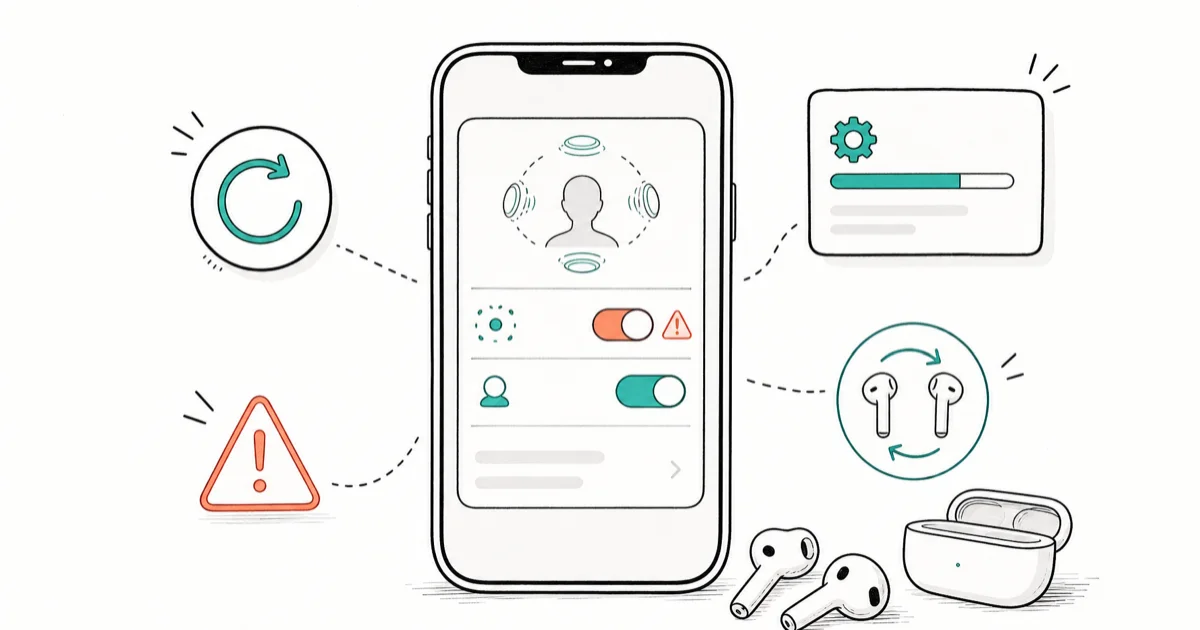
Quick AnswerSpatial Audio works only on AirPods Pro, AirPods Pro 2, and AirPods Max paired with an iPhone or iPad on iOS 14 or later. If it stopped, update iOS and AirPods firmware, re-pair the buds, then toggle Spatial Audio in Control Center.
Spatial Audio is the head-tracked feature that makes Dolby Atmos tracks sound like they’re coming from a fixed point in space. When it breaks, audio drops back to flat stereo or the Control Center toggle vanishes. Every fix below applies to AirPods Pro, AirPods Pro 2, and AirPods Max paired with a recent iPhone on iOS 17 or later.
- Spatial Audio is supported only on AirPods Pro, AirPods Pro 2, AirPods 3, and AirPods Max; standard AirPods 1st and 2nd gen don’t support the feature regardless of iOS version.
- The source iPhone or iPad must run iOS 14 or later, and the chip must be A12 Bionic or newer, which means iPhone XS, XR, or any later model.
- Firmware 6A300 is the minimum reference build for AirPods Pro; AirPods Pro 2 runs 7B19 as of early 2026, and anything older should be updated by placing the case open and lid up next to a connected iPhone for 30 minutes.
- Re-pairing AirPods clears stale Bluetooth handoff records on your Apple ID and resolves most cases where the Spatial Audio toggle in Control Center has gone missing.
- Automatic Ear Detection occasionally locks the audio renderer in stereo mode after a long sleep, and toggling it off then on again restores Dolby Atmos head-tracking without a full reset.
#Why Is Spatial Audio Not Working on Your AirPods?
Three things have to be right at once: hardware, source device, and software state.
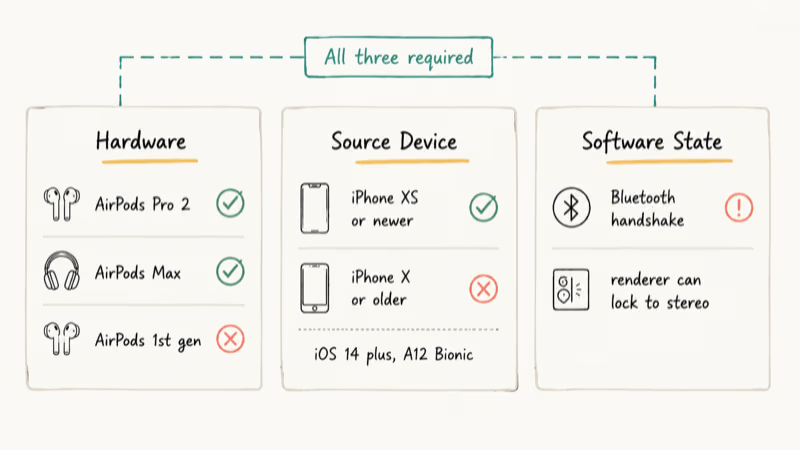
Hardware. According to Apple’s Spatial Audio support page, only AirPods Pro, AirPods Pro 2, AirPods 3, and AirPods Max decode head-tracked Spatial Audio. Standard AirPods 1st and 2nd gen don’t have the U1 chip or the inertial sensors, so the feature won’t appear in Control Center.
Source device. Spatial Audio needs an iPhone or iPad on iOS or iPadOS 14 or later with an A12 Bionic chip or newer. That cuts off iPhone X, iPhone 8, and earlier. Apple Music tracks also have to be tagged Dolby Atmos; lossless and standard tracks fall back to stereo.
Software state. A long session, a mid-stream iOS update, or a device switch can lock the renderer in stereo mode. A re-pair usually fixes it.
If you’re seeing one bud out of sync rather than no Spatial Audio at all, our guide on why one AirPod dies faster covers asymmetric drift.
#How Do You Re-Pair AirPods to Fix Spatial Audio?
Re-pairing is the single most reliable fix because it forces a fresh Bluetooth handshake and rebuilds the codec negotiation between iPhone and earbuds. Skip this step at your peril; methods further down rely on the buds being on a clean pairing record.
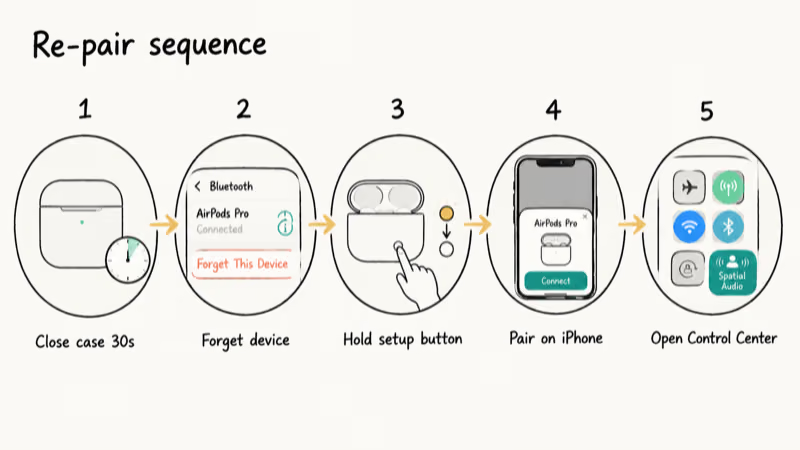
- Put both AirPods in the case and close the lid for 30 seconds.
- Open
Settings>Bluetoothon your iPhone, tap the i next to your AirPods, scroll down, and tap Forget This Device. Confirm. - Open the case lid, hold the setup button on the back of the case until the status light flashes amber, then white.
- Bring the open case next to your unlocked iPhone and follow the on-screen pairing prompt.
- Once paired, play a Dolby Atmos track in Apple Music and swipe down to open Control Center. Long-press the volume slider; the Spatial Audio control should appear.
After a re-pair, the toggle usually returns within seconds. If it still doesn’t show, update the firmware next.
If you’re also troubleshooting connection problems where the buds won’t even pair, our guide on AirPods case not charging walks through related power and Bluetooth issues.
#How to Update iOS and AirPods Firmware
Firmware updates ship silently, so most users have no idea what version they’re on. AirPods Pro 2 runs firmware 7B19 as of early 2026, and Apple has shipped multiple Spatial Audio bug fixes through that channel.
Check your firmware version:
- Pair AirPods to your iPhone.
- Open
Settings>Bluetooth, tap the i next to your AirPods, then scroll to Version. - Compare against Apple’s firmware release notes. The release notes page lists the current build for every AirPods generation.
Force a firmware update:
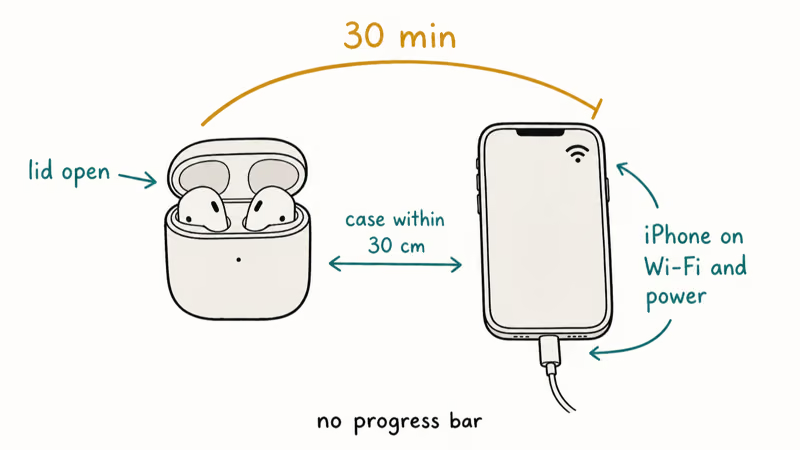
- Connect your iPhone to Wi-Fi and a power source.
- Place AirPods in the case, leave the lid open, and put the case within 30 cm of the iPhone.
- Walk away for 30 minutes. The update installs in the background; there is no progress bar.
Update iOS to 17.4 or later:
- Open
Settings>General>Software Update. - Download and install the latest update.
Apple’s iOS release notes confirms that iOS 17.4 fixed a regression in personalized Spatial Audio that reset head-tracking calibration after every reboot. If your iOS version is older than 17.4, update first and re-test before moving on.
While you’re updating, our iPad keeps freezing fix guide is useful if your source device is an iPad showing similar Bluetooth audio glitches.
#Toggle Automatic Ear Detection and Spatial Audio
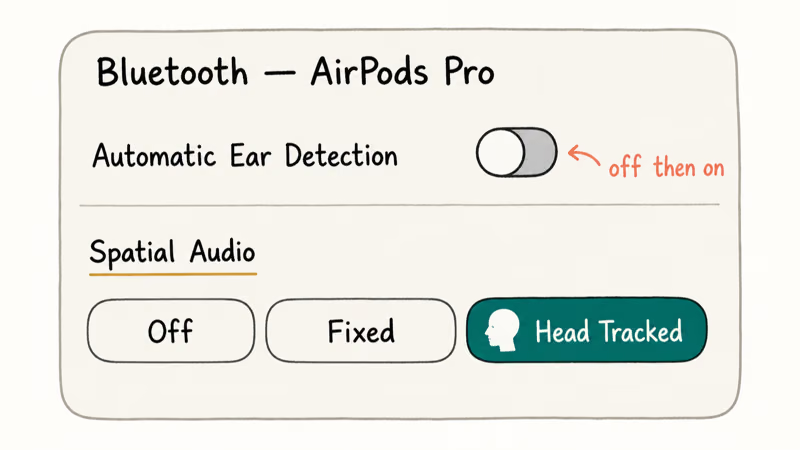
Automatic Ear Detection pauses playback when you remove a bud and resumes when you put it back in. The handoff occasionally leaves the audio renderer locked in stereo mode. Toggling it off and back on resets the renderer without a full re-pair.
- Open
Settings>Bluetooth, tap the i next to your AirPods. - Scroll to Automatic Ear Detection and turn it off.
- Wait 10 seconds, then turn it back on.
- Open Control Center, long-press the volume slider, and tap Spatial Audio. Switch between Off, Fixed, and Head Tracked to confirm the toggle responds.
This fix targets the specific bug where Spatial Audio is technically enabled but audio still sounds flat. It doesn’t help when the Spatial Audio control is missing entirely from Control Center; that case needs a re-pair or firmware update.
#How to Reset AirPods to Factory Defaults
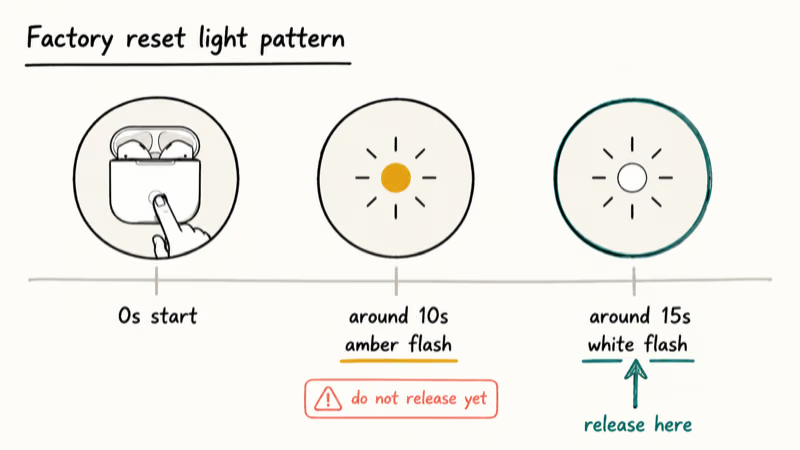
A factory reset clears every Bluetooth pairing, EQ preset, and stored ear-tip fit test. According to Apple’s AirPods reset instructions, this is the recommended last step before contacting support.
- Put both AirPods in the case and close the lid for 30 seconds.
- Open the lid.
- Press and hold the setup button on the back of the case for about 15 seconds, until the status light flashes amber, then white.
- Re-pair the AirPods to your iPhone using the on-screen prompt.
Reset wipes the personalized Spatial Audio profile if you previously set one up using the iPhone TrueDepth camera. To rebuild it after the reset, go to Settings > Bluetooth > [Your AirPods] > Personalized Spatial Audio > Set Up. The setup uses the front camera to scan your face and ears for about 30 seconds.
If your buds are stuck in a state where they won’t even appear in Bluetooth, the Find My AirPods sound pending fix covers that recovery path before you get to a reset.
#Repair Persistent iOS Bugs With Tenorshare ReiBoot
If Spatial Audio still won’t engage after a re-pair, firmware update, and factory reset, the bug is on the iPhone side rather than the AirPods. iOS occasionally enters a state where the audio renderer flag stays locked even after a reboot, and the only way out is a system repair without losing data.
Tenorshare ReiBoot runs a Standard Repair pass that reinstalls iOS over the existing data partition, which clears the renderer flag without wiping your photos, messages, or app data. It downloads the matching firmware package, reinstalls iOS in roughly 10 to 15 minutes, and reboots the phone once so the Spatial Audio control can reappear in Control Center.
Some links on this page are affiliate links, which means fone.tips may earn a commission at no extra cost to you.
Steps:
- Download and install Tenorshare ReiBoot on your Mac or PC.
- Connect your iPhone with a Lightning or USB-C cable.
- Click Standard Repair, then Start.
- ReiBoot fetches the matching firmware package automatically; pick the default download path.
- Click Standard Repair again to start the install. The phone reboots once during the process.
- After reboot, open Control Center and verify the Spatial Audio control is present.
Standard Repair preserves user data; the more aggressive Deep Repair mode wipes the device and is rarely needed for audio bugs.
If you’re also dealing with related iPhone audio quirks, our iPhone alarm not going off guide covers the system-level audio routing bugs that often appear in the same iOS releases.
#Bottom Line
Most Spatial Audio failures trace back to stale Bluetooth pairing data, AirPods Pro 2 firmware lagging behind the current 7B19 release, or the audio renderer stuck in stereo mode after Automatic Ear Detection. Run the fixes in order: re-pair, update firmware and iOS, toggle ear detection, then factory reset. If nothing works, run Tenorshare ReiBoot Standard Repair to fix the iOS-side renderer flag without wiping your data.
The re-pair plus firmware update combo clears most cases. Save factory reset and ReiBoot for the rare bug where the toggle is missing from Control Center entirely.
#Frequently Asked Questions
Does Spatial Audio work with all AirPods models?
No. It needs AirPods Pro, Pro 2, AirPods 3, or AirPods Max.
What iPhone models support Spatial Audio?
Spatial Audio needs an A12 Bionic chip or newer running iOS 14 or later. That covers iPhone XS, XR, 11, 12, 13, 14, 15, 16 series, and the iPhone SE 2nd gen and later. iPad Pro models from 2018 onward, iPad Air 3rd gen and later, iPad mini 5th gen and later, and any iPad on iPadOS 14 or later also work.
Why is the Spatial Audio toggle missing from Control Center?
iOS hides the toggle until a Dolby Atmos source is actually playing.
Does updating AirPods firmware require a Mac or PC?
No. AirPods firmware updates over Bluetooth from any paired iPhone or iPad on Wi-Fi. Place the AirPods in the case, leave the lid open, and put the case within 30 cm of the source device for at least 30 minutes. There is no progress indicator, but you can verify the new version under Settings > Bluetooth > i > Version.
Will a factory reset delete my personalized Spatial Audio profile?
Yes. The reset wipes the face and ear scan you ran during Personalized Spatial Audio setup, along with EQ presets and ear-tip fit results.
You can rebuild the profile in about 30 seconds under Settings > Bluetooth > [Your AirPods] > Personalized Spatial Audio > Set Up. The setup uses the iPhone TrueDepth front camera to scan your head and ear shape, and iOS then fine-tunes the head-tracking math so cues line up with your specific ear geometry. If you skip the rebuild, head tracking still works using a generic profile, but spatial cues feel slightly off-center on critical Atmos mixes.
Why does Spatial Audio drop out during phone calls?
Phone calls use the SCO Bluetooth profile, which is mono and doesn’t carry Spatial Audio at all. The feature only engages on the A2DP stereo profile used by Apple Music, Apple TV, and supported video apps. Audio drops back to plain mono during a call, then reverts when the call ends. If your microphone also fails on calls, our AirPod mic not working fix covers the related Bluetooth profile bugs.
Can I use Spatial Audio with non-Apple apps like YouTube or Netflix?
Yes, but only for multichannel streams. Netflix Dolby Atmos titles work; YouTube standard stereo videos don’t.
How do I check if a song actually has Dolby Atmos?
In Apple Music, open the track and look for the Dolby Atmos badge under the track title. According to Apple’s Apple Music sound quality guide, tracks with the badge stream in Dolby Atmos when your AirPods support it; tracks without the badge fall back to lossless or standard stereo. You can also force Dolby Atmos in Settings > Music > Dolby Atmos > Always On to override the auto-detection.
Apple Siri Settlement: Who Qualifies and How to Claim
Apple's $250 million Siri settlement covers iPhone 15 Pro and iPhone 16 models bought June 2024 to March 2025. See who qualifies and how claims work.
iOS 26.6.1 Security Update: What Apple Fixed and Who Gets It
Apple released iOS 26.6.1 on August 17 with 29 security fixes, including an IPSec interception bug. See what it patches, who gets it, and how to update.
iPhone Adaptive Power: How It Works and When to Use It
Learn how iPhone Adaptive Power works, which models support it, what it changes, and when Low Power Mode is still the better battery-saving choice.
How to Transfer Data to a New iPhone Without iCloud
Move everything to your new iPhone without iCloud: Quick Start device-to-device transfer, wired migration, and encrypted Finder or iTunes backups.