iPad Keeps Freezing: Safe Fixes for Apps and System Lockups
Fix a frozen iPad safely by separating one-app failures from whole-device lockups, then checking storage, updates, temperature, and recovery options.
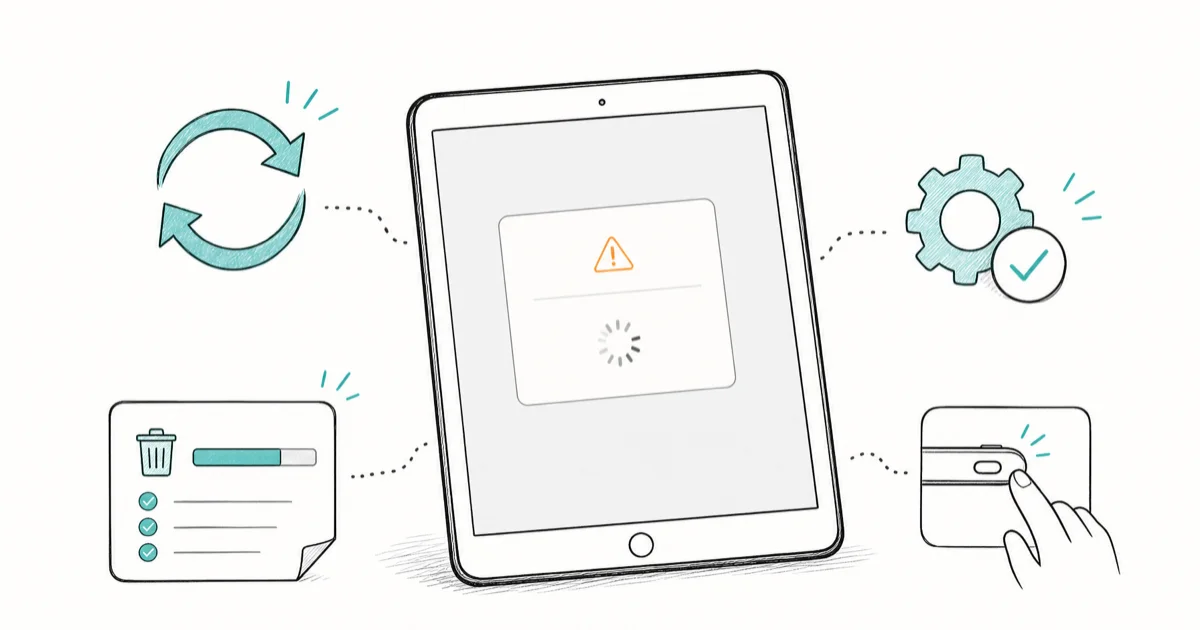
Quick AnswerIf the whole iPad is unresponsive, force restart it with the sequence for a device with or without a Home button. If only one app is stuck, close that app and check its updates before changing system settings.
A frozen iPad needs a different response from a frozen app. If the entire screen ignores touch, use Apple’s force-restart sequence. If one app stops responding while the Home Screen still works, troubleshoot only that app to avoid unnecessary resets.
- Use the presence of a Home button—not an assumed model year—to choose the force-restart sequence
- Close and reopen only an app that is actually unresponsive; routinely closing every app is not a memory fix
- Apple does not publish a universal free-space percentage or weekly restart schedule that prevents iPad freezes
- Try an Update from recovery mode before Restore when Apple presents both options
- Restore erases the iPad; back up first when the device is usable and the backup is current
#What Is Actually Frozen?
Before pressing buttons, check which of these descriptions matches the iPad:
- One app is stuck: You can still open the App Switcher, return to the Home Screen, or use another app.
- The whole iPad is unresponsive: Touch, buttons, and the Home Screen don’t respond normally.
- The iPad is stuck during startup: It remains on an Apple logo, a red or blue screen, or a recovery screen instead of reaching the Lock Screen.
- The iPad works but freezes repeatedly: It recovers after a restart, then the same app or system-wide symptom returns.
Apple publishes different paths for these cases. Treating all four as “low RAM” or “corrupted system files” would be a diagnosis the screen alone can’t prove.
#Force Restart a Completely Frozen iPad
According to Apple’s current frozen iPad instructions, the sequence depends on whether the device has a Home button. It doesn’t depend on release year or whether the iPad has Face ID.
#iPad Without a Home Button
- Press and quickly release the volume button closest to the top button.
- Press and quickly release the volume button farthest from the top button.
- Press and hold the top button until the Apple logo appears.
#iPad With a Home Button
Press and hold the Home button and the top button together until the Apple logo appears.
A force restart is not a factory restore. If the iPad starts normally, use it long enough to see whether the problem belonged to one app or affected the whole system. Don’t repeat the button sequence as scheduled maintenance; Apple presents it for a frozen or unresponsive device.
#If Only One App Freezes
Apple’s unresponsive app checklist starts with closing and reopening the affected app. If that does not help, restart the iPad, check for an app update, and then check for an iPadOS update.
To close the affected app, open the App Switcher and swipe up on that app’s preview. Reopen it and retry the same action. Don’t swipe away every app on the screen. Apple’s iPad guide says there is typically no reason to quit an app unless it’s not responding, and quitting apps is not presented as a way to save memory or battery.
If the app still fails:
- Open the App Store, tap your account picture, and install an available update for that app.
- Test the app on a different network if the freeze happens only while loading online content.
- Check the developer’s support or service-status page.
- Consider deleting and downloading the app again only after confirming how its local data is backed up. Apple warns that deleting an app can remove data stored in it.
When every other app works, a factory restore of the whole iPad is disproportionate. Contact the app developer before erasing the device.
#Check Storage Without Inventing a Threshold
Go to Settings > General > iPad Storage. According to Apple’s storage guide, this screen shows recommendations and per-app usage. iPadOS can also remove redownloadable items and temporary files when space is low.
Use the numbers your iPad shows. Apple does not set one “safe” percentage, a fixed number of gigabytes, or a point at which every iPad starts freezing. If you see Storage Almost Full, review Apple’s recommendations, remove downloads you no longer need, or offload an app while keeping its documents and data. Check a backup before deleting photos, messages, or app data.
If a pending update can’t install, Apple’s update guidance says the device needs enough available storage for that specific download and installation. The required amount varies with the update rather than following a universal rule.
#Update the App and iPadOS
According to Apple’s current iPadOS update guide, back up first, then open Settings > General > Software Update.
Install the latest version available to that iPad. Don’t assume that every update contains a fix for the exact freeze you saw. If the problem began in one app, its own release notes and developer support remain the more relevant evidence.
If an update won’t download or install, check power, internet access, compatibility, and available storage. Our iPad Wi-Fi troubleshooting guide covers network-specific symptoms without treating a stalled download as a hardware freeze.
#Let an Overheated or Very Cold iPad Recover
If the device is unusually hot, shows a temperature warning, dims its display, or slows during a demanding task, stop the task and move the iPad away from direct sunlight. Apple’s temperature guidance lists an ambient operating range of 0–35°C (32–95°F) and says performance can be reduced when the device regulates its temperature.
That source supports a temperature check, not the claim that charging while gaming always causes a lockup. If a temperature warning appears, Apple says to turn off the device, move it to a cooler place away from sunlight, and let it cool before trying again. Don’t put it in a refrigerator or freezer.
#Use Reset All Settings Sparingly
Apple describes Reset All Settings as a rarely necessary option for incorrect or damaged settings after a restart has not fixed a system-feature problem. It’s not the automatic next step for every recurring freeze.
If the iPad is responsive, you have a current backup, and the symptom points to system settings rather than one app, the path is Settings > General > Transfer or Reset iPad > Reset > Reset All Settings.
This does not delete photos, messages, apps, or documents, but it does reset or remove many preferences: Wi-Fi networks and passwords, Bluetooth pairings, Apple Pay cards, privacy and location preferences, accessibility settings, trusted computers, Face ID or Touch ID settings, and more. Be prepared to configure those again. If the problem is only a keyboard, use the narrower steps in our iPad keyboard guide instead.
#Recovery Mode for an iPad Stuck During Startup
Recovery mode is for a different symptom: an iPad that turns on but can’t finish startup, shows a recovery screen, or can’t be updated normally. Apple’s frozen-iPad page says to connect the device to a computer and choose Update when the Update/Restore prompt appears.
On a current Mac, open Finder. On a current Windows PC, open Apple Devices. Apple still mentions iTunes for older Macs and Windows systems that don’t have Apple Devices, but it’s not the default current Windows instruction.
Keep the iPad connected while entering recovery mode:
- Without a Home button: Press and release the volume button closest to the top button, press and release the other volume button, then hold the top button past the Apple logo until the recovery screen appears.
- With a Home button: Hold the Home and top buttons. Keep holding until the recovery screen appears.
Choose Update first. That attempts to reinstall iPadOS without the factory-restore erasure. If the software download takes long enough for the iPad to leave recovery mode, let the download finish, then repeat the documented button sequence.
If Update fails and Apple presents Restore, pause and check your backup. Apple’s separate iPad recovery guide is explicit that Restore reinstalls iPadOS and erases all data. A restore is not a guaranteed cure for an account, app, accessory, or hardware problem. If you need help preserving a computer backup first, see our iTunes backup troubleshooting guide.
#When Should You Request Service?
Request service if the iPad remains unresponsive after Apple’s documented force-restart and recovery steps.
Buttons that don’t work and problems following a drop, liquid exposure, swelling, or other physical damage also need inspection; don’t open the iPad to reseat a display cable based only on a freeze. Apple’s iPad service page provides a model-specific estimate after you select the device and describes in-person and mail-in options. It doesn’t publish one fixed third-party price or promise that a battery replacement will cure freezing. A charging-only symptom belongs in our separate iPad Pro charging guide.
Battery Health is also model-dependent. Apple’s current supported-model list includes specific recent iPad Pro, iPad Air, iPad mini, and base iPad models. On a supported model, open Settings > Battery > Battery Health. If that item is absent, don’t conclude that the battery is healthy or damaged; use Apple’s diagnostics or service path instead.
#Habits That Reduce Avoidable Problems
- Install app and iPadOS updates after reviewing them and making a backup.
- Respond to Storage Almost Full with the recommendations shown on the iPad.
- Close an app when it’s unresponsive, not every app after every session.
- Keep the iPad within Apple’s published temperature range.
- Use known-good cables and power sources when a freeze happens during charging.
- Record whether the symptom affects one app, the whole interface, or startup. That history is more useful to support staff than an assumed hardware diagnosis.
Use the iPad’s own alerts; for a white display, follow the white-screen checks.
#Bottom Line
For a completely frozen iPad, use the force-restart sequence that matches the presence of a Home button. For one frozen app, close and troubleshoot that app. If freezes return, review storage, updates, and temperature without relying on universal thresholds.
Use recovery mode only for startup or update failures, try Update before Restore, and treat Restore as destructive. When Apple-supported steps fail or physical damage is possible, arrange service rather than trying undocumented button combinations or internal repairs.
#Frequently Asked Questions
Does force restarting an iPad erase it?
No. A force restart turns the device off and starts it again; it’s different from choosing Restore or Erase All Content and Settings. Apple’s recovery guide explicitly identifies Restore as the option that erases data.
How much free storage prevents freezing?
Apple does not publish one percentage or gigabyte minimum that prevents every freeze. Open Settings > General > iPad Storage, follow the recommendations shown for that device, and respond to a Storage Almost Full alert without deleting unbacked-up data.
Should I close every background app?
No. Close and reopen an app that is not responding. Apple’s iPad guide says there is typically no reason to quit apps routinely, so don’t present “close everything” as a RAM cleanup or prevention schedule.
What if only Safari or a streaming app freezes?
Test whether the Home Screen and other apps work. If they do, close and reopen the affected app, check its update, and test its network or service status. A network stall inside one app is not proof that the whole iPad froze.
Will a factory restore definitely fix recurring freezes?
No. A restore erases the iPad and reinstalls current software, but it can’t guarantee a fix for a particular app, account, accessory, or hardware fault. Try the symptom-specific checks first and back up before any destructive step.
Why is Battery Health missing on my iPad?
Apple exposes detailed Battery Health and history only on the models listed in its current support page. If the menu is absent, use Apple Support or an authorized provider for battery diagnosis rather than applying an iPhone menu or an unsupported capacity threshold.
Apple Siri Settlement: Who Qualifies and How to Claim
Apple's $250 million Siri settlement covers iPhone 15 Pro and iPhone 16 models bought June 2024 to March 2025. See who qualifies and how claims work.
iOS 26.6.1 Security Update: What Apple Fixed and Who Gets It
Apple released iOS 26.6.1 on August 17 with 29 security fixes, including an IPSec interception bug. See what it patches, who gets it, and how to update.
iPhone Adaptive Power: How It Works and When to Use It
Learn how iPhone Adaptive Power works, which models support it, what it changes, and when Low Power Mode is still the better battery-saving choice.

How to Transfer Data to a New iPhone Without iCloud
Move everything to your new iPhone without iCloud: Quick Start device-to-device transfer, wired migration, and encrypted Finder or iTunes backups.