People Can't Hear Me on My iPhone: 9 Fixes That Work
Fix callers not hearing you on iPhone with 9 clear steps. Covers iOS 18 mic bugs, cleaning, permissions, Voice Isolation, and hardware checks.
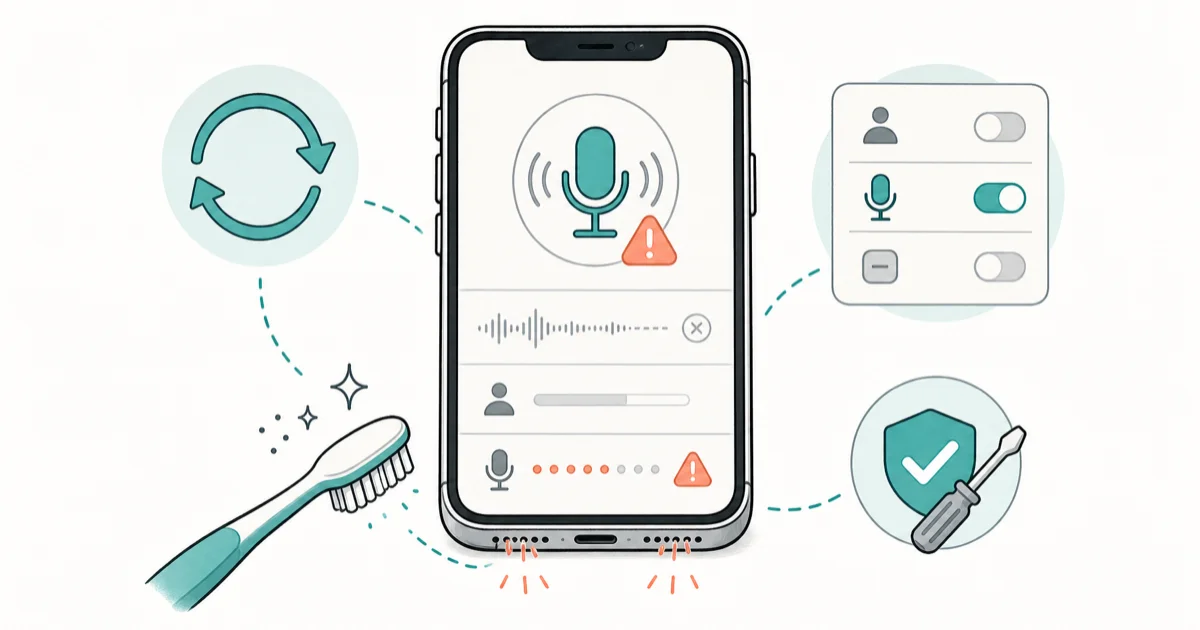
Quick AnswerBrush the bottom microphone with a dry toothbrush, then restart the iPhone. If callers still can't hear you, check Settings, Privacy and Security, Microphone access.
You’re mid-call and the other person says “I can’t hear you.” Most iPhone microphone problems trace back to one of nine causes, and you can usually fix it in under five minutes without plugging into a computer.
This guide walks the fixes in order, from most likely to least likely.
The steps cover recent iPhones on iOS 18, including the Mic Mode workaround for the iOS 18.0.1 bug. If you updated to iOS 18 recently, jump to Fix 6 first. There’s a known bug that started with the 18.0.1 release and hasn’t been fully patched.
- A clogged bottom microphone grille is the single most common cause, and a dry toothbrush usually clears it in under a minute without risking damage.
- iOS 18 and iOS 18.0.1 both shipped with a documented microphone bug where callers could not hear the iPhone user, and toggling Mic Mode between Standard and Voice Isolation during a live call is the workaround Apple Community reports confirm.
- If callers can hear you on speakerphone but not on a regular call, the microphone hardware is intact and the issue is software routing rather than physical damage.
- Resetting Network Settings (Settings, General, Transfer or Reset iPhone, Reset, Reset Network Settings) clears corrupted cellular configs that cause call-only mic failures and does not delete photos, apps, or contacts.
- Recording in Voice Memos is the fastest hardware test: clear playback means a software issue, while muffled or quiet playback confirms the microphone needs repair.
#Fix 1: Clean the Bottom Microphone
This is the number one cause. Your iPhone has three microphones. One sits on the bottom edge next to the charging port, one lives on the back near the camera array, and one is tucked into the earpiece at the top.
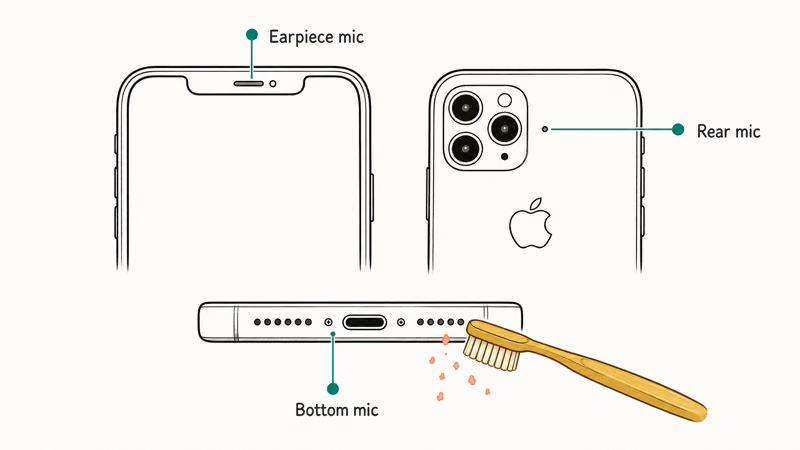
The bottom one handles regular phone calls. It gets clogged with pocket lint surprisingly fast.
Take a dry toothbrush and gently scrub the bottom grille. Not a wet one. Skip the compressed air at close range, too, because that can pack debris deeper into the mesh. You’re just trying to dislodge loose particles.
Do the same for the back mic if you make a lot of speakerphone or video calls. According to Apple’s iPhone microphone troubleshooting guide, blocked microphone openings are the first thing to check before any software step, and Apple specifically recommends a clean, dry brush rather than canned air. After a couple of days in a pocket, a quick brush of the bottom grille often restores call clarity on its own.
While the case is in your hand, take it off. Some bargain cases partially block the bottom mic grille. Run a short test call without the case before moving to Fix 2.
#Fix 2: Restart Your iPhone
It takes 30 seconds. It works more often than it should.
On iPhone 8 and newer:
- Press and quickly release the Volume Up button
- Press and quickly release the Volume Down button
- Press and hold the Side button until the Apple logo appears
On iPhone 7 and older, hold the Side button and Volume Down together until you see the Apple logo. Then test a call. If audio comes through clean, you’re done. If not, keep going.
#Fix 3: Check Microphone Permissions per App
This one trips people up when a single app suddenly can’t hear them, like WhatsApp, Zoom, or Instagram, while regular phone calls still work fine.
- Open Settings > Privacy and Security > Microphone
- Find the app you’re calling from
- Confirm the toggle is on
App missing from the list? It never requested mic access. Delete and reinstall.
One detail worth knowing: if you tap “Don’t Allow” the first time an app asks, iOS won’t ask twice. You have to flip the switch back on manually. iOS gives no follow-up reminder, so people forget the choice they made six months ago and assume the app itself is broken.
#Fix 4: Disconnect Bluetooth Devices
Your iPhone might be sending your voice somewhere you didn’t intend. A car system you paired last summer. A Bluetooth speaker still active in another room. AirPods buried in a backpack across the apartment.
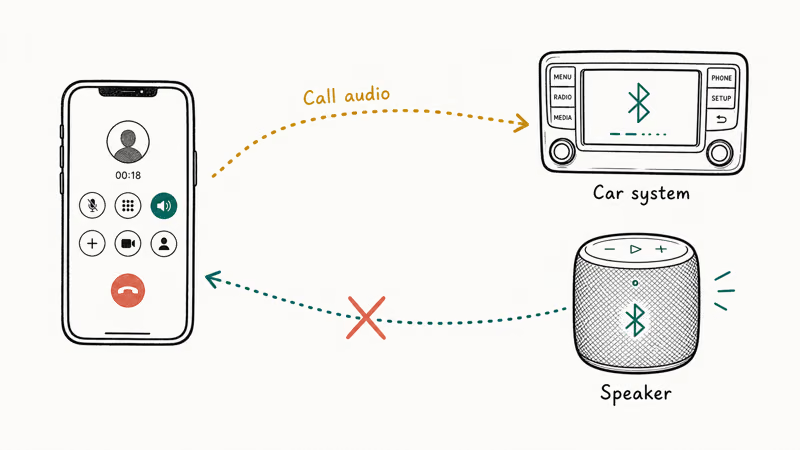
The phone doesn’t always route audio back to itself when those devices fall out of range.
Open Settings > Bluetooth. Either toggle Bluetooth off entirely, or tap the (i) next to any connected device and choose Disconnect. Make a test call. If the problem disappears, that Bluetooth device was the culprit.
This shows up most often with car Bluetooth, where a CarPlay head unit can grab the mic input even after you step out of the car. If your iPhone keeps routing audio incorrectly, the stuck-in-headphone-mode walkthrough covers a related routing failure worth reading next.
#Fix 5: Update iOS and Your Call Apps
Running an older iOS build? Install updates first.
iOS bugs that affect the microphone do happen, and Apple typically patches them within two to four weeks of public reports.
Go to Settings > General > Software Update.
If an update is waiting, install it and re-test. Point releases (like iOS 18.1.1 to iOS 18.2) often include audio fixes that never reach the headline feature list. According to Apple’s iOS 18 release notes, Apple ships unannounced audio-stack patches in nearly every dot release, and several of those patches cite microphone-routing fixes as the reason for the build.
Update your apps from the App Store too. WhatsApp and FaceTime push patches independently of iOS.
#Fix 6: Toggle Voice Isolation (the iOS 18 Mic Bug)
Multiple users in Apple Community discussion threads after the iOS 18.0.1 update reported that callers couldn’t hear them on regular phone calls, even though Voice Memos and FaceTime worked fine. Those threads drew hundreds of “me too” replies. Apple has acknowledged the issue exists but hasn’t posted a guaranteed fix.
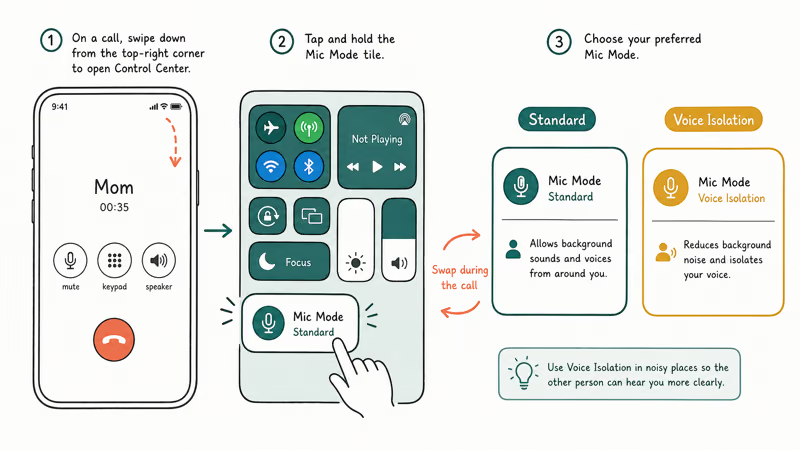
Toggle Mic Mode mid-call.
While on an active call:
- Swipe down from the top-right corner to open Control Center
- Tap Mic Mode (it shows the current mode below the icon)
- Switch from Standard to Voice Isolation, or, if it’s already on Voice Isolation, switch to Standard
According to Apple’s documentation on Voice Isolation, the feature uses on-device machine learning to prioritize your voice and filter out background noise. It launched on FaceTime first, then expanded to regular cellular calls in iOS 16.4. For iPhones stuck in the iOS 18 mic bug, this toggle seems to kick the audio stack back into a working state, even though Apple has not officially documented why the toggle resets the underlying audio session.
On iPhones stuck in the iOS 18.0.1 bug, this toggle typically brings the mic back live for the rest of the call. It often holds across later calls too, though it can fail again, usually early in a call. If the fix only sticks for one call, jump to Fix 8 (Reset Network Settings) for a more permanent solution.
#Fix 7: Set Call Audio Routing to Automatic
Your iPhone has a buried setting that controls where call audio routes by default. If the setting is locked to a Bluetooth device that’s no longer present, calls can silently fail at the mic.
- Open Settings > Accessibility > Touch
- Scroll to Call Audio Routing
- Set it to Automatic
Automatic lets your iPhone decide based on what’s actually connected at the moment of the call. If you’ve been wrestling with iPhone audio routing oddities that send calls straight to voicemail, this same setting is worth verifying there too.
#Fix 8: Reset Network Settings
This sounds drastic. It isn’t.
Reset Network Settings only clears Wi-Fi passwords, Bluetooth pairings, VPN configurations, and cellular settings. Your photos, messages, contacts, and apps stay exactly where they’re stored on the phone.
Go to Settings > General > Transfer or Reset iPhone > Reset > Reset Network Settings.
Enter your passcode and confirm. The phone restarts on its own. You’ll need to reconnect to Wi-Fi networks afterward, so have those passwords handy. The whole reset usually takes only a couple of minutes from tap to first-call-ready.
iPhone Life’s microphone troubleshooting guide recommends this step for persistent call-only mic issues, noting that corrupted network configurations can interfere with how the cellular stack handles audio streams during a live call.
#Fix 9: Test the Hardware and Schedule a Repair
If nothing above worked, the most likely cause is a hardware fault. Before you book a repair, run this fast test:
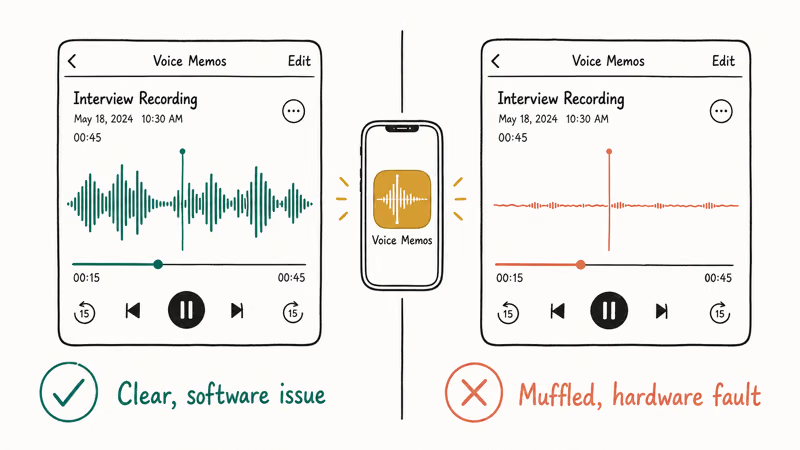
- Open the Voice Memos app
- Record yourself speaking normally for 30 seconds
- Play the recording back
Clear playback in Voice Memos but failed phone calls means the mic hardware is fine. The fault is software or carrier.
Try Settings > General > Transfer or Reset iPhone > Reset > Reset All Settings as a last software step. This is more aggressive than the network reset because it returns every preference on the phone to default. Your data stays put, but every preference toggle resets.
Muffled or quiet playback in Voice Memos means the bottom mic is physically damaged or clogged beyond what brushing can fix. Time to see Apple.
Check warranty status at apple.com/support. If your iPhone is under AppleCare+, microphone repair may be fully covered. Out of warranty, a Genius Bar appointment is still the fastest way to get a quote. Apple’s out-of-warranty mic repair is usually bundled into a broader logic-board or speaker-assembly replacement rather than priced as a single part, so the quote is often a swap rather than a part fix.
For a second opinion or a shorter wait, check for an Apple Authorized Service Provider near you. They use Apple parts and Apple diagnostic tools, and they often offer faster turnaround than busy urban Apple Stores.
#What if Cleaning and Restarting Don’t Help?
Most people stop here when those two basic steps don’t fix it. Don’t.
Next, suspect a per-app permission gap (Fix 3) or a Bluetooth device hijacking your audio (Fix 4). Both take less than a minute to check, and neither requires resetting anything sensitive. Run them before you blame the hardware. Hardware faults are the last bucket on this list, not the first one to investigate.
#Why Does iOS 18 Sometimes Mute the Microphone Mid-Call?
Short answer: a regression in the audio session manager, introduced in iOS 18.0 and only partly addressed in 18.0.1.
Voice Isolation and Standard Mic Mode each load a different audio processing graph. When iOS swaps between graphs (which can happen when an incoming notification briefly steals audio focus), the graph doesn’t always reattach the cellular call’s input bus. Toggling Mic Mode forces a full graph rebuild, which in turn forces the input bus to re-bind to the bottom microphone. That mechanism is why the Fix 6 toggle works as a workaround even when nothing else does.
#A Clip-On Mic When the Built-In One Fails
If the Voice Memos test confirmed a muffled or dying bottom mic, an external clip-on lav mic sidesteps the failing hardware entirely. On a USB-C iPhone (iPhone 15 and later) or an Android phone, a USB-C lav clips near your mouth so callers and recordings get a clear, close voice. It draws power from the phone, so there’s no battery to charge.
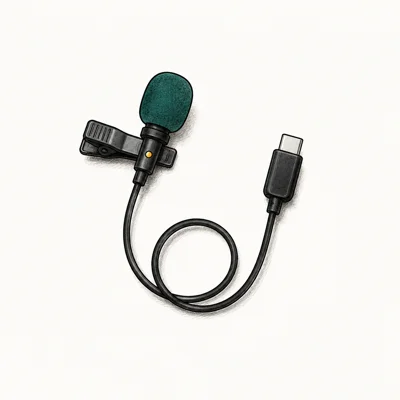
- Sits near your mouth, so callers actually hear you
- No battery to charge, draws power from the phone
- Includes windscreen for outdoor recording
Last updated on Jun 13, 2026
As an Amazon Associate fone.tips earns from qualifying purchases. Prices and availability on Amazon are accurate as of the date above and subject to change.
#Bottom Line
Brush the bottom mic. Restart the phone. That pair fixes most “callers can’t hear me” complaints inside five minutes.
On iOS 18 or 18.0.1? Toggle Voice Isolation first. If Voice Memos plays back muffled, book a repair — software can’t heal torn gaskets or water damage.
If you’re dealing with other audio symptoms on the same phone, check whether your iPhone won’t ring at all or whether visual voicemail is currently unavailable. Those issues sometimes share a root cause with mic failures, especially after a botched iOS update or a carrier-profile change.
The iPhone microphone not working walkthrough covers full-mic-failure cases (including video and Voice Memos).
If callers also report dropped calls or reception cuts mid-conversation, our no signal bars guide walks the carrier-side and SIM-side checks separately from mic hardware.
#Frequently Asked Questions
Why can callers hear me on speakerphone but not on a regular call?
The iPhone uses different microphones depending on the call mode. Speakerphone leans on the bottom mic with the audio stack tuned for a wider pickup pattern, while regular earpiece calls route through a tighter directional mode. If regular calls fail but speakerphone works, the mic hardware is almost certainly fine and the issue is software routing. Try the Voice Isolation toggle in Fix 6 first.
Does putting my iPhone in a case block the microphone?
Yes. Run a test call without the case first.
How do I know which microphone is damaged?
Three short tests, two minutes total. Use Voice Memos to isolate the bottom mic. Record a video with the front camera to isolate the top mic, then record one with the rear camera for the back mic. Whichever clip sounds bad compared to the others is the failed unit, and you can hand the diagnosis straight to the repair tech.
Can a software update break my microphone?
Yes. iOS 18 and iOS 18.0.1 both had documented post-update mic failures in Apple Community forums. Use the Voice Isolation toggle until the next dot release lands.
Will resetting network settings delete my contacts or photos?
No. Reset Network Settings only clears Wi-Fi passwords, Bluetooth pairings, VPN settings, and cellular configurations. Your photos, messages, contacts, and apps are completely untouched. You’ll need to re-enter Wi-Fi passwords after the reset, so have them ready.
My mic works in some apps but not others. Why?
The most common reason is that one app has microphone permission turned off while others have it on. Open Settings, go to Privacy and Security, then Microphone, and check each app individually. The second most common reason is an outdated app version. Update everything from the App Store and re-test.
Can water damage cause microphone problems even if my iPhone survived a splash?
Yes — even with IP67 or IP68 water resistance, liquid can temporarily affect mic performance. If your iPhone got wet recently, don’t charge it and don’t bury it in a bag of rice (that trick is a myth and can leave starch in the ports). Leave the phone in a dry, warm spot for 24 to 48 hours so the mic mesh can clear trapped moisture on its own.
Is this related to iPhone Bluetooth not working or Face ID issues?
Usually no. But if your iPhone took a drop and now has multiple hardware problems including mic issues, they’re probably tied to the same physical impact. Multiple failing components after a fall means the shock loosened internal connections, which is a job for a repair shop rather than software troubleshooting.
Apple Siri Settlement: Who Qualifies and How to Claim
Apple's $250 million Siri settlement covers iPhone 15 Pro and iPhone 16 models bought June 2024 to March 2025. See who qualifies and how claims work.
iOS 26.6.1 Security Update: What Apple Fixed and Who Gets It
Apple released iOS 26.6.1 on August 17 with 29 security fixes, including an IPSec interception bug. See what it patches, who gets it, and how to update.
iPhone Adaptive Power: How It Works and When to Use It
Learn how iPhone Adaptive Power works, which models support it, what it changes, and when Low Power Mode is still the better battery-saving choice.
How to Transfer Data to a New iPhone Without iCloud
Move everything to your new iPhone without iCloud: Quick Start device-to-device transfer, wired migration, and encrypted Finder or iTunes backups.