QuickTime Player Can't Open .MOV: 4 Working Fixes for 2026
QuickTime won't open your MOV? The cause is almost always the codec inside the container, not the file itself. Here's how to fix it in minutes.
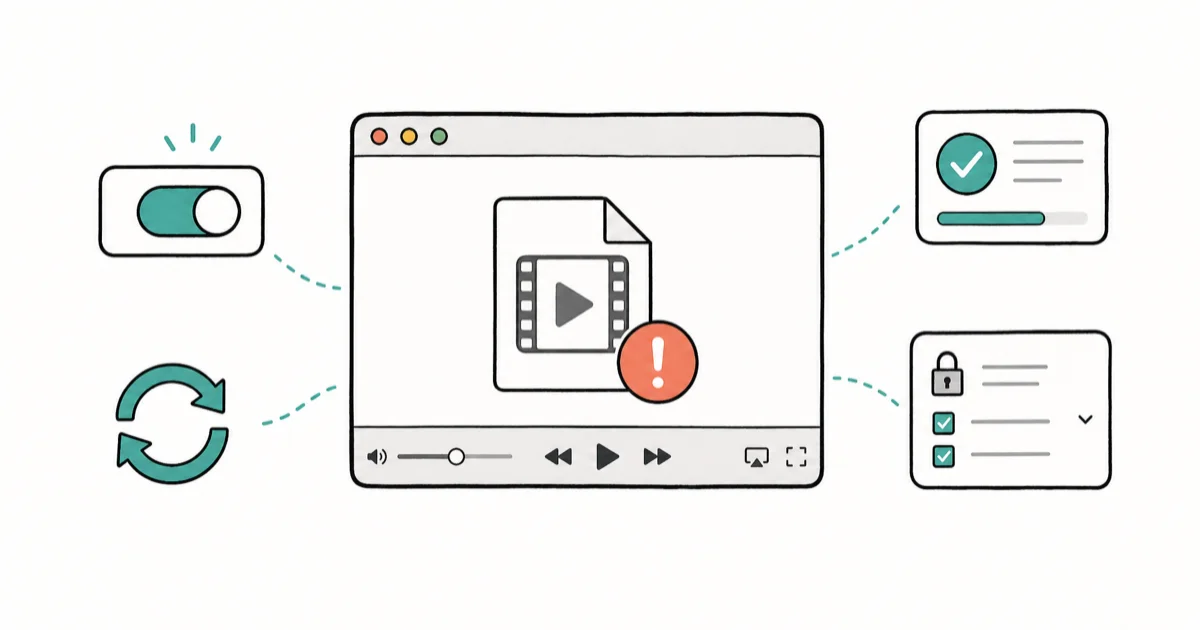
Quick AnswerMost MOV files that QuickTime refuses to open use a codec it doesn't ship with, like HEVC on older macOS or a non-Apple flavor of H.264. Open the file in VLC to confirm it plays, then either update macOS or remux the file with ffmpeg to swap the container without re-encoding.
QuickTime Player can’t open .MOV files for one of three reasons: the codec inside the container isn’t installed, the container header is malformed, or your QuickTime build is too old for the variant. Start by separating a codec mismatch from true file corruption, because the usual fix is remuxing rather than repairing.
- A MOV file is a container, not a codec. QuickTime fails on the audio or video track inside, usually HEVC on pre-Sierra macOS or a non-baseline H.264 profile.
- If VLC plays the file but QuickTime doesn’t, the file is fine. Update macOS, install the codec, or remux to a clean MOV with ffmpeg in under 30 seconds.
- QuickTime 7 was retired with macOS Catalina 10.15 in 2019. Anything calling for “QuickTime Pro” or QuickTime on Windows after 2016 is unsafe and unsupported.
- For truly corrupted files (camera crash, interrupted transfer, dead SD card), Stellar Repair for Video and Wondershare Repairit are the two tools that consistently rebuild the moov atom.
- Re-encoding to MP4 in HandBrake works as a last resort but loses quality; remuxing with ffmpeg keeps the original streams bit-for-bit and finishes in seconds.
#Why Won’t QuickTime Player Open My .MOV File?
MOV is a wrapper. Apple invented it in 1991 and it became the basis of the MP4 specification, which is why the two formats are so similar. The wrapper says “here’s a video track, here’s an audio track, here’s where each chunk lives in the file.” QuickTime opens MOV files every day. What it can’t always open is the codec sitting inside.
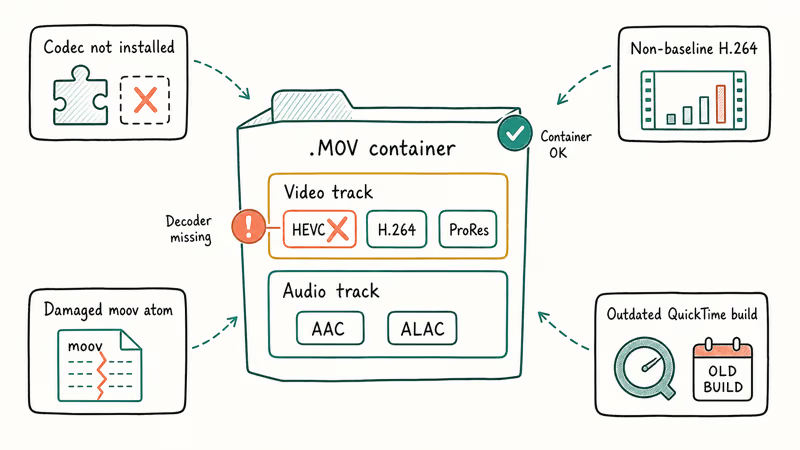
The four common failure paths are:
- Codec not installed. A MOV holding HEVC (H.265) won’t open on macOS El Capitan 10.11 or older because Apple added system-wide HEVC support in macOS High Sierra 10.13. ProRes 4444 XQ won’t open on iOS QuickTime because the decoder is desktop-only.
- Non-baseline H.264 profile. Drones, action cams, and some Android phones write H.264 with profile flags QuickTime’s parser rejects even though the stream itself is valid.
- Damaged moov atom. The moov atom is the index that tells QuickTime where every frame starts. If the camera crashed mid-recording, the moov is missing or at the wrong offset and the file won’t open in any player.
- Outdated QuickTime build. macOS bundles QuickTime updates with system updates. Skip three macOS versions and your QuickTime is three years behind on codec support.
Apple’s QuickTime 7 support page confirms QuickTime 7 was deprecated and pulled from macOS Catalina onward. If a guide tells you to “install QuickTime 7” in 2026, close the tab.
#How Do I Diagnose Why QuickTime Won’t Open My MOV?
Run three checks in this order. Each takes under a minute and tells you which fix to try.
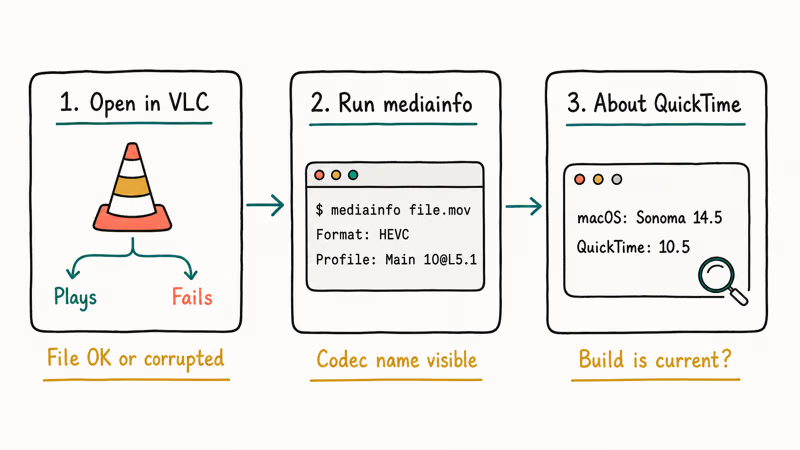
1. Open the file in VLC. Download VLC from videolan.org — the only legitimate source. If VLC plays the file, the file is fine and the problem is QuickTime’s codec support.
2. Inspect the file with mediainfo. Install it via Homebrew (brew install media-info) and run:
mediainfo --Inform="Video;%Format%/%Format_Profile% %Width%x%Height% %FrameRate%fps" yourfile.movYou’ll see something like HEVC/Main 10@L5.1 3840x2160 60.000fps. If the profile is HEVC Main 10 and you’re on macOS Sierra 10.12 or older, that’s your fix path. The same trick works for M2TS files in VLC, which often hide the same codec story.
3. Check QuickTime’s version against your macOS. Open QuickTime Player, go to QuickTime Player > About QuickTime Player. Cross-reference your build with the macOS version. If you’re running macOS Big Sur 11 or older with a recent HEVC iPhone clip, the OS upgrade is the simplest fix.
#Update macOS to Get the Right QuickTime Build
QuickTime ships inside macOS. There’s no standalone updater since QuickTime 7 was retired. To pull in newer codec support:
- Click the Apple menu and choose System Settings (System Preferences on macOS Monterey 12 and earlier).
Open General>Software Update(or just Software Update on older versions).- Install whatever’s available.
For HEVC playback, update to the newest macOS version your Mac supports before assuming the MOV itself is corrupt.
According to Apple’s HEVC support documentation, HEVC hardware decoding requires a 6th-generation Intel Core processor or newer. If Software Update won’t show an update at all, your Mac is past Apple’s update window. Switch to VLC for codec coverage.
#Remux With ffmpeg Instead of Re-Encoding
This is the trick most guides skip. If VLC plays the file, the streams are intact. You don’t need to convert anything. You just need to rewrite the container.
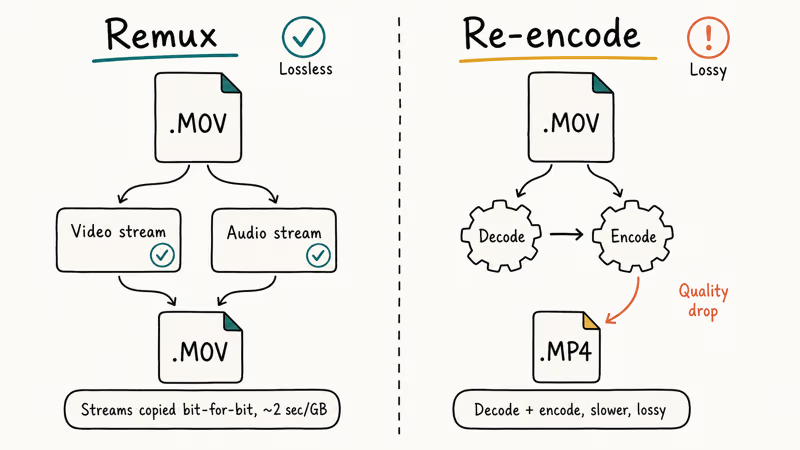
Install ffmpeg with brew install ffmpeg (it’s a one-time setup), then run:
ffmpeg -i broken.mov -c copy -movflags +faststart fixed.movThe -c copy flag tells ffmpeg to copy streams without re-encoding, so it runs quickly and avoids a quality hit.
Same idea works in reverse. Got an HEVC file QuickTime won’t touch and need MP4? Run ffmpeg -i source.mov -c copy fixed.mp4. The HEVC and H.264 remux paths guide covers deeper walkthroughs on each codec, including profile and pixel-format quirks that trip up newer iPhone footage on legacy Premiere Pro and Final Cut Pro 7 timelines.
#Repair Truly Corrupted MOV Files
If VLC also fails to open the file, the moov atom is missing or the file was truncated mid-write. Camera battery dying during a recording, USB transfer interrupted, SD card with bad sectors. These are the main repair options:
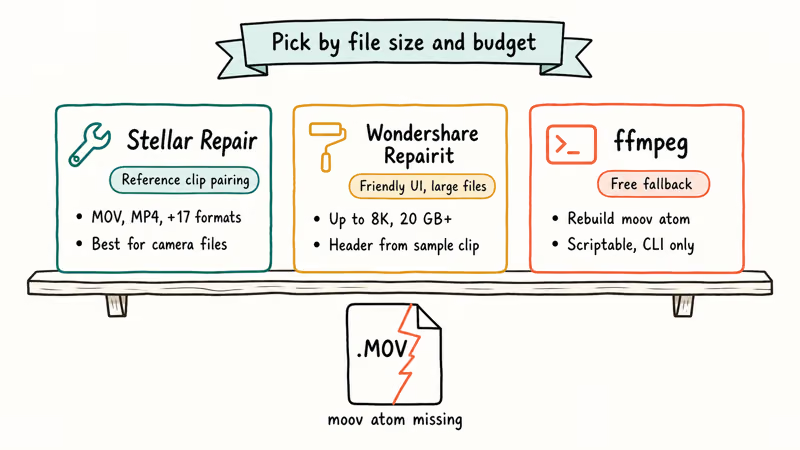
Stellar Repair for Video does the cleanest job on cameras with reference-video pairing. According to Stellar’s video repair page, the tool repairs MOV, MP4, and 17 other video formats. The free version previews but watermarks. Reference-video pairing means you supply a healthy clip from the same camera, and Stellar rebuilds the broken file’s header and codec parameters from that known-good template.
Wondershare Repairit has a friendlier interface. Wondershare’s Repairit video repair page states that Repairit handles 15 video formats and unlimited file size. Drop in a known-good clip from the same camera body and Repairit uses its header layout as a template.
Some links on this page are affiliate links, which means fone.tips may earn a commission at no extra cost to you.
ffmpeg as a free fallback. Run ffmpeg -i corrupt.mov -c copy -movflags faststart -f mov repaired.mov 2>&1 | grep "moov atom". ffmpeg can sometimes rebuild a missing moov atom if the rest of the file is intact, especially for files truncated at the end. It’s not as reliable as the paid tools but it’s free and scriptable. For a deeper rundown on free tools, our roundup of MP4 video repair tools covers the open-source options.
If your phone or camera files are critically important and none of these work, send the original media (not a copy of the file) to a recovery service. The intact bytes on the SD card give them more to work with than just a corrupted MOV on a hard drive.
#Convert MOV to MP4 When Compatibility Is the Real Goal
Sometimes you don’t need QuickTime to open the MOV. You need to email it, upload it, or edit it in software that doesn’t speak the codec. That’s a conversion job, not a repair job.
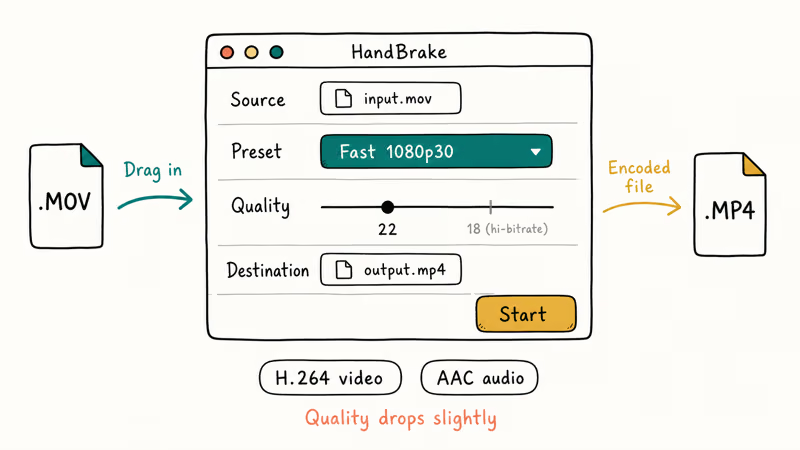
HandBrake is the right tool. Open it, drag the MOV in, choose the “Fast 1080p30” preset, then click Start. The Apple-flavored MOV becomes a universally compatible MP4 with H.264 video and AAC audio.
Quality drops a touch. Re-encoding is lossy. For high-bitrate footage, drop the slider to 18.
For ProRes or other professional codecs going into Sony Vegas or DaVinci Resolve, the Sony Vegas MOV compatibility issues article walks through the codec-by-codec story. Short version: install Apple’s free ProRes decoder for Windows or transcode to DNxHD inside HandBrake.
#Bottom Line
Try ffmpeg’s remux trick first. It costs nothing, runs quickly, and fixes many “QuickTime won’t open this MOV” cases when the streams are intact. If the file still won’t open, the moov atom is damaged and you need Stellar or Wondershare Repairit to rebuild the index. Update macOS only if your codec support is clearly behind, and skip QuickTime 7 advice from any post older than 2019.
#Frequently Asked Questions
Why does QuickTime show a black screen with audio when I open a MOV?
The audio decoder is working but the video decoder isn’t. This is a textbook codec problem. The MOV holds a video format your QuickTime build doesn’t support, often HEVC 10-bit or a non-Apple H.264 profile. Open the file in VLC to confirm the video is intact, then remux with ffmpeg or update macOS.
Can I play MOV files on Windows without QuickTime?
Yes. Apple discontinued QuickTime for Windows in April 2016 after security researchers found unpatched vulnerabilities. Use VLC, MPC-HC, or PotPlayer instead. The Windows MOV playback options guide covers those choices in detail.
How do I tell if my MOV file is actually corrupted?
If two different players (say VLC and IINA) both refuse to open it or play only the first second, the file is corrupted. If one plays it cleanly and another doesn’t, the file is fine and the second player just lacks a codec. The mediainfo command will also fail or show “no tracks” on a truly corrupt file.
Will converting MOV to MP4 lose quality?
Re-encoding loses some quality. Remux instead. Run ffmpeg -i input.mov -c copy output.mp4 to swap the container without touching streams.
Is Wondershare Repairit safe to use on important footage?
Yes, with one caveat. Always work on a copy of the file, never the original. Repairit reads the corrupt input and writes a new file, so the source stays intact, but disk failures during the repair could compromise both.
Why does my new iPhone MOV not play on my older Mac?
Your iPhone records HEVC by default since iPhone 7. Older Macs running macOS Sierra 10.12 or earlier don’t have system HEVC decoding. Either change your iPhone’s camera setting to “Most Compatible” (Settings > Camera > Formats > Most Compatible) to record H.264, or update your Mac’s macOS version, or remux the file with ffmpeg.
Does QuickTime support all MOV files Apple cameras produce?
No. Pro cameras and iPhone Pro models can record ProRes, ProRes RAW, and Apple Log MOV files. Consumer QuickTime can’t decode them smoothly. Use Final Cut Pro or DaVinci Resolve for these.

macOS 27 Compatible Macs: Every Supported Model (2026)
macOS 27 Golden Gate runs only on Apple Silicon Macs. Here is the full list of supported M-series models and the four Intel Macs that lose support.

macOS 27 Golden Gate: Every Major New Feature Confirmed
macOS 27 Golden Gate goes Apple Silicon only, adds a Gemini-powered Siri, refines Liquid Glass, and rebuilds Spotlight. Here is every confirmed change.

macOS 27 Liquid Glass: Every Readability Fix Explained
macOS 27 Golden Gate refines Liquid Glass with an intensity slider, better contrast, cleaner window corners, and edge-to-edge sidebars to fix readability.

macOS 27 Performance: What Golden Gate Makes Faster
macOS 27 Golden Gate speeds up AirDrop, network file browsing, Safari, and Spotlight, with core system improvements on the Apple Silicon-only release.