Best MTS Video Editors for AVCHD Camcorder Files (2026)
Best MTS video editors for AVCHD camcorder files in 2026. Compare Filmora, DaVinci Resolve, Blender, and free tools for editing HD AVCHD footage.
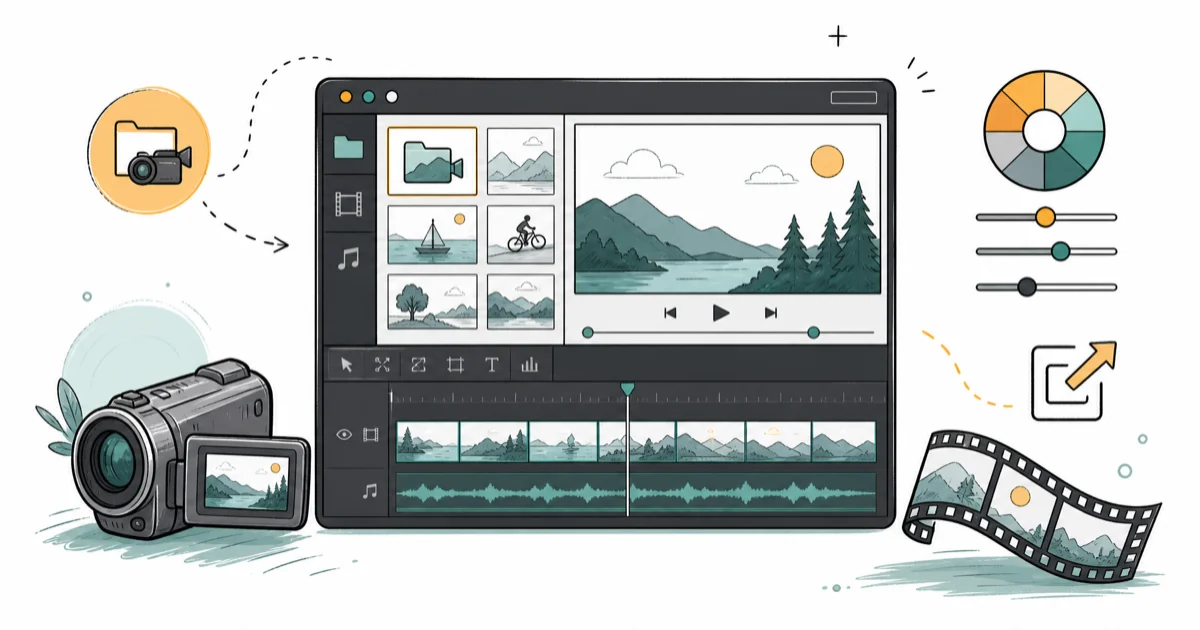
Quick AnswerWondershare Filmora is the best MTS video editor for most home users because it imports AVCHD files directly without transcoding. DaVinci Resolve and Blender are the strongest free picks for power users who want pro-grade color tools at no cost.
The best MTS video editor handles AVCHD camcorder footage natively, without forcing you to transcode every clip before you can drag it onto a timeline. Some consumer editors struggle with MTS files: they show black frames, drop audio, or quietly re-encode your clip during preview. This guide compares which editors import cleanly, which need a workflow tweak, and which are not worth the trouble.
This guide focuses on MTS files you own or have clear permission to edit, from your own camcorder, family archives, or licensed footage. Stick to material you have the rights to before sharing or republishing.
- MTS is the AVCHD container format used by Sony, Panasonic, and Canon camcorders, and not every editor reads it natively, so the wrong choice either shows a black frame or silently transcodes the clip and drops quality.
- Wondershare Filmora and Apple iMovie import MTS files directly on Windows and Mac, which lets you scrub the timeline without a pre-conversion pass.
- DaVinci Resolve is the strongest free pick for color grading and HDR work, while Blender’s video sequence editor handles MTS through its built-in FFmpeg backend at no cost.
- Avidemux and Shotcut are best for quick trimming and format conversion rather than long timeline edits, since their interfaces lack the multi-track polish of paid tools.
- Keeping the original MTS file untouched and exporting to MP4 only at the end of the project preserves every frame of AVCHD detail, since each re-encode pass loses some quality.
#What Is an MTS File and Why Does Format Matter?
MTS (MPEG Transport Stream) is the container format that AVCHD camcorders use to store HD video at 1080p or 4K. According to AVCHD 2 specifications documented in Wikipedia’s AVCHD article, Sony and Panasonic developed the format in 2006, with MTS wrapping H.264 video alongside Dolby AC-3 or LPCM audio inside an MPEG-2 transport stream at bitrates up to 28 Mbit/s.
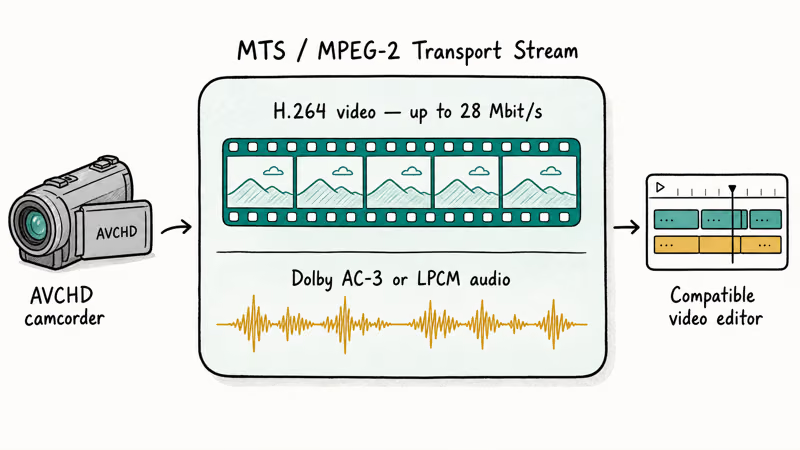
That wrapper is what trips up consumer editors. Many apps assume video files arrive as MP4 or MOV with a familiar codec layout. When they hit an MTS file with AC-3 audio in a transport stream, they either fail to read the audio track, refuse to import the clip, or transcode it in the background, which slows the import and adds a generation of compression loss before you have started.
The right MTS video editor reads the format directly through FFmpeg or its own AVCHD decoder, lets you drop the file on a timeline, and only re-encodes when you export. That workflow protects the source footage. The wrong editor forces a transcode-first pass, which doubles your storage needs and bakes in quality loss the moment you import.
#The Six Best MTS Video Editors in 2026
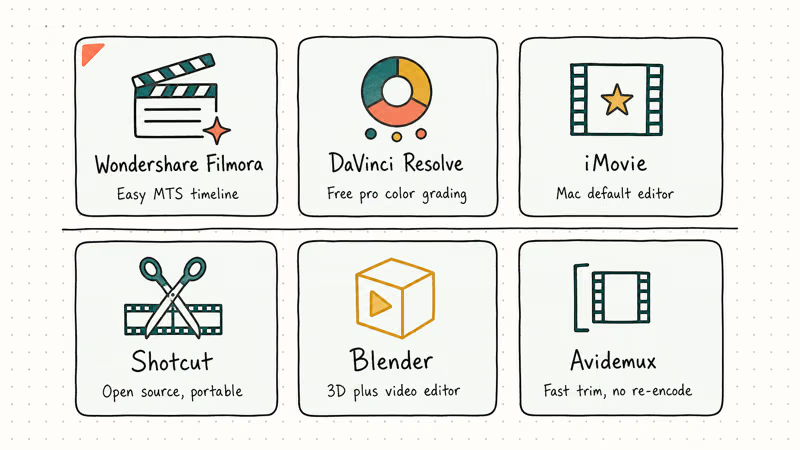
These six editors cover the most practical paths for AVCHD footage, from beginner-friendly timeline apps to free tools built on FFmpeg. Each can work with MTS files, but the experience around that import varies a lot.
#1. Wondershare Filmora
Wondershare Filmora is the easiest entry point for home users who want a polished editor without learning Premiere Pro. The Windows and Mac builds open MTS files from the import panel, place them on a timeline with full audio, and let you scrub through 1080p clips in real time on a mid-range laptop.
Filmora has presets for Instagram, YouTube, and TikTok aspect ratios, a stock library of transitions and titles, and a built-in audio ducker that lowers music when speech plays. The 4K timeline support matters when you import 4K MTS files from newer Panasonic or Sony bodies, since the timeline does not downscale your preview by default.
Filmora’s hardware-accelerated H.264 export is useful on consumer laptops because it avoids relying only on the CPU for final renders. Filmora is also a solid pick for wedding video editing, since chapter markers, slow-motion presets, and the music library shorten the edit on a tight delivery deadline.
Some links on this page are affiliate links, which means fone.tips may earn a commission at no extra cost to you.
#2. DaVinci Resolve
DaVinci Resolve is the most capable free editor on this list. The free build from Blackmagic Design includes the full Cut, Edit, Color, Fairlight, and Deliver pages, and the only major locked features are HDR grading and noise reduction, which sit behind the $295 Studio license.
Resolve reads MTS files through its built-in media engine. AVCHD footage drops onto the Edit timeline cleanly, and the Color page is where the program earns its reputation: primary color wheels, log curves, and node-based grading let you push exposure on underlit indoor camcorder clips far beyond what consumer editors expose.
The free build does have one quirk for AVCHD users. Resolve’s free codec license does not include AC-3 audio decode, so MTS files with Dolby audio can import without sound on Windows. The fix is one of two paths: convert the audio track to AAC first with HandBrake, or upgrade to Studio.
#3. iMovie (Mac Only)
Apple’s iMovie is the default free editor on every Mac and iPhone. The current macOS build reads MTS files from Sony, Panasonic, and Canon camcorders directly, so you can drag a clip onto a project and start cutting without an import wizard.
iMovie’s strength is speed of finish. You drop MTS clips into a project, pick a theme, and the app handles transitions, color matching, and audio normalization automatically. The trade-off is depth: there is no node-based color grading, no multi-cam editing, and the title library is smaller than Filmora’s.
If you hit iMovie rendering errors when exporting MTS projects, the fix is usually clearing the render cache and freeing disk space, since AVCHD timelines burn through scratch storage faster than people expect.
#4. Shotcut
Shotcut is a free, open-source editor that runs on Windows, Mac, and Linux. It uses the same FFmpeg backend Blender does, so it reads MTS files natively without a separate codec install.
The Shotcut interface looks dated next to Filmora, but the feature set is honest: multi-track timeline, keyframe animation, and a library of audio and video filters that cover the basics of consumer editing. Where Shotcut wins is portability. The whole app fits in a single zip download under 100 MB and runs on a USB drive, which matters when you edit on different machines.
Shotcut’s FFmpeg-based import path makes MTS support consistent across platforms. One caveat on Windows: hardware encoding on Nvidia GPUs requires you to enable it manually in Settings.
#5. Blender
Blender is best known for 3D animation, but the Video Sequence Editor inside Blender reads MTS files through the same FFmpeg library Resolve and Shotcut use. According to Blender 4 documentation for the Video Sequence Editor, the editor reads any format FFmpeg supports, with proxy generation at 25%, 50%, 75%, or 100% of source resolution to keep playback smooth on slower hardware. The result is a free, advanced editor with strip-based editing, color management, and multi-pass rendering.
The downside is the learning curve. Blender’s interface is built for 3D artists first, and the video editor lives behind a workspace switch most newcomers miss. The shortcut keys also clash with what Premiere or Final Cut users expect, so the first hour of editing in Blender is mostly relearning the keyboard.
Blender pays back that investment if you also do motion graphics, since you can render a 3D scene and edit MTS footage in the same project file. For straight cuts and color, the dedicated editors above are faster.
#6. Avidemux
Avidemux is the most stripped-down editor on this list. It opens an MTS file, lets you mark in and out points, and exports the trimmed clip with no re-encoding when the source and target codecs match. The whole workflow takes under a minute for a quick cut.
Avidemux’s interface looks like it shipped in 2010, and the feature list is short: trim, filter, save. There is no timeline, no color grading, and no audio mixing. What Avidemux gets right is speed for the one job it does. When you need to split a 90-minute MTS recording into a six-minute highlight clip without re-encoding, no other free editor finishes faster.
Avidemux works well as a trim-and-cut step before importing into Filmora or Resolve, since shorter source clips load faster on the timeline and consume less scratch disk.
#Key Features to Compare in an MTS Editor
Every editor handles MTS imports differently, and the gaps show up most when you push the editor with longer projects. The features that matter most are:
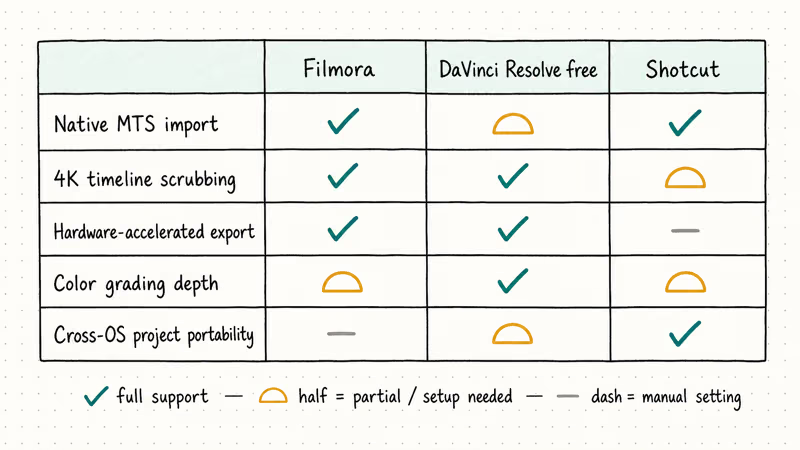
- Native MTS import: The editor reads AVCHD without forcing a transcode. Filmora, iMovie, and Shotcut clear this bar, and Resolve free clears it on video but not on AC-3 audio.
- 4K timeline support: The editor scrubs 4K MTS clips at full resolution. Filmora, Resolve, and iMovie handle this on modern hardware. Older editors downscale by default.
- Hardware-accelerated export: The encoder uses your GPU’s H.264 or HEVC block. Filmora and Resolve expose this clearly. Avidemux and Blender require a manual setting change.
- Color grading depth: The grading panel goes beyond brightness and contrast. Resolve leads here. Blender’s color management is strong, but the curve UI is harder.
- Project portability: The project file opens on a different OS without missing media. Shotcut and Blender are the strongest here. Filmora and iMovie projects are platform-locked.
#Converting MTS to MP4 for Sharing
MTS plays cleanly on the editors above, but it’s a poor format for upload. YouTube, Instagram, and most messaging apps prefer MP4 with H.264 video and AAC audio. According to RF 20 best-practice settings in HandBrake’s official documentation, the MP4 container with the H.264 High Profile preset is the recommended target for AVCHD source footage because it balances broad device compatibility with efficient compression.
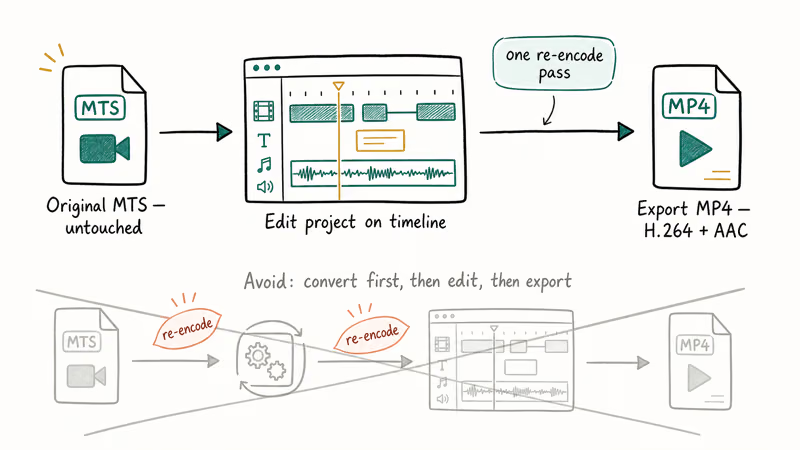
The cleanest conversion path is to keep your original MTS file untouched, edit your project, then export to MP4 from the editor’s deliver page. That gives you one re-encode pass, not two. If you only need a format change without editing, our convert MTS to MP4 guide compares the free VLC and HandBrake paths, and both Wondershare UniConverter and HandBrake batch-convert MTS folders to MP4 with a preset.
If you also work with other formats, the practical differences between MP4 vs MOV come up when you share clips with iPhone or Mac users, since MOV is the native QuickTime format. For older DVD rips you own, you may need to convert VOB files before importing into editors that don’t read VOB directly.
#Tips for a Smooth MTS Editing Workflow
A few habits keep AVCHD projects fast and reliable on consumer hardware:
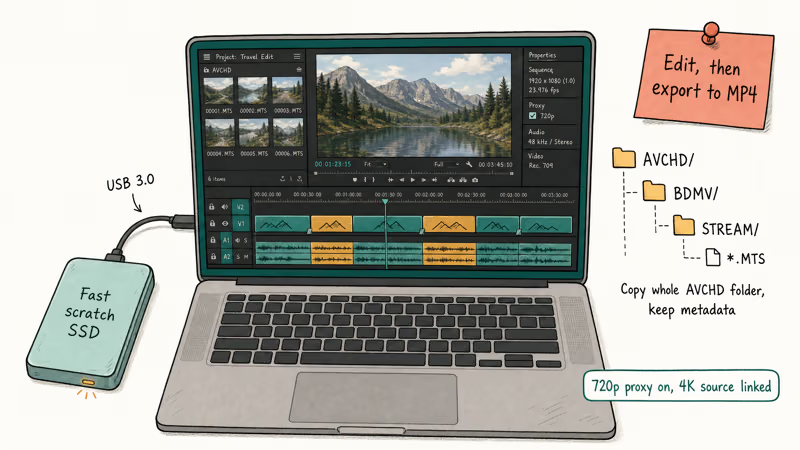
- Back up the SD card before editing. Copy the entire AVCHD folder, not just the BDMV/STREAM/*.MTS files, so the camera’s spanned-clip metadata stays intact.
- Edit from a fast drive. A 1080p MTS timeline reads at roughly 24 MB/s and a 4K timeline at over 60 MB/s. An external SSD over USB 3.0 is the practical minimum.
- Use proxy editing for 4K. Resolve and Filmora both generate proxy files at 720p that cut smoothly on slower laptops. Switch back to full resolution before exporting.
- Keep MTS files under one project root. Some editors lose linked media if you move folders mid-project. Set up the folder layout once and stick with it.
- Export to MP4, not back to MTS. Recording in MTS is the camera’s job. Once you finish editing, MP4 with H.264 is the right delivery format for almost every viewer.
#How Do You Repair Corrupted MTS Files?
MTS files corrupt for the usual reasons: a battery dying mid-record, a dirty SD card contact, or a USB transfer interrupted by a sleep event. The symptom is usually a partial preview that cuts off, a black frame after a few seconds, or an editor that refuses to import the file at all.
The first repair attempt should be free: open the file in video repair tools like Recoverit, Stellar Video Repair, or the open-source untrunc. These tools rebuild the index and recover playable footage from a damaged transport stream.
If the file is structurally intact but only the audio is broken, a streaming download tool like Video Grabber does not help, since the source is local. Use HandBrake or FFmpeg to re-encode the audio track to AAC, which often clears the playback issue without touching the video.
For SD-card corruption, recover the original files first with a card recovery utility, then attempt the MTS repair on the recovered copy. Working on the recovered file leaves the SD card unchanged, which gives you a second recovery attempt if the first one mangles the data.
#Bottom Line
For most home users with a Sony, Panasonic, or Canon AVCHD camcorder, start with Wondershare Filmora. It opens MTS files directly, scrubs cleanly on consumer laptops, and exports to YouTube and TikTok presets without a setup step.
If you grade color or work in HDR, DaVinci Resolve free is the upgrade pick. The catch is AC-3 audio: convert to AAC first or move to Studio. iMovie remains the right call on a Mac when finishing speed beats grading depth.
Skip Avidemux for long-form projects, and skip Blender unless you also do 3D work. The right editor for AVCHD is the one that imports MTS without a transcode and exports MP4 at the end.
#Frequently Asked Questions
Can I edit MTS files on my smartphone?
Phone editors like CapCut and LumaFusion accept MTS files transferred from your camcorder, but the experience is rough on long clips because phones throttle when transcoding 1080p AVCHD. A laptop or desktop with an SSD finishes a 10-minute project in less than half the time, and the cooling holds up better through long exports.
Do I have to convert MTS files before editing?
Not for the editors in this guide. Filmora, iMovie, Shotcut, Blender, and Avidemux all read MTS natively. DaVinci Resolve free reads MTS video but needs the audio converted to AAC first if your camcorder records in AC-3, which is the more common path on Sony bodies.
Are there any free MTS video editors that handle 4K?
Yes. DaVinci Resolve, Blender, and Shotcut all read 4K MTS files for free. Resolve is the smoothest on a recent GPU, Shotcut is the lightest and runs on older laptops, and Blender is the most flexible if you also do motion graphics or 3D work.
Will editing reduce the quality of my MTS footage?
Only at export. Editing on the timeline is non-destructive: trims, transitions, and color adjustments are stored in the project file, not the source MTS. Quality drops happen at the export stage, when the editor re-encodes everything into MP4 or another delivery format. Exporting once at high bitrate keeps the loss low.
Why does my editor show no audio for an MTS file?
The most common cause is missing AC-3 audio support. Sony and some Panasonic camcorders record audio in Dolby AC-3 inside the MTS container, and not every free editor decodes it. Re-encoding the audio track to AAC with HandBrake or FFmpeg solves the issue without touching the video.
What is the largest MTS file an editor can handle?
Filmora and Resolve handle multi-hour MTS projects routinely. The practical limit is your scratch disk, not the editor. A 4K MTS recording at 28 Mbit/s consumes about 12 GB per hour. Editing two hours of footage on a 256 GB SSD will run out of working space before the editor itself complains.
Can I keep the original MTS file untouched while editing?
Yes, and you should. All six editors above link to the source MTS file rather than copying it into the project. Edits are stored as project metadata, and the source file stays exactly as it came off the camcorder. Backing up that original file before you start gives you a clean restore point if a future export goes sideways.

Best Laptop for Running LLMs in 2026: Memory Comes First
The best laptop for running LLMs is a memory purchase first. Compare MacBook unified memory against NVIDIA laptop VRAM, and see what each tier really runs.

Pixel 11 vs Pixel 10: What Changed and Who Should Upgrade
Pixel 11 vs Pixel 10: same screen and camera resolution, new Tensor G6, 25W wireless, and Gemini Intelligence. Here is who should actually upgrade.

Best Power Bank for iPad in 2026: Pro, Air, and Mini
Best power bank for iPad in 2026. Compare mAh tiers and USB-C PD wattage for iPad Pro, Air, and mini, plus airline Wh math, cables, and travel tips.

Best Power Bank With Built-In Cable: Top 2026 Picks
Best power bank with built-in cable picks for 2026. Compare single USB-C, multi-connector, and retractable laptop banks, plus airline Wh math.