How to Transfer Google Photos to iCloud: 4 Easy Methods
Transfer Google Photos to iCloud with Takeout direct transfer, manual download, the iPhone Photos app, or trusted third-party migration tools.
Quick AnswerUse Google Takeout's direct transfer to send your Google Photos library straight to iCloud Photos, or download the archive and upload it through iCloud.com or the Photos app on iPhone or Mac.
Moving your Google Photos library to iCloud is the cleanest way to consolidate years of memories inside the Apple ecosystem after switching from Android. The process is officially supported through Google Takeout.
You can also fall back on manual downloads, the iPhone Photos app, or migration utilities when an album-by-album move makes more sense. This guide walks through all four paths and flags the surprises that the official support pages tend to skip over.
- Google Takeout’s direct transfer to iCloud Photos is the official Apple-supported method and runs entirely on Google and Apple servers without using local storage.
- Apple sends a confirmation email when the transfer queue accepts your request, and the import then completes in three to seven days for libraries above 30 GB.
- iCloud needs enough free storage for every transferred photo and video before you start; check it under Settings, Apple ID, iCloud on iPhone or System Settings on Mac.
- Manual Takeout downloads ship as multi-part ZIP archives with EXIF data preserved in a JSON sidecar file alongside each photo.
- The transfer never deletes your Google Photos copy, so verify counts and album coverage in iCloud before clearing the Google account.
#Why Move Google Photos to iCloud?
iCloud Photos integrates natively with the Apple Photos app on iPhone, iPad, and Mac. Face recognition, Memories, shared albums, and Live Photo playback all behave the way the camera app intends.
Google Photos remains an excellent service, but iPhone owners often see two separate libraries in the photo picker, duplicate notifications, and storage pressure on both clouds at once. Consolidating into iCloud removes that overlap. AirDrop, the system share sheet, and the Photos extension API also all read from iCloud Photos rather than third-party libraries.
If you pay for iCloud+ already, your storage is bundled and Google One often becomes redundant. See what’s in your iCloud before starting a multi-day import to confirm there’s enough free space.
#Google Takeout Direct Transfer to iCloud
Apple announced direct iCloud Photos imports from Google Takeout in late 2021, and the feature has been stable since. According to Apple’s request a transfer of a copy of your data support page, the transfer uses encrypted server-to-server transfers and preserves the original resolution as well as core EXIF metadata such as capture date and GPS coordinates.
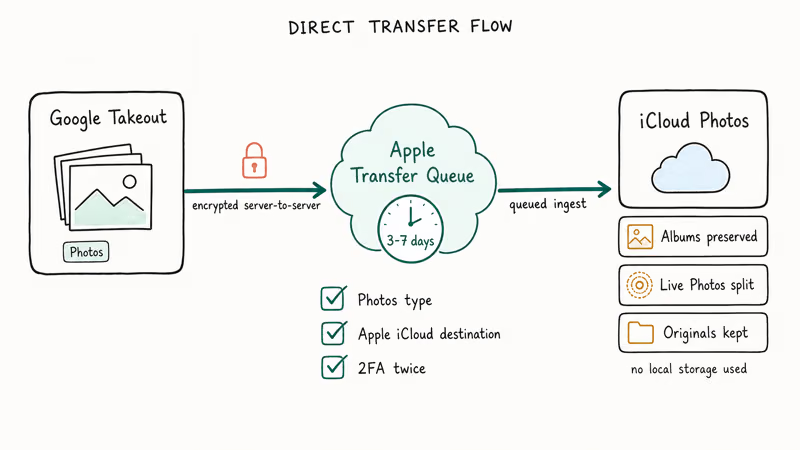
Apple processes every request through a queue rather than instant API calls, which is why even modest libraries take a couple of days end-to-end. The transfer is also one-way; Apple doesn’t offer a reverse path that exports iCloud Photos back to Google through this same flow.
The full workflow is browser-based and runs from your computer:
- Open takeout.google.com/transfer and sign in to the Google account that owns the photos.
- Choose Photos as the data type. Select Apple iCloud Photos as the destination.
- Sign in to your Apple ID when prompted and grant the iCloud Photos permission. Two-factor verification fires twice, once during permissions and once when the queue starts.
- Confirm the transfer summary. Google reports the estimated payload size, which is the figure you should compare against your free iCloud storage.
- Wait for two confirmation emails: one from Google when the export starts, one from Apple when iCloud begins ingesting.
For a library of several thousand photos, the Google export step can run for much of a day, and Apple’s iCloud ingest often takes a couple of days more before every album appears on iPhone. Apple’s documentation states that transfers can take from a few hours to a week depending on Apple’s queue load.
A few things to know about the result inside iCloud:
- Albums move as standalone iCloud albums; the Google folder structure is preserved as album names.
- Live Photos export as a still plus an MP4 motion file, so they show up as separate items in iCloud rather than rejoining as Live Photos.
- Shared library content is not transferred. Only photos and videos in your personal Google Photos library queue.
- Edits made inside Google Photos move as the edited version. The original is also copied if you saved both copies in Google.
#Download and Upload Through iCloud.com
The manual route gives you precise control if you want to migrate one album rather than the whole library, or if you want to inspect EXIF data before it lands in iCloud. The basic loop is to export from Google Photos and upload through the iCloud web app:
- Open Google Photos in a browser, select an album or a date range, and choose Download from the overflow menu. Larger selections export as a ZIP.
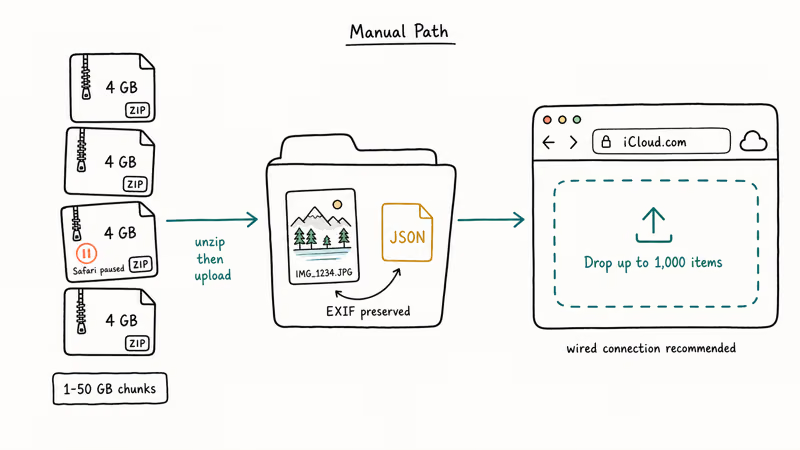
- Alternatively, use takeout.google.com and tick only Google Photos. You can choose archive size from 1 GB to 50 GB; smaller 4 GB chunks tolerate connection drops better than one giant archive.
- Wait for the email with the download links. Google’s support documentation states that links expire after seven days, so download promptly.
- Unzip the archives. Each photo has a matching JSON sidecar with the original metadata in case Apple Photos misreads any timestamps.
- Open iCloud.com, choose Photos, and drag files or use the upload icon to push the unzipped folder.
With a large album, Google splits the export into several 4 GB ZIPs, and a browser like Safari can pause a download partway through on a flaky residential connection. Switching to a wired connection usually fixes it. If you hit the uploading to iCloud paused error, the cause is almost always low local battery, low local storage, or backgrounded Safari, not the network.
The web uploader handles roughly 1,000 items in a single drop before the queue can stall silently, so split larger albums into smaller batches. You can’t restart a stalled batch from the iCloud.com side; you’ll need to refresh and reselect the unfinished files.
#Using the Google Photos App on iPhone
If you already have the Google Photos app installed on iPhone, you can avoid the desktop workflow for smaller transfers:
- Install Google Photos from the App Store and sign in.
- Open Settings, tap your name, choose iCloud, then Photos, and turn on Sync this iPhone.
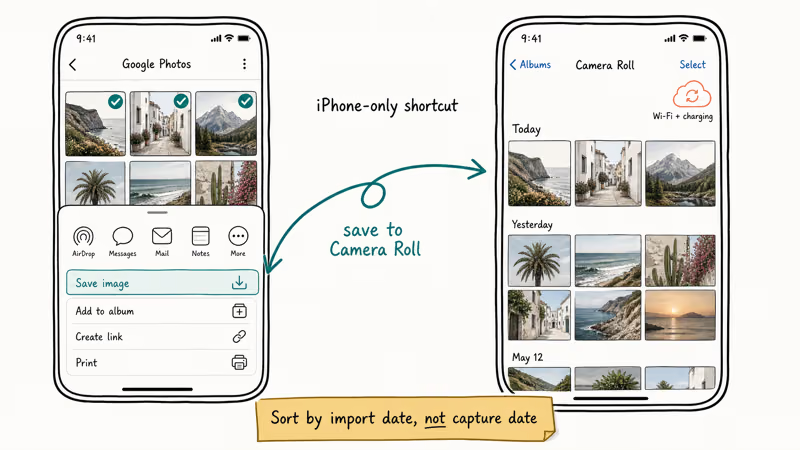
- In Google Photos, select the items you want to move. Tap Share, then Save image or Save video. Each saved file lands in the Camera Roll.
- iCloud Photos uploads them automatically the next time the iPhone is on Wi-Fi and charging.
This path bypasses Apple’s import queue, but it has two caveats. Saved-from-app files inherit the import date, not the original capture date, so albums sorted chronologically will need re-sorting in the Photos app. And the iPhone has to keep the saved files on-device long enough for iCloud Photos to upload them, which means watching local storage carefully.
For Android users without an iPhone yet, the cleanest pattern is to sync Google Photos to a computer first. Our guide on how to sync Google Photos to PC covers the Backup and Sync replacement and Drive for desktop options.
#Should You Use Third-Party Transfer Tools?
Cloud-to-cloud utilities such as MultCloud and Wondershare InClowdz advertise one-click moves between Google Photos and iCloud. They’re useful for repeat or scheduled transfers, but they come with tradeoffs you should weigh before paying.
The trustworthy paid options work by storing your Google and Apple credentials with OAuth tokens, then orchestrating downloads and uploads through their own servers. That means your photos pass through a third-party intermediary, which is fine for non-sensitive libraries but worth thinking about for family or personal archives. Free tiers usually cap monthly transfer volume, and the cap is normally low enough that any real library will require a paid plan.
When to consider a third-party tool:
- You need to transfer between Google Photos and a non-Apple destination such as Dropbox, OneDrive, or Mega in the same workflow.
- You want a recurring sync rather than a one-time migration.
- You already use the platform for other cross-cloud tasks and trust the vendor.
When to skip:
- You only need a one-time move into iCloud. Google Takeout’s direct transfer is free and avoids the third-party server entirely.
- You handle sensitive content and prefer the data path stays Google to Apple without an intermediary.
- You want to keep the EXIF JSON sidecars; some utilities flatten metadata during the relay.
If you do go this route, prefer the affiliate-supported Wondershare InClowdz workflow, which is documented and supports OAuth so your password is never stored in the tool. You can grab it from Wondershare InClowdz.
Some links on this page are affiliate links, which means fone.tips may earn a commission at no extra cost to you.
#Sizing iCloud Storage Before You Start
Apple’s iCloud storage plan support article confirms that the free tier provides only 5 GB of storage, which is rarely enough for a real photo library after backups, mail, and device data are factored in. Paid iCloud+ tiers start at 50 GB and scale to 12 TB.
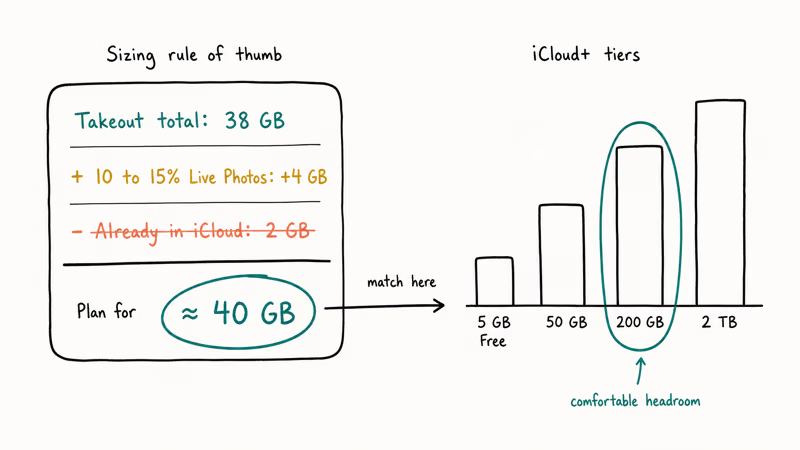
Use this rule of thumb when sizing storage:
- Take the Total size that Google Takeout shows on the export confirmation screen.
- Add 10 to 15 percent for Live Photo motion files, which become separate items in iCloud.
- Subtract anything you already store in iCloud Photos to avoid double-counting.
If your iCloud is already near its limit, our guide on iCloud storage full shows how to free space before you start the transfer, including which large file categories outside of Photos are usually the easy wins. A failed transfer mid-flight won’t roll back cleanly, so the best path is to upgrade or free space ahead of time.
For Android holdouts, iCloud for Android covers the limited browser-based options to read iCloud content from a non-Apple device after the move.
#Common Issues and Fixes
| Issue | Likely cause | Fix |
|---|---|---|
| Apple email never arrives | Apple ID has reached the rolling transfer limit | Wait seven days and retry; Apple confirms that the limit resets weekly |
| Photos appear without dates | iPhone Photos app misread Google JSON sidecar | Re-import via Apple Photos on Mac, which reads the JSON correctly |
| Album structure missing | Direct transfer placed everything in one big timeline | Use the Google album name to filter, then re-create albums in iCloud |
| Same photo shows twice | Live Photo motion saved as separate MP4 | Use the Photos app to merge or delete the duplicate motion file |
| Transfer keeps failing | Apple ID Two-Factor pending on a forgotten device | Sign out unused devices in appleid.apple.com, then retry |
#Bottom Line
For a one-time consolidation, Google Takeout’s direct transfer to iCloud Photos is the right choice in 2026. It’s free, server-to-server, and preserves enough metadata that the Apple Photos app can rebuild dates, locations, and Memories. Plan for a one-week window, top up iCloud+ to comfortably exceed your library size, and keep your Google account untouched until you’ve spot-checked at least three random albums in the Photos app on iPhone.
Reach for the manual download or the iPhone Photos app workflow only when you need album-level control, and reserve third-party tools for ongoing cross-cloud syncs rather than a single migration. If you change your mind later and want to go in the opposite direction, our walkthrough on how to transfer iCloud to Google Drive covers the equivalent Apple-to-Google export.
#Frequently Asked Questions
Will moving photos to iCloud delete them from Google Photos?
No. Apple’s transfer documentation explicitly confirms that both the direct Takeout transfer and the manual export create copies inside iCloud, and your Google Photos library is untouched until you remove items yourself.
How long does the direct transfer take?
It depends on size and queue load. The Google export step usually takes a few hours, and the Apple ingest typically finishes within two to four days for libraries between 30 and 60 GB. Apple’s support page notes that very large libraries can take up to a week. Plan for a full week if your library exceeds 100 GB.
Can I transfer my albums and folder structure?
Partially. Direct transfer keeps album names but flattens the timeline by capture date. Manual ZIP downloads preserve folder structure exactly.
What happens if I run out of iCloud storage mid-transfer?
The Apple ingest pauses and you’ll receive a notification on every signed-in Apple device. Free space or upgrade your iCloud+ plan, and the queue resumes automatically. Photos already in iCloud are kept; the remainder stays queued on Apple’s side for up to seven days. After that window the unfinished portion is dropped and you’ll need to start a fresh Takeout request, so don’t ignore the storage notification.
Does the transfer work for shared albums?
Only photos in your personal library transfer. Apple’s documentation confirms shared library content stays in the original account.
Are videos transferred at original quality?
Yes. According to Apple’s data transfer documentation, codec, bitrate, and resolution are unchanged, with only the container occasionally rewritten for compatibility.
Can I transfer to a family member’s iCloud account?
No. Apple’s transfer flow is keyed to the signed-in Apple ID and can’t target another person’s account. The workaround is to move everything into your own iCloud first, then use Shared Albums or iCloud Family Sharing to give a family member access to specific items they want.
What if I have iCloud Photos disabled on my iPhone?
The direct transfer still works because it uploads server-side. You won’t see the photos on iPhone until iCloud Photos is enabled under Settings, Apple ID, iCloud, Photos. The library is already there waiting.
Apple Siri Settlement: Who Qualifies and How to Claim
Apple's $250 million Siri settlement covers iPhone 15 Pro and iPhone 16 models bought June 2024 to March 2025. See who qualifies and how claims work.
iOS 26.6.1 Security Update: What Apple Fixed and Who Gets It
Apple released iOS 26.6.1 on August 17 with 29 security fixes, including an IPSec interception bug. See what it patches, who gets it, and how to update.
iPhone Adaptive Power: How It Works and When to Use It
Learn how iPhone Adaptive Power works, which models support it, what it changes, and when Low Power Mode is still the better battery-saving choice.
How to Transfer Data to a New iPhone Without iCloud
Move everything to your new iPhone without iCloud: Quick Start device-to-device transfer, wired migration, and encrypted Finder or iTunes backups.