How to See What's in My iCloud Account: Full 2026 Audit
Learn how to see what's in your iCloud using icloud.com, iPhone Settings, or Apple's Data and Privacy export. View files, photos, and backups safely.
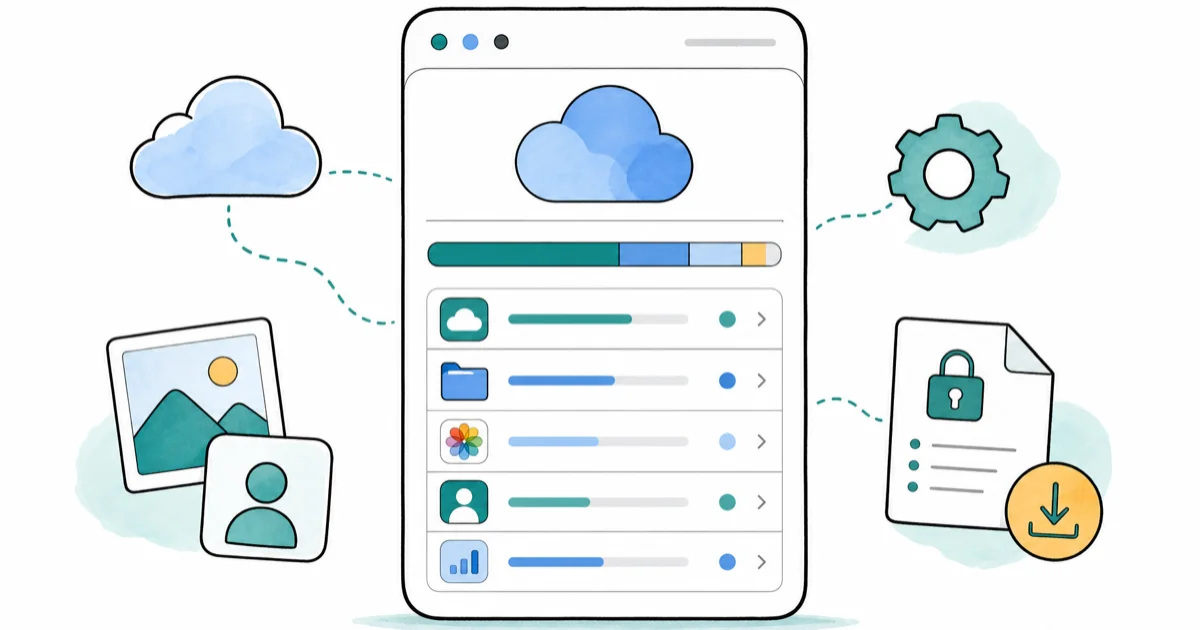
Quick AnswerTo see what is in your own iCloud, open icloud.com in a browser and sign in with your Apple ID, or on your iPhone go to Settings > [Your Name] > iCloud > Manage Account Storage. For a complete archive, request a Data and Privacy export at privacy.apple.com.
If you want to see what’s in your own iCloud, Apple gives you three official paths that work on any device signed into your Apple ID. The right tool depends on whether you need a quick browse, an on-device storage breakdown, or a complete archive of everything Apple has on file.
All three paths are official Apple account-management options, and each one fits a different kind of iCloud audit.
- icloud.com is the fastest way to view Photos, Drive, Mail, Notes, Contacts, Reminders, and Calendar from any browser on any device you sign into.
- Settings > [Your Name] > i
Cloud>Manage Account Storageon iPhone or iPad shows how much space each app, backup, and message library is consuming. - Apple’s Data and Privacy export at privacy.apple.com delivers a complete archive of your selected iCloud content after Apple finishes processing the request.
- Accessing someone else’s iCloud without permission violates the federal Computer Fraud and Abuse Act, so every method here is scoped to your own Apple ID.
- iCloud uses end-to-end encryption for 25 data categories under Advanced Data Protection, which means even Apple can’t read those items without your device passcode.
#Who Is Allowed to See What Is in an iCloud Account?
You’re only allowed to view an iCloud account that belongs to your own Apple ID or one where you have explicit, ongoing authorization from the account holder. That covers your personal Apple ID on your own iPhone, iPad, Mac, or PC signed into your account, a child account you manage through Family Sharing where you have permission, and a deceased person’s account where you have been named a Legacy Contact and Apple has verified your status.
Anything else is off-limits. According to Apple’s iCloud security overview, 25 categories of data are protected by end-to-end encryption when Advanced Data Protection is enabled, and Apple doesn’t hold the keys.
Trying to view another person’s iCloud, even a spouse or roommate, violates 18 U.S.C. §1030 (the Computer Fraud and Abuse Act) and several state privacy statutes; it’s a federal crime in the United States and a similar offence in most other jurisdictions. We focus only on lawful self-access for the rest of this guide.
#Method 1: View Your iCloud Through icloud.com in Any Browser
The web dashboard at icloud.com is the lowest-friction way to see what’s in your iCloud because it works on any computer, including a borrowed one or a public library Mac. Apple confirms that signing in with your Apple ID and two-factor verification unlocks the same Photos, Drive, Mail, Contacts, Notes, Reminders, Calendar, and Find My apps you use on your devices.
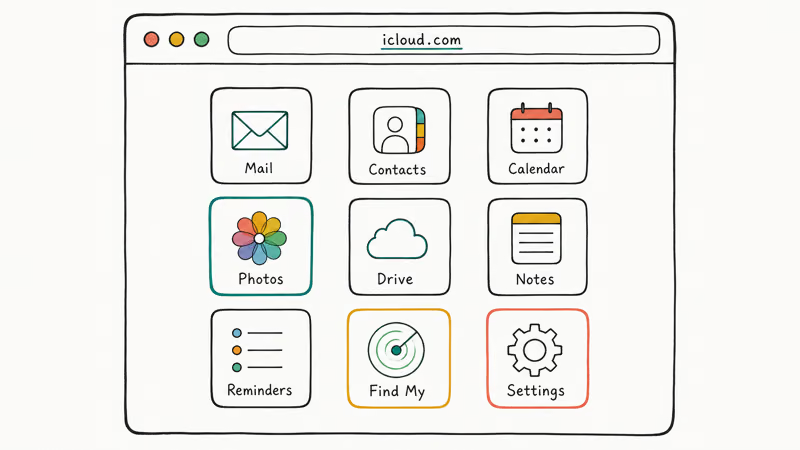
Here is the standard browser walkthrough:
- Open Chrome, Safari, Edge, or Firefox and visit icloud.com.
- Sign in with your Apple ID email and password, then approve the verification code on a trusted device.
- Use the app grid to open Photos, iCloud Drive, Notes, Mail, Contacts, Calendar, Reminders, or Find My in separate tabs.
- Within each app, browse, search, download, share, or delete items as needed.
The web interface is read-write for most categories, so you can free up storage on the spot by deleting old screenshots or large PDFs in Drive. One caveat: device backups and Health data are not browsable from icloud.com. For those, jump to Method 2 or 3.
#Method 2: Check Storage and Backups in iPhone or iPad Settings
The Settings path on iOS and iPadOS gives you something icloud.com can’t: a per-app storage breakdown plus the contents of every device backup tied to your Apple ID. As stated in Apple’s iCloud storage management guide, this is also where you delete old backups, trim Photos, or clear cached attachments to free space.
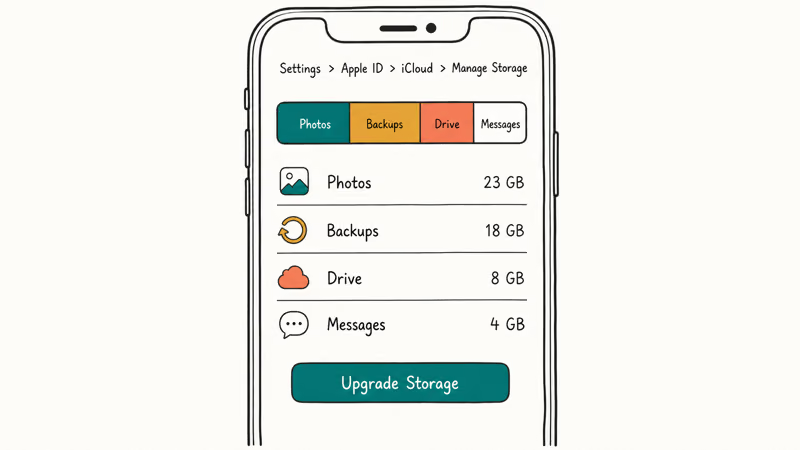
To open the storage view on your own iPhone or iPad signed into your account:
- Open Settings and tap your name at the top.
- Tap iCloud, then tap Manage Account Storage (older versions: Manage Storage).
- Review the colored bar showing how much of your 5 GB, 50 GB, 200 GB, or 2 TB plan is in use.
- Tap any row (Photos, Messages, Backups, Drive, app-specific entries) to see the data type’s contents and the option to delete or trim it.
Settings is also where you toggle individual app sync, like turning off Photos to stop new uploads, and review which devices are using iCloud Backup. If you’ve ever wondered why your iCloud storage is full despite a small photo library, the Backups row is usually the culprit; an iPhone backup commonly runs 1 to 4 GB once messages and app data are included.
#Method 3: Request a Full Data and Privacy Export from Apple
When you need a complete, downloadable snapshot of everything Apple has on file, the Data and Privacy portal is the authoritative source. Apple announced this portal in 2018 to comply with GDPR and California’s CCPA, and it now covers all Apple ID holders globally.
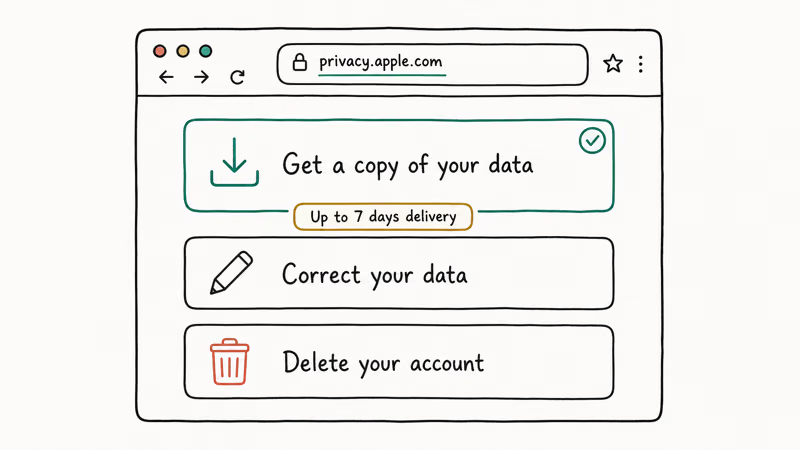
Step-by-step, here is how to request the export:
- Visit privacy.apple.com and sign in with your Apple ID.
- Pick Request a copy of your data.
- Choose which categories you want (iCloud Drive, Photos, Mail, Calendars, Health, Apple Media Services activity, App Store data, AppleCare history, and more) or select all.
- Pick a maximum file size for each ZIP segment (1 GB to 25 GB).
- Submit and wait. Apple processes the request and emails a download link.
Apple says the export can take up to 7 days to prepare. Apple’s portal confirms that exports include the underlying file payload for selected categories, like full-resolution photos, original Drive files, and raw Health XML.
#Method 4: Audit Devices and Sessions Tied to Your iCloud
A complete iCloud audit also covers the devices and active web sessions attached to your Apple ID.
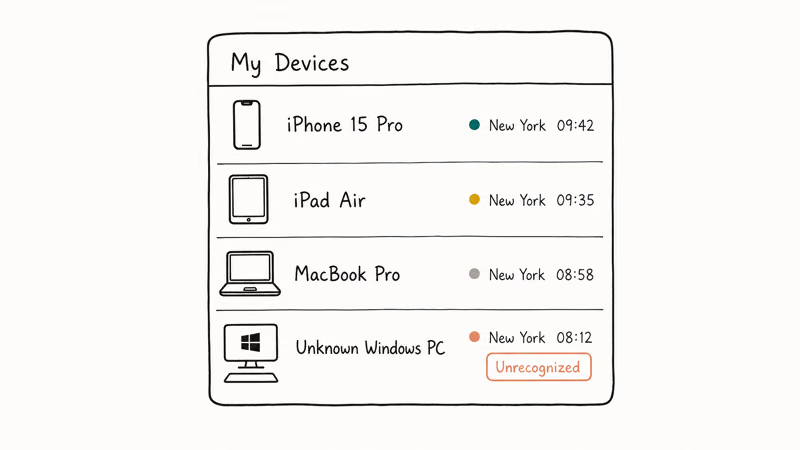
To list every device using your iCloud:
- Open Settings and tap your name.
- Scroll past the Apple services to the device list at the bottom.
- Tap any device to see its serial number, OS version, and Find My status.
- Sign out anything you no longer recognise; the device loses iCloud sync immediately.
Apple’s documentation on Apple ID device list management confirms removing a device also revokes its access to iCloud Photos, Messages in iCloud, and any keychain entries it cached. Pair this audit with our Apple ID verification walkthrough if two-factor codes keep landing on the wrong phone.
#What About Viewing an iCloud Backup’s Detailed Contents?
Apple’s own tools don’t let you browse the inside of an iCloud backup as a folder tree on its own. You can see the size of each backup in Settings > [Your Name] > iCloud > Manage Account Storage > Backups, and you can delete individual app entries from within that backup, but you can’t preview every message, call log, or attachment without restoring the backup to a device.
The lawful workaround is to restore to a spare device you own. According to Apple’s restore-from-iCloud guide, you erase the target iPhone or iPad, then choose Restore from iCloud Backup during the setup assistant.
This is destructive to whatever was on the target device first, so use a wiped spare or a freshly factory-reset trade-in unit. If you’d prefer a non-destructive route, Tenorshare UltData can sign into your own iCloud and preview specific data types from a backup without overwriting the target device, similar in spirit to how downloading individual iCloud backup files works on a per-file basis.
Some links on this page are affiliate links, which means fone.tips may earn a commission at no extra cost to you.
You can always pair that with Tenorshare UltData when the goal is to pull a single conversation thread or photo album out of your own iCloud archive rather than the whole bundle.
#Bottom Line: Which Method Should You Use?
If you just want a quick look at recent photos, notes, or files from a desktop, open icloud.com in any browser and sign in with your Apple ID; it takes under a minute and shows everything sync-enabled across your devices.
If you need a storage audit (what is eating your 50 GB plan, which backups can be deleted, how much Messages is using), open Settings > [Your Name] > iCloud > Manage Account Storage on the iPhone or iPad signed into your account; it’s the only path that exposes per-backup contents and the only place you can delete old device backups.
If you want a permanent, auditable archive (for tax records, evidence preservation, a switch to another ecosystem, or simple peace of mind), request a Data and Privacy export at privacy.apple.com and budget several days for delivery. Mix and match: weekly check via icloud.com, monthly storage cleanup in Settings, and an annual Data and Privacy export keeps you in full control of your own iCloud footprint.
#Frequently Asked Questions
Can I see what is in my iCloud from an Android phone?
Yes. Open a mobile browser, go to icloud.com, sign in, and approve the verification code on an Apple device you own. See our iCloud on Android walkthrough for the smoother flow.
Is it legal to look at someone else’s iCloud account?
No. Accessing another person’s iCloud without authorization is a federal offence under the Computer Fraud and Abuse Act in the United States, and similar laws apply in the UK, EU, Canada, and Australia. The only safe exceptions are accounts you legally manage, such as a Family Sharing child account or a deceased person’s account where Apple has verified you as Legacy Contact.
How long does the Data and Privacy export take to arrive?
Apple states that export preparation can take up to 7 days. Delivery time depends on how much data you request and how many categories you include.
What is Advanced Data Protection and does it affect what I can see?
Advanced Data Protection is an opt-in setting that extends end-to-end encryption to 14 more iCloud data categories, including iCloud Backup, Notes, Photos, Reminders, Safari bookmarks, and Wallet passes. As described in Apple support article HT212520, Apple can’t recover this data if you lose access. You can still view everything from trusted devices, but the icloud.com web interface for some categories is restricted unless you enable web access on the device first.
Why does my iCloud backup look empty in Settings?
It probably belongs to a different Apple ID. The Backups list only shows what’s tied to the account you’re signed into right now.
Can I restore only one item from an iCloud backup without wiping my iPhone?
Not with Apple’s built-in tools. Apple confirms a full restore from iCloud requires erasing the target device first. To pull a single item without a wipe, you need a third-party tool that signs into your own iCloud and reads the backup contents directly. Always run those tools on a device you own and only against your own Apple ID.
Does deleting items from icloud.com also delete them from my iPhone?
Yes, when the category is sync-enabled. Photos, Contacts, Notes, Calendar, Reminders, and iCloud Drive sync bidirectionally, so a delete on icloud.com propagates to every device on the same Apple ID within minutes. Recently Deleted folders typically hold removed items for 30 days. Disable the relevant sync toggle first if you want a local-only copy.
Apple Siri Settlement: Who Qualifies and How to Claim
Apple's $250 million Siri settlement covers iPhone 15 Pro and iPhone 16 models bought June 2024 to March 2025. See who qualifies and how claims work.
iOS 26.6.1 Security Update: What Apple Fixed and Who Gets It
Apple released iOS 26.6.1 on August 17 with 29 security fixes, including an IPSec interception bug. See what it patches, who gets it, and how to update.
iPhone Adaptive Power: How It Works and When to Use It
Learn how iPhone Adaptive Power works, which models support it, what it changes, and when Low Power Mode is still the better battery-saving choice.
How to Transfer Data to a New iPhone Without iCloud
Move everything to your new iPhone without iCloud: Quick Start device-to-device transfer, wired migration, and encrypted Finder or iTunes backups.