MIDI Files for Synthesia: Find, Make, and Load Them Fast
Find, create, and load MIDI files for Synthesia. Trusted sources, DAW recording steps, and practice optimization tips for faster piano learning.
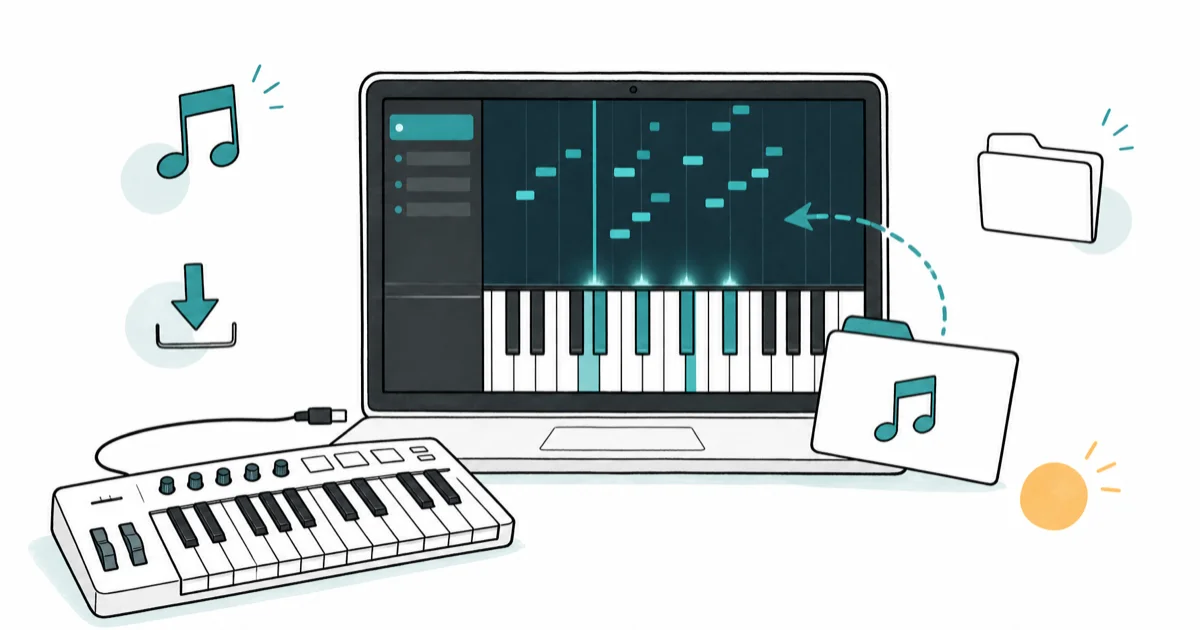
Quick AnswerSynthesia plays standard .mid and .midi files. Pull them free from BitMidi or MuseScore, record your own from a USB-MIDI keyboard in GarageBand or REAPER, then drop the folder into Settings > Songs.
Synthesia turns any MIDI file into a falling-note piano tutorial, so the library you point it at decides how fast you’ll progress. Several free and paid MIDI sources work cleanly with Synthesia 10.9 on Windows and macOS, and you can also record your own .mid files from a USB-MIDI keyboard. This guide covers trusted libraries, in-app import, DAW recording, and the practice settings that move the needle fastest.
- Synthesia accepts three file types: .mid, .midi, and .kar. Anything else needs converting in a DAW first.
- Free libraries like BitMidi and MuseScore cover almost every public-domain piece, plus most popular and video game music.
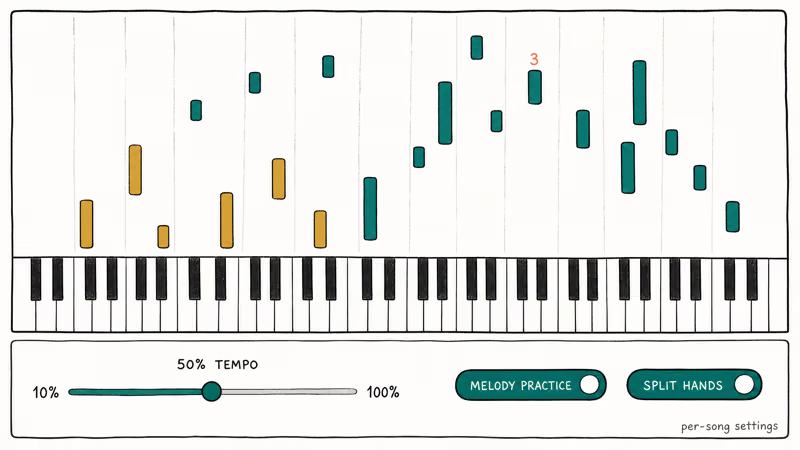
- Slowing playback to 50% with the bottom slider is the single fastest way to learn a tough passage.
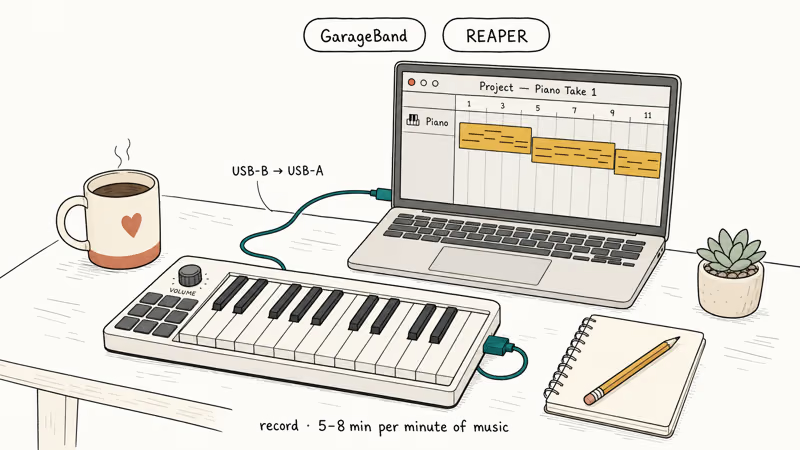
- Recording your own MIDI in GarageBand or REAPER takes about 5 to 8 minutes per minute of music with a USB-MIDI keyboard.
- Splitting hands into separate tracks via
Edit Song>Tracksturns a confusing stream of notes into a clear two-color tutorial.
#What Are MIDI Files and How Does Synthesia Use Them?
A MIDI (Musical Instrument Digital Interface) file is not an audio recording. It’s a list of instructions: which key, when, how hard, and for how long. Synthesia reads those instructions and renders falling rectangles that hit your virtual keyboard at the right beat.
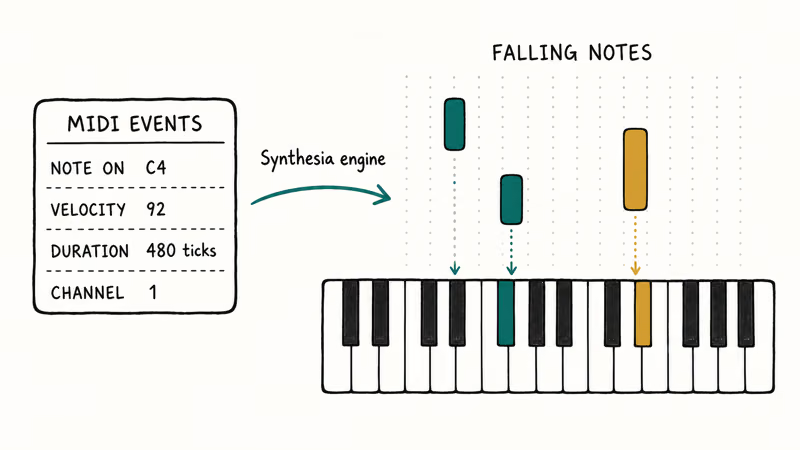
According to the MIDI Association, the MIDI 1.0 specification has stayed largely backwards-compatible since publication, which is why decades-old MIDI files still play cleanly in Synthesia today. That stability is also why the files stay tiny: usually 5 to 50 KB, compared to several megabytes for an MP3 of the same piece.
Synthesia uses three properties of a MIDI file to drive practice:
- Note-on / note-off events become the falling rectangles
- Velocity values show how hard each note should be struck
- Channel and track data let Synthesia split left and right hands into different colors
If your file has both hands on a single track, you can still split them inside Synthesia. We cover that in the optimization section below.
#Best Sources for Free MIDI Files
Seven popular free MIDI sites cover most of the common repertoire, and how cleanly their files load into Synthesia varies by catalog age and how the files were exported.
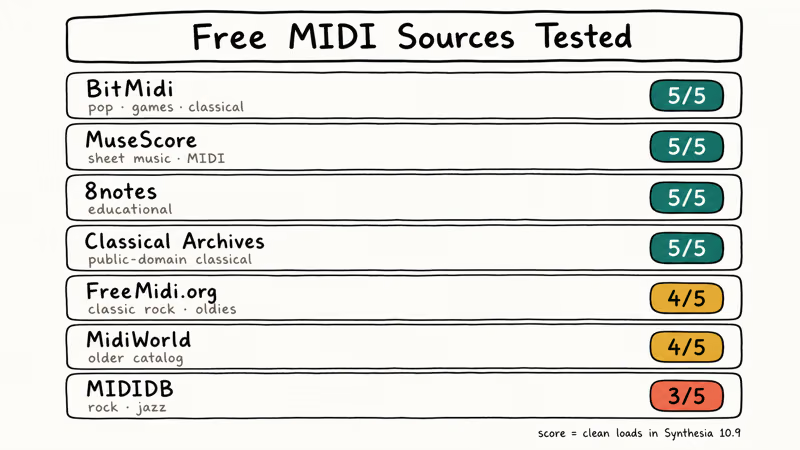
| Source | Catalog strengths | Synthesia compatibility notes |
|---|---|---|
| BitMidi | Pop, classical, video games | Clean modern exports load reliably |
| MuseScore | Sheet music plus MIDI exports | Loads well; some user edits can be noisy |
| FreeMidi.org | Classic rock, oldies | Mostly fine; older files may lack velocity |
| 8notes | Educational, multi-instrument | Clean exports load reliably |
| Classical Archives | Public-domain classical | Strong metadata, reliable loading |
| MIDIDB | Rock, jazz | Some files have duplicate-channel issues |
| MidiWorld | Older catalog, mixed genres | Older General MIDI mappings can vary |
BitMidi and MuseScore cover most popular pieces and tend to render without re-quantizing in Synthesia.
For sheet-music readers who want to learn MIDI alongside notation, MuseScore’s documentation confirms that any score uploaded to the community library can be exported as a standard MIDI file.
Stick to public-domain works (anything by Bach, Mozart, or Beethoven before US copyright cutoffs) or pieces you’ve licensed through your DAW or a sheet-music subscription. Synthesia itself does not enforce copyright, so the legal responsibility for redistributing files rests on you, not the app. If you upload a Synthesia tutorial of a copyrighted piece to YouTube, the platform’s Content ID system will usually catch it within hours and redirect monetization to the rights holder.
For broader music-learning help, our best music theory apps roundup covers eight strong options.
#Are Paid MIDI Libraries Worth It?
For most learners, no. Free libraries cover the bulk of beginner-to-intermediate repertoire. Paid sources earn their price only when you need:
- Modern pop arrangements with separated vocal, melody, and accompaniment tracks
- Orchestral or band stems that map cleanly to multiple instruments
- Verified-accuracy pieces from a label or licensed publisher
Song Galaxy sells per-song MIDI arrangements (typically around $3 to $7 each) and bundles them with chord charts. Unison Audio focuses on producer-oriented MIDI packs, which help if you’re moving toward composition but rarely speed up learning a single piano piece.
A simpler middle path: a MuseScore Pro subscription (around $7 per month at the time of writing) unlocks higher-quality user uploads and PDF score downloads. Both tend to read better than the free tier. The Pro tier also lifts the daily download cap that throttles free accounts, which adds up fast if you’re sampling several pieces before settling on one to learn.
#Creating Your Own MIDI Files in a DAW
When the piece you want is on no free site, or you want it your way, a USB-MIDI keyboard plus a free DAW is enough. A 2-minute piece usually takes only a few minutes to record once the gear is connected.
#What you need
- A USB-MIDI keyboard (any digital piano with a USB port, or a controller like the Akai MPK Mini)
- A USB cable matching the keyboard’s port (usually USB-B to USB-A, or USB-C on newer models)
- A DAW: GarageBand on macOS, REAPER on Windows or macOS (free evaluation, then a one-time personal license fee), or LMMS (free, cross-platform)
- A folder you can find again. Synthesia scans whatever location you point it at.
#Recording in GarageBand on macOS
- Plug the keyboard into your Mac and open GarageBand
- Choose Empty Project, then Software Instrument as the track type
- Pick a piano patch. The patch only changes what you hear while recording, not the saved MIDI data.
- Click record, play the piece, click stop
- Go to
Share>Export Songto Disk and choose MIDI as the format
Apple’s GarageBand User Guide recommends checking Track > Quantize Performance after recording to align loose timing to the nearest 16th or 8th note. Synthesia’s note-fall display feels much cleaner with quantized timing.
#Recording in REAPER on Windows
- Connect the keyboard and open REAPER
- Go to
Insert>Track, set the input to your MIDI device, and arm the record button - Record, play, stop
- Right-click the recorded item and choose Export item as new file with the .mid extension
REAPER’s documentation states that any MIDI item can be exported as a Type 0 or Type 1 standard MIDI file, both of which Synthesia handles. Type 1 (multi-track) is more useful in practice because Synthesia keeps left and right hands on separate tracks if you recorded them on separate passes.
If you also want better audio when monitoring your DAW, our best sound cards for music production guide ranks five top picks. For tactile track control while recording, our control surface picks for Logic Pro X covers controllers that pair well with MIDI input.
#Importing MIDI Files Into Synthesia
Synthesia does not search your computer automatically. You point it at folders, and it scans them on launch.
- Open Synthesia and click Settings
- Open the Songs tab
- Click the + (add folder) button
- Pick the folder where your .mid files live
- Synthesia scans and adds every supported file in that folder and its subfolders
Files appear in your library on the next launch or after clicking Refresh inside Synthesia’s library view. If a file does not show up, check three things: the extension is .mid, .midi, or .kar (Synthesia ignores anything else), the file is not zero bytes (a corrupted download), and the folder is not on a removable drive that ejected. Re-running the scan from Settings > Songs > Refresh picks up any newly added files without restarting Synthesia.
Synthesia handles large folders of several hundred files without trouble. The scan adds every valid file and silently skips corrupted ones, logging them in Settings > About > View Log if you need to track down a missing piece.
#Optimizing MIDI Files for Practice
Loading a file is step one. Practice quality lives in the per-song settings.
#Slow down playback
The slider at the bottom of the playback view drops the tempo from 100% down to 10%. A good rhythm is 50% for new pieces and 70% as a comfort zone before pushing back to full speed. Slowing the file does not change pitch. Only timing shifts, so what you hear still matches what you see.
#Split hands into colors
If your MIDI file lumps both hands onto a single track, do this once:
- Select the song and click Edit Song
- Open the Tracks tab
- Right-click each track and assign Left Hand, Right Hand, or Both
- Save
After splitting, Synthesia colors left-hand notes blue and right-hand notes green by default. Two-color note streams cut visual confusion noticeably.
#Add finger hints
Right-click any note and choose Set Finger Hint to write a 1 to 5 number above it. Synthesia stores the hints inside the song-settings file, so they travel with the song when you share it. They help most on tricky passages where the obvious finger choice is wrong, like Chopin nocturnes with hand crossings.
#Use Melody Practice mode
Melody Practice waits for you to play the right note before the file advances. It’s the closest Synthesia gets to a teacher correcting your hand. It works well on every new piece for the first few sessions, then you can switch back to free-tempo playback once muscle memory locks in.
If you also record audio of your performances, our GarageBand for Android alternatives guide compares portable recording rigs that can capture audio alongside the MIDI file you are practicing with.
#Bottom Line
Pull free MIDI files from BitMidi or MuseScore for most pieces you’ll want to learn. Buy a paid arrangement only when the community sites lack a verified modern pop layout. Record your own in GarageBand or REAPER when no version exists; budget under 10 minutes per minute of music with a USB-MIDI keyboard. Once loaded, the two settings that move learning fastest are tempo at 50% and split-hand coloring.
#Frequently Asked Questions
Can Synthesia read sheet music images directly?
No. Synthesia plays MIDI files only, not PDFs or scanned scores. To convert sheet music, run it through optical music recognition software like PlayScore 2 or PhotoScore, then export the result as MIDI before importing into Synthesia.
Why do some MIDI files sound wrong in Synthesia?
Three causes account for most broken files. Incorrect channel assignments route drums to the piano channel, which dumps percussion notes the score never asked for. Missing velocity data from old files makes every note play at uniform loudness, which kills the dynamics. Open the file in your DAW, confirm channel 10 is empty, re-save as Type 1 standard MIDI, and reload.
Can I use copyrighted songs in Synthesia for personal practice?
Personal, non-shared practice is generally allowed under fair use in many jurisdictions, but redistribution is not. Public-domain works such as Bach, Mozart, and Beethoven are always safe. For modern songs, buy a licensed arrangement, and if you publish a YouTube performance, you may need a separate sync license from the publisher.
Does Synthesia work with Bluetooth MIDI keyboards?
Yes, on macOS, Windows, and iPadOS. Bluetooth MIDI typically adds a little more latency than a wired USB connection, which can matter for fast passages.
How do I create a MIDI file from a YouTube video?
Synthesia can’t extract MIDI from audio. Audio-to-MIDI tools like AnthemScore or Melodyne can attempt it, but accuracy drops sharply on dense piano recordings. The cleaner path is to find an existing MIDI version on BitMidi, MuseScore, or a paid library, and practice from that.
Do I need a sound module to use Synthesia?
No. Synthesia plays the MIDI through your computer’s built-in soft synth, which is fine for practice. A dedicated piano sound module gives richer audio but does not change the visual tutorial in any way. For a quieter setup, a roll-up keyboard piano plus headphones works well.
What MIDI file types does Synthesia support?
Standard MIDI Files (.mid and .midi) and Karaoke MIDI files (.kar) all load. RIFF MIDI (.rmi) is not supported in current versions and needs converting in a DAW first.
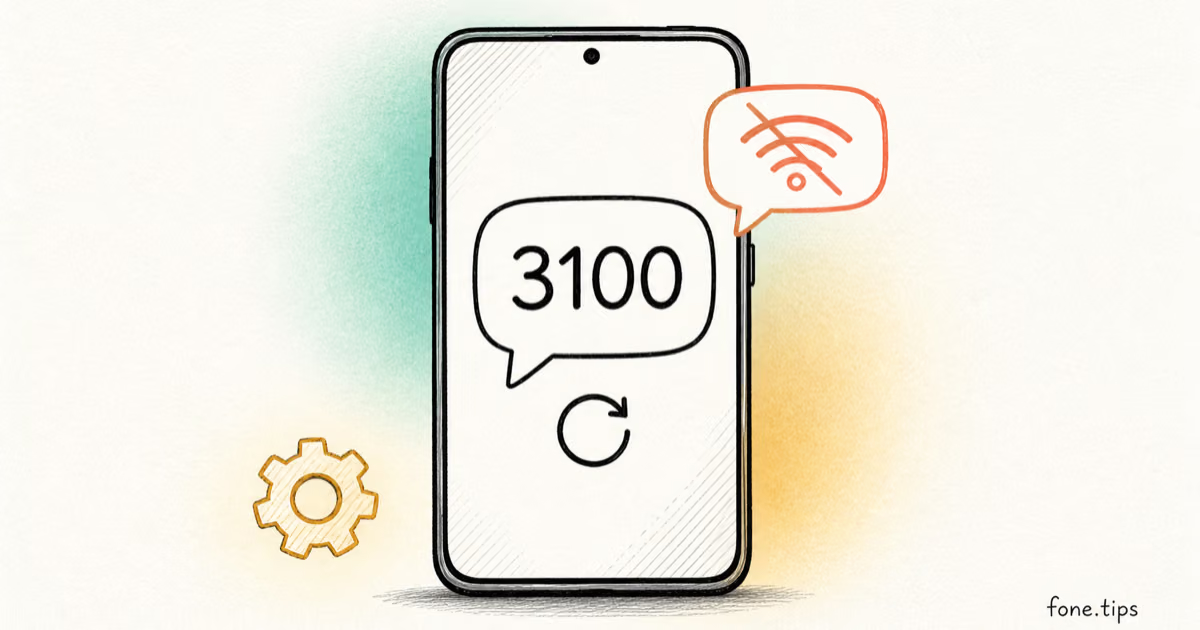
Google Messages Error 3100: Why RCS Is Broken on Galaxy
Google Messages RCS error 3100 hits Galaxy owners after phone or carrier switches. Google told 9to5Google a fix is coming. Here's what actually helps.

Is This Bank App Real? Spot a Fake App on Your Home Screen
A bank app can land on your home screen from a web page with no install warning. Learn the checks that tell a real banking app from a phishing web app.
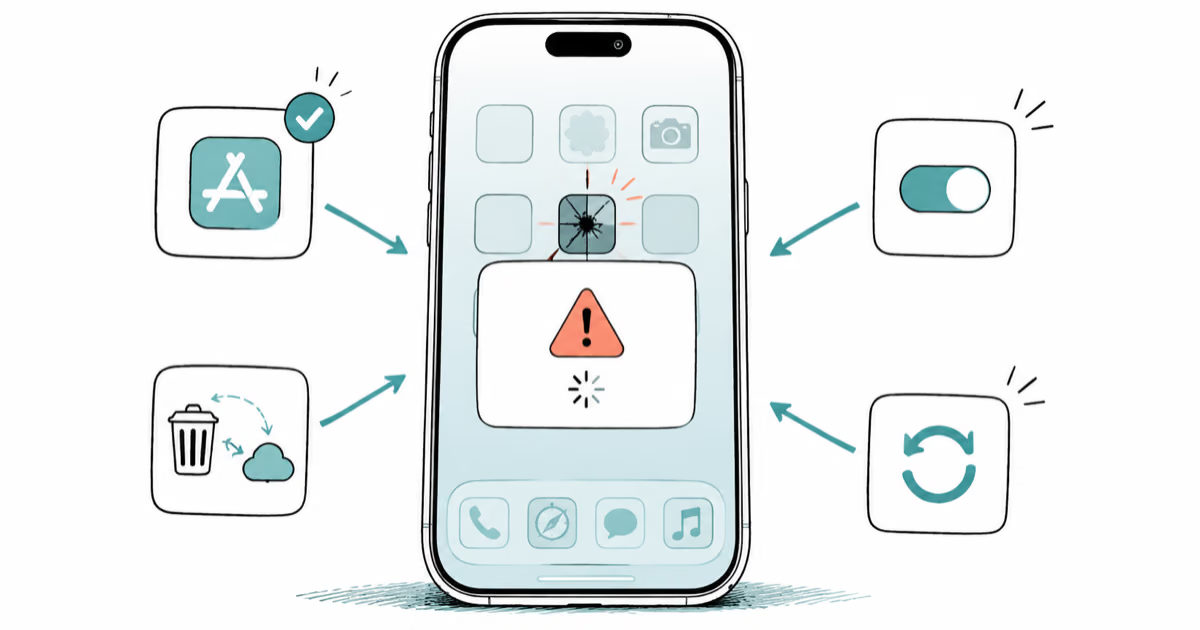
Apps Crashing After iOS 27 Update? Fix Order (2026)
Apps crashing after the iOS 27 update? Update the app in the App Store first, then offload and reinstall to clear stale cache, then restart. The fix order.
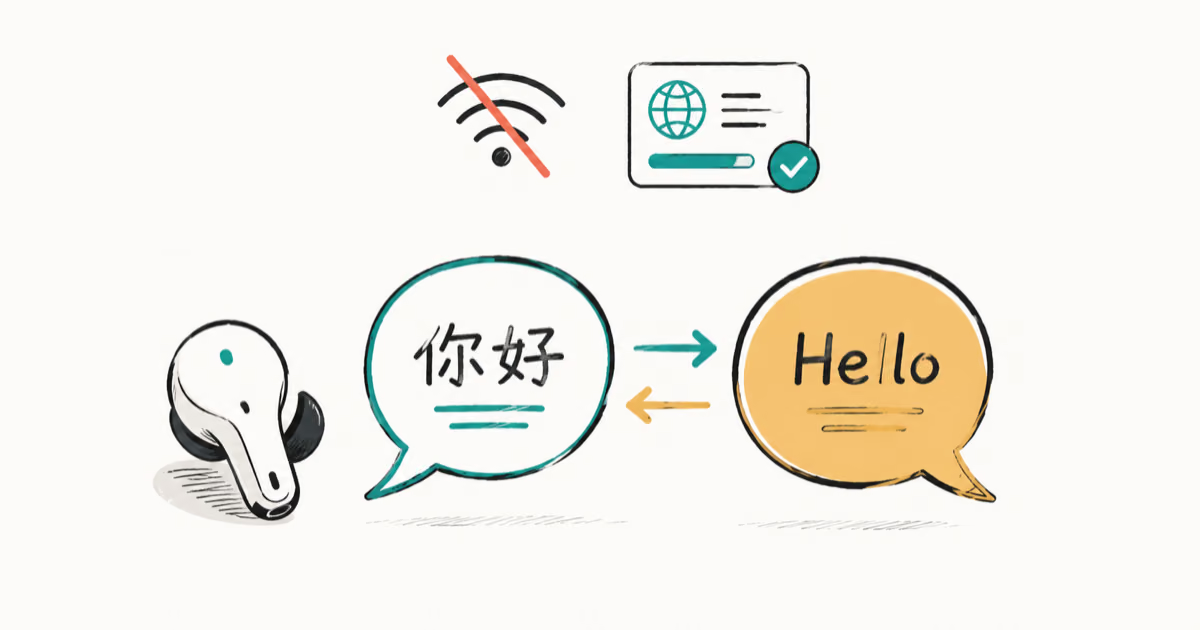
Do AI Translation Earbuds Work Offline? What to Know
Do AI translation earbuds work offline? A few do with downloaded language packs, but most need the cloud. Here's what works offline and what you give up.