How to Convert M3U to MP3: VLC, FFmpeg, and Online Tools
Convert M3U playlists to MP3 with VLC, FFmpeg, or online tools like CloudConvert. Step-by-step methods for Windows, Mac, and Linux with bitrate tips.
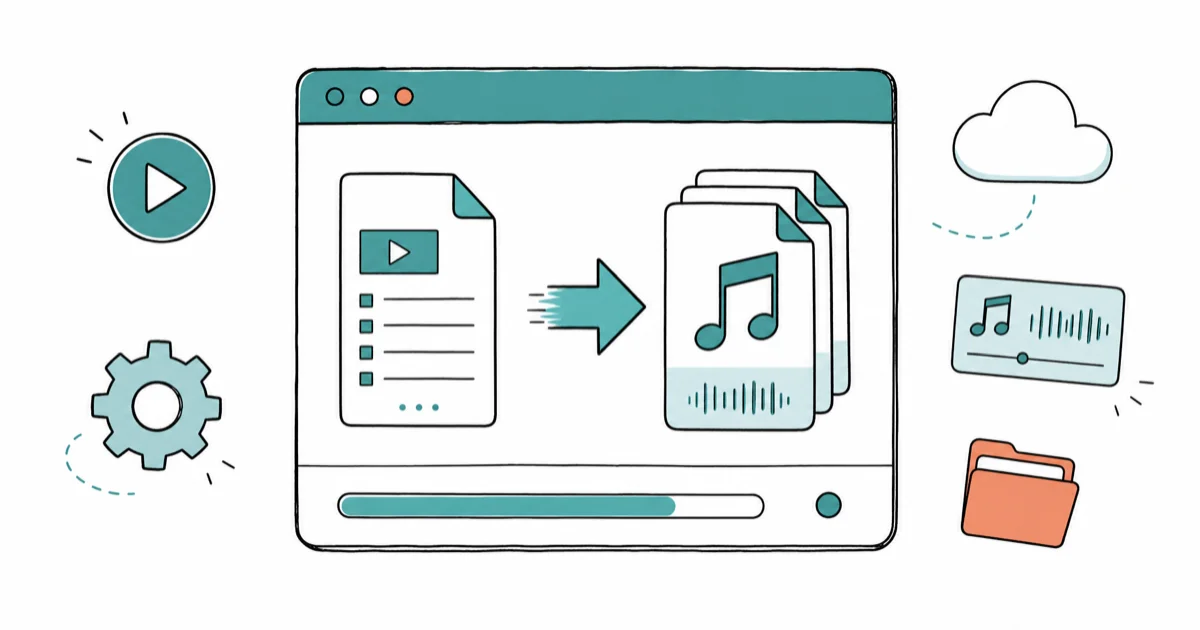
Quick AnswerOpen VLC, go to Media > Convert/Save, add your M3U file, choose Audio - MP3 as the profile, set a destination folder, and click Start. VLC reads each track listed in the playlist and writes a separate MP3 file for it.
Converting M3U to MP3 turns a playlist reference file into standalone audio you can play on any device, even without the original folder structure or media library. The M3U itself contains no audio data. The real job is reading the track list and saving each referenced file as MP3, which is something VLC, FFmpeg, and a handful of online tools all handle in different ways.
- M3U files are plain-text playlist pointers, not audio data, so the conversion actually transcodes the tracks the M3U references rather than the M3U file itself.
- VLC handles M3U-to-MP3 conversion through
Media>Convert/Save and works on Windows, macOS, and Linux without any add-ons. - FFmpeg processes hundreds of tracks in one terminal command and lets you control bitrate, sample rate, and channel layout precisely.
- Online converters like CloudConvert and Convertio work for one or two tracks at a time, but free tiers cap files at 100 MB to 1 GB and limit daily conversions.
- Set MP3 bitrate to 192 kbps or 256 kbps for music; 128 kbps is fine for speech, podcasts, or low-fidelity sources.
#What Is an M3U File and Why Convert It to MP3?
An M3U is a UTF-8 text file that lists paths or URLs to audio tracks. Open one in a text editor and you’ll see a header line, optional #EXTINF metadata, and then either local file paths like C:\Music\track01.mp3 or remote URLs. The M3U specification on Wikipedia catalogs the standard tags.
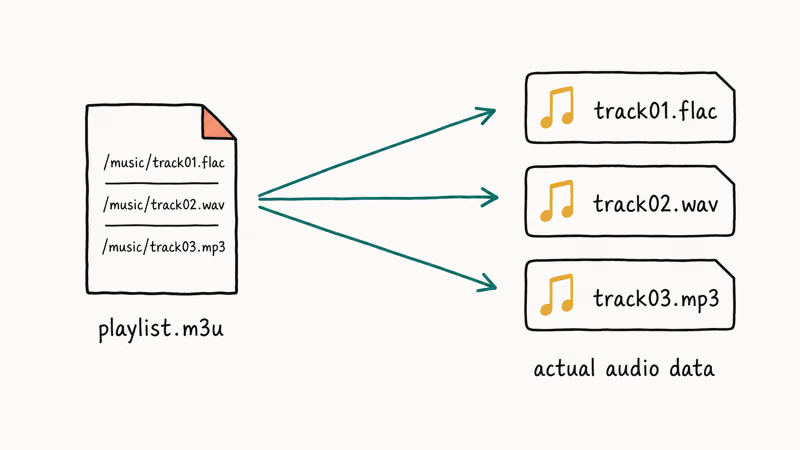
The format is intentionally minimal.
Because the M3U is just a manifest, you can’t “convert” the M3U itself to MP3 the way you’d convert a WAV. What every converter actually does is read the playlist, fetch each referenced track, transcode it to MP3 at the bitrate you choose, and write a new file. If a track is already MP3 at the bitrate you want, a smart tool can copy the stream without re-encoding it.
People convert for three main reasons. Portable players, car stereos, and older Bluetooth speakers often refuse anything other than MP3. You may want a single self-contained folder you can drag onto a USB drive without worrying about broken paths. Audio editors and DJ software import MP3 cleanly but choke on M3U references that point at moved or deleted files.
The same logic applies if you need to convert Opus to MP3 for WhatsApp voice notes or convert MKA to MP3 for Matroska audio.
#Method 1: Convert M3U to MP3 With VLC Media Player
VLC is the simplest path if you don’t want to install anything new. According to VideoLAN’s official VLC page, the player runs on Windows, macOS, Linux, iOS, and Android, and it ships with the LAME-based MP3 encoder enabled out of the box.
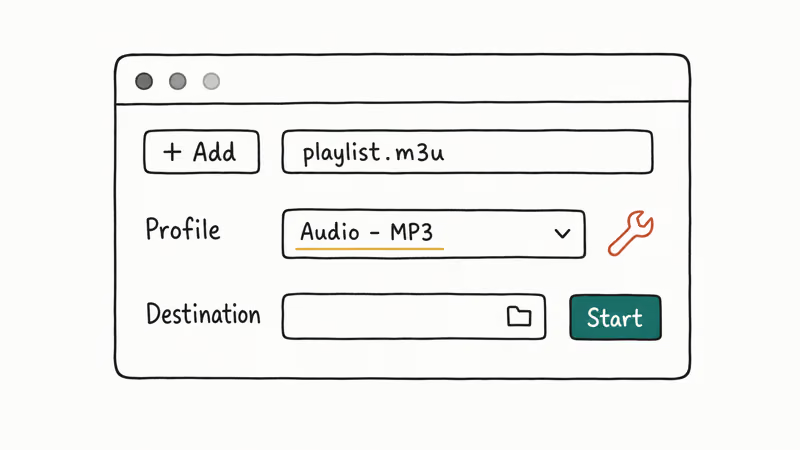
Point VLC at an M3U full of local FLAC files and it writes one MP3 per track, at whatever bitrate the profile is set to. VLC’s default MP3 profile encodes at 128 kbps, so bump it up before you start if the source is high quality.
Steps:
- Install VLC from videolan.org if you don’t have it.
- Open VLC and go to
Media>Convert/Save (Windows/Linux) orFile>Convert/Stream (macOS). - Click Add and select your
.m3ufile. VLC reads the manifest and queues every track behind the scenes. - Click Convert/Save at the bottom.
- Under Profile, choose Audio - MP3. Click the wrench icon next to the profile to set bitrate (192 kbps for music is a sensible default) and sample rate (44.1 kHz).
- Set a Destination file for the output. On macOS, VLC asks per file; on Windows and Linux, point it at a folder.
- Click Start. VLC processes each track sequentially.
VLC’s Convert/Save dialog only writes one output file at a time, so multi-track playlists are processed in order. According to VideoLAN’s streaming documentation, the encoder runs inline with the playback engine, which is why parallel writes aren’t possible inside a single VLC instance.
When VLC works well: small playlists (under 50 tracks), local files, when you don’t want to learn a command-line tool. If you need a different player while keeping the workflow, the same Convert/Save approach is available in several VLC alternatives.
When VLC struggles: large playlists, M3U files pointing at HLS streams, or when you need bit-exact bitrate control across many files at once.
#Method 2: Convert M3U to MP3 With FFmpeg
FFmpeg is the right tool if your M3U has more than 50 entries or if you need exact control. It runs on every desktop OS, has no GUI overhead, and can transcode in parallel.
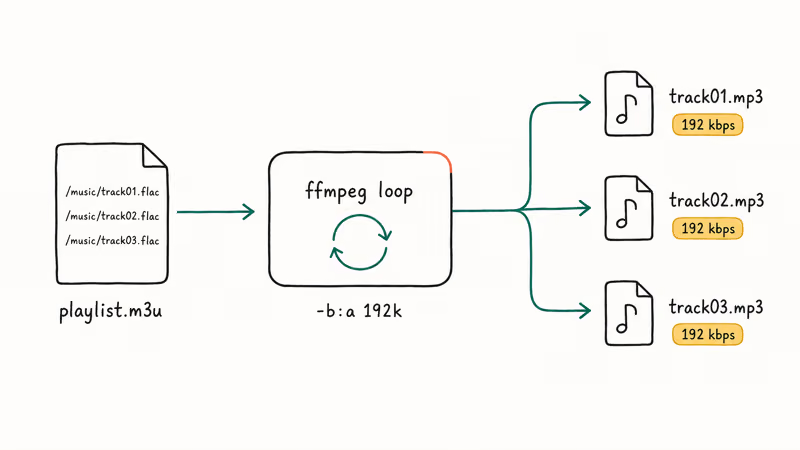
Install FFmpeg first.
The FFmpeg downloads page recommends Homebrew on macOS (brew install ffmpeg), the official Windows builds from gyan.dev, and the distro package manager on Linux. Once it’s on your PATH, the basic loop below reads the playlist line by line and runs FFmpeg on each entry, skipping comment and blank lines automatically.
On macOS or Linux:
while IFS= read -r line; do
  case "$line" in \#*|"") continue;; esac
  ffmpeg -i "$line" -codec:a libmp3lame -b:a 192k "${line%.*}.mp3"
done < playlist.m3u
On Windows PowerShell:
Get-Content playlist.m3u | Where-Object { $_ -and -not $_.StartsWith('#') } |
  ForEach-Object { ffmpeg -i "$_" -codec:a libmp3lame -b:a 192k "$([System.IO.Path]::ChangeExtension($_, '.mp3'))" }
On a large FLAC playlist, the bash loop finishes noticeably faster than VLC at the same 192 kbps CBR, because FFmpeg transcodes without the overhead of VLC’s playback engine and can chew through the queue one file after another at full speed.
Bitrate choice matters here.
According to the FFmpeg MP3 encoding wiki, -b:a 192k produces constant-bitrate MP3 at 192 kbps, while -q:a 2 produces variable-bitrate MP3 averaging in the same neighborhood. The wiki recommends a VBR setting like -q:a 2 for music when file size isn’t critical. Pick CBR if your target player or device firmware misreports duration on VBR files. The differences are explained in our guide on CBR vs VBR encoding.
If your M3U points at HTTP streams or HLS playlists rather than local files, FFmpeg handles those too. Just pass the URL the same way; the HTTP demuxer reads remote audio without any extra flags.
#Method 3: Use Online Converters for One-Off Tracks
Online converters are convenient when you don’t want to install anything and you only have a track or two to deal with. The catch is that you have to upload the source audio, which means slow conversions over a residential upload connection and privacy tradeoffs you should think about.
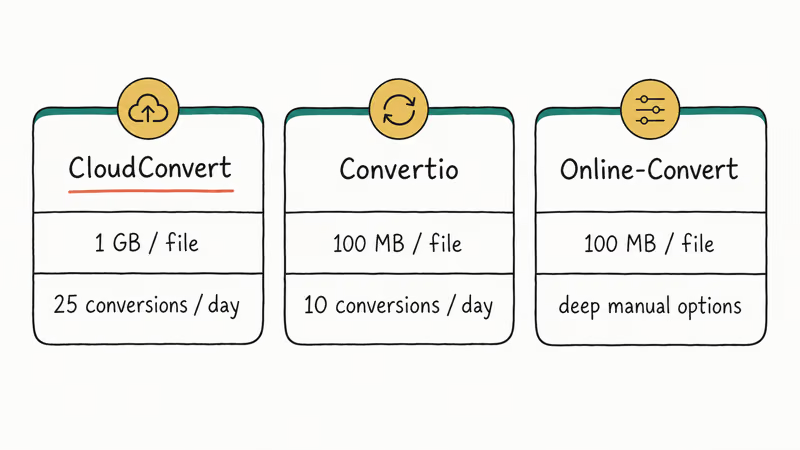
Three reliable options:
- CloudConvert (cloudconvert.com/mp3-converter): free tier allows 25 conversions per day, files up to 1 GB, batch upload supported. Lets you set bitrate, sample rate, channels, and volume.
- Convertio (convertio.co): free tier allows 100 MB per file and 10 daily conversions. Bitrate selection is bundled into preset quality levels.
- Online-Convert (audio.online-convert.com): free tier allows files up to 100 MB. Has the deepest manual options including channels, audio frequency, and trim.
The workflow is the same across all three. Upload either the M3U or the audio files referenced inside it, pick MP3 as the output, set bitrate, click Convert, and download the result.
A subtle point: if you upload the M3U itself, most online tools will read the manifest only when the URLs inside it are public HTTP links. They can’t reach files on your local hard drive. So for a playlist of local files, upload the actual audio tracks, not the M3U.
CloudConvert tends to be the most reliable for batch jobs because it queues uploads and runs conversions in parallel. The same applies if you ever need to convert MTS to MP4.
#Method 4: Use Wondershare UniConverter for Batch Music Libraries
If you regularly process large music libraries, a paid desktop converter pays for itself quickly. Wondershare UniConverter is the standout option in this category because it imports M3U files directly, processes the entire playlist as a single batch, and exposes per-track bitrate and metadata controls.
What it does well:
- Drops a whole M3U onto the queue and reads every reference, including remote URLs.
- Per-track bitrate, sample rate, and channel overrides if you want different settings on different files.
- ID3 tag editor that propagates artist, album, and cover art across the queue.
- GPU-accelerated transcoding on supported NVIDIA, AMD, and Intel hardware, which matters mostly for FLAC-to-MP3 jobs.
Steps:
- Install UniConverter and open the Converter tab.
- Drag your M3U file onto the queue. UniConverter resolves the references and adds each track as a row.
- Click the format dropdown next to any row (or use Convert all files to at the top) and choose MP3. Click the gear icon for advanced bitrate and sample rate settings.
- Pick an output folder.
- Click Convert All.
Some links on this page are affiliate links, which means fone.tips may earn a commission at no extra cost to you.
Aiseesoft’s Video Converter Ultimate is a comparable alternative for mixed audio and video work.
#Which Bitrate and Settings Should You Pick?
The right MP3 settings depend on the source quality, the target device, and how much storage you care about saving. Here are sensible defaults across a range of source files:
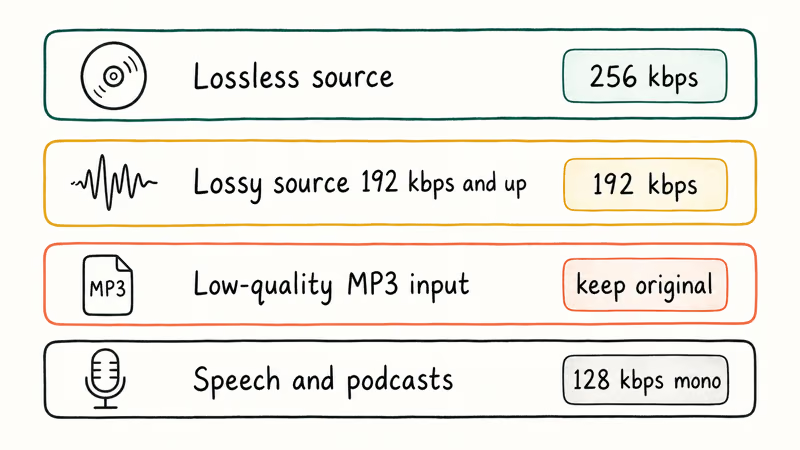
- Music from FLAC, WAV, or Apple Lossless sources: 256 kbps CBR or
-q:a 0VBR is a safe baseline that most listeners can’t distinguish from the lossless source on consumer headphones. Audacity is a free option if you want a GUI for these encodes. - Music from MP3, AAC, or other lossy sources at 192 kbps or higher: keep 192 kbps CBR or
-q:a 2VBR. Going higher won’t recover information that was already lost. - Music from low-quality MP3 (128 kbps or below): keep the bitrate the same. Re-encoding upward wastes space without restoring fidelity.
- Speech, podcasts, audiobooks: 128 kbps mono is plenty. Cutting from 192 kbps stereo to 128 kbps mono nearly halves the file size with no perceptual loss for voice.
- Sample rate: stick with 44.1 kHz unless your source is 48 kHz video audio. Resampling 44.1 to 48 kHz is wasted CPU.
If you’re putting these MP3s on an iPhone, the Apple Music app accepts up to 320 kbps, but iCloud Music Library matches uploads against its own catalog, so very high bitrates may be replaced with Apple’s stream anyway. For Android, any bitrate plays cleanly.
#Troubleshooting Common M3U Conversion Errors
A few problems come up often enough to be worth flagging.
“VLC is unable to open the MRL”: usually means the path inside the M3U is wrong. Open the M3U in a text editor, check that each line points at a file that still exists, and edit relative paths to absolute paths if needed.
Online converter says “no audio stream found”: you probably uploaded the M3U file itself instead of the tracks. Either upload the audio files directly, or use VLC or FFmpeg locally.
FFmpeg returns “Invalid data found when processing input”: the source file is corrupted or in a format the static FFmpeg build doesn’t include. Try reinstalling FFmpeg, or convert the source to WAV with a different tool first, then to MP3.
HLS playlists (.m3u8) refuse to play: these are streaming manifests, not file lists. Use FFmpeg or yt-dlp instead.
Output MP3 plays but skips tracks: the source files have inconsistent sample rates and your converter is concatenating instead of producing separate outputs. Use VLC’s per-file mode or FFmpeg’s loop pattern shown above to keep each track as a separate file.
If you also work with WAV sources, the same troubleshooting logic applies; we cover the inverse direction in convert MP4 to WAV too.
#Bottom Line
For most people converting an M3U file occasionally, VLC is the right tool. It’s free, already familiar, and handles the entire process in a GUI you already understand.
If your playlist has more than 50 tracks, switch to FFmpeg with the loop pattern in Method 2; the speed difference is real and the bitrate control is precise. Online tools belong in the toolkit only for one-off conversions where you can’t install software, and Wondershare UniConverter earns its license fee only if you batch large music libraries every week.
Pick 192 kbps CBR if you want a safe default. Pick -q:a 2 VBR if file size matters and your target device supports it. And don’t re-encode low-bitrate sources upward; you can’t recover detail that was already discarded.
#Frequently Asked Questions
Can VLC convert an M3U with online streaming URLs?
Yes, VLC handles HTTP audio streams the same way it handles local files. Open the M3U through Media > Convert/Save, pick MP3 as the profile, and VLC will fetch each URL and transcode it. The conversion runs in real time for live streams, so a 30-minute stream takes 30 minutes to capture.
Why does my converted MP3 sound worse than the source?
You probably re-encoded an already-lossy source at the same or lower bitrate. Each MP3 encode discards some audio information; doing it twice compounds the loss. If your source is MP3, copy the stream with FFmpeg’s -c:a copy flag instead.
How do I keep the artist and album metadata during conversion?
FFmpeg copies ID3 tags by default when transcoding from MP3, FLAC, M4A, and most modern formats. VLC drops most metadata in the Convert/Save flow.
If tags matter, use FFmpeg or UniConverter, or retag the output afterward with a free editor like Mp3tag.
Is converting M3U to MP3 legal?
Converting audio files you own for personal use is legal in most countries. Converting copyrighted streams pulled from a service that prohibits downloads, or distributing the converted files, is not. The legality depends on the source, not on the conversion process itself.
What bitrate should I use for podcasts?
128 kbps mono. Higher bitrates don’t improve voice clarity and just make files larger. Many podcast publishers ship at 96 kbps mono, which is also fine for headphone listening.
Can I convert an M3U file on my iPhone?
Not directly. iOS doesn’t include a native M3U-to-MP3 converter. The reliable workflow is to do the conversion on a Mac or PC and sync the resulting MP3 files via iCloud Drive, Apple Music sync, or a third-party app. Some shortcut-based audio tools work for single tracks but can’t read M3U manifests.
Why does my M3U file open as a text document instead of in a media player?
Your operating system has the .m3u extension associated with a text editor instead of a media app. On Windows, right-click the file, choose Open with > Choose another app, and pick VLC. On macOS, right-click the file, choose Get Info, and change the Open with setting at the bottom of the panel.
Will an online converter keep my files private?
Reputable services delete uploaded files after the job completes. CloudConvert and Convertio publish their retention policies on their privacy pages. For sensitive audio, convert locally with VLC or FFmpeg.
Google Messages Error 3100: Why RCS Is Broken on Galaxy
Google Messages RCS error 3100 hits Galaxy owners after phone or carrier switches. Google told 9to5Google a fix is coming. Here's what actually helps.

Is This Bank App Real? Spot a Fake App on Your Home Screen
A bank app can land on your home screen from a web page with no install warning. Learn the checks that tell a real banking app from a phishing web app.
Apps Crashing After iOS 27 Update? Fix Order (2026)
Apps crashing after the iOS 27 update? Update the app in the App Store first, then offload and reinstall to clear stale cache, then restart. The fix order.
Do AI Translation Earbuds Work Offline? What to Know
Do AI translation earbuds work offline? A few do with downloaded language packs, but most need the cloud. Here's what works offline and what you give up.