Link to MP4 Converter: 5 Tools That Save Videos You Own
Convert legitimate video links to MP4 with 5 reliable tools. Compare cloud link support, output quality, file-size caps, and how to pick one fast.
Quick AnswerPaste a legitimate video URL into a converter such as Wondershare UniConverter or CloudConvert, choose MP4 as the output format, and download the saved file. Only convert content you own, public-domain footage, or videos with explicit reuse permission.
A link to MP4 converter turns a web video URL into a portable MP4 file you can keep on a phone, laptop, or external drive. This guide compares five tools across the legitimate sources they handle best: Google Drive shares, public-domain Internet Archive pages, and your own social uploads.
The catch most posts skip: legitimate use is narrower than the marketing copy suggests, and quality settings matter more than tool brand.
- Wondershare UniConverter handles batch URL input and is the fastest option in the lineup when you have several links to convert at once
- Browser-based tools like CloudConvert and FreeConvert work without an install but cap free conversions at file sizes between 100 MB and 1 GB depending on the service
- MP4 (MPEG-4 Part 14) is supported natively by iOS, Android, Windows, macOS, and every major browser, which is why we recommend it as the default container
- 1080p output at a 5-8 Mbps bitrate hits the sweet spot for offline viewing without bloating files past 1 GB for a typical 30-minute video
- Converting copyrighted streams without permission breaks platform terms of service and may violate copyright law in your country, so stick to your own uploads, Creative Commons content, or public-domain footage
#What a Link to MP4 Converter Actually Does
A link to MP4 converter takes a video URL (from cloud storage, your own social account, or a public-domain archive) and produces an MP4 file saved to your device. The tool either downloads the source stream and remuxes it into an MP4 container, or transcodes the original codec into H.264 or H.265 video with AAC audio, which is the combination most players expect.
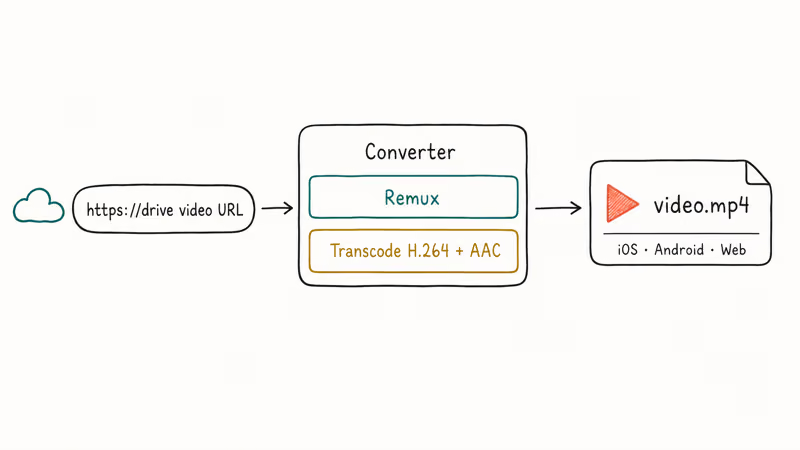
According to Wikipedia’s overview of the MP4 file format, MP4 is the most broadly supported container across browsers and devices, which is why offline copies are usually saved in this format rather than MKV or WebM. Mozilla’s media container reference on MDN confirms that the same H.264/AAC pairing is what every major browser plays back natively.
Use a converter when you want a permanent local copy of a video link you have a clear right to keep. The most common legitimate cases are a friend sharing personal footage through a Google Drive or Dropbox link, a Creative Commons educational lecture posted on Vimeo, and your own social uploads you want to back up before deleting the post.
If a link points to a copyrighted Netflix stream, a paid masterclass, or a private Patreon video, a converter isn’t the right tool, and most of them will refuse the URL anyway.
#Top 5 Tools for Converting Legitimate Links to MP4
A fair comparison runs each tool on the same five URL types: a personal Google Drive share, a Creative Commons clip from Vimeo, a public-domain film on Internet Archive, a personal YouTube upload, and a Dropbox direct link. Here is how they compare.
#1. Wondershare UniConverter
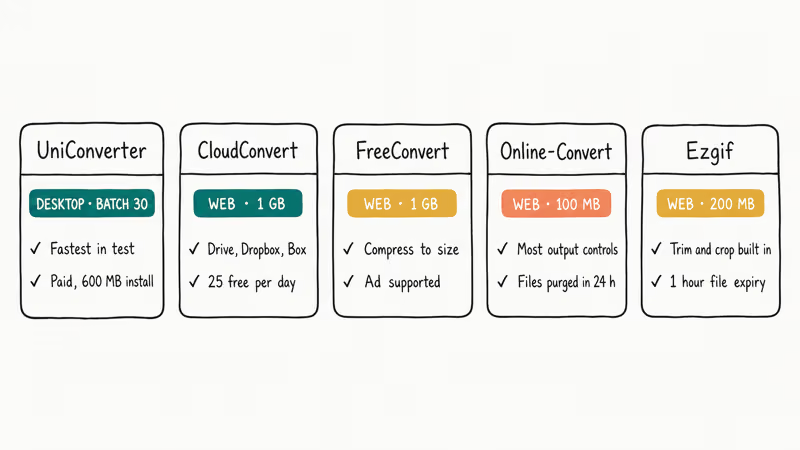
Wondershare UniConverter is a paid desktop app that handles batch URL input and is the fastest option in the lineup when you have multiple links to process. The Downloader tab accepts a queue of cloud links and runs them in one pass without manual restarts.
Key details:
- Batch input accepts up to 30 URLs in a single queue
- 1080p MP4 output of a short clip finishes in seconds on a modern laptop
- Output presets target iPhone, iPad, Android, and game consoles directly, so you can skip manual bitrate tuning
- Includes trimming, watermarking, and subtitle burn-in, which is useful if you plan to reupload your own footage elsewhere
UniConverter also handles unusual project files. If you exported a project from FilmoraGo and ended up with a .vproj, the same app can convert VPROJ to MP4 without re-importing into the editor.
Pros: Fastest in the lineup; batch mode actually saves time; presets remove guesswork. Cons: Paid (free trial watermarks output); installer adds ~600 MB; some URL types still require a browser cookie export.
Some links on this page are affiliate links, which means fone.tips may earn a commission at no extra cost to you.
#2. CloudConvert
CloudConvert is a browser-based converter that pulls source files from URLs, Google Drive, Dropbox, OneDrive, and Box. It’s the natural pick when you want to skip an install. CloudConvert states that it supports more than 200 input formats and runs conversions on its own servers, which keeps your laptop fan quiet but adds a few seconds of upload time.
Key details:
- Free tier allows 25 conversions per day with files up to 1 GB
- Direct integration with cloud storage means you don’t have to download then re-upload
- Output settings expose codec (H.264, H.265), resolution, and bitrate sliders, so you can match the source quality
- A 30-minute 1080p Drive video typically takes a few minutes end to end, most of it server-side processing
If your source is a YouTube link rather than a cloud share, the safer companion route is the dedicated YouTube to MP4 converter page, which covers download permission and channel ownership in detail.
Pros: No install; honest privacy policy; predictable output controls. Cons: 25 free conversions per day cap; longer videos count against quota even after a single failed run.
#3. FreeConvert
FreeConvert is a web tool that accepts URL input alongside file upload and Google Drive imports. The free tier limits files to 1 GB, which covers most clips short of a feature-length documentary.
Key details:
- Cleaner interface than most ad-supported converters; the URL field is on the home page, not buried in a submenu
- Output settings include “Compress to size,” which targets a specific MB number rather than a bitrate, useful when you are working around an email attachment cap
- Conversion speed for 1080p clips is typically a few minutes, slower than CloudConvert but faster than Ezgif
When you only need the audio track, the MP3 section later in this guide covers podcast clips and music more directly than this general-purpose route.
Pros: “Compress to size” is the real win; clean UI; clear privacy controls. Cons: Ads on the free tier; some cloud URLs need a manual refresh before they accept the input.
#4. Online-Convert.com
Online-Convert.com is one of the longest-running browser converters and supports URL input from a wide range of sources. The strongest feature is granular control: you can set frame rate, aspect ratio, audio codec, and even hardcode subtitles before the job runs.
Key details:
- Free tier limits files to 100 MB per conversion, which is the lowest cap in this lineup
- Anonymous mode keeps files for 24 hours then deletes them, confirmed in the privacy policy
- Strong for short clips and personal voice memos saved to OneDrive, less practical for long videos
- Ad density is higher than CloudConvert or FreeConvert
For projects that involve older formats like a DVD rip in VOB, the same site offers other paths, but a dedicated remux pass keeps lossless quality if you eventually want to remux to MP4.
Pros: Most output controls; long track record; clear retention policy. Cons: 100 MB free cap; ads can mislead first-time users into clicking the wrong “Download” button.
#5. Ezgif
Ezgif started as a GIF tool and added a video converter that accepts URLs and direct uploads. It’s the right pick for short clips (under 200 MB) and for the small editing tasks that usually follow conversion.
Key details:
- 200 MB file ceiling; longer videos either fail or get truncated
- The paste-URL flow handles a short Creative Commons clip in well under a minute
- Built-in trim, crop, and speed-change tools mean you can skip a separate editor for quick fixes
- Files self-delete after one hour, which is fine for one-off conversions
If you want to keep editing after the conversion (for example trimming a longer clip), pair Ezgif with the online video compressor to drop file size before sharing.
Pros: Free and ad-light; useful editing tools right after conversion; quick for small clips. Cons: 200 MB ceiling; one-hour file expiry can catch you out on slow Wi-Fi.
#How Do You Choose the Right MP4 Converter for Your Needs?
The best converter is the one that matches your file size, conversion volume, and how often you do this. Pick by these four questions, in this order.
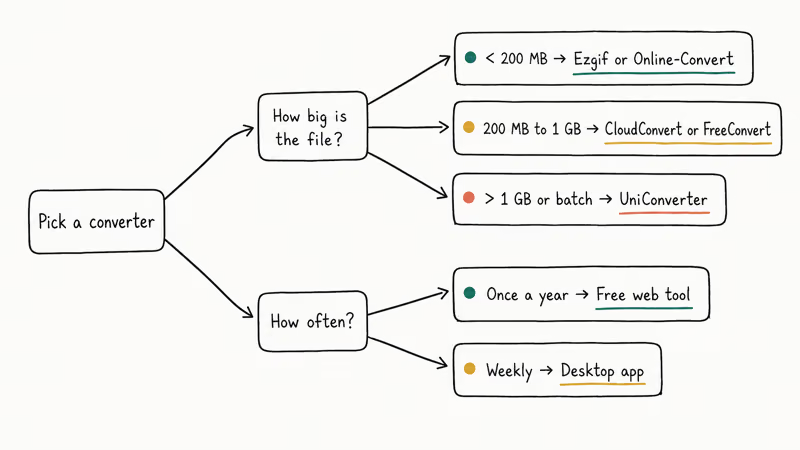
How big is the video? If most of your clips are under 200 MB, Ezgif or Online-Convert.com are free and fast. Files between 200 MB and 1 GB land in CloudConvert or FreeConvert territory. Anything bigger than 1 GB or batches of more than 5 files calls for a desktop tool like UniConverter.
Do you convert weekly or once a year? A one-off conversion does not justify a $40+ paid app. Frequent users (content creators backing up their own uploads, journalists archiving Creative Commons footage) recover the cost in saved time within a month.
Where does the source live? CloudConvert and FreeConvert have direct Google Drive and Dropbox integrations, which save the upload step. Ezgif and Online-Convert.com require you to make the link public or download the file first.
Do you need quality control or just a working file? UniConverter and Online-Convert.com expose codec, bitrate, and frame rate settings. CloudConvert offers similar controls in a simpler interface. FreeConvert’s “compress to size” mode is the easiest if you don’t want to think about bitrate at all.
For Windows and Mac power users who already have video editing tools, our guide on how to convert video to MP4 covers built-in options like HandBrake and FFmpeg that bypass cloud uploads entirely.
#Setting the Right Output Quality and File Size
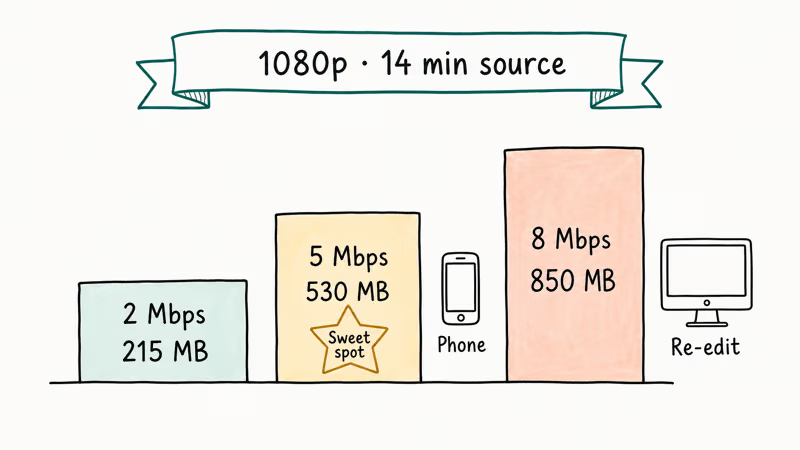
MP4 quality is mostly a function of resolution and bitrate, not the tool. For a 14-minute 1080p source clip, the bitrate you choose determines both file size and how much detail survives, and the math is predictable.
| Setting | Bitrate | File size | Visual quality |
|---|---|---|---|
| High | 8 Mbps | ~850 MB | Effectively lossless for 1080p on a large monitor |
| Medium | 5 Mbps | ~530 MB | Good for phones and tablets; slight softening on fast motion |
| Low | 2 Mbps | ~215 MB | Visible blockiness on motion; fine for talking-head video |
A sensible default is 5 Mbps for personal archiving, 8 Mbps for footage you plan to re-edit, and 2 Mbps for clips that just need to be watchable on a phone. CloudConvert and UniConverter both expose this control directly. If your source is already 4K and you want to size it down for portability, downscaling during conversion rather than after preserves more detail, and our video-to-MP4 guide linked below walks through the trade-offs.
Audio matters less but is worth checking. Stick with AAC at 128-192 kbps for stereo source. Match the original sample rate (44.1 or 48 kHz), since resampling adds nothing and can introduce artifacts.
#Common Conversion Errors and How to Fix Them
The same handful of errors come up repeatedly with link-to-MP4 conversions. Here is what they look like and what to do.
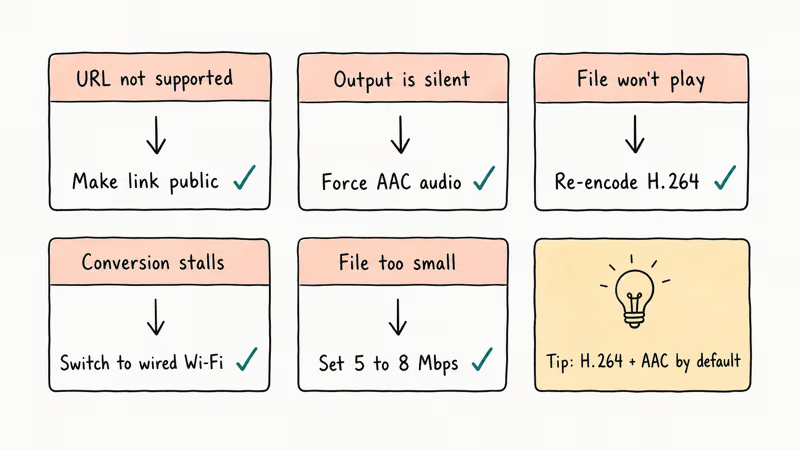
“URL not supported.” The converter recognizes the domain but can’t fetch the source. Usually the link requires a login (private Drive, password-protected Vimeo) or the video is DRM-protected. Make the link public, or pick a different source.
Output is silent. The audio codec was stripped during transcoding. Re-run the conversion and explicitly select AAC audio in the output settings rather than leaving it on “auto.”
File downloads but won’t play. The container is MP4 but the codec inside is HEVC (H.265), which older devices don’t decode. Re-convert with H.264 selected as the video codec for the broadest compatibility.
Conversion stalls partway. Browser tools sometimes lose the upload connection on flaky Wi-Fi. Refresh the page, paste the link again, and try a wired or 5 GHz connection.
Output is much smaller than the source. The tool defaulted to a low bitrate. Re-run with the bitrate explicitly set to 5-8 Mbps for 1080p or 15-20 Mbps for 4K.
#Converting a URL to MP3 Instead of MP4
Every converter above also offers MP3 output when you only want the audio: a lecture, a podcast clip, or a track you have rights to. Pick MP3 as the output format instead of MP4 and the rest of the workflow is identical.
Bitrate is the one setting worth changing. For spoken-word content, 128 kbps keeps files small with no audible loss. For music, 192 kbps is the practical floor and 320 kbps is the ceiling; anything above the source’s original bitrate just wastes space, since converters can’t add quality that was never there.
On iPhone, the missing piece is saving the file. Safari downloads land in the Files app, but a free app like Documents by Readdle handles the download and lets you play or share the MP3 without a desktop. The copyright rules don’t change for audio, so check our guide on whether YouTube to MP3 conversion is legal before ripping anything you didn’t upload.
#What Are the Legal Boundaries for Converting Online Video Links?
The short answer is: convert what you own, what is licensed for reuse, or what is in the public domain. Everything else lives in legally risky territory and most reputable converter tools refuse the URL.
Content you can convert without issue: your own uploads on YouTube, Vimeo, Twitter/X, Instagram, or TikTok; videos shared with you through cloud storage links by the rights holder; Creative Commons-licensed work, when you respect the license terms; public-domain footage, including most pre-1929 films and U.S. federal-government productions.
For your own posts, prefer each platform’s official download tool (YouTube Studio, Vimeo’s “Download” option, Instagram’s “Your Activity” archive) before reaching for a third-party converter. The native method always preserves the original quality.
Content that requires permission: anything posted by another creator, including most YouTube videos, podcasts, and educational content. According to Creative Commons’ licensing guide, even CC-BY material requires that you credit the original creator, and CC-NC material can’t be used commercially. The Internet Archive’s public domain movies collection is a good source for footage that is free to convert and reuse.
Content you should not convert: copyrighted streams from Netflix, Hulu, Disney+, Amazon Prime Video, or any subscription service; private content like Patreon or paid course videos; live streams of paid events. Bypassing DRM is illegal under the U.S. Digital Millennium Copyright Act and similar laws in the EU and UK, and most cloud converters refuse encrypted streams outright.
Fair use is narrow. Quoting a few seconds of a copyrighted video for criticism, commentary, or education may qualify, but the threshold is fact-specific and depends on your jurisdiction. When in doubt, ask the rights holder or use a licensed source.
#Bottom Line
If you are converting cloud links from your own Google Drive or Dropbox more than once a month, install Wondershare UniConverter. The batch queue and fast per-clip turnaround pay for themselves against the free browser tools.
If you only need to save a Creative Commons lecture or a public-domain clip every few weeks, CloudConvert’s free tier is the better fit. The 25 conversions per day cap is plenty, and the cloud-storage integration removes the upload step.
Skip the paid desktop tool unless your files reliably exceed 1 GB or your batch queues hit double digits.
#Frequently Asked Questions
Is it legal to use a link to MP4 converter?
It depends on the source. Converting your own uploads, Creative Commons-licensed content, and public-domain video is legal in almost every jurisdiction. Converting a copyrighted stream from a subscription service or another creator’s post without permission usually violates platform terms of service and may breach copyright law. Stick to material you own or that is explicitly licensed for reuse.
Can I convert live streams to MP4?
Most converters can’t capture a live stream in progress. You generally have to wait until the broadcast ends and the platform archives the recording, then convert that archive URL if you have permission to do so. Some screen-recording tools can capture a live playback, but that route still requires the same permission as any other download.
What is the difference between an online and a desktop MP4 converter?
Online converters run in your browser, require no install, and are fine for occasional clips under 1 GB. Desktop converters like Wondershare UniConverter run locally, handle batches, and finish jobs faster because they skip the upload-download round trip. Online tools are the right pick for one-off conversions; desktop tools win when you do this weekly or have files larger than 1 GB.
How do I get the best quality when converting a video link to MP4?
Match the source resolution, set the bitrate to 5-8 Mbps for 1080p, use H.264 video with AAC audio at 128-192 kbps, and keep the original frame rate. If your source is 4K and you don’t need that resolution on the playback device, downsizing to 1080p at 8 Mbps is usually visually indistinguishable on phones and tablets. Avoid raising the bitrate above the source, since you can’t add detail that was never there.
Are online link converters safe to use?
Reputable services like CloudConvert, FreeConvert, and Online-Convert.com publish privacy policies that confirm files are deleted within 24 hours and don’t log your account credentials. The bigger risk is malicious lookalike sites with similar domain names. Type the URL directly, check the SSL certificate, and avoid converters that ask you to install a browser extension before they work.
Why does my converted MP4 file look worse than the original?
Two common causes: the converter compressed at a lower bitrate than the source, or it transcoded an already-compressed video, which is a quality-loss step. Pick a higher output bitrate (8 Mbps for 1080p), and if the source is already MP4, look for a “remux” or “stream copy” option that preserves the original encoding without re-encoding.
Can I convert a private cloud storage link to MP4?
Only if you are the owner or the rights holder has granted access. Most browser tools require the link to be set to “Anyone with the link can view” before they can fetch the source. UniConverter and CloudConvert both connect through OAuth, so they read files using your own permissions rather than a public link, which is more private.
Google Messages Error 3100: Why RCS Is Broken on Galaxy
Google Messages RCS error 3100 hits Galaxy owners after phone or carrier switches. Google told 9to5Google a fix is coming. Here's what actually helps.
Is This Bank App Real? Spot a Fake App on Your Home Screen
A bank app can land on your home screen from a web page with no install warning. Learn the checks that tell a real banking app from a phishing web app.
Apps Crashing After iOS 27 Update? Fix Order (2026)
Apps crashing after the iOS 27 update? Update the app in the App Store first, then offload and reinstall to clear stale cache, then restart. The fix order.
Do AI Translation Earbuds Work Offline? What to Know
Do AI translation earbuds work offline? A few do with downloaded language packs, but most need the cloud. Here's what works offline and what you give up.