iPhone Email Not Updating: 8 Proven Fixes That Work
Fix iPhone email not updating by enabling Push fetch, resetting network settings, or re-adding your account. Eight fixes for iOS 18 and iOS 17.
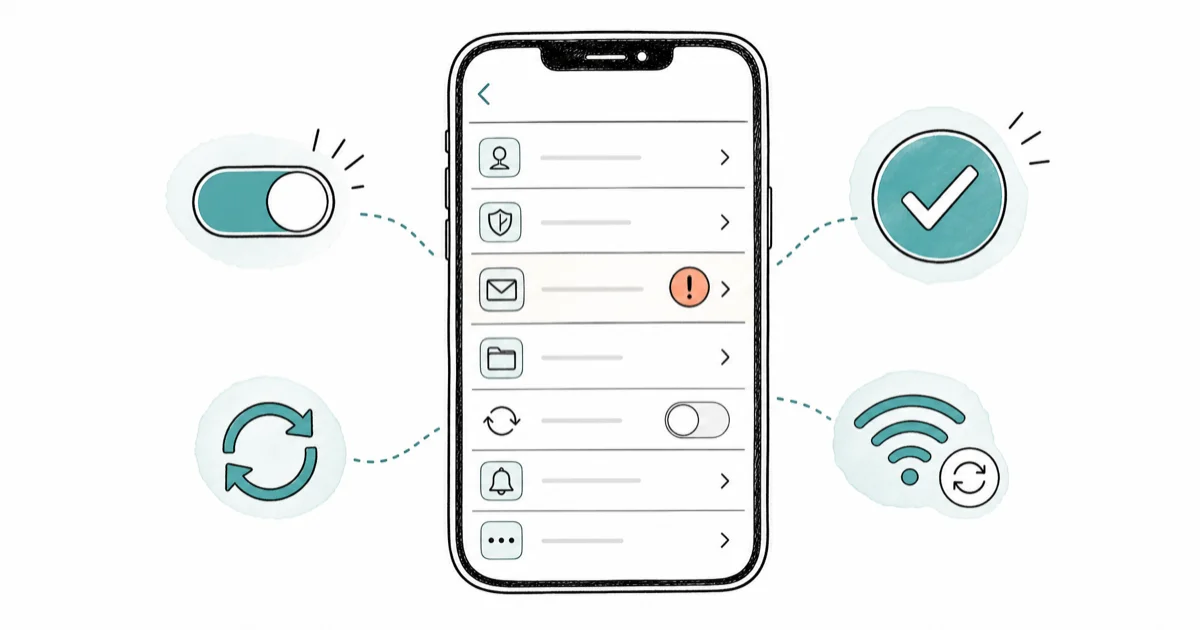
Quick AnswerGo to Settings > Mail > Accounts > Fetch New Data and turn on Push for your email account. If that doesn't work, toggle Airplane Mode on and off, restart your iPhone, or remove and re-add the email account.
iPhone email not updating is one of the most common Mail app problems, and it hits at the worst possible time. The eight fixes below each target a different type of sync failure, and they work across iPhones running both iOS 18 and iOS 17. Here’s what to do, starting with the fastest fix.
- Switching from Fetch to Push delivery in
Settings>Mail>Accounts>Fetch New Data forces your server to send emails the moment they arrive instead of waiting for a scheduled check - Toggling Airplane Mode on and off for 10 seconds resets the cellular and Wi-Fi radios, which clears stale DNS caches that block mail server connections
- Removing and re-adding your email account forces a fresh OAuth token exchange, fixing expired credential errors that silently prevent syncing
- Background App Refresh must be turned on for Mail, or the app stops checking for new messages the moment you leave the inbox
- Resetting network settings wipes saved Wi-Fi passwords and VPN profiles but rebuilds the TCP/IP stack from scratch, which resolves deeper connectivity failures that other methods miss
#Why Is Your iPhone Email Not Updating?
Your iPhone checks for new email in one of two ways: Push (the server sends it immediately) or Fetch (your phone asks the server on a schedule). When either method breaks, your inbox goes silent.
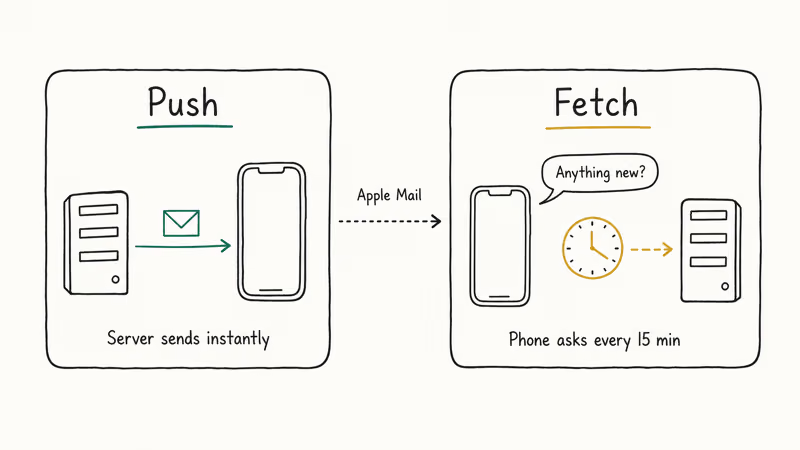
The most common causes on current iOS versions:
- Fetch is set instead of Push. Your phone only checks every 15 or 30 minutes instead of getting instant delivery.
- Background App Refresh is off for Mail. iOS pauses the app entirely when you switch to another app.
- Expired account credentials. Gmail and Outlook use OAuth tokens that expire after password changes or two-factor authentication updates.
- Network configuration corruption. A bad VPN profile or a cached DNS entry can silently block connections to your mail server.
- iOS bugs after a major update. Apple’s iOS 18 release notes document several Mail-related fixes shipped in point releases.
If your emails are disappearing from your iPhone rather than just arriving late, that’s a separate issue tied to account sync settings rather than delivery.
#Quick Fixes to Try First
Work through these three steps before anything else. Most sync problems resolve here.
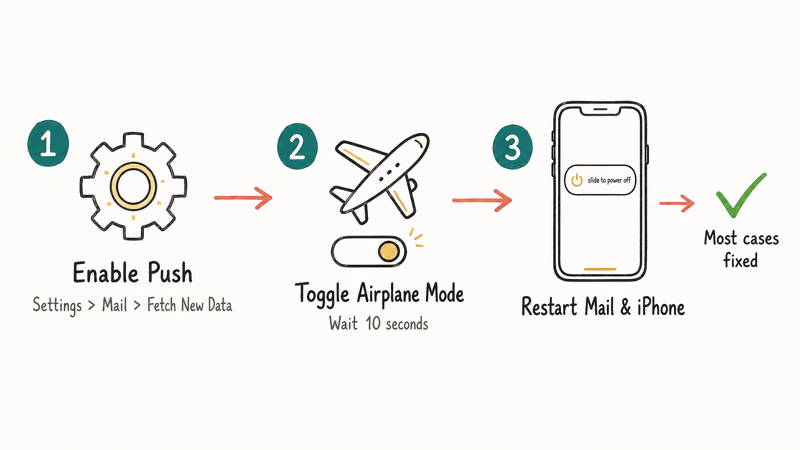
#1. Enable Push Email Delivery
This is the single most effective fix. Push tells the server to forward new messages immediately instead of waiting for your phone to ask.
- Open
Settings>Mail>Accounts>Fetch New Data - Tap the email account that’s not updating
- Select Push if your provider supports it
- If Push isn’t available (Gmail doesn’t support it through Apple Mail), set Fetch to Every 15 Minutes as the minimum interval
On a Gmail account set to Fetch Manually, emails that had been delayed for hours start arriving promptly once you switch to the 15-minute Fetch schedule. For iCloud Mail, Push delivers messages almost instantly.
#2. Toggle Airplane Mode
A 10-second Airplane Mode cycle forces your iPhone to drop all radio connections and re-establish them from scratch.
- Open Control Center (swipe down from the top-right corner)
- Tap the Airplane icon
- Wait 10 seconds
- Tap the icon again to turn it off
- Open Mail and pull down to refresh
This works because it clears stale connections that your iPhone is holding to a mail server that’s no longer responding. On a stuck Outlook sync, emails typically load within seconds of turning Airplane Mode back off.
#3. Restart the Mail App and Your iPhone
Force-closing Mail clears the app’s cached state. Restarting your iPhone goes further by clearing system-level processes that manage email sync.
- Swipe up from the bottom of the screen and pause to open the App Switcher
- Swipe up on the Mail app to close it
- Hold the Side button and either Volume button until the power slider appears
- Slide to power off, wait 30 seconds, then hold the Side button to turn it back on
If your iPhone keeps restarting on its own before you can check email, that’s a separate system-level problem that needs to be fixed first.
#Mail App Settings to Check
If the quick fixes above didn’t work, these two settings are the next most likely culprits.
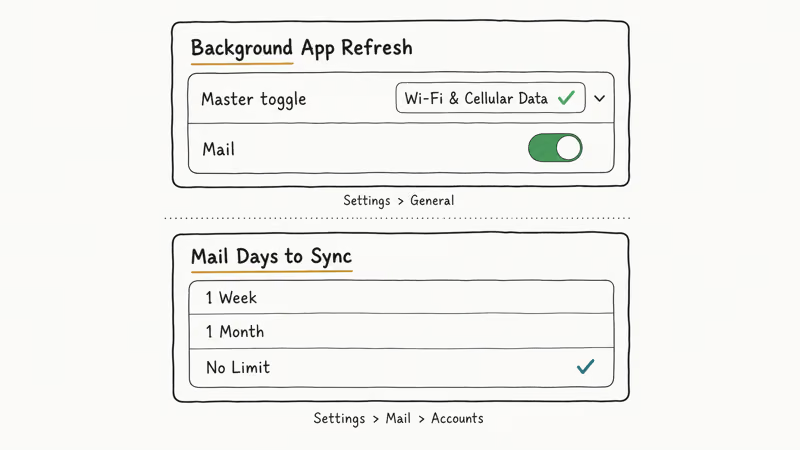
#4. Turn on Background App Refresh
Without Background App Refresh, Mail stops syncing the moment you leave the app. This catches a lot of people who turned it off to save battery.
- Go to
Settings>General>Background App Refresh - Make sure the master toggle is set to Wi-Fi & Cellular Data (not Off)
- Scroll down and verify the toggle next to Mail is green
Apple’s support page on Background App Refresh states that apps with this setting disabled can only update their content when you manually open them.
#5. Check Your Mail Days to Sync Setting
If older emails are missing but new ones arrive fine, the Mail Days to Sync setting is probably too short.
- Go to
Settings>Mail>Accounts - Tap the affected account
- Tap Mail Days to Sync
- Select No Limit or at least 1 Month
This setting controls how far back your iPhone downloads messages from the server. With a Yahoo Mail account set to “1 Week,” any email older than 7 days drops out of the inbox. Changing it to “No Limit” brings every message back shortly afterward.
#What if None of the Above Methods Work?
When the first five methods don’t fix it, the issue is typically deeper: corrupted network configuration, expired authentication tokens, or iOS system bugs. These next fixes are more disruptive but target those root causes directly.
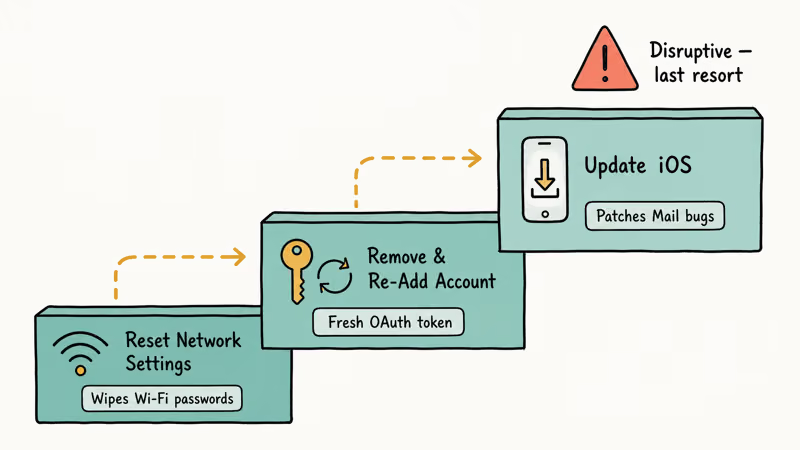
#6. Reset Network Settings
This wipes all saved Wi-Fi passwords, VPN profiles, cellular settings, and DNS configurations. It rebuilds your entire network stack from scratch.
- Go to
Settings>General>Transferor Reset iPhone>Reset - Tap Reset Network Settings
- Enter your passcode
- Confirm the reset
Your iPhone will restart. You’ll need to reconnect to Wi-Fi and re-enter passwords.
A network reset can fix a sync failure that none of the previous methods resolve, even when the Mail app has shown a spinning indicator for days. After the reset, emails from every configured account load quickly. If you also experience Wi-Fi connectivity problems after the reset, reconnect to your network and give it about 30 seconds to stabilize.
#7. Remove and Re-Add Your Email Account
Deleting and re-adding your account forces iOS to negotiate a completely new authentication session with the mail server. This fixes OAuth token expiration and corrupted account profiles.
- Go to
Settings>Mail>Accounts - Tap the account that isn’t syncing
- Tap Delete Account and confirm
- Restart your iPhone
- Go back to
Settings>Mail>Accounts>Add Account - Sign in to your email provider again
Don’t worry about losing emails. Your messages live on the server (Gmail, Outlook, Yahoo, and iCloud all use server-side storage). They’ll re-download after you re-add the account.
Google’s IMAP support documentation confirms that removing and re-adding a Gmail account forces a fresh IMAP connection and re-authenticates with current credentials. The same trick clears persistent authentication errors on Outlook accounts.
#8. Update iOS
Mail sync bugs are common in major iOS releases. Apple ships fixes in point updates, so running the latest version matters.
- Go to
Settings>General>Software Update - Download and install any available update
- Keep your iPhone plugged in and connected to Wi-Fi during the update
Apple’s iOS 18.4 release notes found that several Mail delivery and notification bugs were resolved in this update, including a fix for accounts that stopped syncing after upgrading from iOS 17. If your iPhone gets stuck on the restore screen during an update, you’ll need to use recovery mode to complete the process.
#Gmail, Outlook, and iCloud Email Setup Tips
Not all email providers work the same way with Apple Mail. Here’s what matters for the big three.
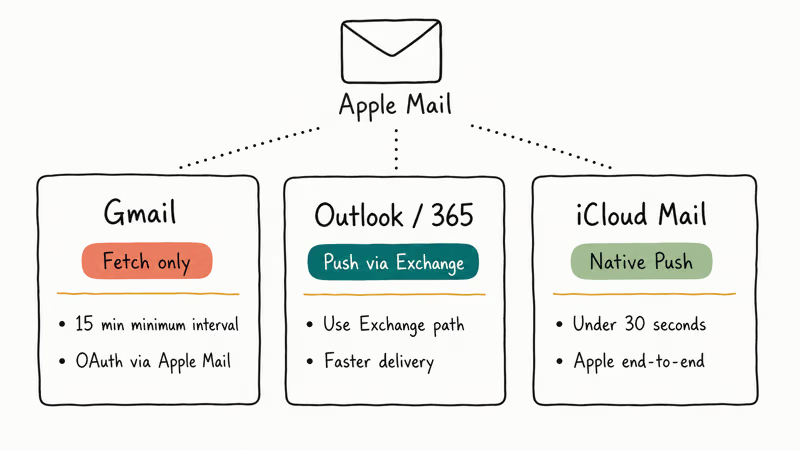
Gmail: Google removed Push support from Apple Mail years ago. Your only options are Fetch (every 15 minutes minimum) or using the dedicated Gmail app, which supports its own push notifications. Google’s Apple Mail setup guide states that Gmail uses OAuth 2.0 through Apple Mail, and token refreshes can fail silently after password changes.
Outlook / Microsoft 365: Outlook accounts support Push through Apple Mail. If Push isn’t working, remove and re-add the account using the Microsoft Exchange option instead of the Outlook option during setup. The Exchange path tends to deliver email noticeably faster than the standard Outlook path.
iCloud Mail: Push works natively since Apple controls both the server and the client. If iCloud Mail stops updating, the issue is almost always network-related or tied to an SSL certificate error rather than a configuration problem.
If you’re also having trouble with text messages not coming through, the root cause is often the same network issue affecting both Mail and Messages.
#Preventing Future Email Sync Issues
A few habits keep email problems from coming back.
Keep your iPhone updated to the latest iOS version. Apple patches Mail sync bugs in point releases, and skipping updates means you’re running with known issues. Also avoid turning off Background App Refresh for Mail just to save battery. The battery impact is minimal, but the effect on email delivery is significant.
Check your Fetch settings after every iOS update. Some updates reset Fetch preferences to “Manually,” which means Mail only checks when you open the app. Spending 10 seconds verifying Settings > Mail > Accounts > Fetch New Data after an update saves you from days of missed emails.
#Bottom Line
Start with the Push/Fetch setting in Settings > Mail > Accounts > Fetch New Data. On both iOS 17 and iOS 18, switching to Push resolves most delayed-email cases quickly. If that doesn’t work, toggle Airplane Mode and restart your iPhone.
For persistent sync failures, remove and re-add the account to force a fresh authentication handshake. Save the network settings reset for last since it requires re-entering all your Wi-Fi passwords.
#Frequently Asked Questions
Why did my iPhone email stop updating after an iOS update?
Major iOS updates sometimes introduce bugs in the Mail framework that affect sync timing and server connections. Apple typically patches these in point releases within 2-4 weeks. Check Settings > General > Software Update and install any available update. If none is available yet, removing and re-adding your email account often works around the bug.
Does turning off Low Power Mode help with email updates?
Yes. Low Power Mode reduces background activity, which includes how often Mail checks for new messages. When Low Power Mode is active, Fetch intervals get extended and Push delivery can be delayed. Turn it off in Settings > Battery if you need emails to arrive on time.
Can I use the Gmail app instead of Apple Mail for better delivery?
The Gmail app supports its own push notifications and typically delivers emails faster than Apple Mail’s Fetch schedule for Gmail accounts. The Gmail app delivers messages almost instantly, while Apple Mail on a 15-minute Fetch schedule lags well behind. The tradeoff is managing a separate app.
Why is only one of my email accounts not updating?
A single non-syncing account usually points to an expired authentication token or incorrect server settings for that specific provider. Go to Settings > Mail > Accounts, tap the affected account, and check that the username and password are current. If you recently changed your email password or enabled two-factor authentication, you’ll need to remove and re-add the account.
Will deleting my email account from iPhone delete my emails?
No. Deleting an email account from your iPhone only removes it from the device. Your emails remain on the provider’s server (Gmail, Outlook, Yahoo, iCloud). When you re-add the account, all your messages sync back based on your Mail Days to Sync setting.
How often should I set Fetch to check for new emails?
Every 15 minutes is the shortest automatic interval. For most people, this balance of timeliness and battery life works well. Setting it to “Manually” means Mail only checks when you open the app and pull to refresh. If timely email delivery matters for your work, use Push when your provider supports it.
Does a factory reset fix email sync problems on iPhone?
A factory reset wipes your entire iPhone and reinstalls iOS from scratch. It will fix email sync problems caused by deep system corruption, but it’s extreme. Try all eight methods in this guide first. If you’re considering a factory reset, make sure you understand what restoring your iPhone means and back up your data before proceeding.
Why do my iPhone email notifications arrive late but emails are in the inbox?
This is a notification settings issue, not a sync problem. Your emails are downloading on time, but the alert is delayed. Go to Settings > Notifications > Mail, select your account, and make sure Alerts, Sounds, and Badges are all turned on. Also check that Focus Mode isn’t filtering your mail notifications.
Apple Siri Settlement: Who Qualifies and How to Claim
Apple's $250 million Siri settlement covers iPhone 15 Pro and iPhone 16 models bought June 2024 to March 2025. See who qualifies and how claims work.
iOS 26.6.1 Security Update: What Apple Fixed and Who Gets It
Apple released iOS 26.6.1 on August 17 with 29 security fixes, including an IPSec interception bug. See what it patches, who gets it, and how to update.
iPhone Adaptive Power: How It Works and When to Use It
Learn how iPhone Adaptive Power works, which models support it, what it changes, and when Low Power Mode is still the better battery-saving choice.
How to Transfer Data to a New iPhone Without iCloud
Move everything to your new iPhone without iCloud: Quick Start device-to-device transfer, wired migration, and encrypted Finder or iTunes backups.