iOS 27 AI Extensions: Use Gemini and ChatGPT With Siri
iOS 27 introduces an Extensions framework that lets you choose Gemini, Claude, or ChatGPT as your preferred AI provider inside Siri and Writing Tools.
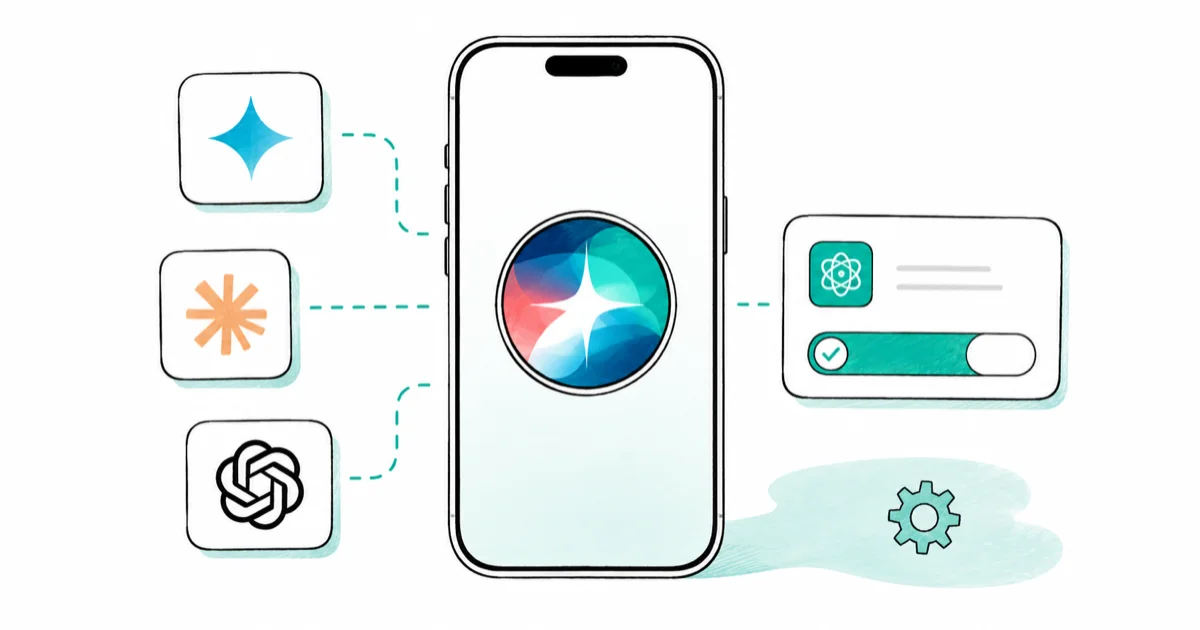
Quick AnsweriOS 27 introduces an Extensions framework that lets you choose Google Gemini, Anthropic Claude, or ChatGPT as your preferred AI provider inside Siri and Writing Tools. The setting lives in Settings under Apple Intelligence and Siri. Apple confirmed the details at its WWDC 2026 keynote.
iOS 27 ends OpenAI’s exclusive arrangement with Siri. Where iOS 18 through iOS 26 gave ChatGPT the only third-party slot, the iOS 27 Extensions framework is expected to open that seat to Google Gemini, Anthropic’s Claude, and potentially others. You’ll pick your preferred model in Settings and it will follow you across Siri queries and Writing Tools.
Updated July 7, 2026: iOS 27 has reached developer beta 3 (July 6, 2026), which switched on a Siri voice menu with Pace and Expressivity controls on compatible devices. This article reflects what Apple has shown through that build.
Updated August 25, 2026: According to Apple’s August 24 release entry, iOS 27.0 developer beta 7 is build 24A5424a, the newest developer build.
- iOS 27’s Extensions framework lets users choose a preferred third-party AI provider for Siri and Writing Tools from a list that includes Gemini and Claude.
- The setting is expected to live in Settings under Apple Intelligence and Siri, in a new Extensions section.
- Apple’s own on-device AI continues to handle notification summaries, basic Writing Tools, and Visual Intelligence, third-party models are an opt-in layer on top.
- ChatGPT remains available and isn’t removed; it becomes one option among several rather than the only third-party choice.
- The Extensions framework also applies to Writing Tools, so you can use Gemini for rewriting emails and notes instead of Apple’s built-in model.
#Apple’s Reason for Opening Siri to Multiple AI Providers
Apple’s original ChatGPT deal in iOS 18 was a bridge, not a strategy. Siri couldn’t handle open-ended questions well, and ChatGPT could, so Apple built a handoff. Users had to explicitly consent each time the query left Apple’s ecosystem, with a dialog asking if they wanted to send the request to OpenAI. That consent step kept the boundary visible: you knew when Siri was deferring to an outside model.
That arrangement solved one problem while creating another: you had no choice. If you preferred Gemini’s responses, or trusted Anthropic’s privacy approach, or simply wanted a different model’s output style, you were stuck with ChatGPT or nothing.
Bloomberg’s Mark Gurman reported in March 2026 that Apple plans to expand that integration substantially, naming at least three providers expected at launch: Google Gemini, Anthropic’s Claude, and the existing ChatGPT arrangement. The goal, according to the report, is a framework that treats third-party AI models as selectable providers rather than a single emergency fallback.
#How Does the Extensions Framework Work?
According to Bloomberg’s reporting, the Extensions setting is expected to appear in Settings under Apple Intelligence and Siri. The section will list available providers, initially ChatGPT, Google Gemini, and Claude, with a radio-button style selection for your preferred provider.
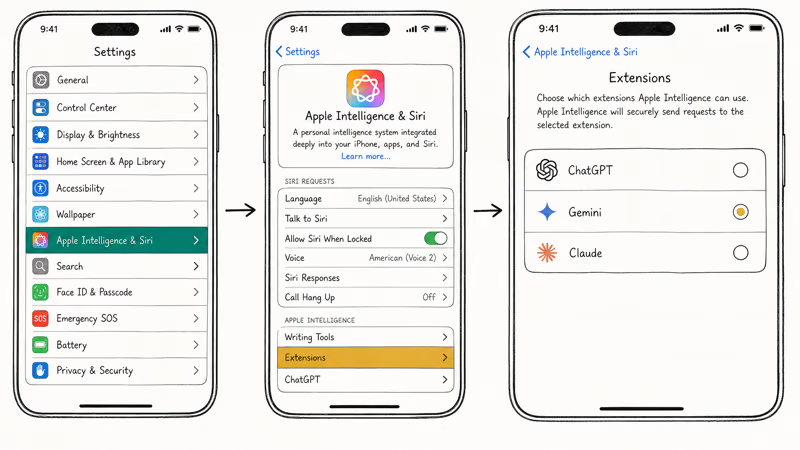
When you ask Siri a question that exceeds Apple’s on-device model’s capability, instead of always routing to ChatGPT, Siri routes to whichever provider you’ve selected. The handoff dialog from iOS 26, the consent prompt asking if you want to send your query to OpenAI, is expected to carry over with your chosen provider’s name instead.
The current ChatGPT integration in iOS 26 is built for text-based handoffs, but the switch can be visible because the response style changes. Whether iOS 27 unifies the visual experience across providers is something Apple will clarify at WWDC.
#AI Providers Expected in iOS 27 Extensions
Bloomberg’s March 2026 report confirms that at least 3 providers are expected at launch: Google Gemini and Anthropic’s Claude alongside the existing ChatGPT integration. Apple may announce additional providers at WWDC.
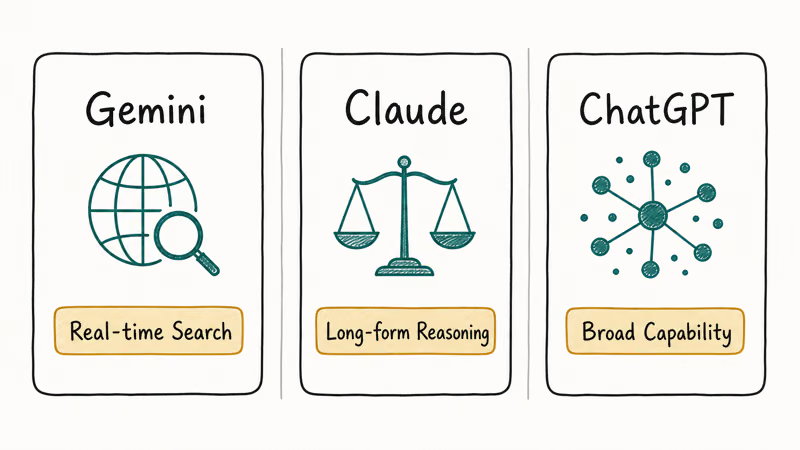
Here’s what each model brings:
Google Gemini: deep integration with Google Search, strong multimodal capabilities, and access to real-time web information. Gemini is already the default AI on Android through Google Assistant, and its integration with Google Workspace makes it particularly relevant for users who work in Gmail and Google Docs throughout the day.
Anthropic Claude: well-regarded for longer-form reasoning, careful answers to complex questions, and a stated focus on safety in model behavior. Claude is integrated into a wide range of productivity tools, and its writing tends to stay conversational, which suits messages and personal notes more than terse factual lookups. If your daily iPhone writing leans toward email and longer notes, that style difference is the practical reason to pick it.
ChatGPT (OpenAI): the existing integration, well-known for broad capability across categories. The current integration supports both the free tier and ChatGPT Plus for users with a subscription.
Apple’s default Writing Tools model is designed for safe, neutral rewrites. The ability to switch to a model with a more distinctive style is a meaningful choice for users who draft a lot of text on iPhone.
#Extensions in Writing Tools
Writing Tools launched in iOS 18 as a system-level AI layer: select any text in any app, tap the pencil icon, and you can rewrite, summarize, or adjust tone. The model behind it has always been Apple’s own.
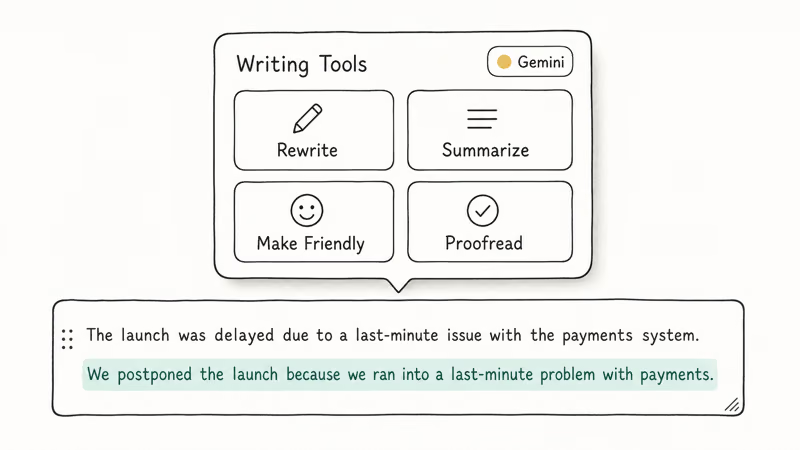
In iOS 27, you’ll reportedly be able to switch Writing Tools to use your preferred provider. Select Gemini and the rewrites use Gemini’s model; select Claude and they use Claude’s. The interface is unchanged, the button placement and editing flow are the same, but the model generating the output is different. For users who write frequently on iPhone, this means a preference you’ve set once follows you across every app that supports Writing Tools.
The models produce notably different output styles. Gemini tends toward direct, information-dense rewrites that cut filler and prioritize clarity, which is useful for professional correspondence. Claude produces more conversational prose that reads naturally in messages and personal notes; Apple’s own model is grammatically reliable and neutral in tone, unlikely to surprise you in either direction. For routine rewrites the differences are minor; for longer documents or writing with a specific voice, the choice of model starts to matter.
Having the choice in Writing Tools is the kind of practical improvement that shows up every time you write on your phone. Your writing context, whether you’re drafting a client email or a personal note, benefits from a model that fits that register.
#Apple’s On-Device AI Remains the Foundation
The Extensions framework is additive, not a replacement.
Apple Intelligence’s core capabilities, notification summaries, priority inbox sorting, Clean Up in Photos, basic Proofreading, Visual Intelligence, continue to run on-device using Apple’s own models. These features work without a connection and without sending data to any third party.
The Extensions layer activates when you ask Siri something that needs more than the on-device model can handle, or when you explicitly configure Writing Tools to use a specific provider. Apple’s official Apple Intelligence page describes the on-device and Private Cloud Compute approach that will continue in iOS 27 regardless of which Extensions provider you choose.
For how Apple Intelligence stacks up against competing platforms, see our Apple Intelligence vs Windows Copilot guide.
#Extensions vs the Current ChatGPT Integration
Three meaningful differences are expected:
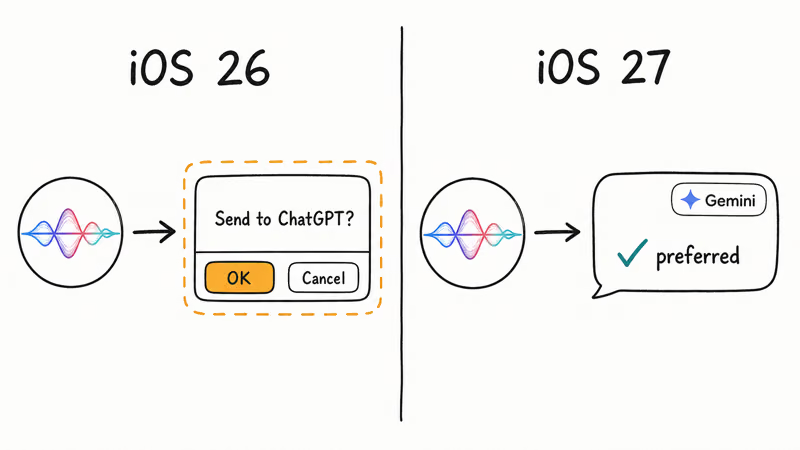
Choice: iOS 26 gives you one third-party option. iOS 27 gives you several. This sounds minor until you’ve wanted Gemini’s search integration or Claude’s writing style and had no way to get it inside Siri.
Scope: the current ChatGPT integration applies only to Siri queries. iOS 27’s Extensions are expected to also apply to Writing Tools, making your provider choice follow you across the system.
Default vs. emergency: current ChatGPT is positioned as a fallback Apple asks permission to use each time. The Extensions model suggests a set-and-forget preference rather than a per-query consent prompt. MacRumors reported in June 2026 that the Extensions preference persists across reboots and app updates, matching how default browser or email settings work today.
#Which iPhones Support Extensions in iOS 27?
Apple hasn’t confirmed hardware requirements for the Extensions framework. Since Extensions rely on a network connection rather than on-device computation, they may be available on a broader range of iOS 27-compatible devices than the on-device Apple Intelligence features. For beta timing and device rollout, see our iOS 27 beta release date guide.
For the full iOS 27 device compatibility picture, see our iOS 27 compatible iPhones guide. For the broader set of iOS 27 AI changes, see our iOS 27 AI features guide.
#Bottom Line
The Extensions framework turns Siri’s third-party AI integration from a single-partner arrangement into an open-choice system. The practical result is that your preferred AI model, whichever one you find most useful, can follow you through Siri queries and Writing Tools without needing to leave the Apple ecosystem to access it.
WWDC on June 8 will confirm which providers launch first and exactly how the Settings interface works. This article will be updated the same day Apple announces. For how the broader Siri redesign connects to this, see our iOS 27 Siri redesign guide.
iOS 27 Beta
#Frequently Asked Questions
Can I set Gemini as my default AI in iOS 27?
Reports indicate yes. The Extensions framework in iOS 27 lets you pick Gemini as your preferred provider for Siri and Writing Tools. Once set, the preference persists across reboots and applies system-wide, with no per-app configuration needed; Siri handles native device tasks on its own, and Gemini activates only when Siri routes a query to the Extensions layer. Apple will confirm the full provider list and Settings path at WWDC on June 8.
Do I need a paid Gemini or Claude subscription for iOS 27?
Based on how the current ChatGPT integration works, free-tier accounts are expected to work. Paid subscriptions to Gemini Advanced or Claude Pro may give access to more capable model tiers, but the free tier should cover standard queries.
Will ChatGPT still be available in iOS 27?
Yes. ChatGPT remains one of the available providers in the Extensions framework. It isn’t removed, it becomes one choice among several rather than the only third-party option.
Does using Extensions send my queries to Apple?
No. When you use a third-party provider through Extensions, queries go to that provider’s servers under that provider’s privacy policy, not to Apple’s. Apple’s role is to route the query; it doesn’t store or process the content. For queries handled by Apple’s own on-device model, no data leaves your device.
Can I use different providers for Siri and Writing Tools separately?
Bloomberg’s reporting described a single Extensions preference that applies to both. Whether iOS 27 allows separate provider settings for each feature hasn’t been confirmed. Apple will clarify at WWDC.
What happens if I don’t choose an Extensions provider?
If you don’t configure an Extensions provider, the behavior is expected to default to the existing ChatGPT integration for Siri handoffs, maintaining backward compatibility with iOS 26.
How do I enable Extensions in iOS 27?
Based on reporting, the setting will be in Settings under Apple Intelligence and Siri, in a new Extensions section. You select your preferred provider from a list, similar to how you choose a default browser or mail app today.
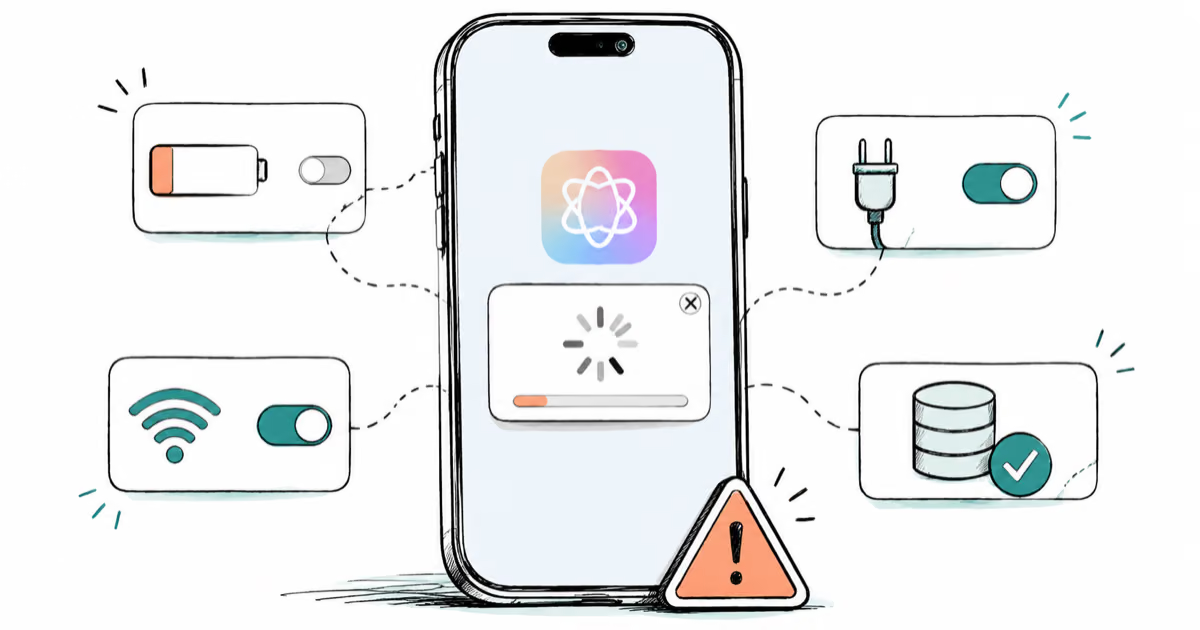
Apple Intelligence Not Working on iPhone? Fixes (2026)
Apple Intelligence not working on iPhone after iOS 27? Turn off Low Power Mode, stay on Wi-Fi while charging, and free up 7 GB. Step-by-step fixes.
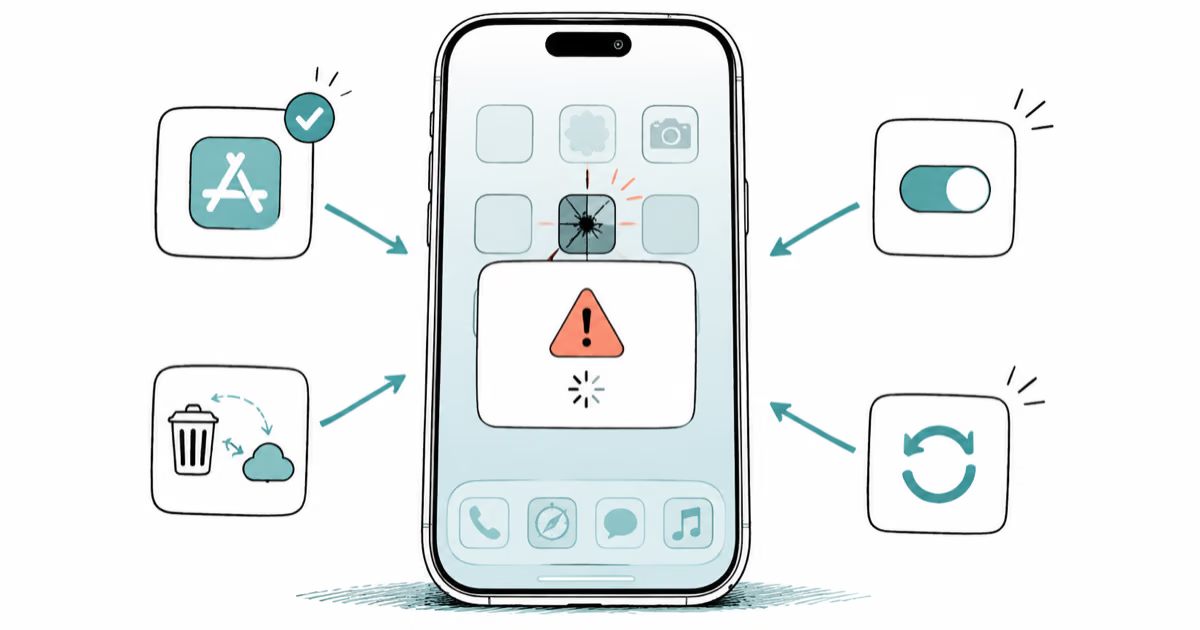
Apps Crashing After iOS 27 Update? Fix Order (2026)
Apps crashing after the iOS 27 update? Update the app in the App Store first, then offload and reinstall to clear stale cache, then restart. The fix order.

Genmoji or Image Playground Not Working? iOS 27 Fix
Genmoji or Image Playground not working on iOS 27? Turn on Apple Intelligence, free up 7 GB, drop Low Power Mode, and let the image model finish.
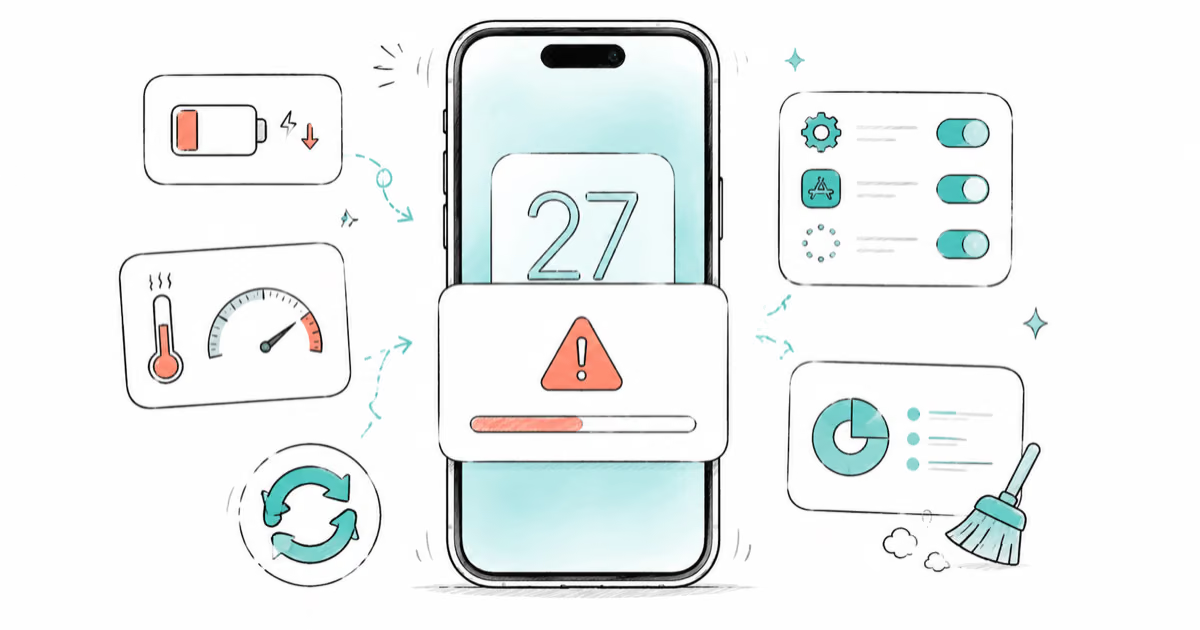
iOS 27 Problems and How to Fix Each of Them (2026)
iOS 27 problems? Battery drain, overheating, Wi-Fi drops, crashing apps, and Apple Intelligence stuck. Each problem with its top fix and full guide here.