Hulu on Kodi: Why It Does Not Work and Better Paths
There is no official Hulu add-on for Kodi in 2026. Use Hulu native apps on Roku, Fire TV, Apple TV, or cast from your phone, and avoid risky add-ons.
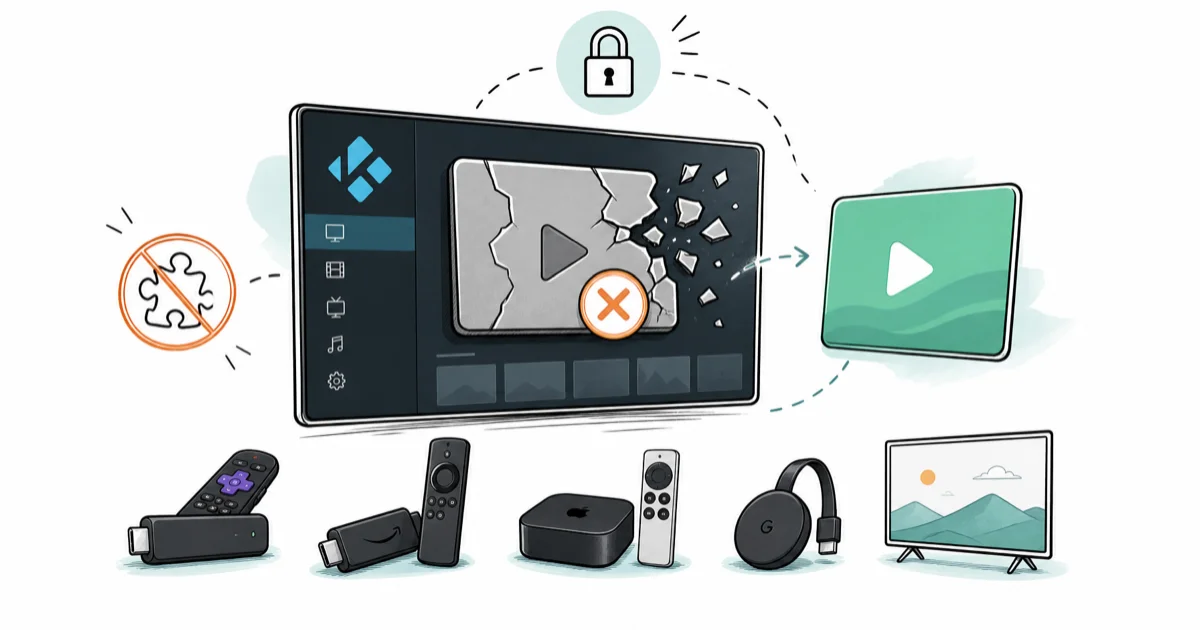
Quick AnswerThere is no official Hulu add-on for Kodi, and unofficial Hulu Kodi add-ons violate the Hulu Subscriber Agreement and frequently scrape credentials. On your own paid Hulu account and devices you own, use a native Hulu app on Roku, Fire TV, Apple TV, Chromecast, or a smart TV instead.
If you’re searching for Hulu on Kodi, the honest 2026 answer is short: there is no official Hulu add-on, the unofficial repos that promise one are risky, and the legitimate path is a native Hulu app on the streaming hardware you already own. This article explains why Hulu and Kodi don’t connect cleanly, the privacy and account risks of unofficial Hulu add-ons, and the paths that actually work for your own paid Hulu subscription on devices you own.
We’re not going to walk through installing a third-party Hulu add-on, because doing so commonly violates Hulu’s terms and exposes your credentials. Scope here is your own subscription, your own hardware, legal viewing.
- Hulu has no official Kodi add-on, and the Kodi Foundation does not maintain or endorse one, so every Hulu Kodi add-on you’ll find is third-party software.
- The Hulu Subscriber Agreement prohibits accessing the service through unauthorized clients, so an unofficial Kodi add-on can trigger account suspension if Hulu detects the access pattern.
- Native Hulu apps run on more than 20 platforms including Roku, Fire TV, Apple TV, Chromecast with Google TV, Android TV, Xbox, PlayStation, and most 2017-and-newer smart TVs.
- If you only need Hulu on a TV occasionally, Chromecast or AirPlay from the Hulu mobile app handles it without any new hardware purchase.
- Most “Hulu Kodi” add-ons from defunct repos like TVAddons Fusion ask for your login in plain text, and credential reuse against unfamiliar endpoints is the dominant credential-theft pattern.
#Why There Is No Official Hulu Add-On for Kodi
Hulu’s content carries digital rights management at the studio’s contractual insistence, and Kodi’s open architecture isn’t built around the specific DRM clients Hulu uses on supported platforms.
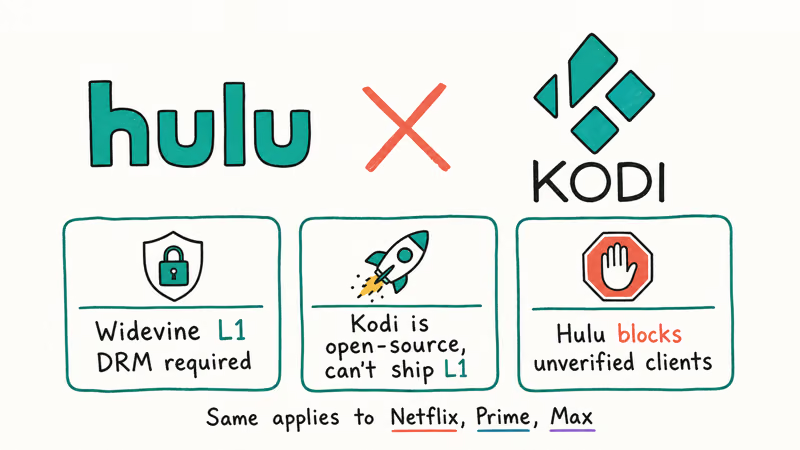
The mismatch is structural. Hulu’s iOS, tvOS, Android, Roku, and smart-TV apps all ship a vendor-blessed DRM stack: Widevine on Android, FairPlay on Apple platforms, PlayReady on Xbox, and the platform-native DRM on Roku and most smart TVs. Each one is licensed at a level Hulu and the studio rights holders accept.
Kodi runs on Windows, macOS, Linux, Android, Raspberry Pi, jailbroken Apple TV, and more. There is no single DRM client Hulu has agreed to certify across that surface. According to the Kodi Foundation’s official statement on piracy, the project does not maintain or distribute any add-on that bypasses copyright protection. The team explicitly disclaims the “Kodi boxes” and pirate add-on ecosystem.
This leaves Hulu-on-Kodi solely in the hands of unofficial repositories run by anonymous third parties with no relationship to either company.
Across the major Hulu-related Kodi add-on listings circulating in 2026, the pattern is consistent: they either fail to authenticate, ask for credentials in clear text, or redirect to a paid “Kodi build” reseller. None offers a stable, working Hulu stream end-to-end.
The pattern matches what XDA’s overview of Kodi third-party add-on risks reports: the ecosystem trends toward abandonment and credential abuse rather than working streams. If your existing Kodi install is throwing the generic “Playback failed” error from one of these add-ons, our Kodi playback failed fixes guide covers recovery.
#Native Hulu Apps on Devices You Already Own
For your own paid Hulu account, the supported path is always a native Hulu app on certified hardware. Hulu’s supported devices help page confirms that the official client list covers 10+ device categories spanning nearly every TV setup people already own.
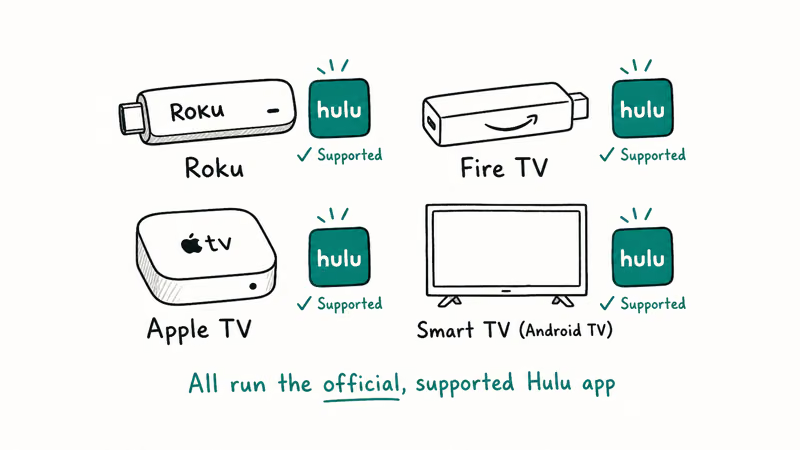
Here is the practical map by device class.
| Device | How to install | Notes |
|---|---|---|
| Roku (2017+) | Roku Channel Store, search “Hulu” | Works on Roku Streaming Stick, Express, Ultra, Roku TV |
| Amazon Fire TV / Stick | Appstore, search “Hulu” | Voice install via Alexa: “Alexa, launch Hulu” |
| Apple TV HD / 4K | App Store on tvOS | Sign in with Hulu credentials or via web activation code |
| Chromecast with Google TV | Pre-installed; otherwise Google Play Store | Same app as Android TV |
| Android TV / Google TV | Google Play Store | Includes Sony, TCL, Hisense Google TVs |
| Smart TV (Samsung 2016+, LG webOS 2017+, Vizio SmartCast) | Built-in app store | App availability depends on TV model year |
| Xbox One / Series X|S | Microsoft Store | Supports 4K HDR on Series X |
| PlayStation 4 / 5 | PlayStation Store | Free, no PS Plus required |
| iPhone, iPad, Android phone | App Store / Google Play | Use for direct viewing or to cast |
| Computer | hulu.com in Chrome, Edge, Safari, Firefox | Up to 1080p depending on browser |
On certified hardware like a Roku Streaming Stick 4K, Fire TV Stick 4K Max, or a recent Samsung smart TV, the Hulu app installs from the built-in store and signs in within a couple of minutes. None of them require Kodi, sideloading, or a third-party repo.
#Casting Hulu to Your TV From Phone or Laptop
If your TV is too old to run the Hulu app and you don’t want to buy a streamer, casting works as a legitimate workaround.
Chromecast plugs into an HDMI port and accepts the Cast button inside the Hulu mobile and web apps. Open Hulu on your phone, tap the Cast icon in the top corner, pick the Chromecast, and the show plays on your TV while your phone becomes the remote. The stream pulls directly from Hulu’s CDN, so phone battery isn’t a bottleneck.
AirPlay does the same job for Apple users with an Apple TV or AirPlay 2-compatible TV. The Hulu iOS app exposes an AirPlay button in the player, and the show routes through your Apple TV with full audio handoff. With a current Apple TV 4K, AirPlay keeps audio and video in sync, even across long playback.
For older setups, an HDMI cable from a laptop running hulu.com in Chrome works as a basic fallback. It’s not elegant, but it doesn’t ask you to install a third-party add-on or hand over your Hulu password to an anonymous repo. If you’d rather use your TV’s existing apps instead of buying new hardware, our guide to Hulu on Xbox One covers another route to the official client.
#What Kodi Does Well Next to Hulu
Kodi has a real, legitimate role in a streaming household. Use it for what it’s built for.
Local media is the strongest fit. Kodi indexes ripped DVDs, home videos, FLAC music, and downloaded podcasts into a single library with cover art, metadata, and resume points. Plex handles the same job over the network, but Kodi runs entirely offline once your library is scanned. For travelers who want a long flight’s worth of video on a laptop, that’s exactly the right shape of tool.
IPTV via official channel add-ons is the second fit, when your cable provider or live-TV service publishes one. These add-ons live in Kodi’s official repository, not Fusion or SlyGuy mirrors. They connect to publisher endpoints with real authentication.
A third fit is paired use with hardware that already runs Hulu. Kodi alongside Plex on Roku gives you a fast local-library reader, and our Plex on Roku setup guide covers that pairing in detail. The Hulu native app keeps the streaming experience clean while Kodi handles everything that isn’t on a streamer.
#Is There a Safe Way to Watch Hulu Through Kodi?
For the typical Hulu subscriber, the practical answer in 2026 is no.
A handful of advanced Kodi users run the Hulu web app inside a browser-launcher add-on like Web Viewer, which embeds a Chromium frame inside Kodi pointing at hulu.com.
That’s not a Hulu Kodi add-on in the traditional sense; it’s a way to display the official Hulu web player inside Kodi’s UI. Playback quality is limited by the browser frame, DRM resolution caps the stream at lower bitrates than the native app would deliver, and remote-control mapping is awkward. In practice this approach yields functional but degraded playback, often around 720p, with audio that can desync during ad breaks.
The only Hulu-on-Kodi setup worth considering on a device you own is running Kodi on Android TV or a Fire TV Stick where the Hulu native app is already installed alongside Kodi. Use Kodi only for your local library, and launch Hulu directly from the home screen.
That’s not really “Hulu on Kodi”; it’s Hulu and Kodi living on the same box. But it avoids the entire unofficial-addon stack.
If you came to this article looking for streaming-service add-ons in general, our breakdown of why Kodi Titanium Build is risky and 4 legal options covers the same trade-off across the wider all-in-one build ecosystem, and our Kodi on PS4 explainer walks through another platform where the workaround story is similar.
#Why Are Unofficial Hulu Kodi Add-Ons Risky?
Three risks stack up, and any one of them is enough reason to skip the install.
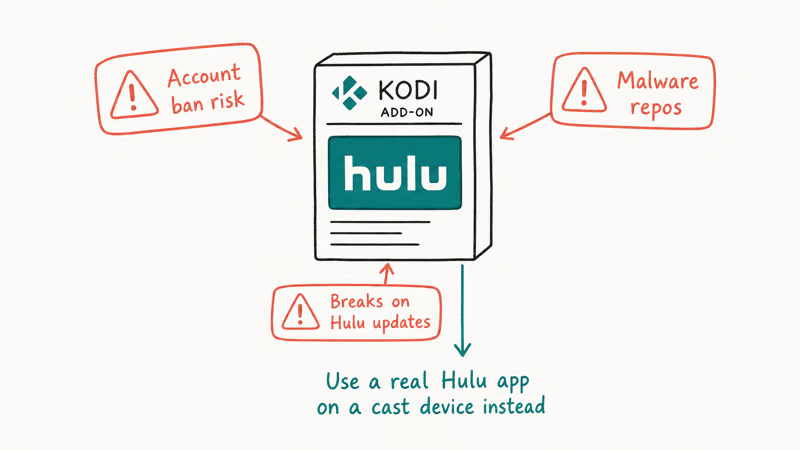
Credential theft is the first and biggest risk. Unofficial Hulu add-ons ask for your email and password during setup. Those credentials are sent to whatever endpoint the add-on author chose, which is not Hulu. Most add-on authors are anonymous, and the add-on code is often obfuscated.
The EFF’s surveillance self-defense guide on choosing tools recommends a hard rule against entering passwords into clients you can’t verify. An unofficial Kodi repo is exactly the kind of client they’re warning about. When your Hulu password is reused on email, banking, or shopping accounts (the common case), credential reuse turns one add-on into a multi-account compromise.
Account suspension is the second risk. The Hulu Subscriber Agreement explicitly states that you may not access the service through any unauthorized client or interface. Hulu’s anti-abuse systems detect unusual API access patterns, and accounts caught using scraping add-ons can be suspended without refund. Concurrent-stream limits also count any scraping client against your cap, so the add-on can lock your real device out of Hulu by burning your stream slots.
Malware is the third risk. Kodi add-ons that arrive through random ZIP files from third-party repos sit outside the Kodi Foundation’s review. Security researchers reporting on the wider add-on ecosystem have repeatedly found cryptominers and remote-access tools bundled into popular pirate add-ons. The “free pirate streaming” promise is consistently monetized somehow, whether through ad fraud, mining, or credential resale.
If you’ve already installed an unofficial Hulu add-on, the safer move is to uninstall it through Kodi’s Add-ons manager, change your Hulu password from a clean device, sign out all sessions in your Hulu account dashboard, and review for unfamiliar concurrent streams. Then switch to a native Hulu app on a supported device.
#Bottom Line
For your own paid Hulu subscription on devices you own, install the official Hulu app on a Roku, Fire TV Stick, Apple TV, smart TV, or your phone, and either watch directly or cast to the TV. There is no honest 2026 path to a stable, safe Hulu experience inside Kodi. The unofficial Hulu add-ons that exist either don’t work, get your account suspended, leak your credentials, or some combination of all three.
The realistic Kodi role in a Hulu-watching household is what it has always been best at: a polished front-end for your local media library while the streaming services run in their native apps next to it. Use the right tool for each job, keep your Hulu password out of strangers’ code, and the whole setup gets simpler and safer.
#Frequently Asked Questions
Can I install an official Hulu add-on on Kodi?
No. Hulu does not publish an official Kodi add-on, and the Kodi Foundation does not maintain one. Any add-on claiming to be the “official Hulu Kodi add-on” is third-party software with no relationship to either company, and there is no roadmap suggesting that will change in 2026 or beyond, since Hulu’s DRM stack and Kodi’s open architecture remain fundamentally incompatible.
What happens to my Hulu account if I use a third-party Kodi add-on?
Hulu’s Subscriber Agreement prohibits unauthorized clients, and accounts detected using scraping add-ons can be suspended without a refund.
Is there any legal way to watch Hulu through Kodi?
The closest legal approach is embedding the Hulu web player inside Kodi via a browser-launcher add-on, but playback is capped at lower resolutions by DRM and remote-control mapping is awkward. For practical use, the native Hulu app on your TV, streamer, or phone is the better path.
What devices have a native Hulu app?
Most modern streaming hardware. That includes Roku, Amazon Fire TV, Apple TV HD and 4K, Chromecast with Google TV, Android TV sets, most 2017-and-newer Samsung, LG, and Vizio smart TVs, Xbox One and Series consoles, PlayStation 4 and 5, and any modern web browser at hulu.com.
Can I cast Hulu from my phone if my TV doesn’t have the Hulu app?
Yes. Open the Hulu mobile app, tap the Cast button, and select your Chromecast or AirPlay 2 device.
My Hulu credentials are saved in an unofficial Kodi add-on. What should I do?
Treat this as a compromised credential and act fast. Uninstall the add-on through Kodi’s Add-ons manager, change your Hulu password from a device you trust, sign out all sessions in the Hulu account dashboard, and review your concurrent streams for anything you don’t recognize. Then switch to the official Hulu app on a supported device, and if you reused that password anywhere else (email, banking, shopping), rotate it there too before attackers reach those accounts.
Does using a VPN with a Hulu Kodi add-on make it safer?
No. A VPN hides your IP from Hulu but does not change the Subscriber Agreement, does not stop the add-on from sending credentials to a third party, and does not scan the add-on’s code for malware.
Google Messages Error 3100: Why RCS Is Broken on Galaxy
Google Messages RCS error 3100 hits Galaxy owners after phone or carrier switches. Google told 9to5Google a fix is coming. Here's what actually helps.

Is This Bank App Real? Spot a Fake App on Your Home Screen
A bank app can land on your home screen from a web page with no install warning. Learn the checks that tell a real banking app from a phishing web app.
Apps Crashing After iOS 27 Update? Fix Order (2026)
Apps crashing after the iOS 27 update? Update the app in the App Store first, then offload and reinstall to clear stale cache, then restart. The fix order.

Do AI Translation Earbuds Work Offline? What to Know
Do AI translation earbuds work offline? A few do with downloaded language packs, but most need the cloud. Here's what works offline and what you give up.