Call History of a Mobile Number: 5 Lawful Ways to Get It
Get the call history of a mobile number lawfully through your carrier, phone settings, or a subpoena. Plus what to do about scam and harassment calls.
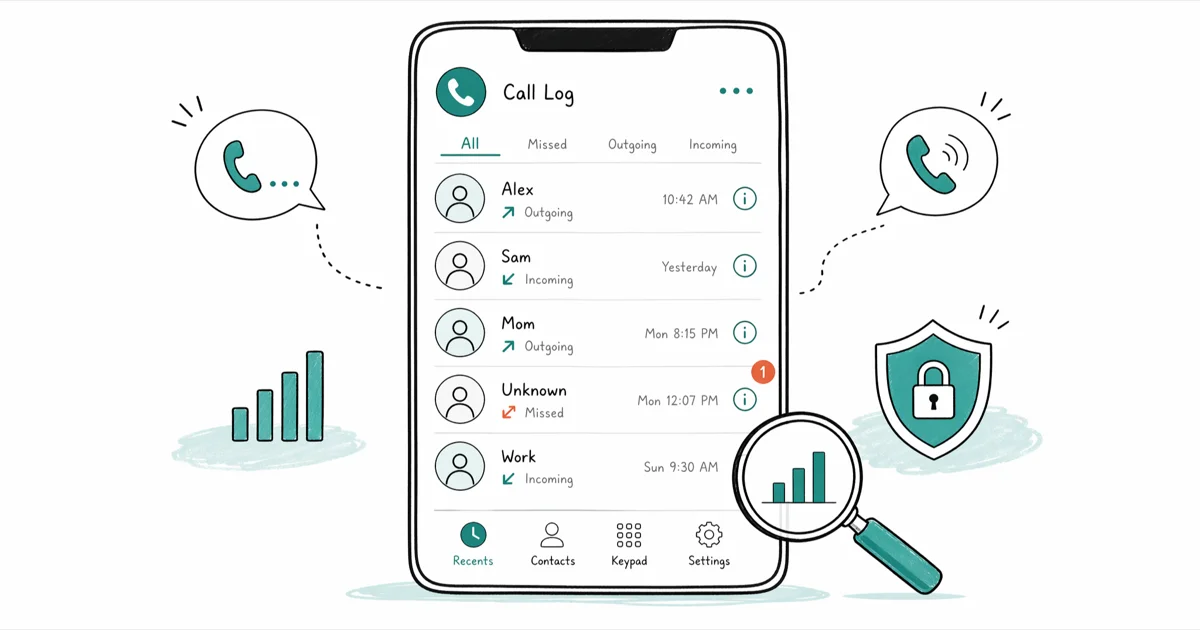
Quick AnswerTo get the call history of a mobile number you own, log into your carrier's online account or app and download the call log from your billing cycle. Pulling another person's records requires their written consent, a court order, or a police report tied to fraud or harassment.
The call history of a mobile number is easy to get for your own line and locked down for anyone else’s. The path you take depends on whose name is on the bill.
AT&T, Verizon, and T-Mobile postpaid portals each expose call detail records differently, and the data only reaches back so far. This guide covers the official routes, the legal limits, and what to do when scam or harassment calls are the reason you’re asking.
- Carrier portals show roughly 90 days of detailed call history for postpaid lines, with longer ranges via paid statement archives
- Prepaid accounts (Cricket, Metro by T-Mobile, Straight Talk) typically expose only 30 to 60 days online
- The Electronic Communications Privacy Act and CFAA make it a federal crime to access another adult’s call records without authorization
- iPhone Recents stores about 1,000 entries; Android’s default Phone app keeps 500 by default and can be pushed higher with Google Contacts sync
- Harassment and scam calls should be reported to the FCC and FTC before any private investigation; police can subpoena carrier records when a case is opened
#Who Can Legally Access Call History of a Mobile Number?
This is the most important section in the article, so we’re putting it first. The Stored Communications Act and the Computer Fraud and Abuse Act both treat phone records as protected data, and the federal wiretapping statute at 18 U.S.C. §2511 confirms that intercepting or accessing electronic communications without authorization carries criminal penalties of up to five years per count.
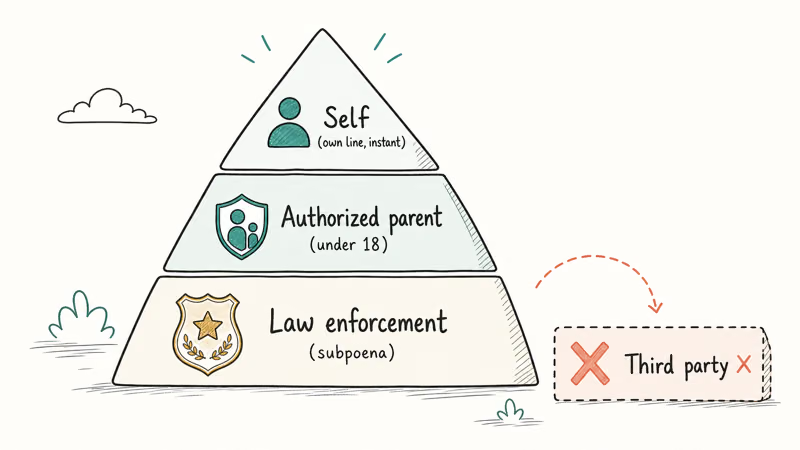
Here is who can lawfully obtain a number’s call history:
- The account holder. If your name is on the bill, you can download your own call detail records (CDRs) any time from the carrier’s portal. A second authorized user on the account, such as a spouse on a family plan, can pull records for any line on that account.
- A parent or guardian. Under most state laws, a parent on the family plan can review call logs for a minor child’s line on the same account. Once that child turns 18 and signs their own contract, that access window closes.
- Law enforcement with a subpoena or court order. Police can compel carriers to produce records under 18 U.S.C. §2703. Civil litigants typically need a subpoena duces tecum signed by a judge.
- An employer for company-owned lines. If the employer owns the device and the SIM, and the employee was notified in writing, the employer can audit the call history on that line.
- A person with explicit written consent. A spouse, attorney, or accountant you authorize in writing can request records on your behalf, though most carriers still want you on the phone or in the account.
If your situation isn’t on that list, the answer is no. Buying call records from a third-party “lookup” service or installing a tracking app on someone else’s phone violates federal law regardless of intent.
#How to Pull Your Own Call History From Your Phone
The fastest way to see recent calls is on the device itself. No login needed.
#iPhone Recents
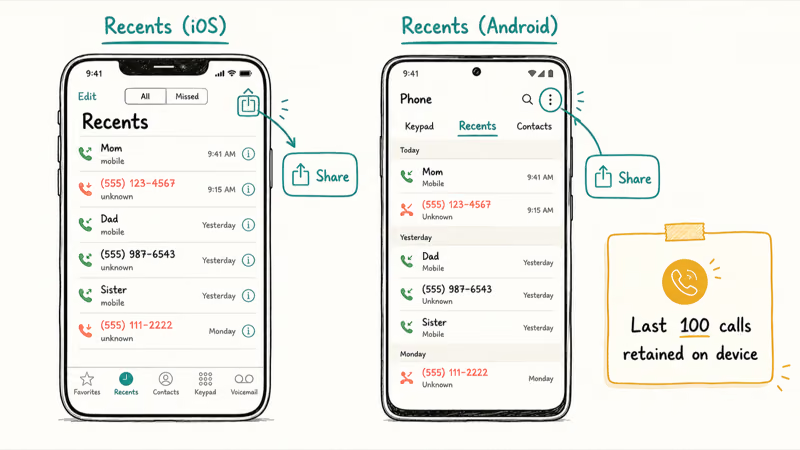
Open the Phone app and tap the Recents tab. You’ll see incoming, outgoing, and missed calls in reverse chronological order. According to Apple’s iPhone User Guide, the Recents list holds up to 1,000 entries before older calls roll off. Once you hit that cap on a heavily used line, the oldest calls drop off automatically.
To see only one type:
- Tap Missed in the top filter row to isolate missed calls
- Tap the small (i) icon next to any entry for the full timestamp, duration, and FaceTime status
- Swipe left on an entry and tap Delete to remove it from Recents (this does not affect carrier records)
If you need a longer history than 1,000 entries, the Recents log won’t help. Skip ahead to the carrier portal section.
#Android Phone app
Open the Phone app and tap the Recents or clock-icon tab. Google’s Phone app help states that the default log retains 500 entries on Pixel and most Android phones, after which older calls are trimmed.
To export the log on a Pixel:
- Open Phone, tap the three-dot menu, then Call history
- Tap and hold any entry, then tap Select all and Share
- Pick a destination (email to yourself, Drive, or a backup app)
Samsung Galaxy devices follow a similar flow under Phone > More > Settings > Call history. On recent One UI builds, the export share sheet typically includes Quick Share, Email, and Samsung Cloud as destinations.
#How to Download Call Detail Records From Your Carrier
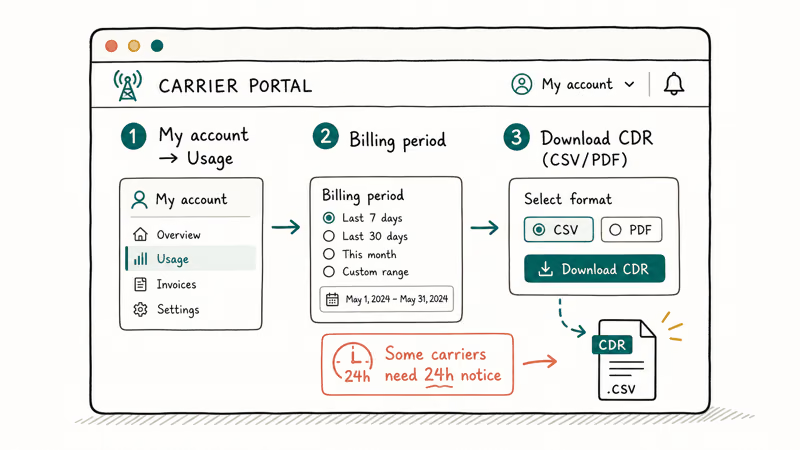
The carrier portal is where you get the longest, most detailed call log. The format is a CSV or PDF that lists every connected and dropped call with timestamp, duration, originating number, and roaming flags.
#AT&T
According to AT&T’s bill and payments support page, postpaid customers can view up to 16 months of bills, with the most recent 90 days showing detailed call activity. Log into att.com/myatt, open Billing, pick the cycle you want, and click See Past Bills & Payments. Inside the bill, the Usage Details link generates a downloadable wireless usage report.
On a consumer postpaid line, the CSV export covers every call within the cycle plus inbound and outbound SMS counts. AT&T charges $5 per CDR request older than 180 days when you need certified records for a court case.
#Verizon
Verizon’s My Verizon usage page provides 18 months of bill history online. To get the call log:
- Sign in at verizon.com/my-verizon
- Tap Account, then Bill, then View Bill
- Pick the cycle, then click Bill Details and choose Voice
The voice section lists each call. For older or certified records, Verizon’s legal compliance page routes attorneys and law enforcement to its Custodian of Records office.
#T-Mobile
T-Mobile lets you pull recent usage from the T-Life app or my.t-mobile.com. Tap Bill, choose a past cycle, then Bill Details. Postpaid lines see roughly 60 to 90 days of detailed call data online. T-Mobile’s terms and conditions confirm that certified records for legal use require a written subpoena to the carrier’s Subpoena Compliance team.
#Prepaid carriers
Cricket, Metro by T-Mobile, Boost, and Straight Talk store far less. Cricket’s online account shows about 30 days of voice activity, and Straight Talk Wireless reported in its help center that detailed call records are not available online for most plans. If you need a prepaid CDR for a court case, you’ll need to call customer support and request it in writing.
#What If You Need Someone Else’s Call History?
Three lawful paths exist, and none of them involve software on the target phone.
1. Written consent. Ask the person to download the records themselves and forward the CSV or PDF. This is the cleanest route for spouses on separate lines, adult family members, or business partners. Most carriers won’t release a third party’s records to you even with their verbal okay.
2. Subpoena or court order. In civil cases like divorce or custody, your attorney can serve a subpoena duces tecum on the carrier. Each major carrier has a Custodian of Records or Subpoena Compliance unit that handles these requests. The FCC’s Communications Privacy summary confirms that carriers must comply with valid legal process.
3. Police investigation. File a report first if the calls involve harassment, stalking, fraud, or theft. Officers can issue preservation orders and subpoena carrier records directly, often within days.
If you’re trying to track down someone who scammed you, give the police your own call log as evidence. They can pull the other side from the carrier.
#Carrier Call History Retention Windows
Public retention windows differ from internal retention windows. Carriers store CDRs much longer than what’s visible in your online account.
According to a DOJ Office of the Inspector General report on call detail record retention, U.S. carriers typically keep CDRs for 18 months to seven years for internal billing and legal compliance, though the customer-facing portal exposes only a fraction.
| Carrier | Visible online | Available via legal request |
|---|---|---|
| AT&T | 90 days | Up to 7 years |
| Verizon | 12 months | Up to 7 years |
| T-Mobile | 60-90 days | Up to 5 years |
| Sprint legacy | Migrated to T-Mobile | Up to 5 years |
| Most prepaid | 30 days | Varies; often 1 year |
Text message content is treated differently than call metadata. Carriers usually keep SMS content for a few days at most, while call metadata persists much longer.
#Documenting Scam or Harassment Calls
If the reason you need a number’s call history is to document harassment, fraud, or stalking, do these four things in order:
- Don’t engage. Let the call go to voicemail. Save any voicemails as audio files.
- Save the timestamps. Note the date and time of every unwanted call. Your Recents log is enough at this stage.
- Report to the FCC. File a complaint at consumercomplaints.fcc.gov under “phone” issues. The FCC’s stop unwanted calls page recommends this step before lawsuits.
- Report to the FTC. Add a complaint at reportfraud.ftc.gov so the number lands in the federal nuisance-call database used to trigger carrier-level blocking.
- File a police report if the calls threaten harm, target a minor, or come from someone violating a restraining order. Police can subpoena the originating carrier and get a name attached to the number.
A caller ID app like Truecaller or Hiya identifies most spam patterns before the call connects, and the same pre-screen step catches spoofed local numbers that look like a neighbor calling. For the harder unknown-number variant, learn how to block calls from no caller ID so the line goes silent without any further evidence collection on your end.
#Signs Someone Else Is Pulling Your Records
SIM swap fraud is the easiest way for an attacker to get your call history without ever touching your phone. The FBI’s Internet Crime Complaint Center reported that SIM swap losses grew from $12 million in 2018 to $68 million in 2021, with each successful attack giving the attacker full access to texts, calls, and one-time passcodes.
Watch for these signals:
- Your phone suddenly says “No Service” or “SOS Only” with no carrier outage in your area
- You can’t log into your carrier app because the password was changed
- Incoming calls and texts stop arriving despite full signal bars
- Account alerts mention a new SIM or device that wasn’t you
If two or more of these appear together, call your carrier immediately from another phone. The same recovery flow covered in our guide on SIM card recovery options applies here: AT&T, Verizon, and T-Mobile will all freeze a line on request to stop further damage. Then change your email password, your carrier portal password, and turn on a carrier port-out PIN.
If your phone is missing along with the calls, the lawful next step is tracking your phone using Find My or Find My Device, not searching for the number in a public lookup.
#Bottom Line
For your own line, the AT&T, Verizon, or T-Mobile portal is the right tool and takes under five minutes. For anyone else’s line, the only lawful options are written consent, a subpoena issued through an attorney, or a police investigation tied to a real complaint. If scam or harassment calls are the reason you’re asking, report the number to the FCC and FTC first; the federal databases trigger automatic carrier blocking faster than any private record pull.
#Frequently Asked Questions
Can I get a list of incoming and outgoing calls for any mobile number?
Only if you’re the account holder, the parent on a family plan with a minor’s line, or you have a subpoena. There is no public lookup service that legally exposes another person’s call records. Sites that claim to do so either lie about what they return or sell data scraped from breaches.
How far back does call history go on iPhone?
The iPhone Recents log holds up to 1,000 entries before the oldest call drops off. For carrier-side detail, AT&T shows 90 days online, Verizon shows 12 months, and T-Mobile shows 60 to 90 days. Older records require a written request to the carrier, often with a fee for certified copies.
Can my employer see my personal call history?
Only on a company-owned device with a company SIM, with written notice at hire. BYOD lines paid through a stipend stay yours.
Are third-party call lookup services legal?
Reverse-lookup tools that identify the carrier or general region tied to a number, like Truecaller’s caller ID, are legal. Services that promise to return a target person’s full call log are not. The FTC has taken enforcement action against companies marketing covert call-tracking apps, so steer clear of anything advertising “secret” or “stealth” access.
What’s the difference between call history and call detail records?
Recents is a local device view. CDRs are the carrier’s official log with timestamps, durations, and tower handoffs.
Can I recover deleted call history?
If you deleted entries from the Recents log on your phone, they’re gone from the device, but the carrier still has them. Log into your carrier portal or contact support and request a usage report for the cycle in question. iCloud and Google account backups can sometimes restore Recents on a new phone, though that depends on whether the deletion happened before or after the last backup.
Will my carrier tell me if someone requested my call records?
Sometimes. Criminal subpoenas with nondisclosure orders gag the carrier. Civil subpoenas usually trigger an account notice.
Do prepaid phones have call history I can download?
Yes, but the window is much smaller. Cricket, Metro by T-Mobile, and Boost expose about 30 days online. Straight Talk and TracFone don’t offer detailed CDRs through the customer portal at all; you have to call support and request the records by mail. Keep your own backup if you rely on prepaid for billing or legal purposes.
Is This Bank App Real? Spot a Fake App on Your Home Screen
A bank app can land on your home screen from a web page with no install warning. Learn the checks that tell a real banking app from a phishing web app.
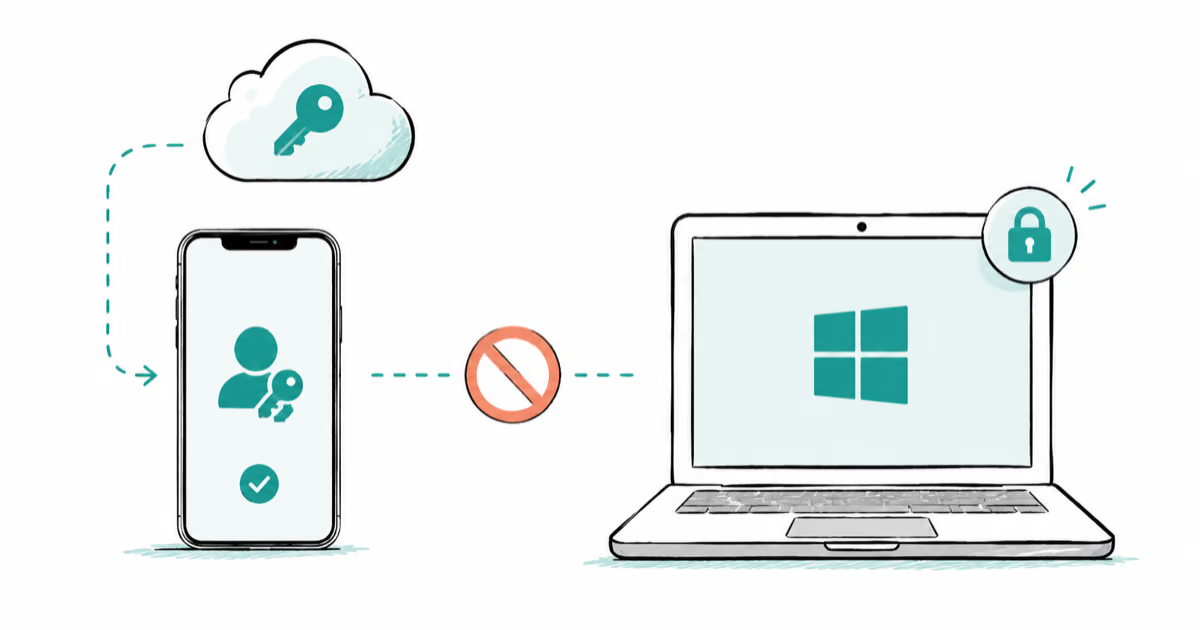
Passkeys Not Syncing Between iPhone and Windows? Read This
Passkeys not syncing between iPhone and Windows is by design, not a bug. Here is why iCloud passkeys skip Windows Hello and the three ways to fix it.
VPN Not Working on Snapdragon X? Why It Fails, How to Fix
Your VPN won't install or connect on a Snapdragon X Copilot Plus PC because Windows on ARM can't emulate the network driver. Here are the fixes that work.
How to Check If a Link Is Safe Before You Click It
Learn how to check if a link is safe with official-first steps: read the real domain, use the app instead, and treat scanners as a second opinion only.