Recording a Spouse for Infidelity Evidence: Legality Guide
Recording a spouse for divorce evidence is a felony in 11 US states and family courts often refuse the audio anyway. Here is what the law allows.
Quick AnswerRecording a spouse without consent is a felony in 11 US states and the recording is rarely admissible in family court, even where it's legal. Talk to a divorce attorney before you record anything.
Searching for a voice activated recorder to catch a cheating spouse is one of the fastest ways to turn a painful suspicion into a criminal charge. Federal and state wiretap laws treat secret audio recording of another person’s conversations as a serious crime in much of the country. Family courts routinely exclude that audio even when it’s captured legally.
- Eleven US states require all-party consent for recording private conversations, making secret spousal recording a felony in those jurisdictions.
- The federal Wiretap Act (18 USC 2511) imposes up to five years in prison and civil damages of $10,000 or $100 per day of violation, whichever is higher.
- Family court judges in most states refuse illegally obtained audio under the exclusionary rule, so a felony recording rarely changes the divorce outcome.
- Licensed private investigators carry insurance, jurisdiction knowledge, and court-admissible reporting that a hidden recorder can’t match.
- Counter-surveillance steps are reasonable if you suspect your own spouse is recording you, starting with a phone spyware scan and a sweep of shared rooms.
#Is It Legal to Record Your Spouse Without Their Knowledge?
The short answer depends on where you live and whether you’re a party to the conversation.
According to the Reporters Committee for Freedom of the Press recording guide, the federal baseline allows recording a conversation if at least one participant has consented, and that participant can be you. Most US states and the District of Columbia follow this one-party consent rule. Recording your own call with your spouse is generally fine in those jurisdictions.
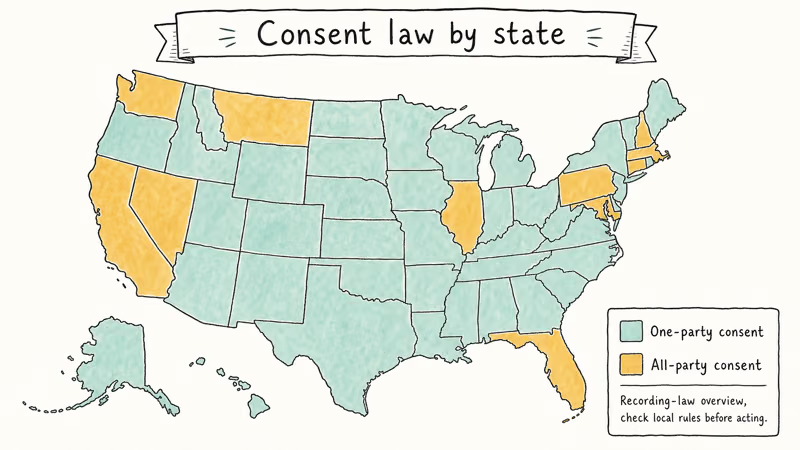
Eleven states are stricter. California, Connecticut, Florida, Illinois, Maryland, Massachusetts, Michigan, Montana, Nevada, New Hampshire, Pennsylvania, and Washington require every party to a private conversation to consent before any recording begins. Recording your spouse’s calls there without their knowledge is a felony.
The picture gets harder when the recorder runs in a room where you’re not present.
Hiding a voice activated device in a bedroom your spouse uses alone, in their home office, or in their car when you’re not in it fails the one-party test in every state. You aren’t a party to the conversations it captures. Federal prosecutors have brought wiretap cases against spouses for exactly this scenario, and several have ended in conviction.
#One-Party vs All-Party Consent States Compared
The distinction comes down to who has to agree before recording starts. A one-party state lets any participant in a conversation record it, even without telling the others. An all-party state, sometimes called a two-party state, requires explicit consent from every person whose voice will be captured.
| State category | Consent rule | Typical criminal exposure | Civil exposure |
|---|---|---|---|
| Federal default | One-party | Up to 5 years prison | $10,000 minimum or $100/day |
| One-party states (39 + DC) | At least one participant | Misdemeanor to felony | State civil damages vary |
| All-party states (11) | Every participant | Felony in most | $5,000+ statutory damages common |
Table 1: Consent law tiers under the federal Wiretap Act and state statutes. Source: Reporters Committee for Freedom of the Press state-by-state guide.
Several states add wrinkles. Massachusetts forbids secret recording but allows openly visible recording. Illinois rewrote its eavesdropping statute in 2014 after the Illinois Supreme Court struck the original down in People v. Clark, and the new version still requires all-party consent for private conversations.
Maryland’s all-party rule famously tripped up a journalist who recorded a public official during the 2009 ACORN sting. The recording itself was legal under the news exception, but the subject filed a civil suit anyway and reached a six-figure settlement years later.
Cross state lines and the stricter rule generally controls.
Because the wiretap statutes of all 50 states and DC interact in complicated ways, the safest assumption is to treat any private conversation as all-party-consent material, particularly if the audio could end up in a federal courtroom.
#When Is a Recording Admissible in Family Court?
Even when the recording itself is legal, getting it into evidence is a separate hurdle.
The American Bar Association confirms that judges in most US family courts apply state evidence rules and Federal Rules of Evidence 401 through 403 to any audio submitted. The recording has to be relevant, authenticated, and weighed against unfair prejudice. Hidden audio of a spouse’s private call often loses on the third prong alone.
Illegally obtained audio is the easier case to predict.
According to a 2018 American Bar Association practice note on family law and electronic surveillance, audio recorded in violation of state wiretap law is barred under the exclusionary rule in most jurisdictions. The recording attorney can face bar discipline for offering it. A handful of states apply “fruit of the poisonous tree” doctrine that also bars derivative evidence the recording uncovered.
Legal recordings face a softer filter, but a real one. Judges weigh whether the audio adds anything beyond what witness testimony already establishes, whether the timestamps and chain of custody are clean, and whether playing the audio would inflame the trier of fact against the recording spouse.
In published family law decisions, secret-but-legal recordings tend to be admitted only when they directly contradict the recorded spouse’s sworn testimony. Refusals tend to come in cases where the proponent couldn’t show clean handling of the file.
Infidelity itself rarely shifts the outcome of a no-fault divorce. Property division, custody, and support hinge on financial and parenting facts that audio of a private call almost never proves.
#The Federal Wiretap Act and Domestic Recording
The federal Wiretap Act, 18 USC 2511, governs interception of wire, oral, and electronic communications.
The Department of Justice states that violations carry up to five years in federal prison plus civil damages. The statute applies to private individuals as well as government actors, and there’s no marital exemption written into the text. Federal circuit courts split on whether an “interspousal exception” reads into the law.
Six circuits have rejected any spouse-to-spouse carve-out: the Second, Fourth, Eighth, Ninth, Tenth, and Eleventh. A husband or wife who plants a recorder gets treated the same as any other defendant.
Only the Fifth Circuit reached the opposite conclusion in 1974’s Simpson v. Simpson, and it hasn’t formally overruled itself. Later panels have narrowed Simpson to its specific facts. According to a 2021 review by the Berkeley Technology Law Journal, no federal circuit has expanded the exception in the last two decades, and most family law practitioners treat it as functionally dead.
State criminal charges add a second layer.
Pennsylvania prosecutors filed felony wiretap charges against a wife who recorded her husband’s calls during a custody dispute in Commonwealth v. Spangler. Florida brought similar charges in McDade v. State, which the Florida Supreme Court resolved by holding that the all-party consent statute applies inside the marital home.
The combined exposure of federal and state charges for a single recording session can reach a decade of potential prison time on paper.
#Smarter Alternatives to Covert Recording
Four lanes work better than a hidden microphone.
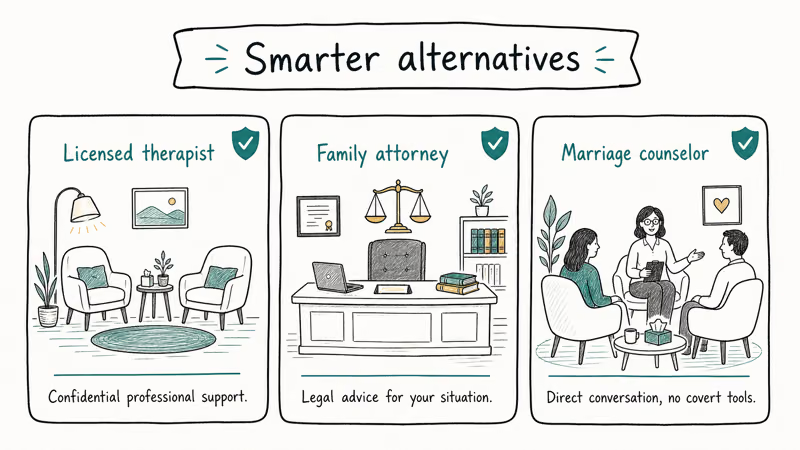
A licensed private investigator is the option most family law attorneys recommend when a client wants documented evidence. PIs hold state licenses, carry liability insurance, and know which surveillance methods their jurisdiction allows. The American Bar Association confirms that PI evidence is the most common form of infidelity documentation accepted in family court.
A divorce attorney is the second piece. Most family law firms offer a paid consultation in the $200 to $400 range that establishes attorney-client privilege over anything you tell them, including suspicions you haven’t yet acted on.
Family law firms commonly warn new clients not to record their spouse before the first meeting, precisely because an illegal recording can damage the client’s own case.
Marriage counseling sits in a third lane. A licensed therapist can’t legally testify about what was said in session in most states, but the process can either repair the marriage or clarify that divorce is the right path. The American Association for Marriage and Family Therapy maintains a directory of licensed providers searchable by ZIP code.
Banking and digital records are the fourth lane, and the one that produces the most useful evidence. Joint account statements, credit card records, shared-cloud-storage timestamps, and lawfully accessed text message threads on shared family plans give a divorce attorney concrete numbers to work with.
None of those require a hidden microphone, and most don’t trigger an evidentiary battle.
#Legitimate Uses for Voice Recorders
Voice recorders themselves are useful tools when used openly. Consent on tape changes everything.
Journalists carry pocket recorders for source interviews after obtaining verbal consent on tape. Doctors use them for patient notes during rounds. Students record lectures with the instructor’s permission. Writers dictate first drafts.
A pocket voice recorder captures clear, intelligible speech at conversational distance.
Hardware in this category is widely available. The Sony ICD-UX570, Olympus WS-883, and Zoom H1n cover the entry-level professional bracket between $80 and $200 new. The Tascam Portacapture X8 sits at the high end for podcasters and field producers.
All four record in WAV and MP3, expose a clear physical record button, and produce a visible LED while running.
If you need a recorder for your own iPhone or iPad, the built-in Voice Memos app is free and handles most use cases that an external recorder would. The microphone hardware in modern iPhones rivals dedicated handheld recorders for close-range speech.
Our guide to iPhone microphone troubleshooting covers the most common causes when Voice Memos picks up no audio. The connect an external microphone to iPhone walkthrough explains how to plug in a lavalier or shotgun mic for better quality.
#Counter-Surveillance: How to Tell If Your Spouse Is Recording You
Counter-surveillance is the reasonable concern when the situation reverses. Phones first, rooms second.
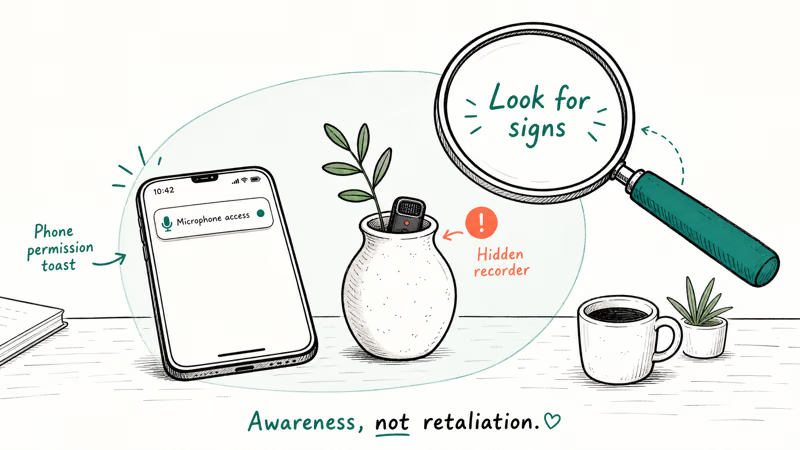
The first sweep is a phone scan. Most domestic surveillance now runs as stalkerware rather than a physical recorder.
Three resources cover the phone-scan workflow:
- How to detect spyware on iPhone walks through battery anomalies, unexpected configuration profiles, and Apple’s built-in Safety Check feature added to the iOS Settings app in iOS 16.
- Apple’s official Safety Check support documentation covers the same workflow if you prefer the first-party walkthrough.
- The companion post signs your cell phone is being tracked, tapped, or monitored covers Android.
Hardware comes next. Physical recorders are smaller now but still leave clues.
A USB drive, smoke detector, picture frame, or wall clock that arrived without explanation is worth examining. Listen for faint clicks when the room goes silent, and check shared spaces for tiny lens or microphone openings.
Most domestic surveillance doesn’t justify a professional sweep, though FBI consumer guides cover RF detectors for serious cases.
Apps deserve a closer look than hardware. Anything labeled “parental control” on a phone you own is worth auditing, because consumer stalkerware often disguises itself this way. The walkthrough at how to stop mSpy from spying on you explains the removal flow.
If you suspect surveillance and you’re also concerned for your physical safety, the National Domestic Violence Hotline (1-800-799-7233) maintains a network of advocates trained in tech abuse.
They help assemble evidence safely and connect you locally.
#Bottom Line
Buying a voice activated recorder to gather divorce evidence on a spouse is a strategy that fails in two directions at once.
In an all-party consent state, it’s a felony that can land you in prison and bankrupt you in civil damages. In a one-party state, the audio rarely changes a no-fault divorce outcome and often loses on admissibility objections. The path that actually works is a paid consultation with a family law attorney, followed by a licensed PI if documentation is needed, and a phone spyware scan if the suspicion runs the other direction. Skip the recorder.
#Frequently Asked Questions
Is recording your own phone call with your spouse legal?
In one-party states, yes. In the 11 all-party states, no, even on a call between spouses. The California penalty is up to a year in jail and a $2,500 fine per recording, and Florida charges it as a third-degree felony with a five-year ceiling. Federal law adds another five years on top in interstate calls that cross a one-party state into an all-party state, which is more common than people realize given how mobile numbers route.
Rarely. Judges exclude illegally obtained audio outright in most states, and admitted covert recordings often hurt the recording spouse more than the recorded one.
What is the penalty for illegal wiretapping in an all-party state?
It varies but the worst-case picture is severe. California: misdemeanor or felony, up to one year in jail and a $2,500 fine per recording. Florida: third-degree felony with up to five years in prison. The federal Wiretap Act adds up to five more years and statutory damages of $10,000 or $100 per day, whichever is greater, plus attorney’s fees.
Can my spouse legally record me without telling me?
Yes in a one-party state if they’re a participant in the conversation, no in an all-party state. The same authentication and prejudice rules that limit your recording of them limit theirs of you.
Are home security cameras with audio legal in shared spaces?
The video portion is usually fine inside your own home. The audio portion is the legal hazard, because state wiretap statutes still apply to audio capture in private settings. Many all-party states require posted notice or all-occupant consent before audio recording in a shared space, and a security cam aimed at the living room qualifies. Disable the audio track on cameras in any room your spouse uses, and consult counsel before relying on any audio you’ve already captured.
What should I do if I think my spouse is recording me?
Start with a phone scan for stalkerware and inventory any new objects in shared rooms. Document anything you find with photos and timestamps before removing it. Then consult a family law attorney before any confrontation, because what you do next can become evidence in a custody case. The National Domestic Violence Hotline offers free guidance on the tech-abuse side.
Will a private investigator’s recording hold up in court?
PI evidence is the most common form of infidelity documentation accepted by family courts. Licensed investigators understand jurisdictional consent rules, produce authenticated reports, and carry insurance. Expect $75 to $150 per hour for surveillance work.
Does federal law have an exception for married couples?
No federal circuit has formally adopted an interspousal exception in the last twenty years. The Fifth Circuit’s 1974 Simpson v. Simpson case is the closest thing to one, but later panels limited Simpson to its facts and the six other circuits to address the question have rejected any spousal carve-out outright. Treat federal Title III as fully applicable to spousal recording.
Is This Bank App Real? Spot a Fake App on Your Home Screen
A bank app can land on your home screen from a web page with no install warning. Learn the checks that tell a real banking app from a phishing web app.
Passkeys Not Syncing Between iPhone and Windows? Read This
Passkeys not syncing between iPhone and Windows is by design, not a bug. Here is why iCloud passkeys skip Windows Hello and the three ways to fix it.
VPN Not Working on Snapdragon X? Why It Fails, How to Fix
Your VPN won't install or connect on a Snapdragon X Copilot Plus PC because Windows on ARM can't emulate the network driver. Here are the fixes that work.
How to Check If a Link Is Safe Before You Click It
Learn how to check if a link is safe with official-first steps: read the real domain, use the app instead, and treat scanners as a second opinion only.