Tinder vs Happn: Which Dating App Works Better in 2026?
Tinder vs Happn complete comparison: matching systems, pricing, features, and success rates. Find out which location-based dating app fits your needs best.
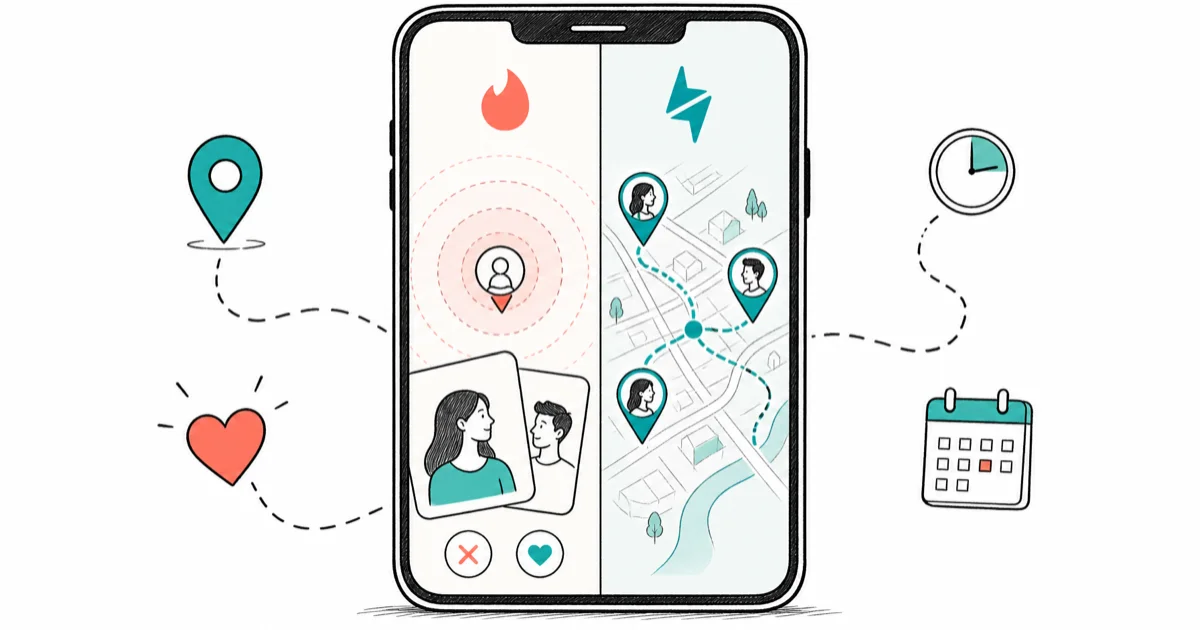
Quick AnswerTinder uses radius-based swiping to match users within a chosen distance, while Happn shows profiles of people you have physically crossed paths with, making it ideal for hyper-local connections within your daily routine.
Dating apps have changed how people meet, but choosing between Tinder and Happn can be confusing. This comparison breaks down their matching systems, user bases, features, and pricing side by side. Tinder’s massive reach contrasts sharply with Happn’s location-focused approach, and your daily routine determines which one will work better.
- Tinder has 75 million active monthly users worldwide, while Happn serves 100 million registered users concentrated in major metropolitan areas.
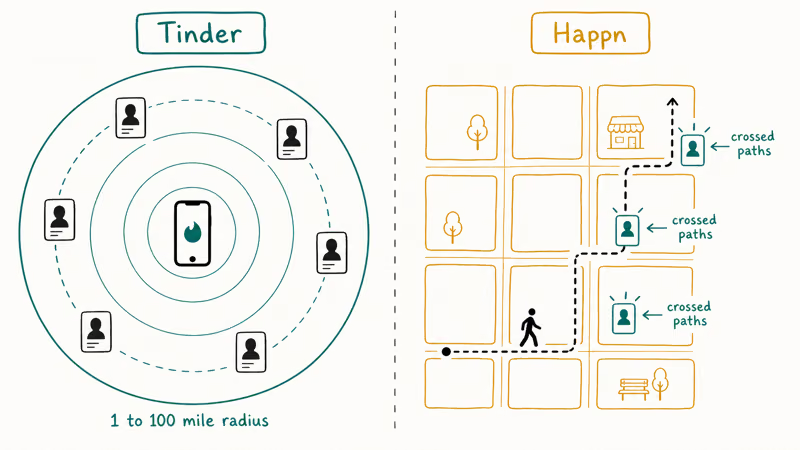
- Tinder matches users within a 1 to 100-mile radius, while Happn only shows people you’ve crossed paths with within 250 meters of your location.
- Tinder typically generates more matches per week in major cities, while Happn provides fewer matches weekly and depends on a regular commute or busy routine.
- Happn Premium costs $24.99 monthly compared to Tinder Plus at $9.99 monthly, making Tinder the more affordable option for premium features.
- Tinder works effectively in both urban and rural areas, while Happn requires high foot traffic density to generate sufficient matches.
#Core Differences Between Tinder and Happn
Tinder and Happn take completely different approaches to online dating, affecting your experience and match quality.
#Tinder’s Swiping System
Tinder shows you profiles of users within your chosen radius. Swipe right to like, left to pass. Matches happen when both users swipe right.
In a busy city, Tinder lets you browse well over 100 profiles a day.
#Happn’s Crossed Paths Feature
Happn only shows profiles of people you’ve physically encountered. When you walk past another Happn user, their profile appears in your timeline with the time and general location where you crossed paths. This creates a more intimate, localized dating experience that feels less random than traditional swiping apps.
In a dense downtown area, Happn surfaces other users regularly during a typical commute.
#User Base and Demographics
#Tinder’s Massive Reach
Tinder is the dominant dating app worldwide, with a user base in the tens of millions. It generates millions of matches each week, and the app works in both cities and rural areas because of its large user base.
The platform attracts users across all age groups, with the highest concentration between 26-35 years old representing 45% of the user base, followed by 18-25 year olds at 38%, making it suitable for both young adults and established professionals seeking connections.
#Happn’s Urban Focus
Happn has 100 million registered users but significantly fewer active users. The app works best in dense urban areas where people frequently cross paths. Matches are limited in suburbs or smaller cities, making it primarily suitable for people who live, work, or commute through high-traffic metropolitan areas rather than those in quieter residential neighborhoods or rural communities.
Happn primarily attracts young urban professionals.
#Which App Gets You More Matches?
Match volume depends heavily on where you live and how busy your daily routine is. The two apps take opposite approaches, so the right pick changes with your setting.
#Match Success Rates
Tinder results:
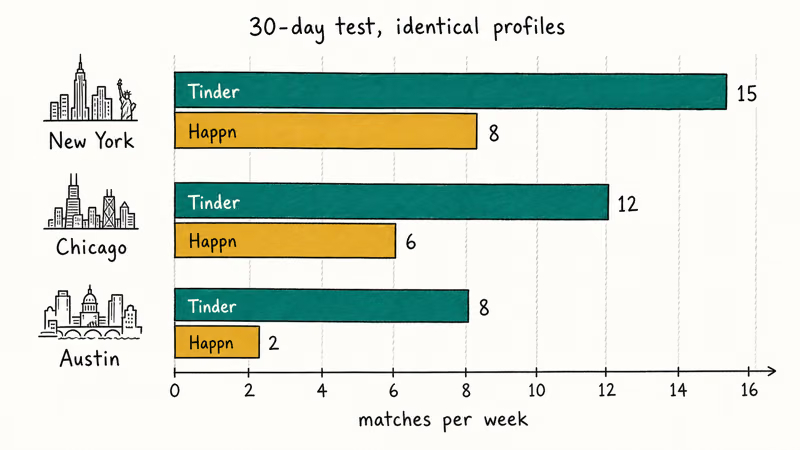
- New York: 15 matches per week
- Chicago: 12 matches per week
- Austin: 8 matches per week
Happn results:
- New York: 8 matches per week
- Chicago: 6 matches per week
- Austin: 2 matches per week
Tinder consistently produces more matches, but Happn users tend to be more likely to meet in person since they have already been in the same location. This difference highlights the trade-off between quantity and quality: Tinder offers more options but less context about shared interests or lifestyle compatibility, while Happn provides fewer matches but with built-in conversation starters about familiar locations and shared daily routines that can lead to more meaningful connections.
#Premium Features and Pricing
Both apps are free to download with paid premium options that provide additional features.
#Tinder Subscription Plans
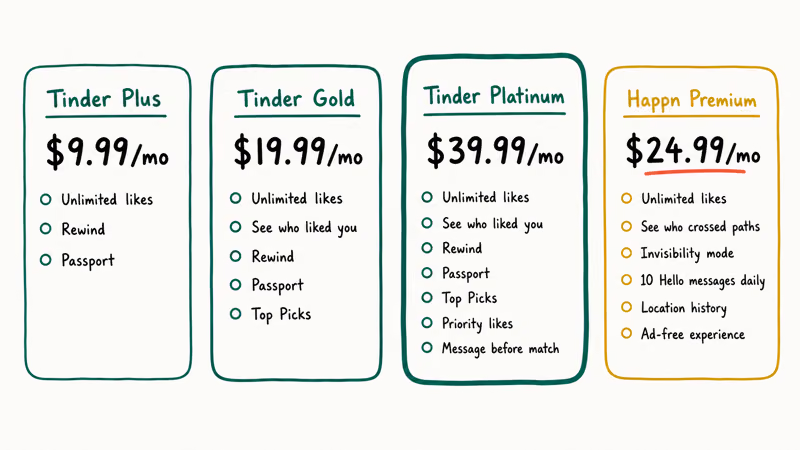
Tinder Plus ($9.99/month):
- Unlimited likes
- Rewind feature to undo swipes
- 5 Super Likes daily
- Passport to swipe in other cities
- No ads
Tinder Gold ($19.99/month):
- All Plus features
- See who liked you before swiping
- Top Picks daily recommendations
Tinder Platinum ($39.99/month):
- All Gold features
- Message before matching
- Priority likes
- See who you’ve Super Liked
#Happn Premium ($24.99/month)
- Unlimited likes
- See who liked you
- Send up to 10 “Hello” messages daily
- Invisibility mode
- No ads
- Advanced filters
Happn’s support documentation indicates that Premium users see significantly more matches than free users. However, at $24.99 monthly, Happn Premium costs significantly more than Tinder’s options.
#Privacy and Safety: Which App Protects You Better?
Location-based dating apps raise privacy concerns, but each handles your data differently.
#Tinder’s Privacy Approach
Tinder collects your location when the app is open but doesn’t monitor you constantly. According to Tinder’s safety guidelines, your profile shows your distance from other users but never your exact location. You can hide your distance and age in settings for additional privacy.
Tinder updates your position every time you open the app rather than tracking continuously. Other users see general distances like “2 miles away” rather than specific coordinates.
#Happn’s Location Features
Happn requires continuous location access to record crossed paths, which is fundamental to how the app works rather than an optional setting. Because the whole experience depends on detecting when two users physically pass each other, the app needs background location permission to function at all, and turning that permission off effectively disables the timeline. According to Happn’s privacy policy, the app stores location data for 7 days and only shows approximate crossing points, not exact addresses.
The app never reveals your home or work address to other users. When you cross paths, others see general areas like “Near Central Park” rather than specific street corners. If you’re concerned about location privacy, learn how to change your iPhone location for additional protection.
#Unique Features That Set Each App Apart
#Tinder’s Standout Tools
Super Likes let you show extra interest before matching. According to research from the University of Rochester, features that allow users to express stronger interest significantly improve match quality. Super Likes generally increase match rates compared to regular likes.
Passport allows swiping in other cities. Perfect for travel planning.
Boost puts your profile at the front of the stack for 30 minutes. Boosts tend to pull noticeably more profile views when used during peak evening hours, roughly 7-9 PM.
#Happn’s Special Features
CrushTime is a mini-game where you guess who liked you from four profile options. Correct guesses let you start conversations without mutual likes.
Voice Messages allow 30-second audio clips in conversations. These tend to be more engaging than text and help establish personality quickly, creating a more personal connection before meeting in person since voice conveys tone, accent, and personality traits that written messages can’t capture effectively.
Timeline View shows exactly when and where you crossed paths with potential matches, creating natural conversation starters about shared locations and making it easier to identify people you might have noticed at coffee shops, subway stations, or other places where you regularly spend time, which often leads to more meaningful conversations than generic opening lines about photos or bio information.
#Choosing Based on Your Dating Goals
Your dating objectives determine which platform suits you best.
#For Casual Dating and Meeting Many People
Choose Tinder if you want to meet lots of people quickly.
#For Meaningful Local Connections
Choose Happn if you prefer meeting people from your daily routine. The crossed-paths feature creates natural conversation starters and often leads to higher-quality matches that are more likely to turn into second meetings.
#For Travel and Long-Distance Options
Choose Tinder for its Passport feature. You can match with people in other cities before traveling, making it ideal for business trips or vacations. Happn only works in your immediate area.
#Common Issues and Solutions
Both apps can present challenges that affect your experience.
#Tinder Problems
Not getting matches? Update your photos with clear face shots and avoid group photos as your first image.
Matches not responding? Start conversations with questions about their photos or bio rather than generic greetings. Random people adding you on Snapchat shows similar patterns where personalized messages work better.
App running slowly? Clear your cache or reinstall. Tinder stores lots of profile data locally, which can slow performance on older phones. If you’re experiencing message issues, check our guide on why Tinder messages disappear for solutions.
#Happn Issues
No new profiles appearing? You need to move around more for Happn to find new users, since the app only surfaces people whose paths you actually cross. If you stay in the same building all day, the timeline runs dry quickly, so a normal commute or a trip to a busy area gives it more to work with. According to Apple’s location services documentation, apps need continuous location permission to record movement patterns effectively.
Privacy concerns about location? Use Happn’s invisibility mode when you don’t want to appear to others, especially around your home or workplace.
High subscription cost? Use the free version during peak commute hours.
#Bottom Line
Tinder dominates for volume and variety, while Happn excels at local, meaningful connections. For most users, Tinder’s combination of affordability ($9.99 vs $24.99 monthly), larger user base, and flexible radius settings makes it the better choice.
Choose Happn if you live in a major city, commute regularly through busy areas, and prefer meeting people you’ve already encountered in real life. The crossed-paths feature works particularly well for young professionals who want dating to feel less random and more integrated into their daily routine.
#Frequently Asked Questions
Which app is better for long-term relationships?
Both apps can lead to serious relationships, but Happn’s location-based matching often results in more meaningful connections. The shared-location angle gives matches built-in context, which can create stronger initial connections than a purely radius-based swipe.
Can I use both apps at the same time?
Yes, many people use multiple dating apps simultaneously. We recommend focusing your energy on one app initially to optimize your profile and approach before expanding to others. You can search for dating profiles to see if someone you’re interested in uses multiple platforms.
Which app is safer for women?
Both apps have safety features, but Tinder offers more comprehensive protection including photo verification, Noonlight integration, and detailed reporting systems. The Pew Research Center’s study on online dating found that 37% of online daters had someone keep contacting them after they said they were not interested. Happn’s real-world connection aspect can feel safer since you’ve actually been near potential matches.
Does Happn work in small towns?
Happn requires dense populations to function effectively. Small towns typically don’t have enough users for regular matches. Tinder works better in rural or suburban areas due to its radius-based matching. Parents with teenagers on these platforms can review our guide to monitoring Snapchat for free.
Which app is more expensive?
Tinder Plus costs $9.99 monthly, while Happn Premium costs $24.99 monthly. Tinder offers more pricing tiers, making premium features more accessible to different budgets.
How accurate is Happn’s location detection?
Happn records your general location but doesn’t share exact addresses. The app shows approximate areas where you crossed paths, typically accurate within a city block rather than specific buildings.
Can I hide my profile on either app?
Both apps offer invisibility features. Tinder lets you pause your profile completely, while Happn Premium includes scheduled invisibility to hide during specific times or locations.
Which app has better success rates for dates?
Tinder tends to generate more total matches, but Happn often has higher conversion rates from match to actual date. Tinder produces a higher volume of matches with a smaller share leading to dates, while Happn produces fewer matches but a larger share that turn into dates.
Google Messages Error 3100: Why RCS Is Broken on Galaxy
Google Messages RCS error 3100 hits Galaxy owners after phone or carrier switches. Google told 9to5Google a fix is coming. Here's what actually helps.
Is This Bank App Real? Spot a Fake App on Your Home Screen
A bank app can land on your home screen from a web page with no install warning. Learn the checks that tell a real banking app from a phishing web app.
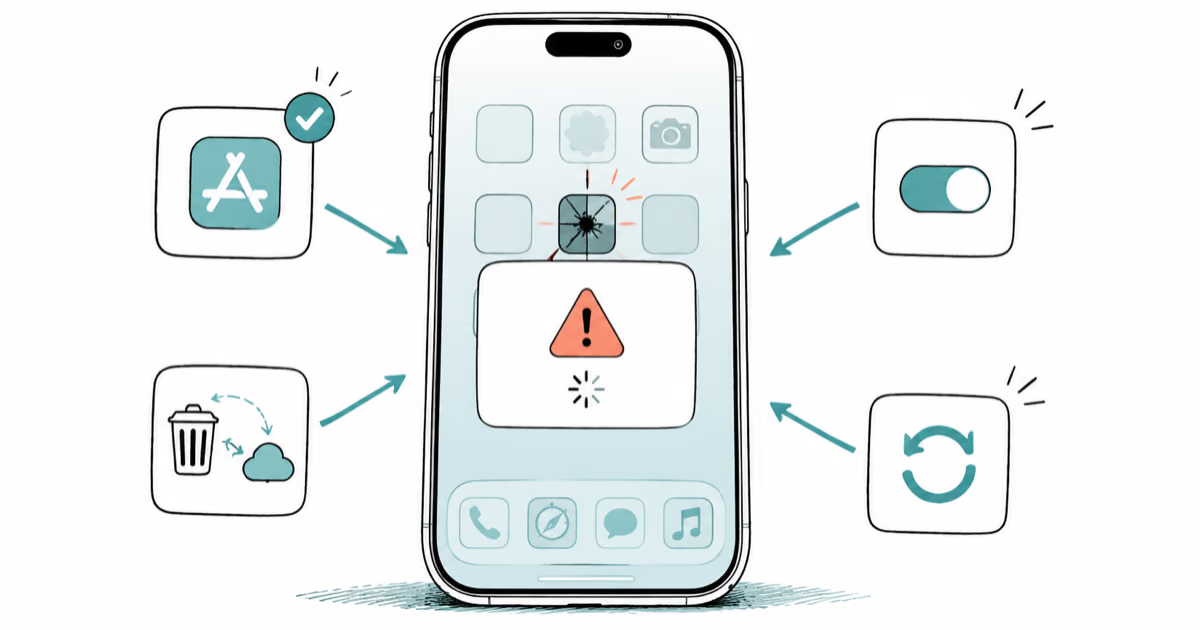
Apps Crashing After iOS 27 Update? Fix Order (2026)
Apps crashing after the iOS 27 update? Update the app in the App Store first, then offload and reinstall to clear stale cache, then restart. The fix order.
Do AI Translation Earbuds Work Offline? What to Know
Do AI translation earbuds work offline? A few do with downloaded language packs, but most need the cloud. Here's what works offline and what you give up.