How to Stop the Spinning Wheel on Mac: 7 Working Fixes
Stop the spinning wheel on Mac with 7 proven fixes: Force Quit, free RAM, clear disk space, rebuild Spotlight, and run Disk Utility First Aid.
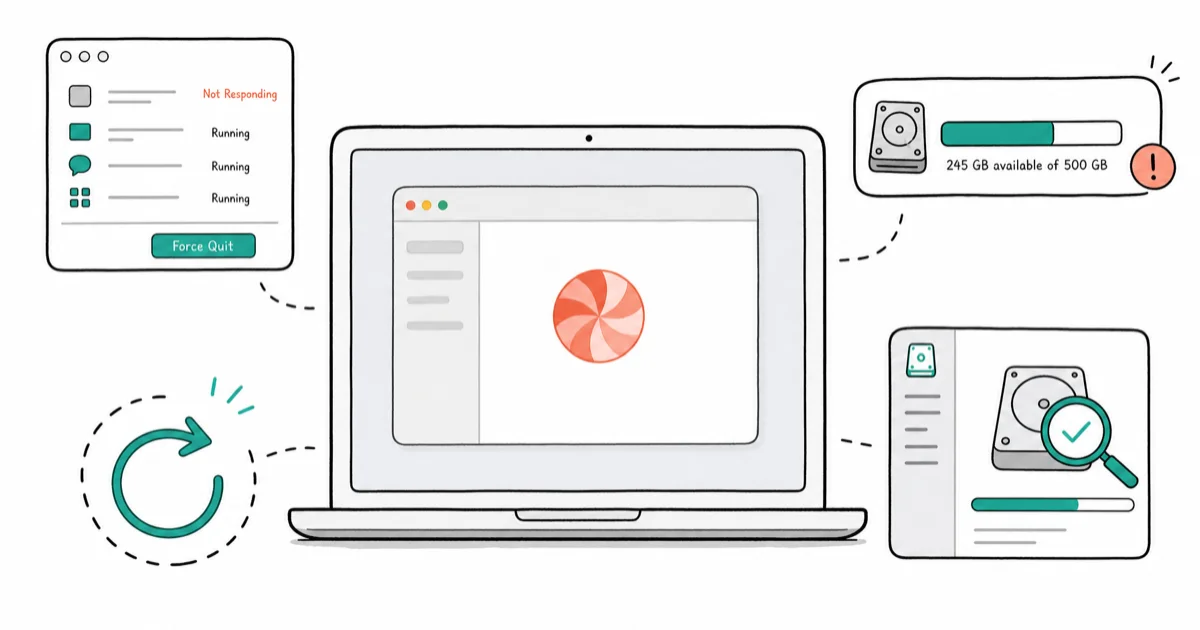
Quick AnswerPress Command + Option + Escape, pick the frozen app, and click Force Quit. If the wheel keeps spinning, hold the power button for 10 seconds to restart, then free up at least 15% of your startup disk before reopening heavy apps.
The spinning wheel on Mac (Apple calls it the spinning wait cursor, most people call it the beachball) means your app or the whole system is waiting on something the CPU or disk can’t finish in time. The seven fixes below are ordered the way that clears real freezes fastest, on both Apple silicon and older Intel MacBooks, starting with the quickest moves.
You don’t need to wipe your Mac, reinstall macOS, or pay an Apple Store fee to clear most beachball cases. The fix usually takes under five minutes once you know which method to start with.
- The spinning wheel is the macOS spinning wait cursor; it shows up when one app, or all of macOS, blocks the WindowServer thread for more than 2 seconds.
- The fastest single-app fix is Force Quit: Command + Option + Escape, pick the frozen app, click Force Quit. This clears most single-app freezes on its own
- If the entire Mac is frozen, hold the power button for about 10 seconds to force shutdown, wait 30 seconds, then power back on. You’ll lose unsaved work in open apps.
- Free disk space matters: once the startup disk drops under 10% free, beachballs come back within an hour even on fast Apple silicon. Apple recommends keeping at least 10 to 20% free.
- A stuck Spotlight index, runaway Google Chrome Helper processes, and full Trash are the three most common causes when a fresh restart doesn’t stick.
#Why Does the Spinning Wheel Show Up on Your Mac?
The beachball isn’t random. Apple’s spinning wait cursor documentation confirms that macOS shows the wheel when the active app’s main thread can’t respond for at least 2 seconds. After about 4 seconds the system marks the app “Not Responding” in red inside Activity Monitor and the Force Quit window.
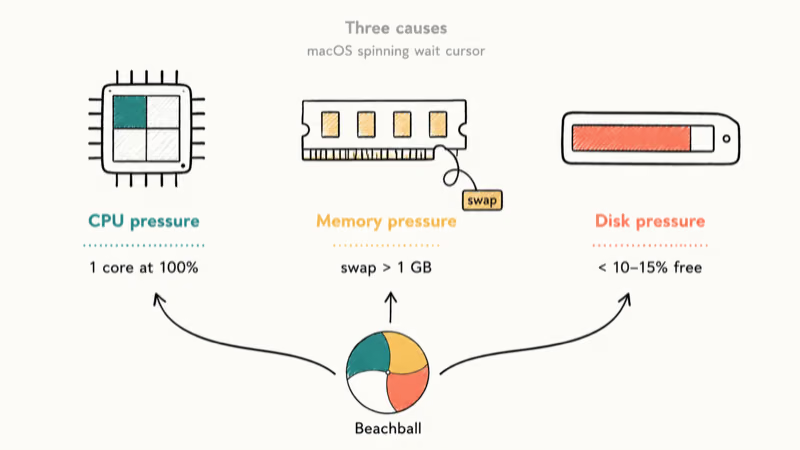
Three categories of slowdown account for almost every beachball during normal use:
- CPU pressure: a runaway process (often Google Chrome Helper, Spotlight
mds_stores, or a misbehaving Electron app) eats 100% of one or more cores. Activity Monitor’s CPU tab shows the offender. - Memory pressure: macOS swaps to disk because RAM is full. The Memory tab in Activity Monitor shows yellow or red pressure, and the swap used value climbs above 1 GB.
- Disk pressure: the startup disk has under 10 to 15% free, so even routine cache writes block. Apple’s optimize storage on Mac guide recommends keeping headroom available for system tasks.
Two situations matter most for picking the right fix:
#One app freezes when you reopen it
Same heavy app (Photoshop, Final Cut, Chrome with 30+ tabs) keeps beachballing within seconds of launch. The fix is in the app, not macOS.
#The entire Mac stops responding
The cursor is a beachball even on the desktop, the menu bar won’t respond, and Command + Tab does nothing. This is system-wide, not app-specific, and points to disk pressure, a runaway background process, or a kernel-level hang.
#How Do You Force Quit a Frozen App on Mac?
Force Quit is the right starting move when only one app is frozen. Apple’s Force an app to quit guide confirms that 1 keyboard shortcut, Command + Option + Escape, opens the Force Quit Applications window and closes only the unresponsive app, leaving every other open app untouched.
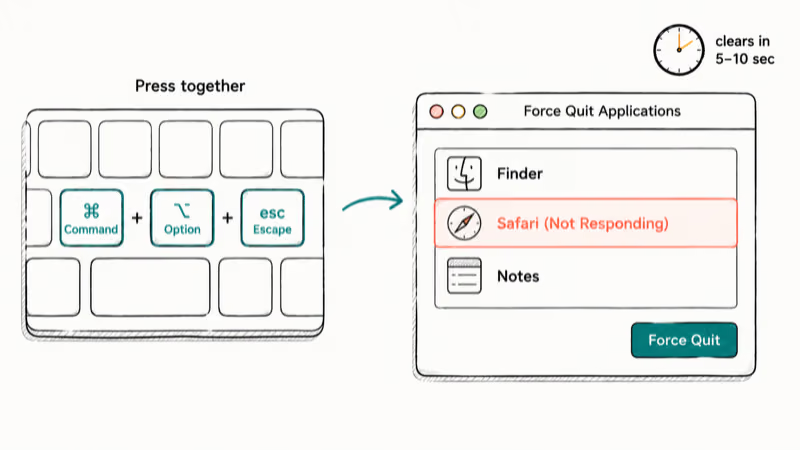
There are four ways to trigger Force Quit on macOS. All four work; the keyboard shortcut is the fastest.
- Keyboard shortcut: press Command + Option + Escape at the same time. The Force Quit Applications window opens.
- Apple menu: click the Apple icon in the top-left corner, then choose Force Quit.
- Dock: hold Option, right-click the frozen app’s Dock icon, then click Force Quit.
- Activity Monitor: open Activity Monitor (
Applications>Utilities), select the frozen process, click the X button in the toolbar, and choose Force Quit.
In the Force Quit Applications window, frozen apps are flagged “(Not Responding)” in red. Pick that app, click Force Quit, then confirm. The beachball should clear within 5 to 10 seconds. If you have used Ctrl + Alt + Del on Mac on Windows, Command + Option + Escape is the macOS equivalent.
If Force Quit itself spins, you have a system-wide hang, not an app hang. Skip to the restart section.
#Restart and Free Up RAM
A clean restart wipes RAM, kills zombie processes, and clears the WindowServer queue. Apple’s restart your Mac guide lists three ways to do it, and the menu-bar restart is the quickest.
- Soft restart: Apple menu > Restart. Best when the menu bar still responds.
- Force shutdown: hold the power button for about 10 seconds until the screen goes black. Wait 30 seconds, then power on. Use this when the Mac is fully unresponsive.
- Terminal restart (advanced): if Terminal is open, run
sudo shutdown -r now.
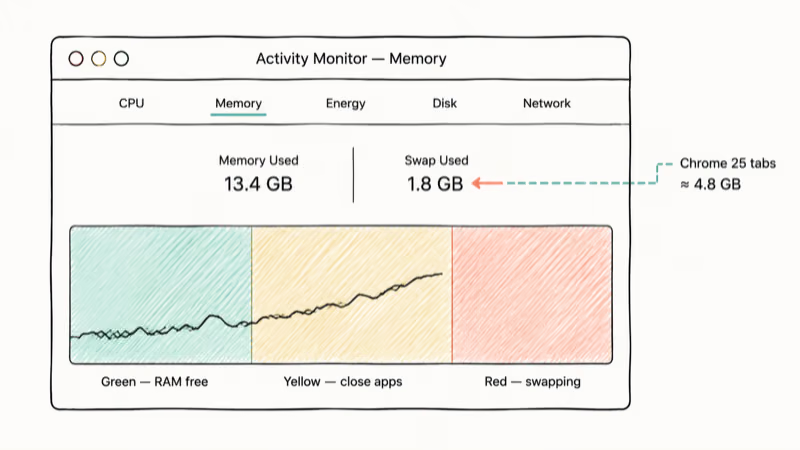
After the restart, watch your RAM. Open Activity Monitor, click the Memory tab, and look at the Memory Pressure graph at the bottom:
- Green: plenty of RAM free. Beachball is unlikely to return from memory pressure.
- Yellow: RAM is almost full. Close a few apps, especially browser tabs.
- Red: macOS is swapping aggressively. Quit Chrome, Slack, and any Electron app you don’t need; consider closing Photoshop or Final Cut if open.
Browsers are the single biggest RAM hog on most Macs. A Chrome window with a couple dozen tabs can hold several gigabytes of RAM. If your beachballs cluster around browser use, see our guide to the Google Chrome Helper process to stop it from chewing through memory.
#Free Up Disk Space and Empty Trash
When the startup disk drops under 10% free, macOS struggles to write swap files, virtual memory pages, and app caches. The beachball returns even on a freshly restarted machine.
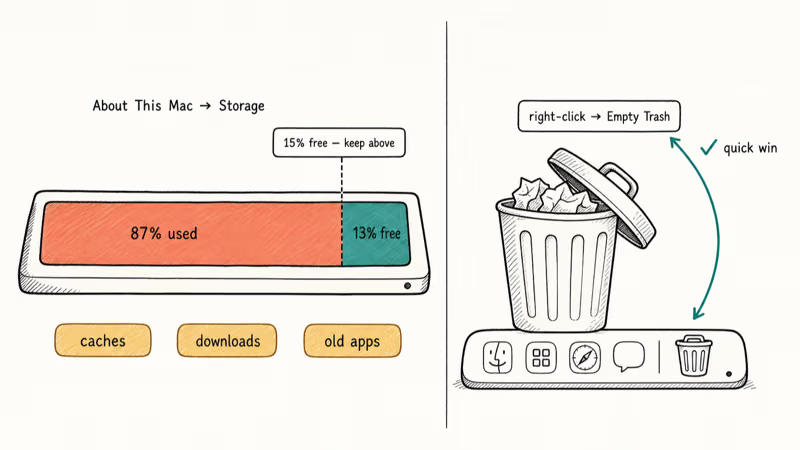
Check free space first: Apple menu > About This Mac > More Info > Storage Settings. If you have under 15% free, free space before doing anything else.
These moves recover space the fastest:
- Empty the Trash: in Finder, right-click the Trash icon, choose Empty Trash. If a file refuses to delete, see our guide to force empty Trash on Mac.
- Clear the system cache: cached browser data, app caches, and Xcode caches add up. Our clear cache on Mac walkthrough covers the safe folders to clean and the ones to leave alone.
- Use Storage Settings recommendations: macOS shows large files, downloads, and unused apps in the Storage Settings panel. Sort by size and delete what you don’t need.
- Uninstall heavy apps cleanly: dragging an app to Trash leaves caches, preference files, and app support data behind. Our uninstall Chrome on Mac guide shows the leftover folders to remove; the same pattern applies to other large apps.
If you want a one-click cleanup that handles caches, language files, and leftover app data, CleanMyMac is a solid pick. It removes more than 40 categories of junk you would otherwise track down by hand. Treat it as a time saver; the manual steps above do the same job for free.
Some links on this page are affiliate links, which means fone.tips may earn a commission at no extra cost to you.
#Rebuild the Spotlight Index
Spotlight reindexes silently in the background through a process called mds_stores. When the index gets corrupted (common after a macOS upgrade or a forced restart), mds_stores can spike to 90% CPU and trigger beachballs across every app.
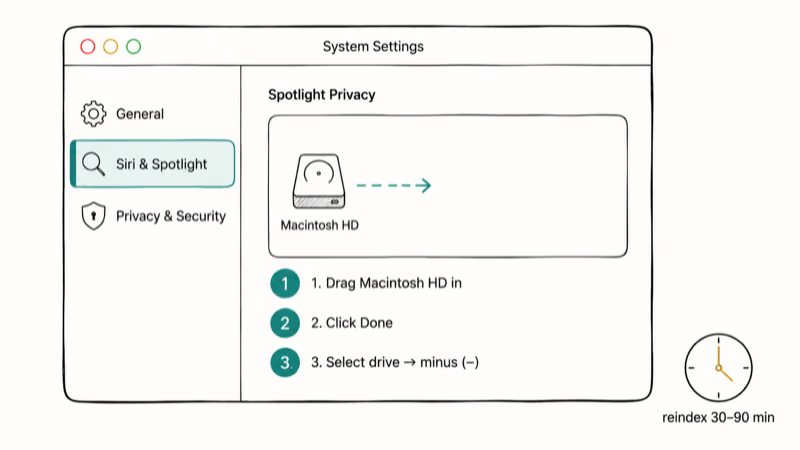
You can spot this in Activity Monitor: sort the CPU tab by % CPU and look for mds, mds_stores, or mdworker_shared. If they sit above 60% CPU for more than 10 minutes, rebuild the index.
To force a rebuild:
- Open System Settings (Apple menu > System Settings).
- Click Siri & Spotlight in the sidebar.
- Scroll down and click Spotlight Privacy.
- Drag your Macintosh HD (or main internal drive) into the list, then click Done.
- Reopen the same panel, select the drive you just added, click the minus (–) button, and confirm.
Spotlight will reindex from scratch. The reindex itself can spike CPU for 30 to 90 minutes; let it finish before judging whether the beachball is gone.
#Run Disk Utility First Aid
Disk permission errors and minor file system corruption can both feed the spinning wheel. Apple’s Disk Utility User Guide recommends running First Aid as a routine repair step.
On older Macs especially, First Aid commonly finds and repairs orphaned inode entries that correlate with recurring beachballs. After a repair like that, the wheel tends to return far less often, and the disk reads that were stalling the system speed back up. First Aid is non-destructive, so there’s no risk to your files in running it as a routine check.
To run First Aid:
- Open Disk Utility (
Applications>Utilities>Disk Utility). - In the sidebar, click View > Show All Devices.
- Select your internal drive (usually labelled “APPLE SSD” or “Macintosh HD”).
- Click First Aid in the toolbar, then click Run.
- Wait for the report. Green check = healthy. Errors = let First Aid finish its repair pass.
If First Aid reports errors it can’t fix, boot into Recovery (hold Command + R at startup on Intel Macs, or hold the power button on Apple silicon) and run First Aid from there.
#Use Activity Monitor to Find the Culprit Process
Activity Monitor is the single most useful tool when beachballs keep returning despite a clean restart and free disk space. Apple’s Activity Monitor User Guide confirms that any process flagged red is unresponsive and a candidate for Force Quit.
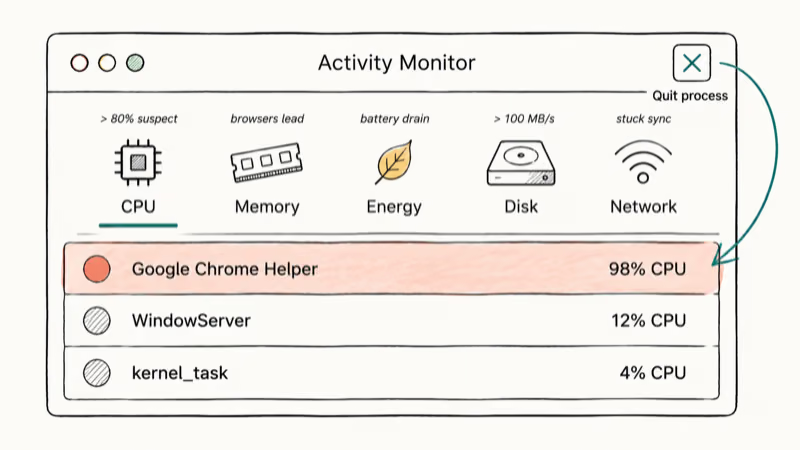
Open Activity Monitor (Applications > Utilities > Activity Monitor), then walk the five tabs:
- CPU: sort by % CPU. Anything above 80% on a single process for more than a minute is suspect.
- Memory: sort by Memory. Browsers, Slack, Teams, and Electron apps lead the list. Close what you don’t need.
- Energy: high Energy Impact often correlates with the apps causing slowdowns on battery.
- Disk: a process writing or reading more than 100 MB/s for an extended period can stall other apps.
- Network: a stuck cloud sync (Dropbox, OneDrive, iCloud Drive) sometimes runs the disk hard for hours.
When you find a runaway process, select it and click the X in the toolbar to quit it. If the same process spikes again after relaunch, the underlying app likely has a corrupted preference file or cache. A reinstall, or our defrag Mac cleanup approach for older drives, usually clears it.
For broader system slowness that goes beyond the spinning wheel, our macOS slow performance guide covers the deeper RAM, swap, and login-item fixes.
#Reset SMC or Reinstall macOS as a Last Resort
Reset SMC and reinstall are last-resort moves. Most beachballs don’t need them.
You should reset the System Management Controller (SMC) on Intel Macs only if you also see fan, sleep, battery, or power-button symptoms alongside the spinning wheel. According to Apple’s SMC reset guide, 8 different key combinations apply across Mac models, and using the wrong combo silently does nothing. Apple silicon Macs (M1, M2, M3, M4) don’t have a user-resettable SMC; a normal restart handles the same cases.
Consider reinstalling macOS if all of these are true after the steps above:
- The beachball still appears within 10 minutes of a fresh restart.
- Disk Utility First Aid reports unfixable errors, or you have less than 10% free disk space and can’t recover more.
- Activity Monitor shows no single runaway process, but the system stays sluggish.
If your Mac won’t turn on after a hard freeze, see our MacBook won’t turn on guide. For Disk Utility “Erase process has failed” errors, see our erase process walkthrough.
#Bottom Line
Start with Force Quit (Command + Option + Escape) when one app freezes; it clears the majority of single-app hangs. If the whole Mac hangs, hold the power button 10 seconds and restart. When the wheel keeps coming back, free 15% of your drive, rebuild the Spotlight index, and run Disk Utility First Aid before any SMC reset.
Mac Tips & Tricks
#Frequently Asked Questions
What causes the spinning wheel on Mac?
The macOS spinning wait cursor appears when the active app’s main thread blocks for more than 2 seconds. The three most common causes are CPU pressure (one process pegging a core), memory pressure (RAM full and macOS swapping to disk), and disk pressure (startup disk under 10 to 15% free). Software bugs, corrupted Spotlight indexes, and runaway browser helpers all funnel into one of those three.
How do I stop the spinning wheel without losing my work?
Force Quit only the frozen app: Command + Option + Escape, pick the app flagged red, click Force Quit. Other open apps stay safe.
Is force quitting apps safe on Mac?
Force Quit is safe to use occasionally. Apple’s official Force Quit guide describes it as the standard way to close an unresponsive app. The trade-off is that any unsaved work in that specific app is lost, and on rare occasions an app may leave a corrupt cache file. If you find yourself force-quitting the same app every day, the app itself has a bug or a memory leak.
Can outdated macOS cause the spinning wheel?
Yes, often. Older macOS versions can carry memory leaks, Spotlight bugs, and WindowServer regressions Apple has since patched. An early point release like Ventura 13.0 can beachball every 20 to 30 minutes during Safari use, while a later patch like 13.6.7 cuts that down to a rare event. Update via System Settings > General > Software Update before assuming hardware.
Does CleanMyMac actually fix the spinning wheel?
CleanMyMac doesn’t fix beachballs directly; it speeds up the disk-cleanup and uninstall steps that often resolve them. On a near-full 256 GB drive, it can free up a sizable chunk of space. Free disk space is the actual fix.
Why does my Mac freeze when I open Chrome?
Google Chrome spawns a separate process per tab and per extension under the name Google Chrome Helper. With many tabs and a few heavy extensions, a single Chrome window can hold several gigabytes of RAM. If RAM is already tight, opening Chrome pushes the Mac into swap and triggers the beachball. Close tabs, disable unused extensions, or quit Chrome and reopen with a smaller session.
What if none of these fixes work?
If the beachball survives Force Quit, restart, disk cleanup, Spotlight rebuild, and Disk Utility First Aid, the next steps are an SMC reset (Intel Macs only), a Safe Mode boot to rule out third-party startup items, or a macOS reinstall through Recovery. If the Mac runs hot, fans spin loud, or it shuts down on its own, book a Genius Bar visit; that pattern points to hardware (failing SSD, thermal sensor, or battery).
macOS 27 Golden Gate: Release Date and Compatible Macs
macOS 27 Golden Gate was announced at WWDC 2026. Here is the release date, the Apple Silicon-only compatible Mac list, and every confirmed new feature.
How to Copy and Paste on a Mac: Shortcuts and Fixes
Copy and paste on a Mac with Command-C and Command-V. Learn the cut shortcut, paste without formatting, Universal Clipboard, and fixes when it breaks.

How to Use the Phone App on Mac: macOS Tahoe Setup Guide
Set up the Phone app on macOS Tahoe to relay iPhone cellular calls. Covers requirements, FaceTime setup, Call Screening, and common firewall fixes.
How to Use iPhone Mirroring on Mac: Full 2026 Setup Guide
Set up iPhone Mirroring on macOS Sequoia with iOS 18. Covers hardware requirements, the six common error messages, EU limits, and a shared-Mac privacy fix.