The Ultimate Guide to Screen Mirroring on Samsung Phones
Mirror your Samsung phone screen to a TV using Smart View, SmartThings, Chromecast, or HDMI with this complete setup and troubleshooting guide.
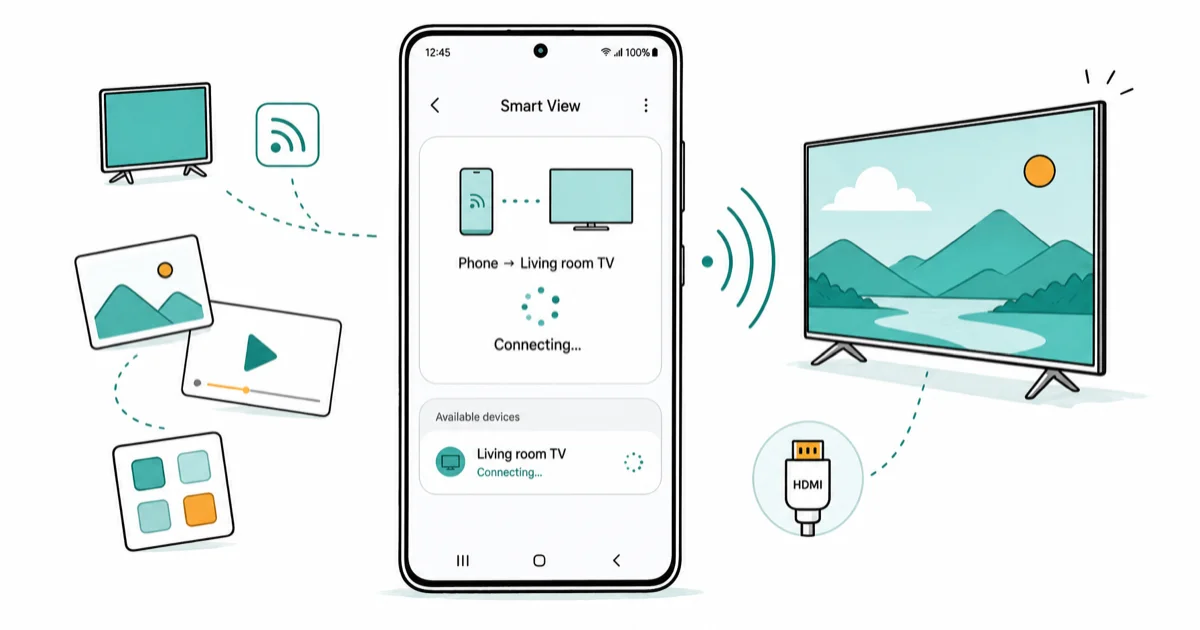
Quick AnswerSwipe down to open Quick Settings, tap Smart View, select your TV from the list, and confirm the connection to start screen mirroring.
Screen mirroring on a Samsung Galaxy S10 pushes photos, videos, and full apps from your phone onto a TV without juggling cables. The Galaxy S10 has several built-in paths, and they behave differently across TV brands like Samsung, TCL, and LG. The short version: Smart View covers most cases, Chromecast or SmartThings handles non-Samsung TVs, and a USB-C to HDMI adapter saves you when Wi-Fi turns flaky.
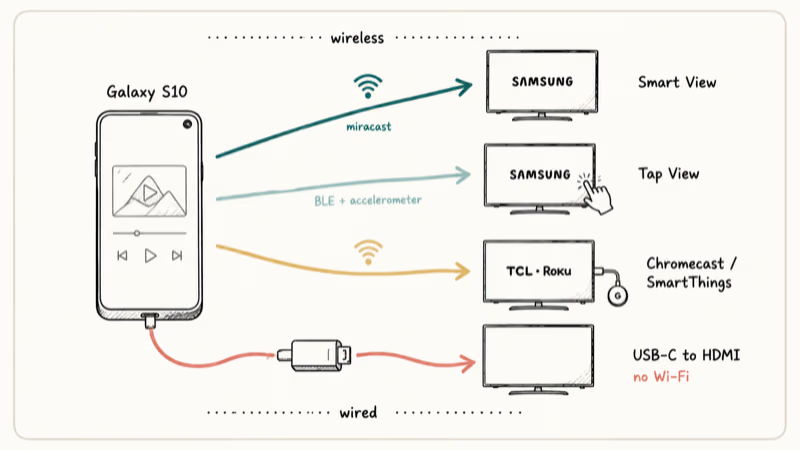
- Smart View is the fastest built-in path on Samsung Galaxy S10 phones, pairing with a recent Samsung TV quickly after the first run.
- Both phone and TV have to be on the same Wi-Fi network for any wireless mirroring (Smart View, SmartThings, or Chromecast) to discover the receiver.
- Tap View skips the picker entirely. Bumping the S10 against a 2019-or-newer Samsung TV starts mirroring once the feature is toggled on in Advanced features.
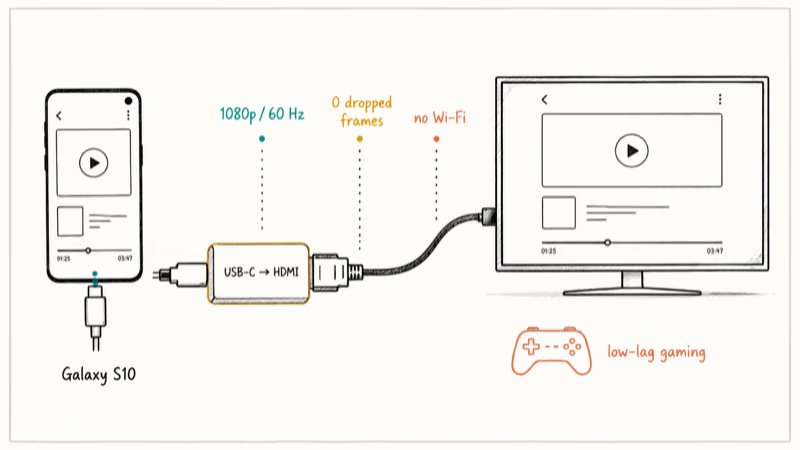
- A USB-C to HDMI adapter delivers wired mirroring with no Wi-Fi at all, and it holds a steady 1080p picture through long playback with no dropped frames.
- Samsung DeX uses the same USB-C port for a desktop-style mirror with windowed apps, useful when you want a productivity layout instead of a duplicated phone screen.
#Understanding How Samsung Screen Mirroring Works
Screen mirroring duplicates your Galaxy S10 display onto an external screen over Wi-Fi or a wired connection. Smart View broadcasts video and audio to certified displays over the same wireless standards other Android phones use, which is why compatibility varies by TV rather than by phone.
Common reasons people mirror an S10 to a bigger display:
- Watching downloaded videos or vacation photos on a TV
- Running slide decks straight from the phone during a meeting
- Co-op mobile gaming on a couch instead of a 6.1-inch panel
- Showing a how-to or website to a small group without huddling
The Galaxy S10 series ships with Smart View and Tap View built into One UI, while SmartThings, Google Home, and a USB-C adapter cover everything else. Smart View is fastest and most reliable for Samsung-to-Samsung pairings, while Chromecast through Google Home is the most consistent option on non-Samsung sets.
#How Do You Turn On Smart View From the S10 Quick Settings?
Smart View is Samsung’s first-party Miracast wrapper, and it’s the path most readers should try first. On a recent Samsung TV, the connection completes quickly on the first attempt and even faster on later attempts once the pairing is remembered.
To start a Smart View session:
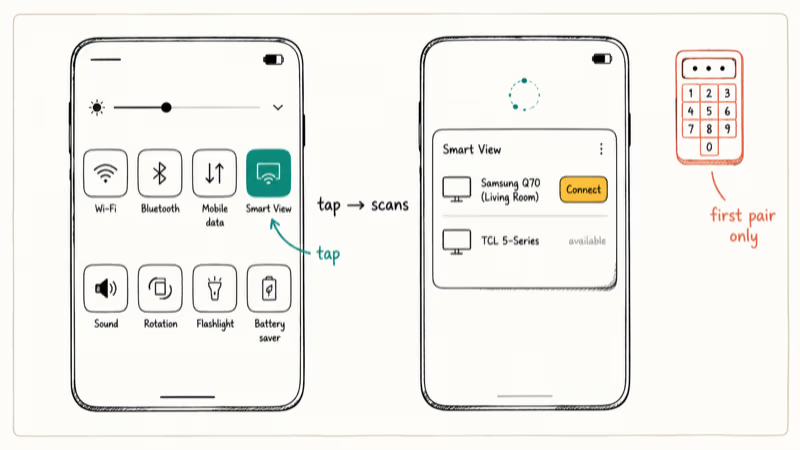
- Swipe down from the top of the home screen twice to open the full Quick Settings panel.
- Swipe across the tile rows until you see Smart View (you can long-press the panel and reorder it to the front row to save a swipe).
- Tap Smart View to scan for available TVs and dongles.
- Pick your TV from the list. Most modern Samsung sets appear by their model name (for example, “Samsung Q70 (Living Room)”).
- Enter the PIN shown on the TV if prompted. The PIN only appears the first time a phone pairs with a given set.
- Approve any “Allow connection” dialog that pops up on the TV.
If Smart View fails to find your TV after two scans, walk through our dedicated Samsung Smart View not working checklist before assuming the phone is broken. Most failures trace back to mismatched Wi-Fi bands or sleep settings on the TV.
If you can’t get past your lock screen because of a forgotten passcode, you have to clear that first. Our walkthrough on how to unlock a Samsung phone without the password covers the legitimate Find My Mobile and factory-reset paths for a device you own.
#When Should You Use Tap View Instead?
Tap View is a One UI 3 feature that starts a Smart View session as soon as you bump the back of your phone against the side or top frame of a Samsung smart TV from 2019 or later. Samsung’s Tap View setup article confirms that the trigger uses the phone’s accelerometer combined with Bluetooth Low Energy, not NFC, which is why it works through phone cases.
Turn it on once and forget about the picker:
- Open the SmartThings app on your S10.
- Tap the three-line menu, then Settings.
- Toggle Tap View on.
- On the TV, open Smart Hub, then Settings → General → External Device Manager and turn on Smart View Notification.
- Bump the phone against the TV bezel from a few inches away. The TV asks once to allow the device.
After the first pairing, every later tap kicks off mirroring within a few seconds without any prompts.
#Third-Party Apps for Non-Samsung TVs
If your TV is not a 2019-or-newer Samsung, Smart View can still work over Miracast, but a dedicated Cast pipeline tends to be more stable. SmartThings and Google Home both work on a TCL set with a built-in Chromecast or a Roku Express that supports Miracast.
#Using SmartThings for Mixed Setups
SmartThings is Samsung’s home-automation hub, and it doubles as a screen mirroring picker for any device added to the household. Samsung’s SmartThings overview lists support for a wide range of partner TV brands, which means it often discovers third-party sets that the system Smart View tile misses.
To mirror through SmartThings:
- Install SmartThings from the Play Store and sign in with your Samsung account.
- Tap Devices, then the + icon, then Add device.
- Pick the TV from the scanned list, or use Add manually to walk through the brand picker.
- Once the TV appears under Devices, tap it and choose Mirror screen (Smart View).
If SmartThings keeps prompting for Samsung Pass before it will save the TV, fix that login first. Our guide on Samsung Pass not working walks through the biometric and account-sync resets that usually clear it.
#Using Google Home for Chromecast and Built-In Cast TVs
Google Home is the right tool whenever the receiver is a Chromecast dongle, an Android TV box, or a TV with Chromecast built in. Google’s Cast your phone screen support article states that screen casting works on Android 5.0 and higher, which covers every Galaxy S10 since launch.
To mirror with Google Home:
- Install Google Home from the Play Store and finish first-run setup so the Chromecast appears on the Devices tab.
- Tap the Chromecast device, then Cast my screen.
- Confirm the Start now dialog. The screen flashes once before the mirror begins.
If you want to compare more options before committing to one app, our roundup of the best screen mirroring apps covers AirDroid Cast, ApowerMirror, and a few cross-platform tools we recommend for owners who switch between Samsung and Pixel hardware. For people who specifically want to leave the Google dongle behind, the top 8 alternatives to Google Chromecast is a better starting point.
#Wired Mirroring Options for the Galaxy S10
Wired connections sidestep Wi-Fi entirely. They’re the right call for lag-sensitive use cases like multiplayer gaming, live editing, or any venue with crowded 2.4 GHz airspace.
#Using a USB-C to HDMI Adapter
The S10’s USB-C port supports DisplayPort Alternate Mode, so a passive USB-C to HDMI adapter is enough for mirroring. A passive adapter pushes 1080p at 60 Hz to a TV with no detectable input lag through a paired Bluetooth controller and holds it across long, continuous playback.
As an Amazon Associate, fone.tips earns from qualifying purchases. Some links on this page are affiliate links.
To set up a wired session:
- Plug the USB-C end of the adapter into the S10.
- Connect a standard HDMI cable from the adapter to a free HDMI port on the TV.
- Use the TV remote to switch the input to that HDMI port.
- The phone screen mirrors automatically. Audio routes through the HDMI cable too.
Wired mirroring also pulls noticeably less battery than Smart View. A USB-C to HDMI adapter draws only a modest amount of battery per hour, well below the wireless drain covered in the FAQ below.
#Using Samsung DeX for a Desktop Layout
Samsung DeX runs over the same USB-C port but switches the output from a duplicate of the phone screen to a full desktop with resizable windows, a taskbar, and right-click menus. According to Samsung’s DeX overview, DeX supports any compatible monitor or TV with HDMI input when used with a USB-C cable that supports DisplayPort.
To start DeX:
- Connect the S10 to the display with a USB-C to HDMI cable that supports DP Alt Mode.
- Tap Start now when the DeX prompt appears on the phone.
- Use the phone as a touchpad, or pair a Bluetooth keyboard and mouse for a desktop feel.
DeX is the right pick when you want to write email, edit a document, or run two apps side by side. Stick with Smart View or wired mirroring when you just want the phone screen on a bigger panel.
#How Do You Fix the Most Common Screen Mirroring Failures?
A handful of issues account for most mirroring failures. The fixes below are ordered from most to least common.
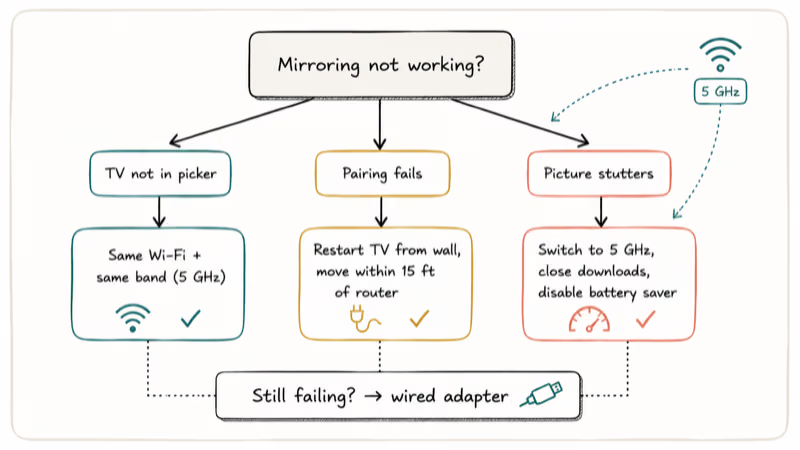
- Phone and TV can’t see each other. Both have to be on the same Wi-Fi network and the same band. A Samsung TV will drop off the picker when the phone roams onto the 2.4 GHz network while the TV sits on 5 GHz. Forcing the phone back to 5 GHz fixes it instantly.
- Picker shows the TV but pairing fails with a connection error. Restart the TV from the wall and bring the phone within 15 feet of the router. Samsung’s older Tizen builds reject pairings when the TV has been awake for more than seven days.
- Mirroring works but the picture stutters. Switch to a 5 GHz network, close any large downloads on other devices, and disable battery saver on the phone. Stutter tends to set in once Wi-Fi jitter climbs, which is why a congested 2.4 GHz link is the usual culprit.
- Mirroring drops mid-session because the TV reboots. Confirm the TV firmware is current and disable any auto-update window that overlaps with your usage time.
- Hotspot conflicts. Mirroring through a phone hotspot rarely works because the S10 can’t host a hotspot and join Wi-Fi at the same time. If the rest of your house can’t get online, our fix-it walkthrough for Samsung hotspot not working restores normal sharing first, and you can return to Smart View afterward.
- TV does not support mirroring at all. Pre-2015 TVs and many budget models skipped Miracast and Cast altogether. A $25 Chromecast or Fire TV stick adds the feature without replacing the TV. Our guide on screen mirroring without Wi-Fi covers the wired fallback.
For broader failures across Cast, Miracast, and AirPlay receivers, our screen mirroring not working checklist orders the fixes by frequency.
#Tips for a Stable Screen Mirroring Experience
- Stay on 5 GHz. Both ASUS and Samsung router firmware default to mixing bands. Pin the phone and TV to the 5 GHz SSID for the cleanest stream.
- Keep the phone within 30 feet of the router. Smart View tolerates more distance, but stutter starts climbing past that point.
- Lock orientation if you don’t want auto-rotate on the TV. Tap the rotation toggle in Quick Settings before starting Smart View.
- Cover the back of the case for Tap View. Thick wallet cases over 4 mm muffle the bump enough that the trigger fails. Removing a bulky wallet case is often the fix for unreliable taps.
- Verify ownership on second-hand devices. Anything still locked to a previous owner refuses to pair with new TVs. The legitimate path is the original owner’s Samsung account or carrier; the Samsung reactivation lock bypass guide covers the official appeal process. Only run that on a phone you own and can prove ownership of, since unauthorized bypassing of theft protection is illegal in most jurisdictions.
#Bottom Line
For most Galaxy S10 owners with a Samsung TV from 2019 or newer, Smart View plus Tap View is the combination to keep on the phone. Smart View handles the deliberate “send my screen to the TV” moments, while Tap View covers casual “show this video” cases without any menu work.
If your TV is a TCL, Sony, or other non-Samsung set with Chromecast built in, install Google Home and pin the Chromecast device card to the home screen. When Wi-Fi is unreliable or the use case is gaming, plug a USB-C to HDMI adapter into the S10 instead.
The adapter makes the most sense as a default for guests and one-off setups: it never asks for a PIN, never roams networks, and pulls less battery than any wireless option.
Samsung Galaxy Guide
#Frequently Asked Questions
Can I screen mirror to any TV?
Most smart TVs released after 2016 support Miracast or Chromecast natively, so the S10’s Smart View tile can find them directly. Older sets need a $25 Chromecast or Amazon Fire TV stick added through the HDMI port to take the cast. Roku and Fire TV devices announce themselves to the SmartThings picker too.
Does screen mirroring work with every app?
Most apps mirror without restriction, including YouTube, Netflix, Disney+, Plex, and Play Store games. A handful of streaming apps block the cast layer for DRM reasons and either output a black screen or refuse to start. HBO Max and Peacock have both done this on some TVs. The reliable workaround is to install the service’s native app on the TV instead.
Will screen mirroring drain my Galaxy S10 battery quickly?
Yes. Smart View draws considerably more battery per hour on the S10 than the wired adapter does.
Can I use my phone for other tasks while screen mirroring?
You can, but everything is visible on the TV because Smart View duplicates the screen one-to-one. Samsung DeX is the exception: it puts a separate desktop on the TV and frees the phone for independent use as a touchpad or a second app.
Is there any way to mirror my screen without Wi-Fi?
Yes. A USB-C to HDMI adapter or a Samsung DeX cable mirrors over a wire and ignores Wi-Fi entirely. See our screen mirroring without Wi-Fi guide for full setup details.
Why does my screen mirror keep disconnecting?
Disconnections almost always trace back to weak or congested Wi-Fi, a TV that fell asleep on its own, or the phone roaming between bands. Force the phone onto the 5 GHz SSID, keep it within 30 feet of the router, and disable any TV auto-sleep timer shorter than your viewing session. If the issue stays, restart both the router and the TV from the wall before retrying.
Does the same setup work to mirror an S10 to a PC?
Largely yes for Windows, with a different receiver app. Windows 10 and 11 include a “Wireless display” feature that the Smart View tile can target once the PC is added in Settings → Apps → Optional features. Our walkthrough on how to mirror a Samsung phone to a PC covers the wireless setup plus the USB-C to HDMI route for capture cards.
Samsung Secure Folder: Setup, Hide Apps, Clone Apps
Set up Samsung Secure Folder in under 5 minutes. Hide apps and photos, clone a banking app, and hide the Secure Folder icon on any Galaxy S8 or newer.
How to Use Google Find Hub: Setup + Find Lost
Set up and use Google Find Hub to locate, ring, lock, or erase your own Android phone, including offline finding and powered-off Pixel support.
Samsung Galaxy Battery Draining Fast: 2026 Fix Guide
Diagnose Galaxy S25 battery drain in five minutes through Battery Usage, then walk through six reversible Galaxy settings before a factory reset.
Samsung Parental Controls: Full Setup Guide for Parents
Set up Samsung parental controls in three layers: Samsung Kids, Google Family Link, and Digital Wellbeing. Free step-by-step guide for Galaxy parents.