PGSharp Pokemon Go: Why the Modded APK Costs You the Account
PGSharp violates Niantic's Pokemon Go terms, triggers shadowbans, then permanent bans. Here's what the modded APK risks and what to use instead.
Quick AnswerPGSharp is a modded Pokemon Go APK that bundles GPS spoofing and automation, which puts your account on the fast track through Niantic's three-strike enforcement to a permanent ban. Use Adventure Sync, the Pokemon GO Plus accessory, and Remote Raid passes to play more efficiently without breaking the rules.
PGSharp pitches itself as a shortcut. It’s a modded Pokemon Go APK that bolts GPS spoofing, a joystick, and auto-walk into one Android install. The trade looks easy until Niantic flags the trainer profile and the years of progress vanish in a single update cycle. This guide assumes you own the Niantic account in question and explains why the modded APK route is the most reliable way to lose it, plus the legitimate alternatives that cover the same use cases.
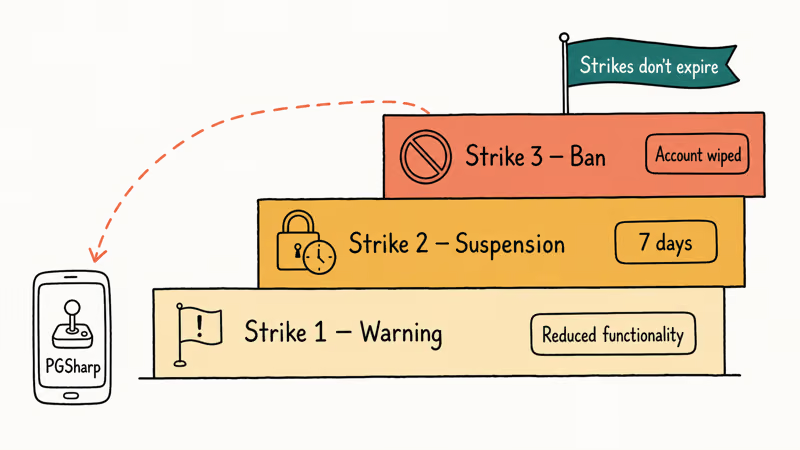
- Niantic’s three-strike policy escalates from a written warning to a 7-day suspension to a permanent ban for modded clients, GPS spoofing, and bot use as a single rule class
- PGSharp ships as a repackaged Pokemon Go APK signed by a third-party key, which fails Google Play Integrity attestation and any signature comparison Niantic runs server-side
- Shadowbans are silent. Rare spawns disappear, raid invites stop, and IVs lock to weighted-low values for roughly 7 days, often without the trainer noticing for the first three or four
- A permanent ban wipes Shiny Pokemon, Mythicals like Mew and Mewtwo, raid catches, Master League rank, and any progress already registered to Pokemon HOME from that account
- Adventure Sync, Pokemon GO Plus +, Remote Raid passes, and monthly Community Days replace the convenience PGSharp markets without exposing the account to enforcement
#What PGSharp Actually Is
PGSharp isn’t a companion tool.
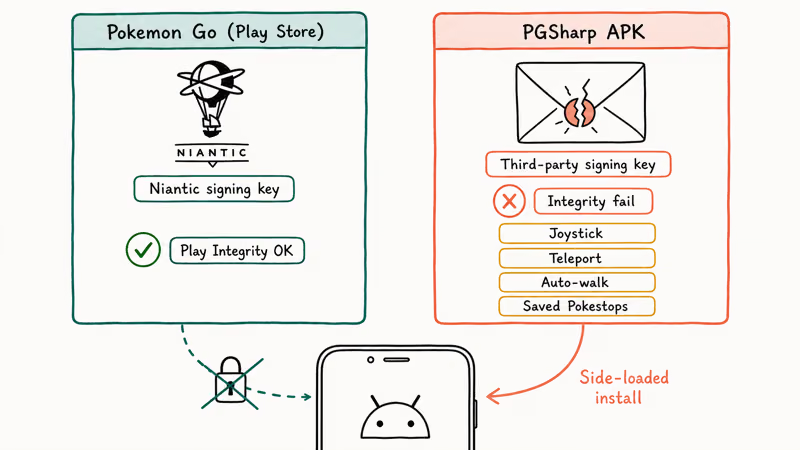
It’s a fork of the Pokemon Go Android client with extra menus welded on, distributed as a side-loaded APK that replaces the legitimate Play Store install. The bundled features are exactly the ones Niantic’s terms call out by name. A virtual joystick that lets the trainer move without walking, a teleport function that drops the avatar at any coordinate, an auto-walk feature for hatching eggs, and a saved-locations list for jumping between Pokestops.
Because the install is a modified client, every session signs requests with a key the official client never produced. Niantic’s own Play Store listing shows the legitimate signature; PGSharp can’t replicate it without breaking. According to Niantic’s Pokemon Go Terms of Service, modifying, decompiling, or distributing modified clients is a violation, as is “using bots, mods, or third-party software to interact with the Services.” PGSharp checks every box on that list.
The cost the marketing copy hides is account loss. Because the build runs under a third-party signing key, the integrity check fails at first launch even before any spoof movement is active. The flag stays on the trainer profile, so reverting to the legitimate client doesn’t undo the warning.
The trainer eats the strike. The APK doesn’t.
#Why Does Niantic Ban PGSharp Users?
Niantic’s stated reason is that modded clients and spoofing damage gameplay for trainers who walk. A spoofer who teleports between rare spawn nests claims encounters, gym slots, and PvP rankings that legitimate trainers spent hours earning. The integrity of every leaderboard, raid economy, and Community Day depends on each account being a real device in a real place.
The contractual reason is older.
Pokemon Go’s three-strike policy confirms that 3 escalations apply to cheat detection. Strike one is a warning paired with reduced functionality, strike two is a 7-day full suspension, and strike three is a permanent ban that wipes the trainer’s progress, badges, and Pokedex. Niantic’s documentation states that strikes don’t expire after any 12-month window. A warning issued in 2022 still counts toward the second-strike threshold today.
Detection isn’t binary either. Niantic announced periodic enforcement waves that sweep accounts with mod-signature traffic in batches, which is why some PGSharp users go months between strikes and then receive all three in the same week. The wave model also explains why “but my friend has been spoofing for two years” anecdotes don’t generalize. The wave hasn’t reached that account yet.
The third pressure is liability. According to the Wikipedia entry on the Pokemon Go community, Niantic has weathered multiple legal challenges from spoofers and emulator vendors since launch. The published policy ladder makes those defenses cleaner; an unambiguous published rule gives Niantic a stronger legal position than a discretionary enforcement model.
That’s why the rule book reads the way it does.
#How Does Pokemon Go Detect Modded Clients Like PGSharp?
This section stays deliberately high-level. Niantic doesn’t publish exact heuristics, and tutorials that walk through bypassing detection are exactly what the policy is designed to punish.
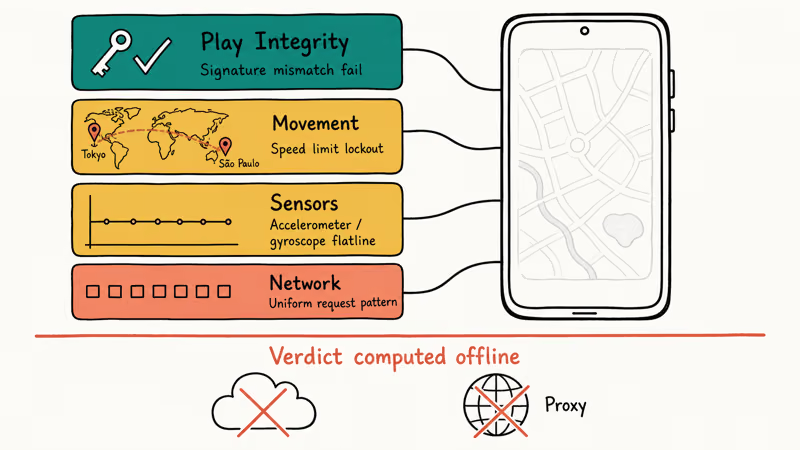
What public documentation does say is that Pokemon Go layers four signal types before the login screen even appears. According to Google Play Integrity, the attestation system that replaced SafetyNet returns a hardware-backed verdict that fails by design when the installed package signature doesn’t match the legitimate Play Store version. PGSharp can’t pass this check because it ships under a different signing key.
The client also checks for impossible movement patterns. A trainer’s GPS position can’t physically jump from Tokyo to São Paulo between two consecutive heartbeats; an account that does so trips the speed-limit lockout for several hours and adds a flag to the profile. The third signal is sensor consistency. Accelerometer, gyroscope, and barometer readings on a real phone follow a noisy human pattern, while a stationary device claiming to “walk” via PGSharp’s auto-walk shows perfectly flat sensor traces.
The fourth check compares network behavior. Real mobile sessions mix cellular, Wi-Fi, and motion patterns; rooted or modified clients tend to produce a flatter, more uniform request pattern. None of these checks need an internet round trip, which is why VPNs and proxies don’t help. The verdict has been computed before the request ever leaves the device.
A single PGSharp session can flag a Google account so that, even after logging back into the legitimate client, raid invitations and rare encounters dry up for days. The flag follows the trainer profile, not the device. Tools like iSpoofer for Pokemon Go and emulator setups like KoPlayer trip the same heuristics; switching mod brands isn’t a workaround.
The next ban arrives just as fast.
#What You Lose When the Account Goes Down
A permanent ban is not a reset. It’s a wipe.
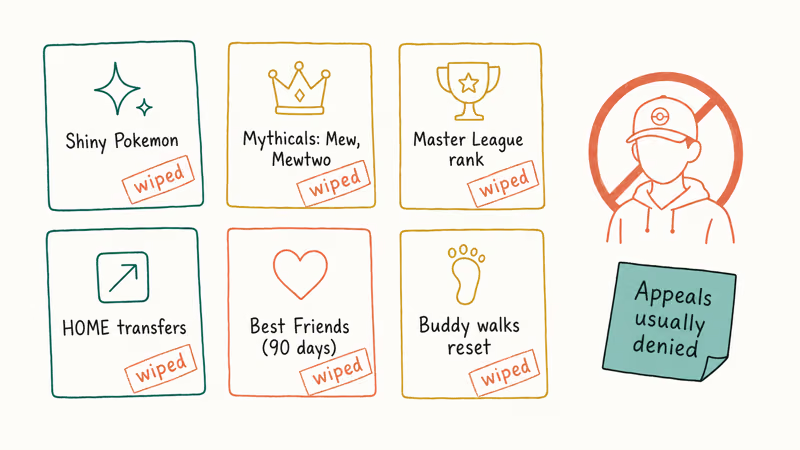
The trainer profile holds every Shiny Pokemon caught since launch, every Mythical like Mew, Celebi, Mewtwo, Genesect, Volcanion, Magearna, and Marshadow that came from one-shot research lines, every legendary raid catch, every EX Raid pass, and the current Master League rank. None of that recovers on appeal when the strike originated from a modded client install. According to Niantic’s enforcement appeals policy, appeals from trainers who admit modded software use are typically denied at the first review.
The damage extends past Pokemon Go. Pokemon Pass-Up to Pokemon HOME keeps a record of every Pokemon transferred from the banned account, but the original send-side account is the one that gets the credit for the catch. A banned trainer who already pushed legendary catches to HOME loses the future ability to pull them back into Pokemon GO under the same identity. Pokemon Trainer Club credentials stay tied to the ban as well, which complicates re-registering on a fresh account.
Buddy progression resets too. Best Buddies, the daily heart streaks, the postcard collection, the Mega Evolution residual energy, and the route registration history all live on the banned profile. Players who spent two seasons walking the same Charmander from buddy to Best Buddy face starting that 80-walk grind again on a fresh account, while also losing access to any seasonal rewards they redeemed during that period.
The most underrated cost is friendship rank. A Best Friend connection takes 90 days of in-person daily gifts to reach. Banned accounts disappear from every friend list they participated in, which means the friend on the other side loses that 90-day investment as well. Local raid groups can fragment after one member’s ban takes down several shared Best Friend slots and the lucky-trade unlocks attached to them.
That damage spreads beyond your own profile.
#What Shadowbans Look Like in Practice
Niantic’s shadowban is silent.
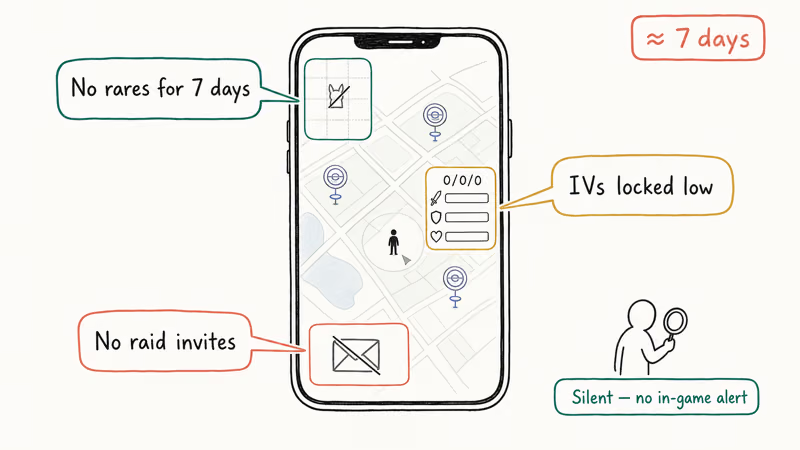
Gameplay continues. The map still loads, Pokestops still spin, and the trainer can still hatch eggs. What changes is the spawn pool. Rare Pokemon stop appearing in the Nearby radar, raid lobbies fail to send invites, and IVs on caught Pokemon either lock to 0/0/0 or weight heavily toward poor stats.
Trainers often spend three or four days assuming the spawns are just bad before they notice the pattern. Every encounter for the past week has been a common, low-IV duplicate. Niantic’s published guidance recommends waiting out the soft ban for around 7 days while making no further policy violations, then checking whether normal spawn variety returns.
The real cost of the shadowban is event-shaped. Community Day events run on Saturdays once a month and depend on spawn boost rates that the shadowban hides entirely. A trainer flagged on a Tuesday will see the next Saturday’s Community Day pass with no Shiny rate, no boosted move, and no encounters of the featured Pokemon. The same applies to raid weekends, GO Fest tickets, and Spotlight Hour bonuses.
None of these refund.
Compounding the issue, the shadowban changes the in-game support form’s response. Tickets filed during a shadowban are throttled and often closed without a human review; the support team triages around active soft bans because the account is already flagged. The fastest way to confirm a shadowban is to catch 10 common Pokemon in a row and check whether any IV reaches 67% or higher.
#The Legitimate Ways to Play More Efficiently
Most trainers reach for PGSharp for one of three reasons. They want to hatch eggs without walking, they want to catch raids in cities they don’t live in, or they want to fill a daily quota when they’re stuck inside. Pokemon Go has shipped enough first-party features over the past three seasons that none of those needs require modding the client.
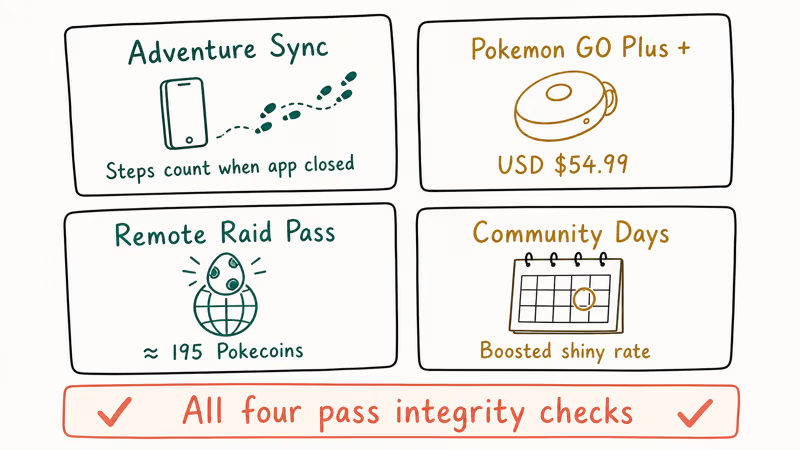
Adventure Sync is the official Apple Health and Google Fit integration. Open Settings inside Pokemon Go, scroll to Adventure Sync, and connect your fitness data source. Walking distance counts toward egg hatching, buddy candy, and the weekly fitness rewards even when the app is closed.
Step counts come from the phone’s built-in pedometer, so you don’t need to leave the screen on.
Pokemon GO Plus + is the second-generation auto-spin and auto-catch accessory, priced at USD $54.99. The original Pokemon GO Plus runs USD $34.99 and still works with the current client. Both devices auto-spin Pokestops and auto-throw Premier Balls at nearby Pokemon while the phone stays in your pocket, and the Plus + adds sleep tracking that hatches eggs overnight. Niantic explicitly endorses these accessories, so they pass every integrity check.
Remote Raid passes are the answer for people who want raid catches without traveling. Each pass costs around 195 Pokecoins (roughly USD $1.99 at standard exchange) from the in-game shop, with discounted multi-pass bundles, and lets you join any raid lobby in the world. They cover Mythical raids and any other lobby without the account ever leaving the legitimate client.
Community Days run on the second Saturday of most months and are the fastest legitimate path to Shiny rare Pokemon. The featured species appears at boosted spawn rates for three hours along with an exclusive learnable move, which is the closest thing to a teleport-to-spawn-nest experience that exists in the legitimate game. The featured Pokemon list publishes a month in advance on the Pokemon Go official news page, so you can plan around it.
For accessibility-related travel limitations, Pokemon Go ships an in-app accessibility settings panel under Settings > Accessibility. Distance-based features like egg hatching scale with walking speed and the game accepts wheelchair and stroller pace as valid movement. The accessibility settings are the safe path; don’t treat a real accessibility need as justification for modded software, since the ban consequences hit the same way regardless of the trainer’s circumstances.
For trainers who specifically want a bigger screen, screen mirroring an Android phone to a Windows or Mac display through Phone Link or AirPlay is one of the rare setups where the convenience of a big monitor doesn’t cost you compliance. The phone still does the actual game work, the integrity check still sees a real device, and the mirror just shows a copy of the screen.
#Bottom Line
PGSharp is a working modded APK and a fully functional broadcast signal to Niantic’s anti-cheat. If your goal is to keep the account you’ve invested years and dozens of Community Days into, uninstall PGSharp today, reinstall the legitimate Pokemon Go client from the Play Store, and lean on Adventure Sync, Pokemon GO Plus +, and Remote Raid passes to fill the convenience gap.
The single recommendation from this guide is specific: don’t sign your main trainer into a PGSharp build, even once. Niantic’s published 7-day soft ban window is the warning shot. The strike attached to the profile is permanent, and the cost of starting fresh climbs every season as new features lock behind level 30 or higher.
Pokémon GO Guide
#Frequently Asked Questions
Is PGSharp safe to use on Pokemon Go in 2026?
No. Niantic’s three-strike policy treats modded APKs as an immediate violation, and the modded client signature fails Play Integrity at install. The risk is permanent account loss, not a temporary inconvenience. The “safe” framing on PGSharp’s own marketing reflects the vendor’s interest, not Niantic’s enforcement record.
Will Niantic ban my account just for installing PGSharp without using it?
No. The ban triggers on Pokemon Go launching inside the modded APK, not on the file sitting in your downloads folder. That said, an accidental tap on the wrong icon can flag the profile in seconds, so deleting the APK entirely is the safer path.
Can a VPN hide that I’m using PGSharp?
A VPN moves your IP address but doesn’t change the Play Integrity attestation, which is what flags the modded client in the first place. The verdict has been computed before any request leaves the device. Switching VPN providers, regions, or protocols has no effect on the integrity result.
How long does a Pokemon Go shadowban last after a PGSharp flag?
A shadowban triggered by a single PGSharp session typically runs about a week before rare spawns reappear. Niantic doesn’t publish a precise table, and longer locks of two to three weeks have been reported for repeated offenses. Saving daily screenshots of your Nearby radar helps confirm which spawns the shadowban actually muted.
Is there a legitimate way to play Pokemon Go without walking?
Yes. Adventure Sync counts steps from your phone’s pedometer while the app is closed, Pokemon GO Plus + auto-spins Pokestops and catches Pokemon while you sit, and Remote Raid passes let you join raids worldwide. None of these break any rule, and all three replace the convenience PGSharp markets without putting your trainer profile at risk of a permanent ban.
What happens if my friend logs into my account from PGSharp?
The strike attaches to the trainer profile, not the device. If a friend logs into your account on their PGSharp install and triggers the integrity check, the warning, suspension, or ban moves to your account when you log in next. The strike record is held server-side on Niantic’s infrastructure and isn’t affected by the client used to trigger it.
Should I appeal a Pokemon Go ban from PGSharp use?
Appeals filed by trainers who admit modded software use are typically denied at first review. Niantic’s appeal process is designed for trainers who were flagged in error, such as a Pokemon Go multi-account misclassification. Modded client cases are documented and harder to overturn, which is why prevention beats appeal.
Can I fix a Pokemon Go location error without using PGSharp?
Most “failed to detect location” issues come from high-accuracy mode being disabled in Android location settings or Background App Refresh being off on iOS. Switching those toggles back on resolves the issue on a real phone in under a minute. None of those steps require modded software or third-party GPS overrides.
Pokemon GO GPS Signal Not Found: 7 Proven Fixes (2026)
Pokemon GO GPS signal not found? Seven ordered fixes for Android and iPhone covering precise location, permissions, mock-location, and more.
TweakBox Pokemon GO Review: Does It Still Work in 2026?
TweakBox Pokemon GO usually fails. Learn why, what Niantic's ban policy means for your account, and which official alternatives to use instead.
How to Auto Walk in Pokemon GO: Safe and Risky Methods
Learn how Pokemon GO Adventure Sync credits real activity, why fake-step and GPS tools risk account strikes, and which official options to use.
How to Find Magikarp Nests in Pokemon GO (2026 Guide)
Find Magikarp nests in Pokemon GO using community maps, water biomes, and rainy weather boosts. Plus candy farming tips to evolve Gyarados fast.