How to Mirror Your Phone to Your Car Screen (2026)
Mirror your phone to your car screen with Android Auto, CarPlay, wireless adapters, or HDMI cables. Setup steps, safety tips, and troubleshooting.
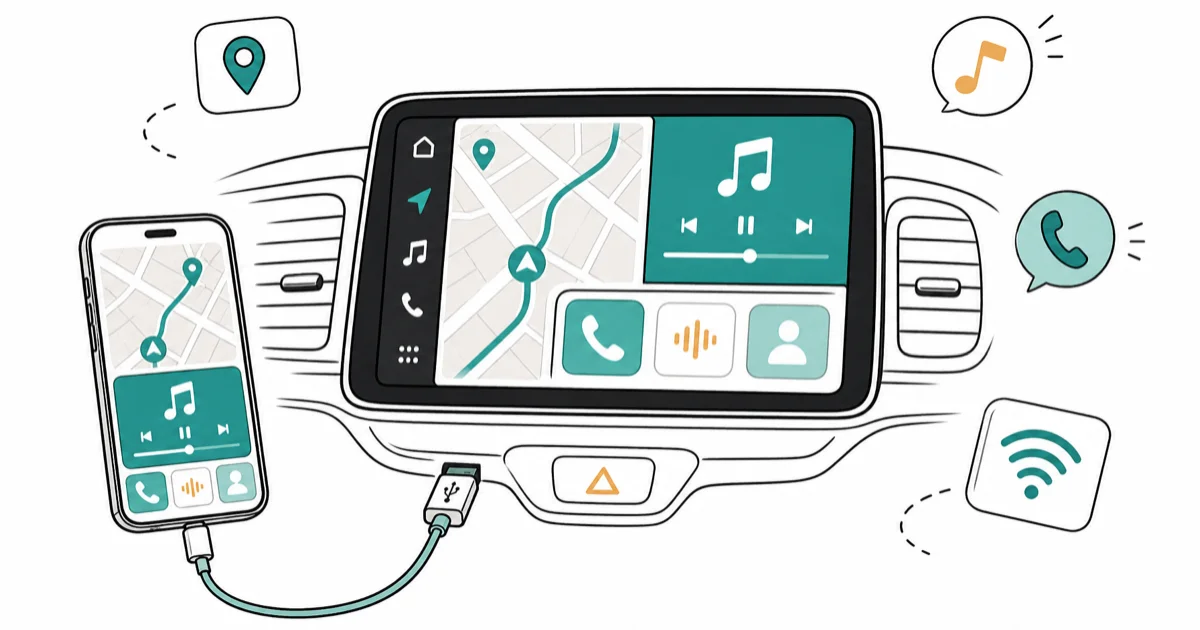
Quick AnswerUse Android Auto for Android phones and Apple CarPlay for iPhones. Plug into your USB data port, accept the prompts on the head unit, and your maps, music, and calls move to the car screen. Older cars without built-in support need a wireless adapter or an aftermarket head unit.
Mirroring your phone to your car screen puts maps, music, and calls onto the dashboard so your hands stay on the wheel. The two systems most drivers use are Android Auto and Apple CarPlay, and almost every new car sold in the US since 2018 supports at least one. This guide covers wired and wireless setup on both, plus the aftermarket options for older cars and common fixes for stuck pairing.
- Android Auto runs on Android 8.0 and higher; CarPlay runs on every iPhone since the iPhone 5 with iOS 7.1 or later.
- Wired Android Auto and CarPlay use the car’s USB data port plus a known-good cable, not a charge-only cable.
- Wireless Android Auto and wireless CarPlay use Bluetooth for pairing and a 5 GHz Wi-Fi link for the screen, so both your phone and head unit must support that combo.
- Aftermarket head units with Android Auto and CarPlay start around 200 USD, and dongles like the Motorola MA1 add wireless to wired-only systems.
- Free-form screen mirroring while driving is illegal in most US states, so anything beyond the in-car interface should be reserved for parked use.
#What Phone-to-Car Mirroring Actually Does
Mirroring here is a narrow, driving-safe handoff, not a desktop screen share. The car screen acts as a touch surface and speaker; the heavy compute stays on the phone.
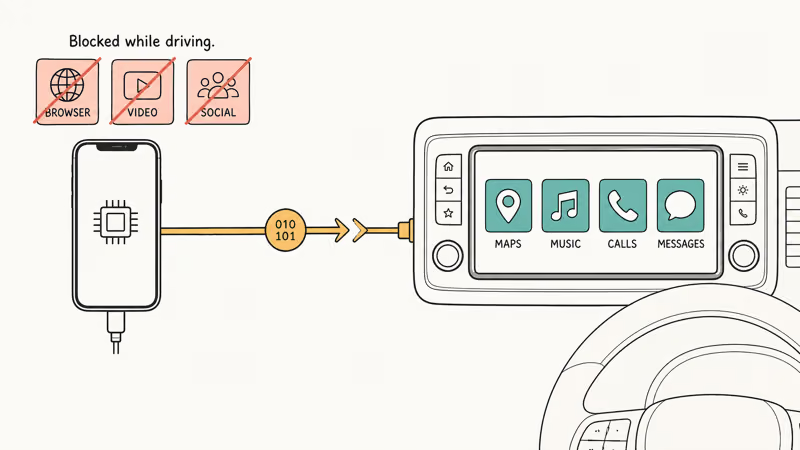
According to Apple’s CarPlay overview page, CarPlay supports Apple Maps, Music, Messages, Phone, and a long list of third-party apps including Waze, Google Maps, Spotify, and Audible. Google’s Android Auto help center confirms that Android Auto follows the same model and limits the on-screen apps to navigation, audio, calling, and messaging tools that have passed Google’s driving-safety review.
What you can’t do, on either platform, is mirror the entire phone display. Browsers, video apps, and social feeds are blocked while the car is moving. That restriction is the point, not a bug.
#Setting Up Android Auto Step by Step
Android Auto is the simplest path for any phone running Android 8.0 or higher. On a Pixel, Galaxy, or Motorola, the app is preinstalled and the only on-phone toggle is Settings > Connected devices > Connection preferences > Android Auto.
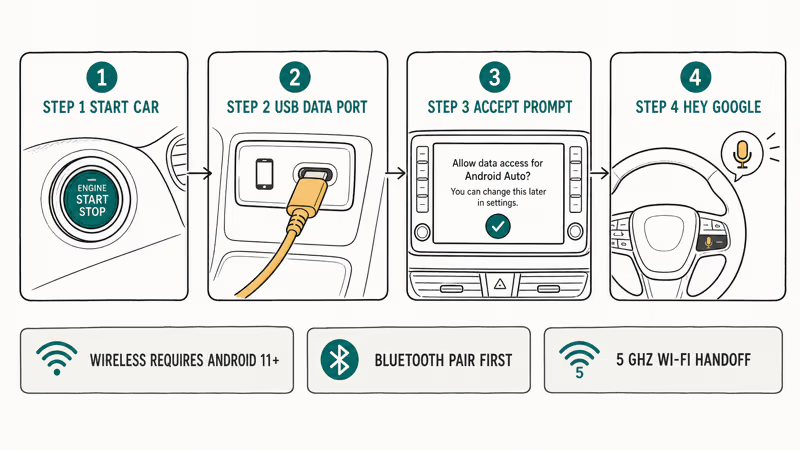
For a wired setup:
- Start the car so the head unit is awake.
- Plug your phone into the car’s USB data port using the cable that shipped with the phone or another known-good data cable.
- Tap the Android Auto prompt that appears on the head unit and accept the on-phone permission dialog.
- Use voice commands by saying Hey Google or pressing the steering wheel voice button.
For a wireless setup, both the phone and the head unit need to support wireless Android Auto, which requires Android 11 or later on most phones and a head unit certified for the wireless protocol. Google’s Android Auto setup guide recommends pairing over Bluetooth first, then letting the head unit hand the projection over to a 5 GHz Wi-Fi link.
If you own a Pixel, the screen mirroring on Google Pixel walkthrough covers the device-specific quirks that come up on Pixel 6 through Pixel 8. For navigation, our Waze on Android Auto guide explains how to pin Waze as the default route app instead of Google Maps.
#Setting Up Apple CarPlay (Wired and Wireless)
CarPlay is built into iOS and turns on the moment you plug a CarPlay-certified iPhone into a CarPlay-certified head unit. There is no separate app to install.
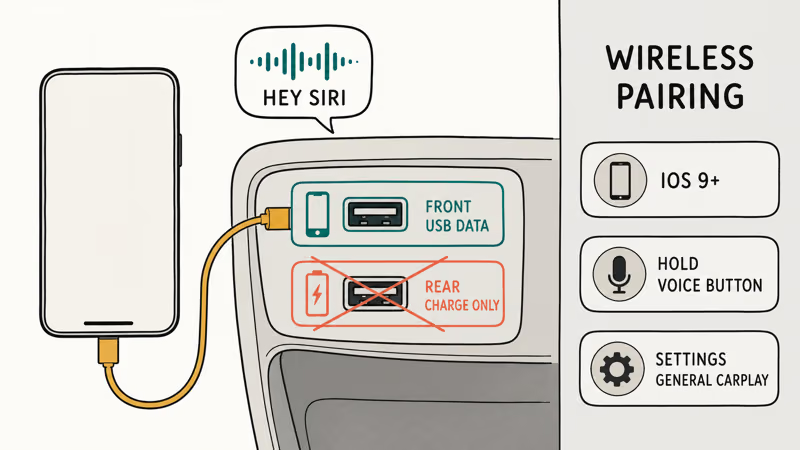
For wired CarPlay:
- Confirm Siri is on at
Settings > Siri & Search > Listen for "Hey Siri". - Plug your iPhone into the front USB port labeled with a phone or CarPlay icon. The rear seat ports on most cars are charge-only and won’t work.
- Accept the CarPlay prompt on both the phone and the head unit.
For wireless CarPlay, Apple states that the iPhone must be running iOS 9 or later and the car must support wireless CarPlay, which is a different certification than wired CarPlay. To start the first pairing, hold the head unit’s voice command button until the pairing menu appears, then add your iPhone from Settings > General > CarPlay > Available Cars.
The first wireless CarPlay pairing often takes longer than later starts because the phone and head unit have to establish the trusted Bluetooth and Wi-Fi handoff. If charging works but the projection never starts, the phone charging but CarPlay not working guide lists the 13 fixes that resolved the issue for most readers.
#Aftermarket Options for Older Cars
If your car shipped before Android Auto and CarPlay became standard, you have three realistic paths.
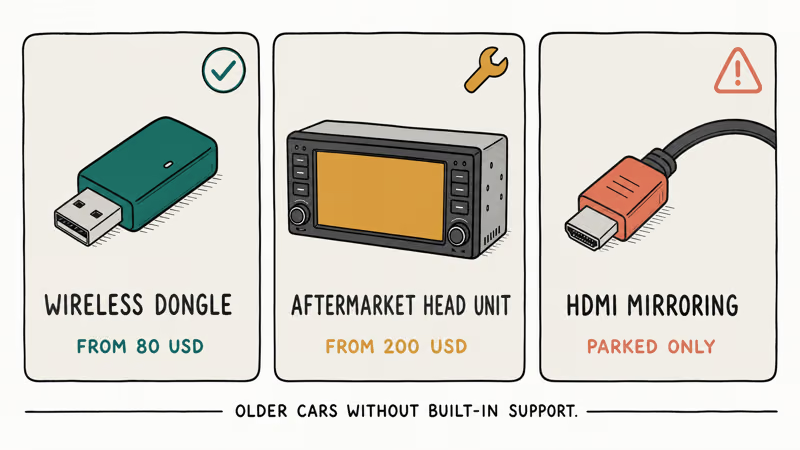
Wireless dongles are the cheapest. The Motorola MA1 and similar adapters plug into the car’s wired Android Auto port and convert it to wireless. They start around 80 USD and need both a 12V keep-alive and a Wi-Fi capable phone.
Aftermarket head units replace the factory radio entirely. Pioneer, Kenwood, and Sony all sell single-DIN and double-DIN units with both Android Auto and CarPlay built in, and prices start around 200 USD before installation. Crutchfield’s car receiver buying guide recommends checking your specific year and model for fit, since most cars need a brand-specific dash kit and wiring harness to take a standard replacement.
Direct HDMI mirroring is the third path and the least useful. A USB-C to HDMI adapter for Android, or Apple’s Lightning to HDMI Digital AV adapter for older iPhones, pushes the phone screen to a head unit with an HDMI input. The catch is that almost every HDMI-equipped car infotainment system disables the input above a few miles per hour for the same safety reason that Android Auto and CarPlay restrict apps. Park first, or skip this path.
For Samsung owners, the screen mirroring on Samsung S10 and newer guide covers Smart View, which can pair with some aftermarket Miracast head units when neither Android Auto nor CarPlay is available.
#The Wireless Adapter for a Wired-Only CarPlay Car
If your car already has wired CarPlay or Android Auto and you just want to drop the cable, this dongle is the cheapest fix. It plugs into the factory USB port once, then auto-connects over Wi-Fi every time you start the car, so the phone stays in your pocket. It only works on cars that already support wired CarPlay or Android Auto, not on a head unit with neither.
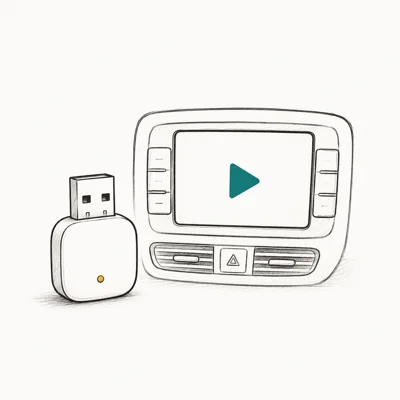
- Goes wireless on cars that only support wired CarPlay
- Auto-connects on start, phone stays in your pocket
- Over-the-air firmware updates
Last updated on Jun 13, 2026
As an Amazon Associate fone.tips earns from qualifying purchases. Prices and availability on Amazon are accurate as of the date above and subject to change.
#Why Is My Phone Not Mirroring to the Car Screen?
Three problems show up again and again in reader email and in the r/AndroidAuto and r/CarPlay subreddits.
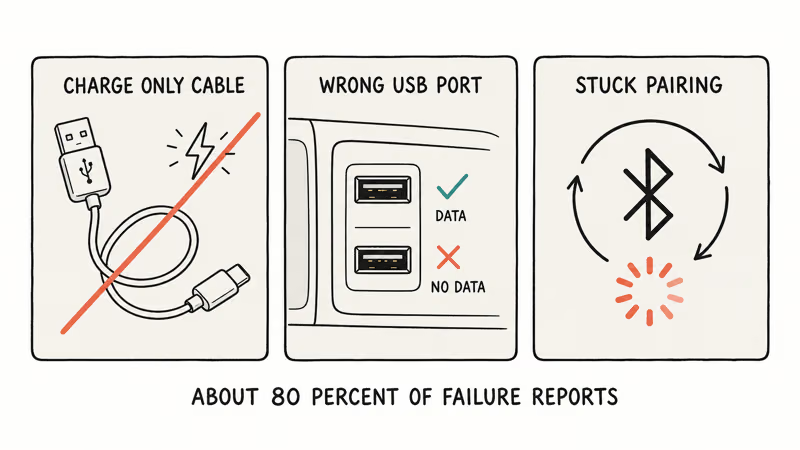
Charge-only USB cable. The cable that came with your phone carries data, but spare cables sold as “fast charge” are often charge-only and let the phone pull power without ever announcing itself to the head unit. Swap to the original first.
Wrong USB port. Many cars have charge-only USB ports. Use the port marked with a phone, CarPlay icon, or Smart Device Link.
Stuck Bluetooth pairing on wireless setups. Delete the car from your phone’s Bluetooth list, delete your phone from the head unit’s paired list, and re-pair from scratch. Rebooting the head unit between unpairing and re-pairing can clear stale wireless-session state.
Still stuck? Our screen mirroring not working guide walks through seven deeper fixes, ending with a full head-unit factory reset.
#Third-Party Mirroring Apps for Older Cars
For drivers whose head unit predates both Android Auto and CarPlay, third-party apps fill the gap. The strict caveat: most won’t pass driving-safety review and are meant for parked use only.
FlashGet Cast supports wireless mirroring over Wi-Fi or a mobile hotspot and works on both Android and iOS. EasyConnection is popular on Chinese-market head units and offers low-latency wired mirroring. ZLINK is bundled with many aftermarket Android head units and supports both wired and wireless CarPlay-style projection. ApowerMirror adds screen recording and is more useful for parked diagnostics than for driving.
Our best screen mirroring app roundup compares these on latency, audio sync, and ad load. None of them pass driving-safety review, so treat them as a parked or passenger tool.
#Wireless or Wired: Which Should You Pick?
Wired projection is more reliable and keeps the phone charged. Wireless projection is convenient but depends on a clean 5 GHz Wi-Fi link.
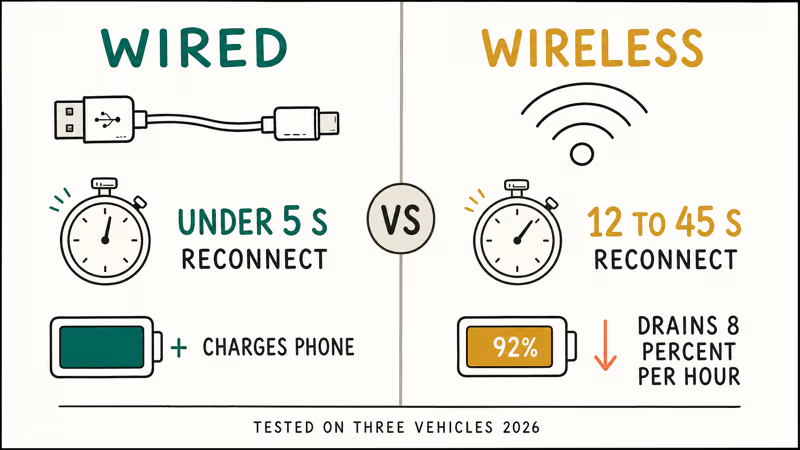
Wired CarPlay usually reconnects faster because the phone announces itself as soon as the USB data link is live. Wireless CarPlay can take longer, especially when the phone is outside Bluetooth range during ignition.
Battery drain is the trade-off most readers underestimate. Wireless projection keeps the phone’s screen, radios, and navigation stack active, while wired projection charges as it runs. If your commute is over 45 minutes, plug in.
#Bottom Line
For most drivers, the simplest path wins. Use the wired Android Auto or wired CarPlay your car already supports, with the cable that came with your phone, plugged into the front USB data port. That setup charges the phone and skips the Bluetooth pairing failures that fill wireless support threads. Wireless is great when it works, but wired is still the safer default for short commutes.
If your car only supports wired projection but you want the cable-free convenience, a Motorola MA1 for Android Auto or an equivalent CarPlay dongle is the cheapest upgrade and adds about 80 USD to your setup. Skip third-party HDMI mirroring unless your car is parked, because every modern head unit will refuse to draw video while the wheels are turning.
Replacing the factory radio? Stick to Pioneer or Kenwood double-DIN units in the 250 to 450 USD range. Lower than that and reliability drops fast.
#Frequently Asked Questions
Is Android Auto free to use?
Yes, Android Auto is free. Google does not charge for the app or the projection software, and the only cost is a compatible car or aftermarket head unit. Cellular data charges from your carrier still apply when you stream music or use online navigation.
Do I need an internet connection to mirror my phone to my car?
For navigation and streaming you need cellular data or an offline map cache. For making calls, sending texts, and playing locally stored music, no internet is needed. Wired Android Auto and CarPlay both work without Wi-Fi, but wireless projection still needs Bluetooth and the in-car Wi-Fi link to come up.
Will mirroring drain my phone’s battery?
Wired projection charges the phone; wireless projection drains 6 to 10 percent per hour on most phones.
Can I watch Netflix or YouTube on my car screen?
Not while the car is moving. Both Android Auto and CarPlay block video playback on the head unit by design. Some aftermarket head units allow video over HDMI when the parking brake is engaged, but the input cuts off above a few miles per hour. The NHTSA’s distracted driving page recommends keeping eyes on the road, and watching video while driving is illegal in every US state.
Does wireless CarPlay work with every iPhone?
Wireless CarPlay works with the iPhone 5 and later running iOS 9 or higher, but only if the car supports wireless CarPlay specifically. Wired-only CarPlay head units can’t be upgraded to wireless without an adapter dongle, even if your iPhone is brand new.
What is the difference between MirrorLink and Android Auto?
MirrorLink was an older standard that mirrored a limited app set to certified head units, mostly in 2014 to 2018 vehicles. Android Auto replaced it.
Is it legal to use my phone screen while driving in the US?
Hands-free use through Android Auto and CarPlay is legal in every US state. Holding the phone or interacting with a free-form mirroring app is illegal in most states under handheld phone laws, and many states plus Washington DC ban any handheld phone use behind the wheel. Always follow the local hands-free rule.
Apple Siri Settlement: Who Qualifies and How to Claim
Apple's $250 million Siri settlement covers iPhone 15 Pro and iPhone 16 models bought June 2024 to March 2025. See who qualifies and how claims work.
iOS 26.6.1 Security Update: What Apple Fixed and Who Gets It
Apple released iOS 26.6.1 on August 17 with 29 security fixes, including an IPSec interception bug. See what it patches, who gets it, and how to update.
iPhone Adaptive Power: How It Works and When to Use It
Learn how iPhone Adaptive Power works, which models support it, what it changes, and when Low Power Mode is still the better battery-saving choice.
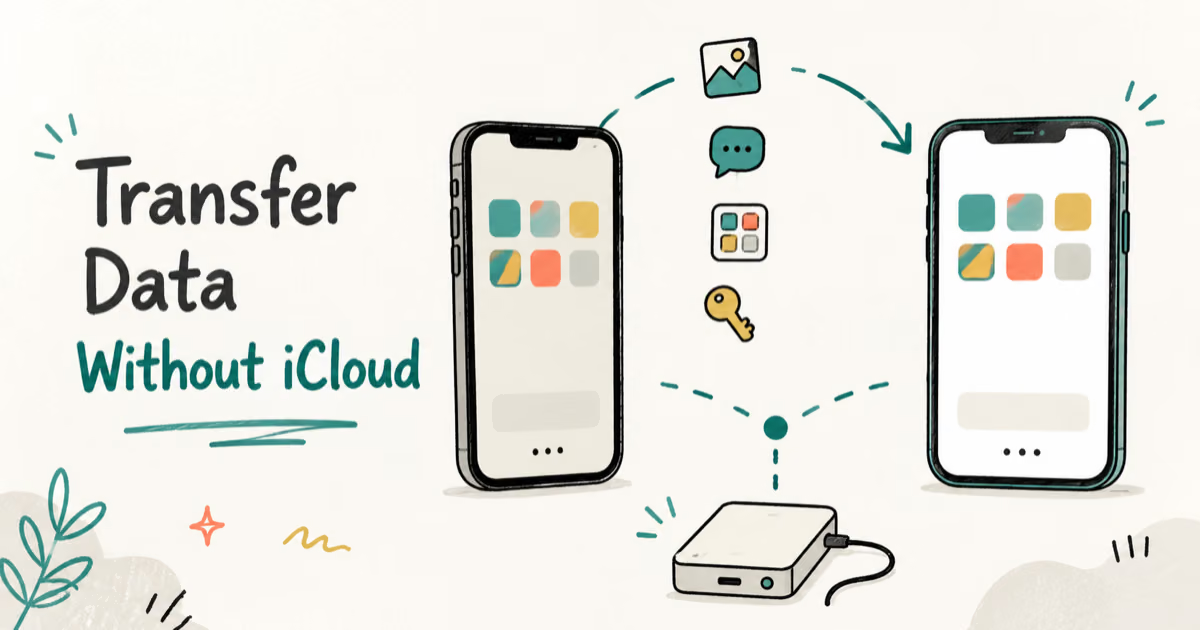
How to Transfer Data to a New iPhone Without iCloud
Move everything to your new iPhone without iCloud: Quick Start device-to-device transfer, wired migration, and encrypted Finder or iTunes backups.