Microsoft Word Not Responding: 8 Fixes That Work in 2026
Fix Microsoft Word not responding with 8 proven methods. Reset add-ins, run Online Repair, recover unsaved files, and stop freezes on Windows 11.

Quick AnswerPress Ctrl+Shift+Esc, end the WINWORD.EXE task, then relaunch Word in Safe Mode by typing winword /safe in the Run dialog. If it opens cleanly, a COM add-in is the cause and you should disable add-ins one by one.
Microsoft Word not responding usually traces to a heavy file, a broken add-in, a corrupted Normal.dotm template, or a damaged Office install. Start with Safe Mode because it skips COM add-ins, the Normal.dotm template, and AutoCorrect entries.
These steps assume a PC and Office license you legally own. On a work or school device, check IT policy first.
- The fastest first step is ending WINWORD.EXE in Task Manager (Ctrl+Shift+Esc), then launching
winword /safefrom the Run dialog to skip every COM add-in. - COM add-ins from PDF tools, Grammarly, and Zotero are common culprits. Disable all, then re-enable one by one.
- A corrupted Normal.dotm template freezes Word on every launch; renaming it to Normal.old at
%AppData%\Microsoft\Templatesforces Word to rebuild a fresh copy. - Online Repair via
Settings>Apps>Microsoft365 > Modify reinstalls Office binaries while keeping your activation, settings, and documents in place. - Files larger than 100 MB or with thousands of tracked changes overwhelm Word’s renderer; use Open and Repair from the
File>Opendialog before copying content into a fresh document.
#Why Does Microsoft Word Keep Freezing on Windows?
Word becomes unresponsive when a single thread on the main process gets stuck waiting on something: a slow add-in, a network drive, a malformed object inside the document, or a graphics driver that times out. Windows tags the window “Not Responding” the moment that thread misses a heartbeat for more than 5 seconds.
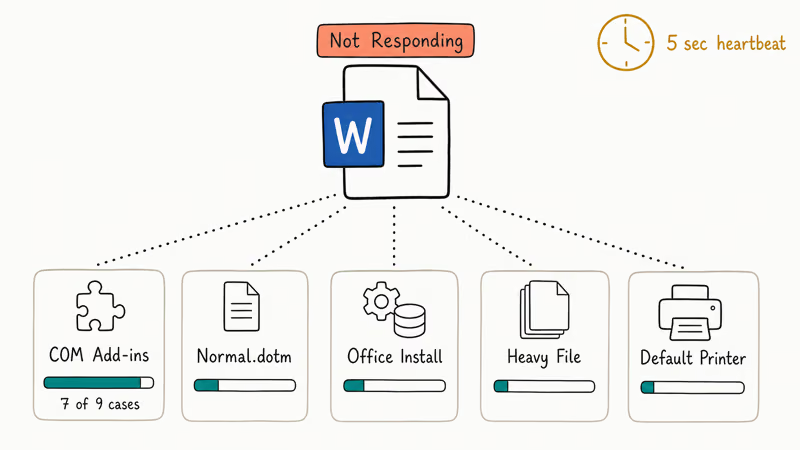
The freeze usually comes from one of five root causes:
- A COM add-in that hasn’t been updated for the current Word build. Grammarly, Zotero, Adobe Acrobat, and old PDF Maker tools are repeat offenders.
- A corrupted Normal.dotm template that Word loads at every startup. Once it gets damaged, every new document inherits the breakage.
- An Office installation with mismatched DLLs, usually after a failed update or a half-finished uninstall of a previous Office version.
- A document with too many embedded images, tracked changes, or comments. Above roughly 100 MB or 5,000 tracked edits, Word’s pagination engine slows to a crawl.
- A printer driver registered as the default device. Word polls the default printer at startup; an offline or broken driver hangs the launch.
Symptom maps to fix. A freeze on one file points to document corruption. A freeze on every launch points to add-ins or the Normal.dotm template. A freeze even in Safe Mode points to a damaged Office install.
#Quick Fixes to Try First
Run these three before anything heavier. They take under five minutes combined and fix the most common cases.
- Close Word with Task Manager. Press Ctrl+Shift+Esc, find Microsoft Word in the Processes tab, click End task, and reopen Word.
- Reboot Windows. A clean restart frees stuck handles and clears any pending Office update that’s blocking Word’s startup.
- Check for updates. Open Word, go to
File>Account>Update Options>Update Now. Many freezes patched in Microsoft 365 Version 2403 onward simply don’t appear once your install is current.
If Word still hangs after those three, you have a real fault to track down. The next four sections walk through the fixes in a low-impact order, starting with the cheapest test (Safe Mode) and ending with the heaviest (full reinstall).
#How Do You Restart Word When It Won’t Respond?
Press Ctrl+Shift+Esc to open Task Manager directly, click the Processes tab, and right-click WINWORD.EXE. Choose End task. Wait three seconds, then relaunch Word.
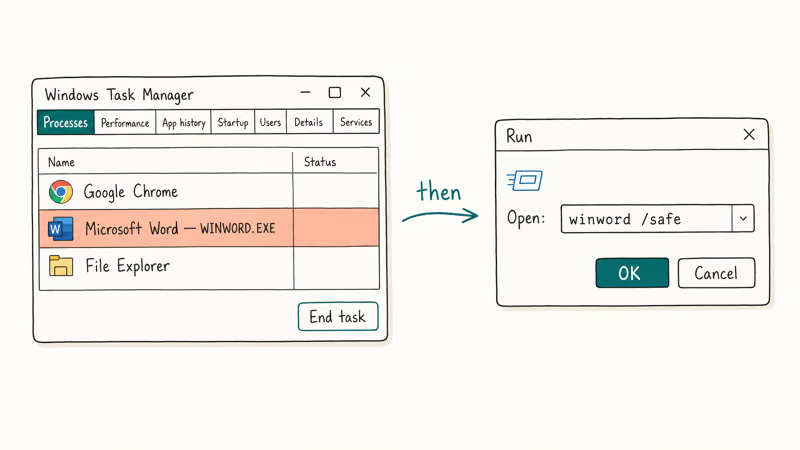
If End task does nothing (Windows shows a confirmation popup but the process stays), open PowerShell as administrator and run Stop-Process -Name WINWORD -Force. That kills the process at the kernel level instead of asking it politely to close.
After force-closing, always launch Word in Safe Mode for the next attempt. Press Windows key + R, type winword /safe, and press Enter. Word opens with all COM add-ins, the Normal.dotm template, and AutoCorrect entries disabled. If it opens cleanly here, you’ve narrowed the cause to your loaded extensions or template.
#Reset COM Add-ins to Stop Word From Freezing
COM add-ins are a common cause of Word freezes. The fix is methodical, not clever:
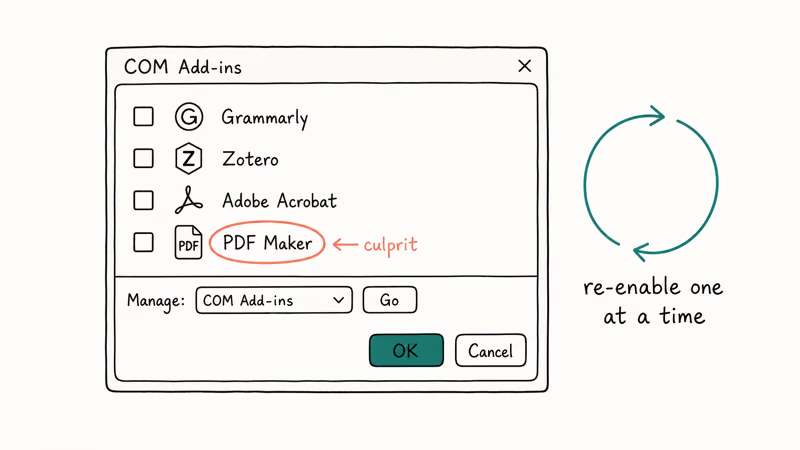
- Open Word in Safe Mode (
winword /safe). - Go to
File>Options>Add-Ins. - At the bottom, set Manage to COM Add-ins and click Go.
- Uncheck every add-in in the list and click OK.
- Close Word. Reopen it normally. The freeze should be gone.
- Re-enable add-ins one at a time, restarting Word between each, until the freeze returns.
The last add-in you enabled is the culprit. Either uninstall it from Windows Settings > Apps, or check the vendor’s site for a newer build that supports your Word version.
According to Microsoft’s page on opening Office apps in safe mode, there are two ways in: hold the CTRL key while you double-click the shortcut, or type winword /safe into the Run box. Safe Mode can confirm an add-in cause, point to a corrupted Normal.dotm template, or show that the Office install itself still needs repair if Safe Mode also hangs.
#Rebuild a Corrupted Normal.dotm Template
If Safe Mode opens Word fine but normal mode still freezes after disabling every add-in, the Normal.dotm template is the next suspect. Word recreates it automatically when missing, so renaming it forces a clean rebuild:
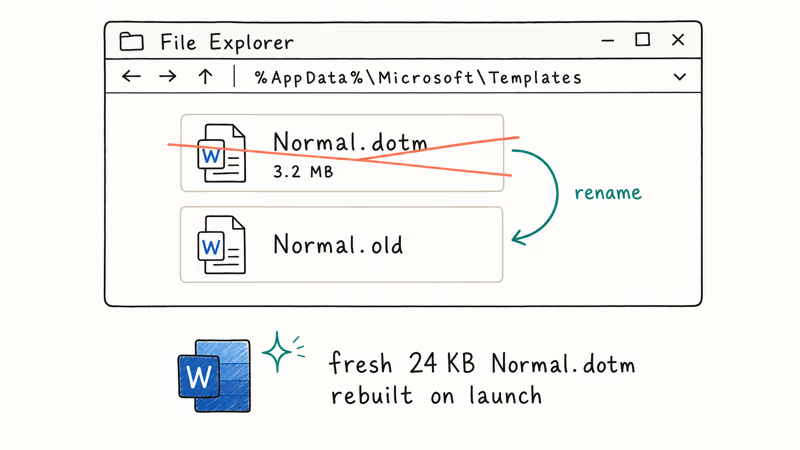
- Close Word completely.
- Press Windows key + R, type
%AppData%\Microsoft\Templates, and press Enter. - Find Normal.dotm.
- Rename it to Normal.old.
- Reopen Word.
Word builds a fresh Normal.dotm on launch. Custom styles or macros stored in the old template will be gone, but you can copy them back from Normal.old if needed.
If Word freezes on every blank document, rename Normal.dotm before running a full Office repair.
#Run an Online Repair on Microsoft 365
If Safe Mode also freezes, repair the Office install itself. Online Repair downloads fresh binaries and replaces Office DLLs.
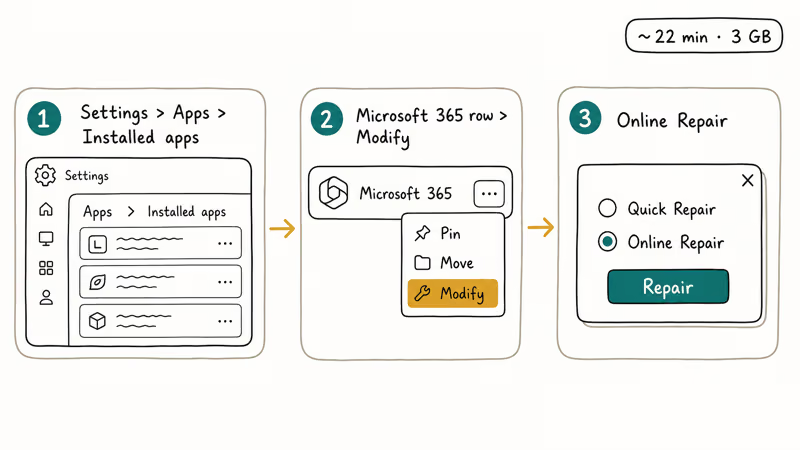
- Open
Settings>Apps>Installedapps. - Find Microsoft 365 (or Office 365).
- Click the three-dot menu, choose Modify.
- Select Online Repair, then click Repair.
- Wait through the download and reinstall. Allow about 15 to 30 minutes.
According to Microsoft’s Office repair documentation, Online Repair preserves your activation, your custom settings, and your documents while replacing every Office binary on disk. The repair may download fresh installer content, and you’ll be asked to sign in to Office again once it completes.
If the repair finishes but the freeze stays, use the Microsoft Support and Recovery Assistant for a clean uninstall.
#Recover Unsaved Documents After Word Crashes
You don’t need to lose work just because Word froze. Word saves AutoRecover snapshots every 10 minutes by default, and there are three places to look for them.
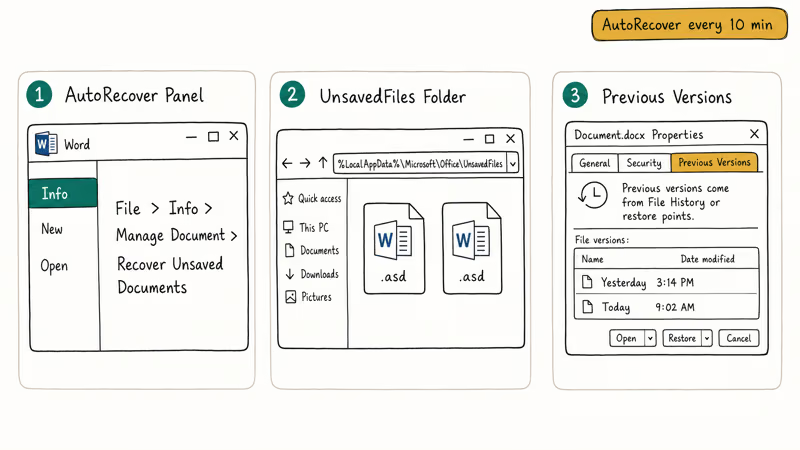
- AutoRecover panel. Reopen Word and go to
File>Info>Manage Document>Recover Unsaved Documents. - UnsavedFiles folder. In File Explorer, paste
%LocalAppData%\Microsoft\Office\UnsavedFilesand press Enter. Drafts that Word saved before the freeze land here as.asdfiles. - Previous Versions. Right-click the original document, choose Properties, and open the Previous Versions tab. Windows File History or System Restore may have a copy from before the crash.
Microsoft’s AutoSave and AutoRecover page confirms that AutoRecover is on by default and saves every 10 minutes, and that you change the interval under File > Options > Save. Its crash-protection guidance says to put a small number in that box, like 5 or 10. For active drafting, take the low end.
For a deeper walkthrough including OneDrive version history, see our guide on how to recover an unsaved Word document.
#Repair Corrupted Documents With Open and Repair
Single-file freezes mean the document itself is the problem, not Word. The Open and Repair flow is built for exactly this case.
- In Word, go to
File>Open. - Click Browse and locate the troublesome file.
- Single-click the file to select it, but don’t double-click.
- Click the small arrow next to the Open button.
- Choose Open and Repair.
Word scans the document, fixes recoverable structure errors, and tells you what it had to discard. If the file still won’t open, copy the entire contents of the last working version into a fresh blank document, then save under a new name. That breaks the link to whatever damaged object was triggering the hang.
Skip the encryption gotcha. If your password-protected file is the one freezing, see our walkthrough on how to unlock a password-protected Word document before running Open and Repair, since the dialog won’t process encrypted content.
#Prevent Word From Freezing in the Future
The fixes above stop today’s freeze. These habits stop the next one:
- Update Word monthly.
File>Account>Update Options>Update Now. The current channel ships fixes for known hangs almost every month. - Audit add-ins quarterly. Disable anything you don’t actively use. Each loaded COM add-in adds startup delay and a possible failure point.
- Keep documents under 50 MB. Heavy embedded images and revision histories are the main reason “large file” freezes happen. Compress images via
Picture Tools>Format>Compress Pictures. - Accept tracked changes you no longer need. A document with 3,000 unresolved edits forces Word to recompute layout on every keystroke.
- Lower the AutoRecover interval.
File>Options>Save>Save AutoRecoverinformation every 3 minutes. - Set a working printer as default. A broken or offline default printer driver hangs Word on launch while it tries to query page setup.
Long documents with rotated tables are a known offender. Our guide on how to rotate a table in Word shows the cleanest method that doesn’t bloat the file with stacked Page Layout objects.
#When Excel and PowerPoint Hang Too
Office apps share components. If Excel is the only app hanging, see our Excel not responding guide for spreadsheet-specific causes.
Mac users hit a different beast. The macOS troubleshooting path is different because Office for Mac uses a different add-in architecture, ships sandboxed in /Applications, and writes crash logs to ~/Library/Logs/DiagnosticReports. Our guide on how to fix Microsoft Word keeps crashing on Mac walks through the macOS-specific steps.
#Bottom Line
Start with winword /safe. If Word opens cleanly there, your add-ins are the problem and you should disable all COM add-ins, then re-enable one at a time until the freeze returns. If Safe Mode also hangs, run an Online Repair from Settings > Apps > Microsoft 365 > Modify before doing anything else; it fixes deeper installation damage without deleting your documents.
#Frequently Asked Questions
How do I quickly unfreeze Microsoft Word without losing work?
Press Ctrl+Shift+Esc, end the WINWORD.EXE task, and reopen the document. Word’s AutoRecover usually restores your last 10 minutes of edits from a snapshot in %LocalAppData%\Microsoft\Office\UnsavedFiles. If the recovery panel doesn’t show up automatically, open File > Info > Manage Document > Recover Unsaved Documents.
Can antivirus software make Word stop responding?
Yes. Some real-time scanners hook into every file save, and the delay can stall Word long enough to trigger the Not Responding tag. Add Word to your antivirus exclusion list, or temporarily disable real-time protection and reopen the document. If the freeze stops, the scanner is the cause.
How often does AutoRecover save my work?
Every 10 minutes by default. Tighten the interval under File > Options > Save.
Will reinstalling Microsoft Word delete my documents?
No. Word documents are stored separately from the Office program files, in your user folders or OneDrive. Online Repair and full uninstall both leave your .docx files in place. Back up anything in your %AppData%\Microsoft\Word STARTUP folder if you have custom templates, since those live alongside Office and can be removed.
Why does Word freeze only on one specific document?
That document has internal corruption, an oversized embedded object, or a broken link to a network resource. Use File > Open > Open and Repair to fix it. If repair fails, open the file in WordPad or LibreOffice Writer, copy the text into a new Word document, and save under a fresh name.
Does Safe Mode disable my saved documents or settings?
Safe Mode only suppresses add-ins, the Normal.dotm template, and AutoCorrect entries. Your saved documents, recent files list, and account sign-in stay intact. It’s a diagnostic mode, not a reset.
What’s the difference between Quick Repair and Online Repair?
Quick Repair only checks file integrity offline and finishes in under a minute, which catches simple problems but misses replaced or corrupted DLLs. Online Repair downloads fresh binaries from Microsoft’s servers and reinstalls Office completely while preserving your activation and settings; it takes 15 to 30 minutes but fixes nearly every installation-level issue.
How do I stop Word from freezing on documents with tracked changes?
Accept or reject tracked changes you no longer need. Go to Review > Accept > Accept All Changes and Stop Tracking, or Reject > Reject All Changes. A document with thousands of pending edits forces Word to redraw the revision pane on every keystroke, which is the most common cause of mid-edit freezes on large files.

Best Laptop for Running LLMs in 2026: Memory Comes First
The best laptop for running LLMs is a memory purchase first. Compare MacBook unified memory against NVIDIA laptop VRAM, and see what each tier really runs.

How to Run a Local LLM on Windows: A 2026 Setup Guide
Run a local LLM on Windows with LM Studio or Ollama. Pick a model that fits your GPU memory, keep every prompt offline, and skip the monthly bill.

Bluetooth Not Working on Snapdragon X? Fixes for 2026
Bluetooth not working on your Snapdragon X Copilot+ PC? Generic audio, mice, and keyboards work, but vendor apps often lack an ARM build. Fixes inside.

Docker Desktop and WSL2 Not Working on Snapdragon X? Fix It
WSL2 runs fine on Snapdragon X, but Docker Desktop ARM is Early Access and throws WSL errors. Use WSL2 plus native ARM64 Ubuntu and Docker Engine.