Kik vs WhatsApp: 9 Key Differences for 2026 Messaging
Kik vs WhatsApp compared head to head in 2026: encryption, group size, file limits, video calls, and safety. See which messaging app fits you.
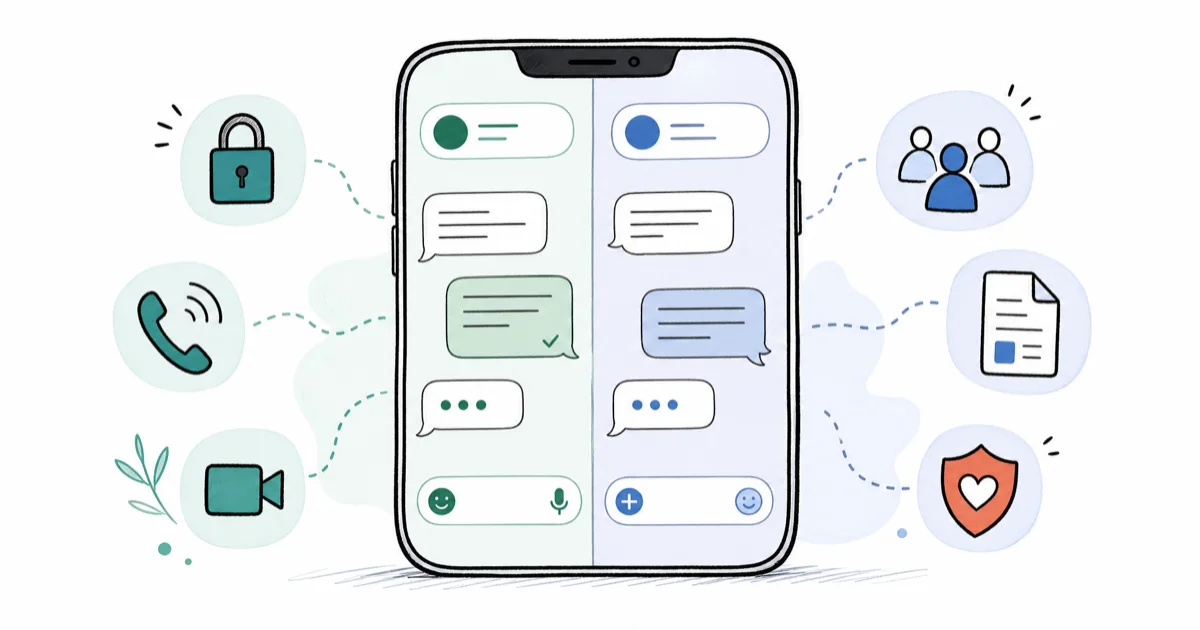
Quick AnswerWhatsApp wins for most people because it has end-to-end encryption by default, free voice and video calling, and over 3 billion users. Kik is mainly useful if you want to chat without sharing your phone number, but its privacy and audience are both weaker.
Kik vs WhatsApp comes down to one trade: privacy through anonymity versus privacy through strong encryption. Kik lets you chat without exposing your phone number, while WhatsApp protects every message and call with end-to-end encryption by default. The practical comparison turns on account setup, group chats, calling, and what each platform does with your data in 2026.
- WhatsApp encrypts every message, call, and photo by default, while Kik has no end-to-end encryption on regular chats
- Kik signs you up with just an email plus a username; WhatsApp requires a working phone number for SMS verification
- WhatsApp supports very large groups and group video calling, while Kik caps groups at 50 members and has no built-in calling at all
- WhatsApp dominates global messaging with billions of users, while Kik’s audience is far smaller and skews much younger
- For most users, WhatsApp wins on privacy and reach; Kik only makes sense if hiding your phone number outweighs every other concern
#How Do Kik and WhatsApp Compare at a Glance?
Here’s the side-by-side breakdown of how the two apps stack up in 2026.
| Feature | Kik | |
|---|---|---|
| Account signup | Email plus username | Phone number plus SMS |
| Default encryption | None on regular chat | End-to-end on every chat |
| Group size cap | 50 members | Up to 1,024 members |
| Voice or video calls | None | Free voice plus 32-person video |
| Max file size | 25MB | 2GB |
| Native desktop app | Web only | Mac and Windows installers |
| Global reach | Smaller niche base | Largest messaging app globally |
| Bot platform | Removed in 2019 | None for consumers |
| Best fit | Anonymous chat | Encrypted everyday messaging |
The headlines: WhatsApp leads on privacy, scale, and calling. Kik leads on anonymity but trades almost everything else.
#Account Setup: Phone Number vs Username
The first thing you’ll notice is who needs what to sign up.
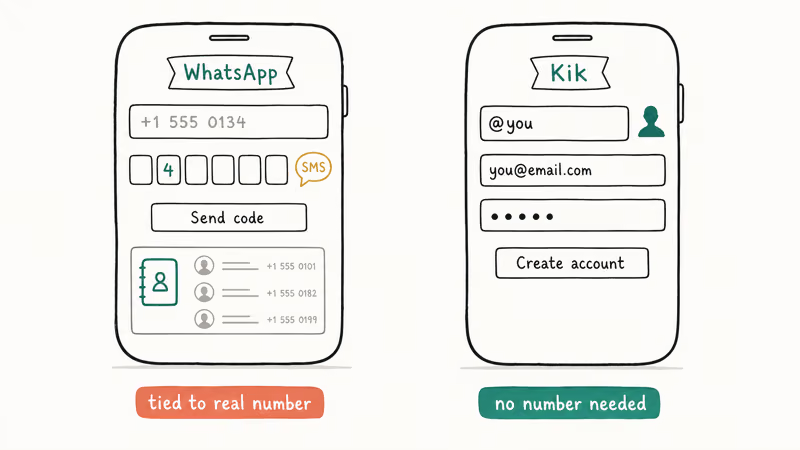
WhatsApp registration starts and ends with your phone number. After downloading the app, you enter your number, receive a 6-digit SMS code, and you’re in. WhatsApp then scans your phone’s contact list and shows everyone who already has the app, and that’s the network effect that makes it so sticky.
Kik takes the opposite approach. You pick a username, type any email address, set a password, and skip the phone number entirely. WhatsApp requires SMS verification and then shows contacts who already use the app after setup.
This split has real consequences:
- WhatsApp ties your messaging identity to your real phone number. Friends recognize you instantly, but strangers can find you if they have your number.
- Kik gives you actual anonymity. Strangers can’t find you unless you share your username, and even friends won’t see your name or photo unless you set them.
If you want to keep your number off public-facing apps, the walkthrough on hiding your phone number on WhatsApp explains the workable settings, but Kik’s username system bypasses the issue entirely.
The downside of Kik’s anonymity is the same as its upside. You can be contacted by anyone who guesses or finds your username, including spam bots and adults targeting teens. The guide to Kik scams covers the warning signs, and parents should treat that as required reading before letting kids install Kik.
#How Does Each App Handle Encryption?
Encryption is where these two apps split most sharply.
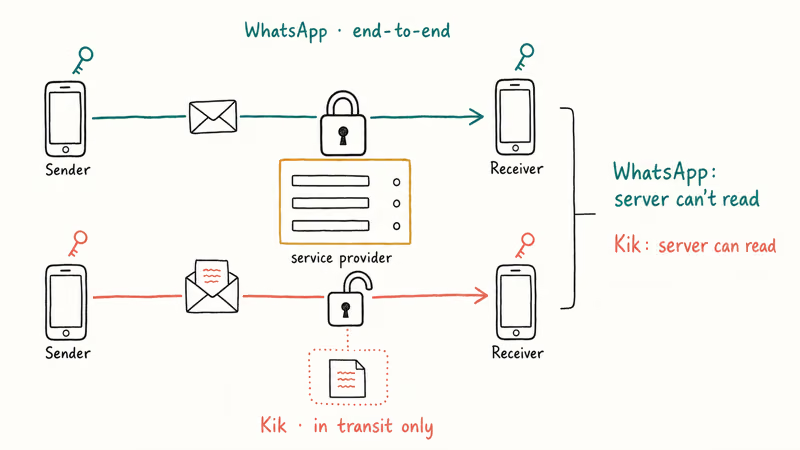
WhatsApp uses end-to-end encryption on every chat, every voice call, every video call, and every status post by default, with no toggle to turn it on. According to WhatsApp’s security overview, every message and call uses the Signal Protocol, the same open-source cryptographic standard used by Signal itself. WhatsApp’s own servers can’t decrypt your messages.
Signal Foundation’s protocol documentation states that the Double Ratchet algorithm gives every message a fresh encryption key, so a single key compromise can’t expose your entire chat history. That’s the cryptographic guarantee WhatsApp inherits.
Kik does not work this way. Standard chats on Kik are encrypted in transit (TLS, like any HTTPS connection) but are not end-to-end encrypted. Kik’s servers can technically read message content, and the app retains chat data on its servers for a window of time before deletion.
For most threat models, that gap matters:
- A leak from Kik’s servers would expose chat content. A leak from WhatsApp’s servers would expose only metadata (who messaged whom, when).
- Law enforcement subpoenas can pull message content from Kik. WhatsApp can hand over only account info and metadata because they don’t hold the keys.
If encryption-by-default is your baseline, Signal vs Telegram is a more meaningful comparison than this one. Both of those apps put encryption first, while Kik treats anonymity as a substitute for it.
#Group Chats and Media Limits
Group sizes and file caps are where WhatsApp pulls clearly ahead.
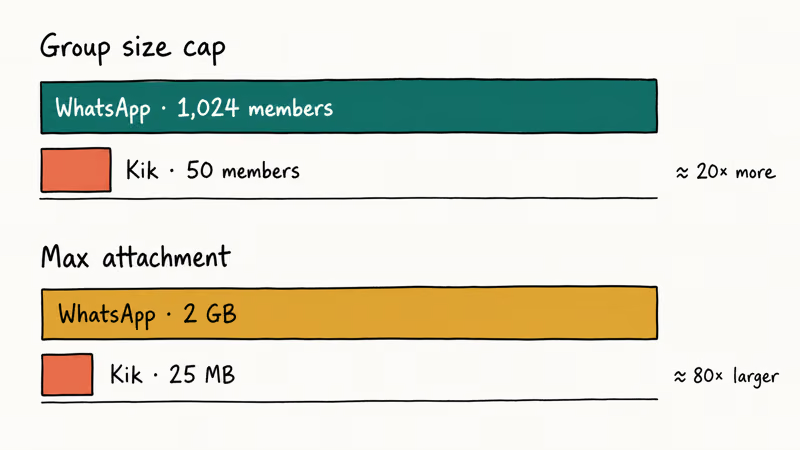
WhatsApp expanded its group cap to 1,024 members in 2022, up from 256. Kik groups still max out at 50 participants. That makes WhatsApp more practical for large communities, while Kik groups stay small by design.
Files break down the same way. WhatsApp lets you send up to 2GB per attachment, large enough for most drone clips, design files, or 4K video segments. Kik caps each file at roughly 25MB.
Large files that fit inside WhatsApp’s attachment limit won’t fit inside Kik’s much smaller cap, so Kik may refuse the upload instead of suggesting a workaround.
If you regularly share long videos or hi-res images, Kik will choke on most of them.
#Calling, Bots, and Browser Features
WhatsApp covers all three; Kik covers only the last one.
WhatsApp has free 1-to-1 voice and video calls and group video for up to 32 participants, all encrypted end to end. Call quality holds up over Wi-Fi or LTE, and there’s no time limit on free calls. Kik still has no native calling, so you’d need a separate app to talk live with someone you met on Kik. If calling is a priority for you, the Discord vs WhatsApp breakdown is more useful than asking Kik to do it.
Kik’s Bot Shop was retired in 2019 when Kik Interactive ceased operations and the brand was sold. WhatsApp never had a consumer bot platform, only the WhatsApp Business API for verified companies.
Web browsing is one place Kik wins. The app has a built-in browser, useful for sharing pages without leaving the chat window. WhatsApp does not, so links open in your default browser instead.
#Audience and User Base in 2026
WhatsApp owns the global messaging market. It’s the default messaging app in India, Brazil, Mexico, most of Europe, and large parts of Africa and Southeast Asia. Meta has reported user counts in the billions, and the network effect runs deep: if you message family overseas, odds are they’re already on WhatsApp.
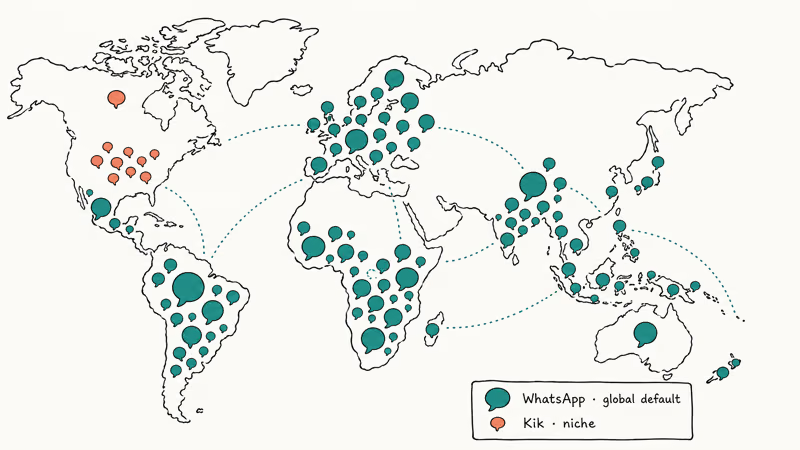
Kik’s reach is much narrower. After Kik Interactive’s 2019 shutdown and MediaLab’s acquisition, the app stayed online but lost most of its momentum. According to Wikipedia’s Kik Messenger entry, MediaLab acquired the platform in October 2019 and continues to operate it today, but the active user base is a fraction of WhatsApp’s.
Kik’s audience skews much younger. WhatsApp covers kids, parents, grandparents, and businesses on the same platform.
The practical impact on your daily messaging:
- On WhatsApp, almost every contact you’d want to reach is already there or will install it on request.
- On Kik, you mostly chat with people you’ve met inside Kik (friends from games, online communities, or random username trades).
If you’re trying to find a specific person, the walkthrough on searching for someone on WhatsApp using a phone number takes seconds. Kik requires that the other person share their username with you first.
#Bottom Line
Pick WhatsApp unless you have a specific reason not to. End-to-end encryption by default, group calls, 2GB attachments, and a user base in the billions make it the safer, more capable choice for almost everyone. Even the privacy concern that Kik tries to solve, phone-number exposure, has workable mitigations on WhatsApp without giving up encryption.
Pick Kik only if you specifically need to message someone who insists on Kik (often a teen or gaming-community contact), or if you’re willing to give up encryption for the ability to chat without sharing your number. If you’re a parent, weighing Kik’s safety profile matters more than the feature list. The anonymity that draws teens also draws bad actors, and you should assume both are present.
#Frequently Asked Questions
Is Kik safer than WhatsApp?
No. WhatsApp is significantly safer because every chat and call is end-to-end encrypted by default.
Can you use WhatsApp without giving out your phone number?
Not directly. Registration requires a working phone number for SMS verification, and WhatsApp won’t let you finish setup without one. After signup, you can hide your number from contacts you message in groups by editing your profile and turning on contact-only privacy settings. The number stays attached as the account ID, so a complete hide isn’t possible.
Does Kik have video calling in 2026?
Kik still has no built-in voice or video calling feature. To call someone you met on Kik, switch to FaceTime, Zoom, or WhatsApp itself.
Why do teenagers use Kik instead of WhatsApp?
Two reasons. The username-only signup means they don’t need a phone plan or a verified mobile number, and the anonymity makes it easier to chat with people they meet in games, fandoms, or other online communities without exposing personal details that parents could trace.
Did Kik shut down or get acquired?
Kik Interactive announced it was shutting down the messenger in 2019, citing a long-running SEC dispute over the Kin cryptocurrency. Within weeks, the app was acquired by MediaLab, a holding company that operates several legacy social apps. The Bot Shop and the Kin integration were both retired during that transition. Kik itself has stayed live ever since, with periodic feature changes but the same brand.
Is WhatsApp owned by the same company as Facebook and Instagram?
Yes. Meta acquired WhatsApp in 2014 and has owned it since.
Can businesses message customers on Kik?
Not in any serious way. Kik never built out a real business-messaging platform, and what it had was rolled back during the MediaLab transition. WhatsApp Business is the standard tool for company-to-customer messaging at scale.
Should I use both apps at the same time?
Many people do. WhatsApp handles everyday contacts, work groups, and family chats with strong privacy. Kik fills in for anonymous conversations or specific communities you only know inside the app, so the two apps don’t really compete for the same role on your phone.
Google Messages Error 3100: Why RCS Is Broken on Galaxy
Google Messages RCS error 3100 hits Galaxy owners after phone or carrier switches. Google told 9to5Google a fix is coming. Here's what actually helps.

Is This Bank App Real? Spot a Fake App on Your Home Screen
A bank app can land on your home screen from a web page with no install warning. Learn the checks that tell a real banking app from a phishing web app.
Apps Crashing After iOS 27 Update? Fix Order (2026)
Apps crashing after the iOS 27 update? Update the app in the App Store first, then offload and reinstall to clear stale cache, then restart. The fix order.
Do AI Translation Earbuds Work Offline? What to Know
Do AI translation earbuds work offline? A few do with downloaded language packs, but most need the cloud. Here's what works offline and what you give up.