iPhone Maps Not Working? 9 Fixes That Actually Work in 2026
Apple Maps not working on iPhone? Re-enable Location Services for Maps, refresh your connection, and reset Network Settings. 9 proven fixes inside.
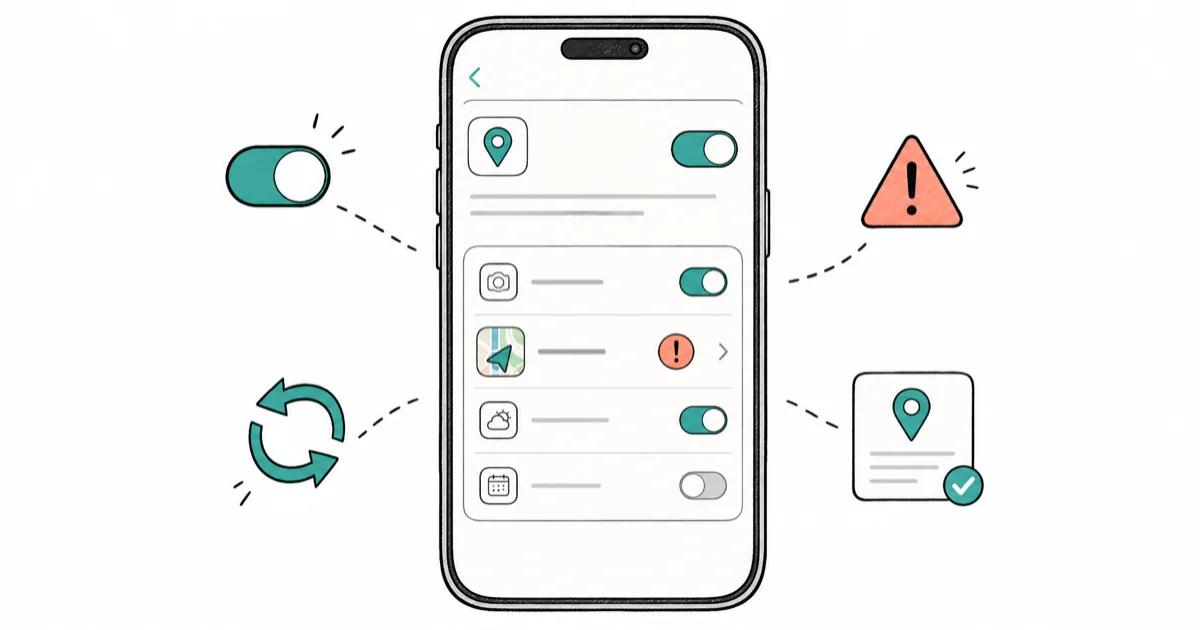
Quick AnswerOpen Settings, Privacy and Security, Location Services, Maps, and switch it to While Using the App with Precise Location on. If Maps still fails, toggle Airplane Mode for ten seconds, force-close the app, then reset Network Settings under General, Transfer or Reset iPhone.
iPhone Maps not working usually traces back to one of three things: Location Services is off for the app, the data connection is choked, or the app cache went sideways after an iOS update. The fixes below are ordered by how often they resolve the problem, so the quick wins come first.
- Location Services for Maps must be set to “While Using the App” with Precise Location enabled, otherwise Maps can’t pull a GPS lock indoors or in dense areas.
- A weak data connection is the second most common cause; toggle Airplane Mode for 10 seconds to force a fresh cellular handshake before deeper fixes.
- Reset Network Settings clears stuck DNS, VPN, and APN entries that block tile downloads, but you’ll need to re-enter Wi-Fi passwords afterward.
- Compass calibration matters more than people think: when the blue dot spins or points wrong, recalibrate via the Compass app and confirm Compass Calibration is on under System Services.
- If a single specific area refuses to render, the cache for that region is corrupt; offload Maps via Settings, General, iPhone Storage, then reopen to rebuild it.
#Why Is My iPhone Maps Not Working?
Apple Maps depends on three things working together: GPS hardware, an internet connection, and Apple’s tile and routing servers. When any of the three fails, you see a different symptom. Knowing which one broke tells you which fix to try first.
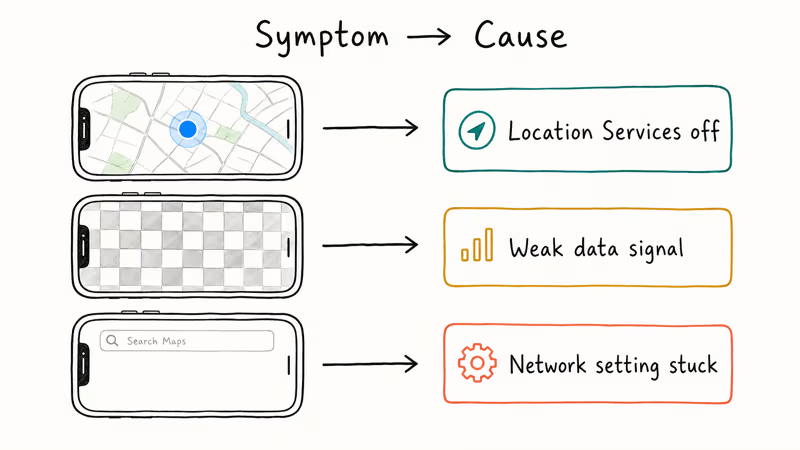
| Symptom you see | Most likely cause | First fix to try |
|---|---|---|
| Blue dot stuck or missing | Location Services disabled for Maps | Toggle Maps location to “While Using the App” |
| Tiles load gray or partial | Cellular or Wi-Fi data weak | Toggle Airplane Mode for 10 seconds |
| Search returns no results | DNS or network setting stuck | Reset Network Settings |
| Routes calculate wrong distance | Compass uncalibrated | Open Compass app, recalibrate |
| App crashes on launch | Cache corrupt after iOS update | Offload Maps from iPhone Storage |
Apple’s Location Services support article states that Maps blends 4 signal layers (GPS, Wi-Fi, Bluetooth, and cellular tower data) to fix your position within roughly a 5-meter radius outdoors with a clear sky view. A single broken layer can degrade accuracy without breaking the app entirely. That’s why Maps sometimes “works” but routes you a block off.
This is a common pattern after an iOS update: search and routing work fine, but the blue dot floats a few hundred feet off until the compass is recalibrated.
#Quick Fixes (Try These First)
Start here. The large majority of “Maps not working” cases resolve at this layer without touching anything advanced.
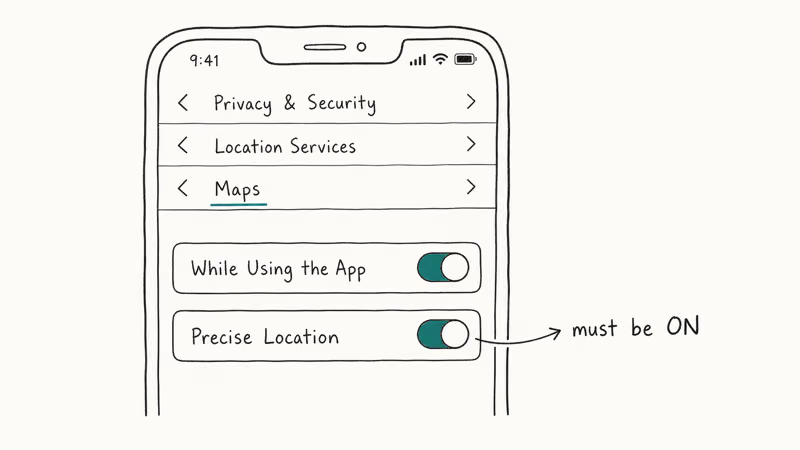
#1. Confirm Location Services Is Set Correctly
This is the single most common cause. Many people remember turning Location Services on at setup but never check that Maps specifically has permission.
- Open Settings, tap Privacy & Security, then Location Services.
- Make sure the master toggle at the top is on.
- Scroll down and tap Maps.
- Select While Using the App or While Using the App or Widgets.
- Toggle Precise Location on.
“Never” or “Ask Next Time” won’t let Maps pull a fix. Precise Location off rounds your position to a several-block radius, which is why the blue dot drifts.
#2. Refresh the Connection With Airplane Mode
Maps caches tiles aggressively, but routing and search hit Apple’s servers in real time. A weak handshake during a cell-tower switch can leave the app stuck.
- Swipe down from the top-right of the screen to open Control Center.
- Tap the airplane icon to enable Airplane Mode.
- Wait a full 10 seconds, then tap the airplane icon again to disable it.
- Reopen Maps.
If you’re on Wi-Fi, also toggle the Wi-Fi icon off and on. In spotty coverage, this airplane-mode reset clears the majority of stalls on its own.
#3. Force-Close and Reopen Maps
A simple app restart clears in-memory state without touching settings.
- Swipe up from the bottom edge and pause halfway to open the App Switcher.
- Find the Maps preview and swipe up on it to close.
- Tap Maps from your Home Screen to relaunch.
Use the same move when Maps freezes mid-route. According to Apple’s iPhone user guide, force-quitting an app frees its memory and resets its session, which clears most one-off freezes within 5 seconds of relaunch.
#4. Update iOS and the Maps App
iOS updates ship Maps fixes regularly, especially after Apple Maps data refreshes. iOS 18.3 in particular included routing fixes that solved a long-standing crash on launch.
- Go to Settings, General, Software Update.
- Install any pending update.
- Open the App Store, tap your profile, and update Maps if listed.
Maps is bundled with iOS, so it usually updates with the OS. The App Store path catches the rare standalone refresh.
#How Do You Reset Network Settings to Fix Maps?
When the quick fixes don’t move the needle, the next layer is network state. Reset Network Settings clears Wi-Fi passwords, VPN configurations, cellular preferences, and DNS overrides, anything that could quietly route Maps traffic into a dead end.
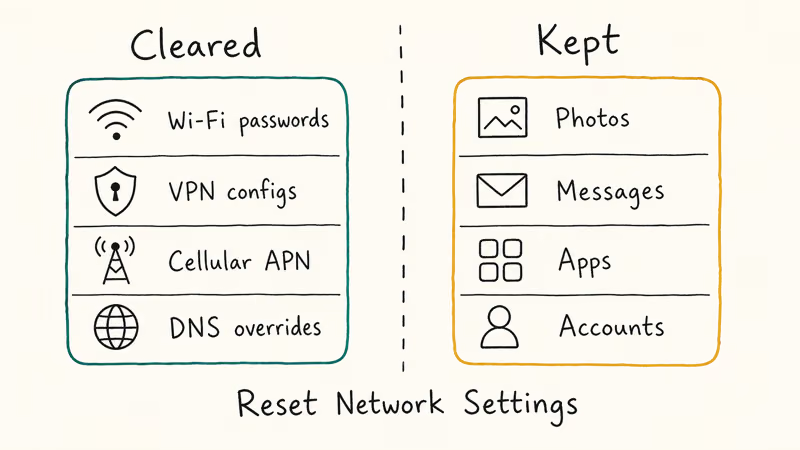
- Open Settings, tap General.
- Scroll to Transfer or Reset iPhone, then tap Reset.
- Select Reset Network Settings.
- Enter your passcode and confirm.
Your iPhone restarts and forgets every Wi-Fi network. You’ll need to re-enter passwords for networks you want to rejoin. Cellular settings restore from your carrier profile automatically.
A Network Settings reset clears most “Maps tiles won’t load” cases on its own. The ones that survive it usually need compass recalibration or an app reinstall instead.
If your Wi-Fi was already flaky, our iPad won’t connect to Wi-Fi guide walks through the same steps for tablets and lays out which carrier APNs to double-check.
#Advanced Fixes for Persistent Maps Failures
If quick fixes and the network reset didn’t help, the issue is deeper. These steps target less-common causes.
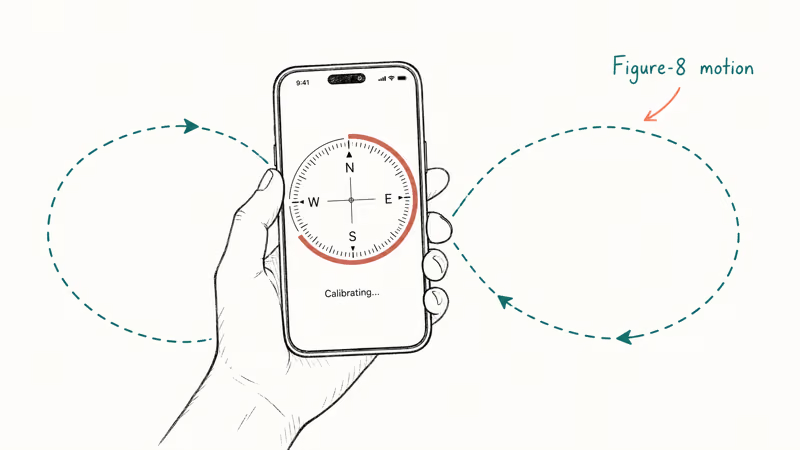
#5. Recalibrate the Compass
When the blue dot spins, points the wrong direction, or routes you to walk against traffic, the compass needs calibration. Apple Maps uses the magnetometer to orient routes; if it’s confused, the app guesses.
- Open Settings, Privacy & Security, Location Services, then scroll to the bottom and tap System Services.
- Make sure Compass Calibration is on.
- Open the Compass app.
- Tilt the screen and roll the iPhone in a figure-8 motion until the calibration ring fills.
- Return to Maps. The blue dot should snap to your actual heading.
Compass drift also follows iPhone repairs, magnetic phone mounts, and some MagSafe accessories. If you switched cases recently, that may be the cause.
#6. Check Apple’s System Status
Sometimes the problem isn’t your phone. Apple’s System Status page lists active outages for Maps Display, Maps Routing, Maps Search, and Maps Traffic separately.
If any Maps row shows a yellow or red indicator, wait for Apple to resolve it. There’s nothing local you can do during an outage. Maps Search outages are brief and infrequent, almost always announced on the Status page.
#7. Sign Out of iCloud Maps and Sign Back In
iCloud syncs Saved places, Guides, and your favorites. When that sync gets stuck, Maps can stall on launch or refuse to load saved locations.
- Go to Settings, tap your name at the top, then iCloud.
- Scroll to Show All, find Maps, and toggle it off.
- Wait 30 seconds, then toggle it back on.
Your saved places will resync. It’s a lighter touch than signing out of iCloud entirely and almost always fixes the “saved location won’t open” problem.
#8. Offload Maps and Reinstall
iOS doesn’t let you fully delete Maps the way you would a third-party app, but you can offload it. Offloading clears the cache while keeping your saved data.
- Go to Settings, General, iPhone Storage.
- Find and tap Maps in the app list.
- Tap Offload App.
- After it offloads, tap Reinstall App.
Reinstalling pulls a fresh copy from iOS without erasing your iCloud-synced favorites. It’s the right fix when Maps crashes on launch or shows persistently broken tiles in one region. According to Apple’s iPhone Storage documentation, offloading frees the app’s local data, typically 200-400 MB, without removing user-generated content tied to your Apple ID.
#9. Reset Location & Privacy as a Last Resort
Wiping every app’s location permissions is the nuclear option. You’ll get the “Allow location access” prompt again for every app the next time you open it.
- Go to Settings, General, Transfer or Reset iPhone, Reset.
- Tap Reset Location & Privacy.
- Enter your passcode.
Use this only after offload and reinstall fail. It’s effective but mildly annoying because every app asks for permissions again on first launch.
#Fixing Specific Maps Problems
Different symptoms point to different fixes. Match the one closest to what you’re seeing.
#Blank Map or Gray Tiles
Map area shows nothing or a checkerboard. Almost always a connection or cache issue.
- Toggle Airplane Mode for 10 seconds.
- Force-close Maps and reopen.
- If still blank, reset Network Settings.
- If only one region is gray, offload Maps to clear the regional cache.
#Voice Navigation Silent
Maps gives directions visually but no spoken turn cues.
- Open Maps, start a route, tap the audio icon in the top-right.
- Choose Loud or Normal, not Mute.
- Check your physical mute switch. Maps voice respects it on most iOS versions.
- Disconnect from Bluetooth speakers if voice is routing to a device that’s offline. If Siri itself is broken, our Hey Siri not working guide covers the related Siri-side fixes.
#Wrong Location or Drifting Blue Dot
Map shows you somewhere you’re not, or your position jumps.
- Turn Precise Location on for Maps.
- Recalibrate the compass.
- Step outside or to a window. GPS struggles indoors and in steel-frame buildings.
- If the location is consistently wrong, our iPhone location wrong guide digs into the network-based location fallback that often misfires.
#Maps Crashes on Launch
App opens, then closes immediately. Points to corrupt cache or an iOS-version mismatch.
- Update iOS to the latest version.
- Offload Maps, then reinstall.
- Free up at least 2 GB of storage if you’re near full. Maps needs working memory.
#Routing Sends You the Wrong Way
Route exists but takes you down closed roads or against traffic.
- Update iOS. Apple ships routing data fixes regularly.
- Check your transportation mode (driving vs walking vs cycling).
- Recalibrate the compass for accurate turn-by-turn cues.
- If routing fails consistently in one area, try Google Maps or Waze for that route. Our Waze not working guide covers Waze-specific issues if you switch and run into the same trouble.
#GPS Fails Entirely
You see “Location Not Available” and the blue dot never appears.
- Confirm GPS hardware: open the Compass app and check for a heading.
- Toggle Location Services off, wait, turn it back on.
- If even the Compass shows nothing, it may be a hardware issue. Our iPhone GPS not working guide covers the deeper hardware-side checks.
#Switching to Google Maps as a Workaround
Apple Maps has improved a lot since the 2012 launch, but Google Maps still wins for most people in most cities. A few honest patterns separate where each app pulls ahead.
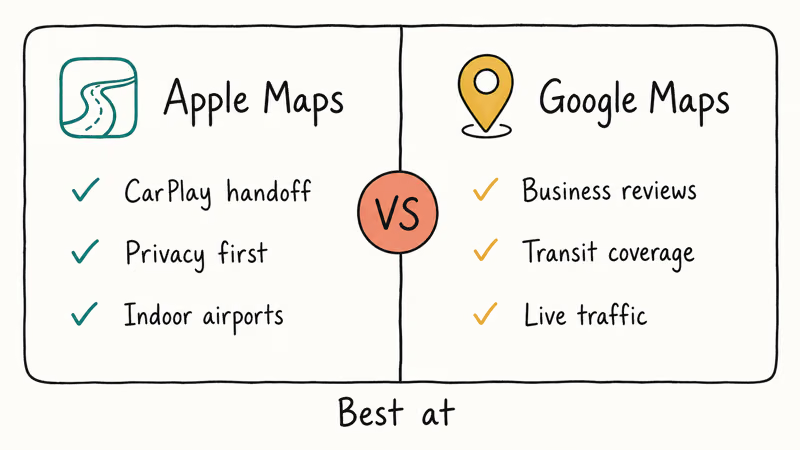
Apple Maps is better at: integration with iOS (CarPlay handoff, Siri suggestions, lock-screen route previews), privacy (no Google account required), and indoor maps for major airports.
Google Maps is better at: business listings and reviews, public transit accuracy, satellite imagery freshness, and crowd-sourced traffic. According to Google’s Maps Help documentation, Google’s transit directions cover thousands of cities globally, which is broader than Apple’s coverage in many regions.
If Apple Maps keeps failing in your area specifically, switching to Google Maps is a legitimate workaround while Apple updates their data. If Google Maps is also misbehaving, our Google Maps not working guide walks through the equivalent fixes on its side.
#When to Contact Apple Support
Most Maps problems are software, but a few point to hardware. Reach out to Apple Support if:
- The Compass app shows no heading or jumps wildly even after calibration. The magnetometer may be damaged.
- GPS works for some apps but never Maps after a full reinstall and Reset Location & Privacy.
- iPhone is consistently locating you in the wrong city, even with Precise Location on and a clear sky view.
- Maps freezes during turn-by-turn and only a force-restart of the iPhone clears it.
Schedule through Apple’s Get Support page and pick “Maps” or “GPS issue” as the topic. Bring your test results from the Compass app. Apple techs ask for that first.
#Bottom Line
For most Maps failures, the fix is the first three steps in order: confirm Location Services for Maps is “While Using the App” with Precise Location on, toggle Airplane Mode for 10 seconds, then force-close and reopen the app. If that doesn’t clear it, reset Network Settings before touching anything heavier. Save the offload-and-reinstall step for crashes and persistent regional tile failures, and only Reset Location & Privacy if everything else has failed twice.
#Frequently Asked Questions
Why is my iPhone Maps not showing my location?
Blue-dot loss happens in two scenarios. Either Location Services for Maps is set to “Never” or “Ask Next Time,” or the GPS hardware can’t get a fix. Check the setting first under Settings, Privacy and Security, Location Services, Maps. If it’s already enabled, step outside to a clear-sky area for 30 seconds.
How do I fix Apple Maps when it’s not giving voice directions?
Start a route, tap the audio icon in the top-right corner of the Maps screen, and confirm it’s set to Loud or Normal. Check your physical mute switch on the side of the iPhone. Maps voice follows it on iOS 17 and later. If audio is routing to a paired Bluetooth device that’s powered off, disconnect Bluetooth and try again.
Can I use Apple Maps offline on iPhone?
Yes, since iOS 17 Apple Maps supports offline regions. Open Maps, tap your profile picture, select Offline Maps, then Download New Map and pick an area. Large metro areas take 1-2 GB. Offline maps work for navigation, search, and turn-by-turn even with cellular off.
Why does my Maps app keep crashing on iPhone?
Crashes usually trace to corrupt app cache after an iOS update or low free storage. Update iOS first. If crashes continue, offload Maps via iPhone Storage. If crashes persist, free up at least 2 GB.
How often does Apple update Maps data?
Apple updates Maps data continuously on the server side for business listings, traffic, and transit. Major map data refreshes ship alongside iOS updates roughly every 6-8 weeks. Detailed City Experience features tend to roll out region-by-region with each iOS point release rather than all at once.
Why is the blue dot wrong on Apple Maps?
Blue-dot drift happens when Precise Location is off or the compass needs calibration. Turn Precise Location on at Settings, Privacy and Security, Location Services, Maps. Then open the Compass app and roll the iPhone in a figure-8 motion until the calibration ring fills. The dot should snap to your real heading.
Will resetting Network Settings delete my photos or apps?
No. Reset Network Settings only clears Wi-Fi passwords, cellular preferences, VPN configurations, and DNS overrides. Your apps, photos, messages, and accounts stay intact. You’ll need to rejoin Wi-Fi networks manually after the reset, but everything else stays in place.
Does Low Power Mode affect Apple Maps?
Yes, slightly. Low Power Mode reduces background GPS polling and may delay how quickly Maps detects you’ve moved between cell towers. Turn-by-turn navigation still works fully, but the blue dot may update less smoothly. Turn off Low Power Mode in Settings, Battery if Maps feels sluggish.
Apple Siri Settlement: Who Qualifies and How to Claim
Apple's $250 million Siri settlement covers iPhone 15 Pro and iPhone 16 models bought June 2024 to March 2025. See who qualifies and how claims work.

iOS 26.6.1 Security Update: What Apple Fixed and Who Gets It
Apple released iOS 26.6.1 on August 17 with 29 security fixes, including an IPSec interception bug. See what it patches, who gets it, and how to update.
iPhone Adaptive Power: How It Works and When to Use It
Learn how iPhone Adaptive Power works, which models support it, what it changes, and when Low Power Mode is still the better battery-saving choice.
How to Transfer Data to a New iPhone Without iCloud
Move everything to your new iPhone without iCloud: Quick Start device-to-device transfer, wired migration, and encrypted Finder or iTunes backups.