How to Turn Off Autocorrect on iPhone: A Complete Guide
Turn off autocorrect on iPhone via Settings > General > Keyboard. Learn how to disable predictive text, auto-capitalization, and spell check too.
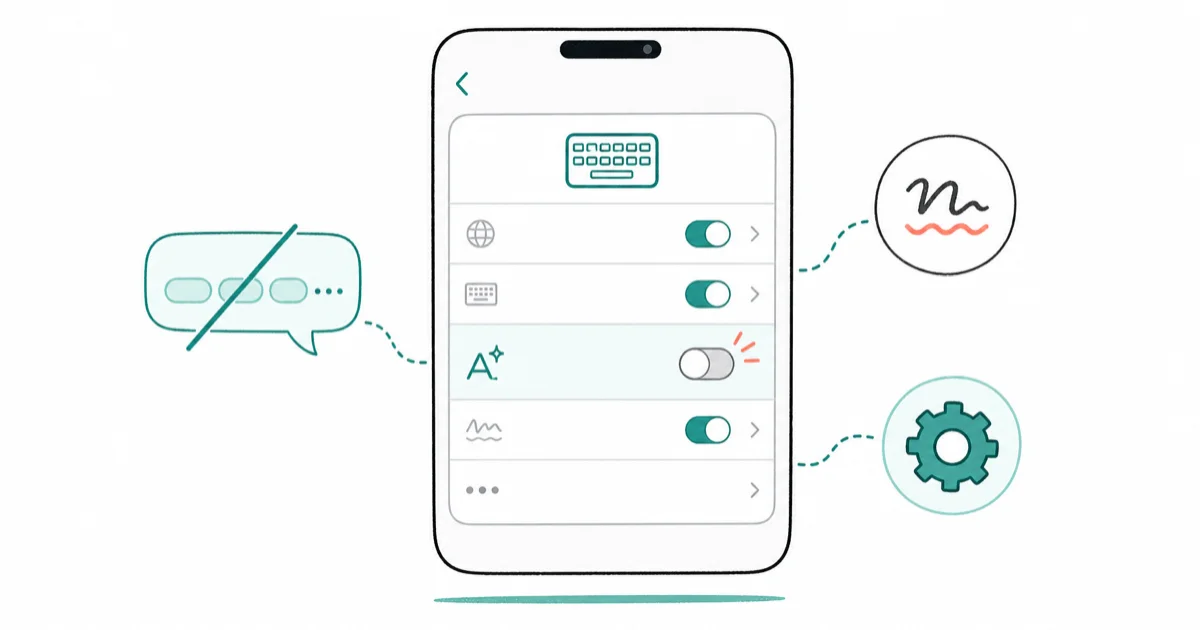
Quick AnswerGo to Settings > General > Keyboard, then toggle off Auto-Correction. You can also disable predictive text and spell check from the same screen.
Autocorrect helps catch typos, but it often rewrites proper nouns, slang, and bilingual messages into words you never meant to send.
This guide walks through the exact toggle path on iOS 17 and iOS 18, plus how to keep spell-check underlines on even after Auto-Correction is off. It also covers where Screen Time restrictions can lock the setting under a managed profile.
- The Auto-Correction toggle lives at
Settings>General>Keyboard andtakes effect on the next keystroke - Predictive text, Auto-Capitalization, and Check Spelling are independent switches on the same screen
- Turning off Auto-Correction while keeping Check Spelling on underlines misspellings in red without rewriting them
- Text Replacement shortcuts like “omw” expanding to “on my way” keep working even after autocorrect is fully disabled
- Resetting the Keyboard Dictionary in
Settings>General>Transferor Reset iPhone clears learned words if bad corrections persist
#Why would you turn off autocorrect on iPhone?
Autocorrect is built around a dictionary of common English words and a learning model that adapts to what you type. According to Apple’s iPhone User Guide for keyboard input, the keyboard “automatically corrects misspellings and predicts what you’re about to type.” That works for everyday messages. It works against you in four common situations.
The most common reasons people disable it:
- Proper nouns and contact names that aren’t in the dictionary get rewritten into similar-looking real words
- Bilingual typing where switching languages mid-message triggers wrong-language corrections
- Technical writing with acronyms, model numbers, or product codes that look like typos to the keyboard
- Slang and informal abbreviations that get expanded into formal phrases you didn’t want
The strongest case for turning it off is bilingual typing. iOS autocorrects against the active keyboard’s dictionary, so Spanish, French, or German words typed on the English keyboard can get rewritten into similar-looking English words. Switching keyboards mid-message fixes it, but most people forget the globe key. Turning Auto-Correction off outright is more reliable than retraining the muscle memory of tapping the globe every time you swap languages.
If your keyboard misbehaves in other ways (lag, missing keys, ghost taps), autocorrect isn’t the cause. Check our troubleshooting walkthrough for an iPhone keyboard that’s not working instead. If Messages itself is the problem and texts aren’t arriving, see iMessage not working.
#How do you turn off autocorrect on iPhone?
The process is the same on every iPhone running iOS 11 or later, which covers the iPhone 5s through iPhone 15 Pro Max. Apple’s keyboard guide confirms that the toggle path hasn’t moved across recent iOS versions.
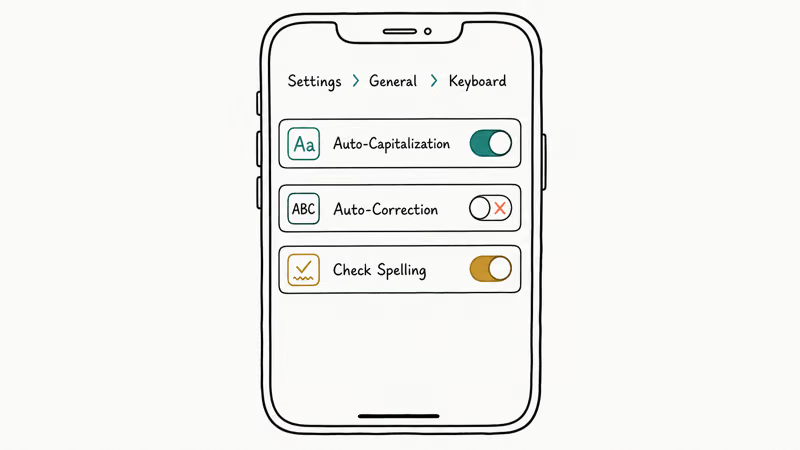
- Open the Settings app on your iPhone
- Tap General
- Tap Keyboard (about a third of the way down the screen)
- Find Auto-Correction under the All Keyboards section
- Tap the green toggle so it turns gray
The change takes effect immediately. Type a misspelled word on purpose, and the keyboard leaves it alone.
A brief pause can happen the first time you type in an app that had been backgrounded. iOS rebuilds its keyboard state once before honoring the new setting, so the very first keystroke after the toggle may still receive the old behavior. After that, apps that use the standard iOS keyboard should respect the toggle without needing a restart.
If the toggle won’t stay off, the cause is almost always a Screen Time content restriction managing keyboard settings under a managed profile. Go to Settings > Screen Time > Content & Privacy Restrictions and check whether keyboard settings are locked. Apple’s Screen Time restrictions guide states that an administrator-locked profile can override individual keyboard toggles even after they appear to flip in Settings.
#Customizing other keyboard settings
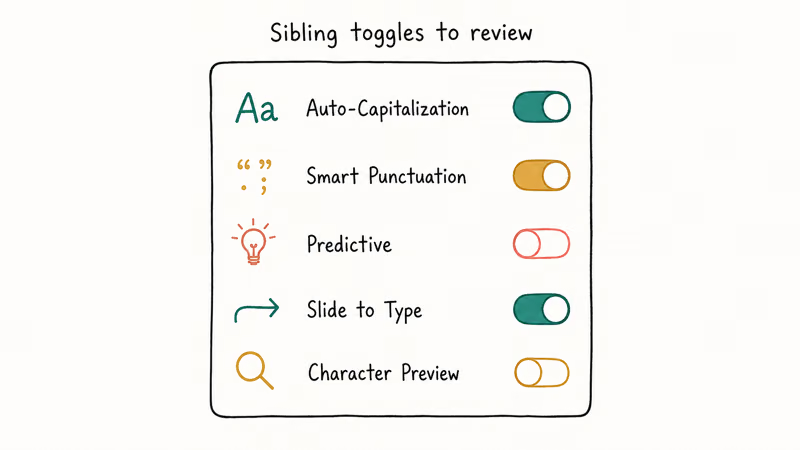
The Keyboard screen has five independent toggles.
#Disabling predictive text
Predictive text is the strip of suggested words above the keyboard, and it also drives the inline gray text completions Apple added in iOS 17. Both surfaces share the same on-device language model, so this single toggle controls them together.
In Settings>General>Keyboard, find Predictive Text- Toggle the switch to the off position
The QuickType bar disappears.
#Turning off auto-capitalization
Auto-Capitalization is what makes the first letter after a period jump to uppercase. It also fires after a question mark, an exclamation mark, or a newline. Apple’s keyboard guide states the behavior applies in every input field that uses the system keyboard, including brand names like iPhone, eBay, iOS, and macOS that start with a lowercase letter and get corrected on every sentence start.
- In Keyboard settings, find Auto-Capitalization
- Toggle the switch off
This is the toggle to turn off if you write in lowercase as a style choice, or if you type a lot of brand names that start with a lowercase letter (iPhone, eBay, iOS).
#Adjusting spell check
Spell check is separate from autocorrect. With autocorrect off and Check Spelling on, the keyboard underlines misspelled words in red but doesn’t change them, so you decide whether to fix each one.
- In Keyboard settings, find Check Spelling
- Make sure the toggle is on (green)
We recommend keeping this on for most users. It gives you a visual signal without the silent rewrites that make autocorrect frustrating.
#Tips for better typing without autocorrect
Turning autocorrect off doesn’t mean accepting more typos. Two built-in features pick up the slack.
#Using text replacement
Text Replacement is a keyboard shortcut system. Type a short trigger and iOS expands it into a longer phrase, regardless of whether autocorrect is on. Apple’s Text Replacement documentation confirms that replacements sync across all devices signed into the same iCloud account when Keyboard is enabled under iCloud settings.
- Go to
Settings>General>Keyboard>Text Replacement - Tap the plus sign in the top-right corner
- In the Phrase field, enter the full text you want (for example: “on my way”)
- In the Shortcut field, enter the trigger (for example: “omw”)
- Tap Save
Common useful shortcuts: your email address, your home address, frequent canned responses, signature blocks, and any string of characters you find yourself retyping more than twice a week. Each entry takes about ten seconds to add and saves time forever. If you found the standard iPhone keyboard cramped, our guide on how to make the keyboard bigger on iPhone covers landscape mode and accessibility options.
#Third-party keyboard options
If the stock keyboard doesn’t fit your typing style, the App Store has alternatives with smarter prediction and gesture typing. Popular choices:
- SwiftKey: Microsoft’s keyboard with adaptive prediction and gesture typing
- Gboard: Google’s keyboard with built-in search and glide typing
- Grammarly Keyboard: focused on grammar and tone suggestions
Each one ships its own autocorrect engine you can configure independently of the system setting.
For broader iPhone troubleshooting beyond the keyboard, our guides on AirDrop not working and iPhone camera not working cover the next-most-common settings menus people get stuck in.
#Troubleshooting autocorrect issues
If autocorrect still misbehaves after you’ve turned it off, the keyboard dictionary or iOS itself is likely the culprit.
#Resetting the keyboard dictionary
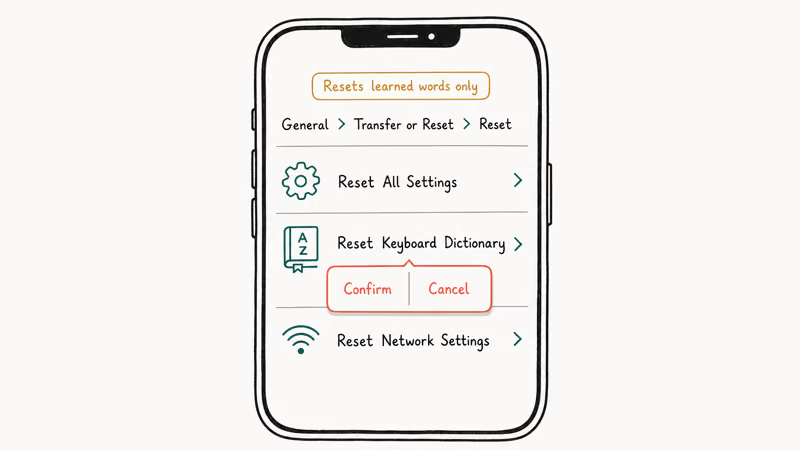
iOS learns words you type often and adds them to a personal dictionary. If learned words got merged with bad corrections, a reset is the cleanest fix.
- Go to
Settings>General>Transferor Reset iPhone - Tap Reset
- Tap Reset Keyboard Dictionary
- Enter your passcode and confirm
This erases learned words but doesn’t touch your saved Text Replacements. Apple’s reset documentation states that the dictionary reset is reversible only by re-typing words to rebuild the learning data.
#Updating iOS
Apple announced fixes for several keyboard prediction bugs in the iOS 17.4 release notes, and similar fixes ship with most point releases. If autocorrect feels stuck on a behavior you can’t change, an iOS update is often the cleanest fix.
- Go to
Settings>General>Software Update - Tap Update Now if a newer version is available
- Plug in to power and let the update finish
If your iPhone gets stuck during the update process, our walkthrough on how to fix a frozen iPhone covers force restart sequences that don’t lose data.
#Pros and cons of disabling autocorrect
#Benefits
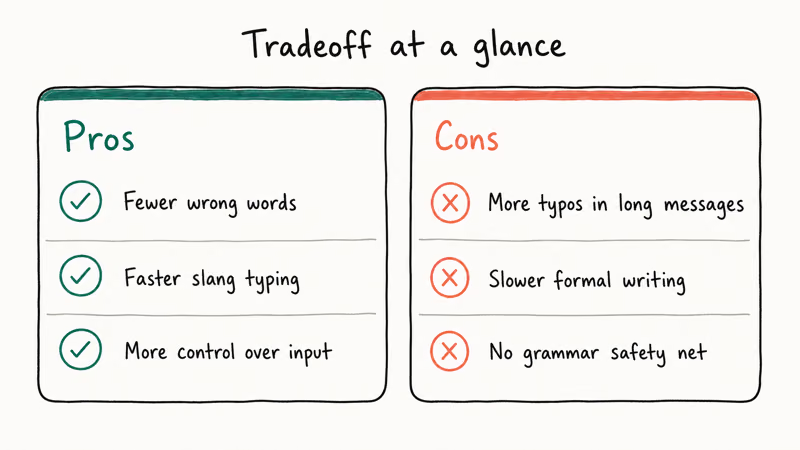
- More control over your typing, especially with names and technical terms
- No more autocorrect fails in messages or work emails
- Better bilingual typing when you switch languages without switching keyboards
- Clearer signal about your typing accuracy, since you see what you actually typed
#Trade-offs
- You’ll need to proofread more carefully since silent corrections won’t catch typos
- Common transpositions like “teh” stay misspelled until you fix them manually
- Typing speed may dip for a week while your fingers stop relying on auto-fix
- Predictive suggestions still help if you keep Predictive Text on, so don’t disable both unless you want a fully manual keyboard
#Bottom Line
Turn off Auto-Correction in Settings > General > Keyboard and leave Check Spelling on. That’s the lowest-friction setup for technical writing and bilingual messaging, because it gives you the red-underline safety net without silent rewrites. Keep Predictive Text on if you want word suggestions; turn it off only if you want a fully manual typing experience. Re-enable Auto-Correction the same way if you change your mind.
iPhone tips & tricks
#Frequently Asked Questions
Will turning off autocorrect affect other apps?
Yes. Autocorrect is a system-wide setting tied to the iOS keyboard, so it applies to every app that uses the standard iPhone keyboard. Messages, Mail, Notes, Safari, Reminders, WhatsApp, Slack, Telegram, and Discord all stop autocorrecting at the same moment. Third-party keyboards from the App Store have their own autocorrect toggles that work independently.
Can I turn autocorrect back on later?
Yes, just flip the Auto-Correction toggle back on at Settings > General > Keyboard.
Does turning off autocorrect also disable spell check?
No, they’re separate toggles on the same screen. Check Spelling underlines misspellings in red without changing them, while Auto-Correction silently rewrites them. Turning off Auto-Correction but leaving Check Spelling on is the lowest-friction setup for most users.
Will disabling autocorrect affect my other Apple devices?
No. Keyboard settings are per-device.
Can I disable autocorrect for specific apps only?
iOS doesn’t offer a per-app autocorrect toggle. It’s all-or-nothing at the system level. The standard workaround is to install a third-party keyboard such as Gboard, SwiftKey, or Grammarly Keyboard and switch to it only inside apps where you want different behavior. Apple’s keyboard guide confirms third-party keyboards run their own correction engines independent of the iOS setting.
Why does autocorrect keep changing the same word incorrectly?
A bad correction can stick if you’ve accidentally accepted it before, since iOS learns from every word you tap to confirm.
Does autocorrect work the same on iPad?
Yes, the setting path and behavior are identical on iPadOS. Apple’s keyboard documentation confirms that iPad uses the same keyboard framework as iPhone, so Auto-Correction, Predictive Text, and Check Spelling all behave the same way and live in the same Settings location.
How to Transfer Data to a New iPhone Without iCloud
Move everything to your new iPhone without iCloud: Quick Start device-to-device transfer, wired migration, and encrypted Finder or iTunes backups.
Best Wireless Earbuds for iPhone in 2026: USB-C Era Picks
Best wireless earbuds for iPhone in 2026, comparing AirPods Pro 3, Sony WF-1000XM6, Bose QC Ultra, and Anker Liberty 4 NC on the USB-C iPhone lineup.
iPhone Keyboard Lag? 7 Proven Fixes for iOS 26 (2026)
Fix iPhone keyboard lag with 7 proven fixes for iOS 26. Covers restart, storage, predictive text, third-party keyboards, and dictionary reset.
How to Block Porn on an iPhone: A Guide for Parents
Learn how to block porn on iPhone using Screen Time, DNS filtering, and safe browsers. Step-by-step guide for parents to protect kids' devices.