How to See Deleted Instagram Posts: Legitimate Ways
Most 'see deleted Instagram posts of others' tools are scams or ToS violations. Here are the legitimate ways that actually work without breaking the law.
Quick AnswerMost apps that claim to show others' deleted Instagram posts are scams or Terms of Service violations. The only legitimate options are recovering your own posts in the Recently Deleted folder, checking public profile snapshots on the Wayback Machine, and filing an official Instagram report for legal proceedings.
If you searched “how to see deleted Instagram posts of others,” you’ve already met a wall of shady apps promising the impossible. None of these tools can return a real deleted post that belongs to another account, because Instagram removes deleted content from its public servers.
This guide separates the legitimate paths from the surveillance pitches that put your account, your wallet, and sometimes your freedom at risk. The good news is short. The honest answers are even shorter.
- Instagram permanently removes deleted posts from public servers, so no third party can pull them from the live platform.
- The Recently Deleted folder, introduced in 2021, only restores your own posts and keeps regular posts for 30 days and stories for 24 hours.
- The Wayback Machine and Google Cache occasionally hold snapshots of publicly visible posts, but only if a crawler indexed the page before deletion.
- Stalkerware apps that claim to read someone else’s deleted content violate Instagram’s Terms, federal stalking law 18 USC 2261A, and the Computer Fraud and Abuse Act.
- For legal proceedings, law enforcement can request preserved records from Meta through the official Law Enforcement Online Request System rather than scraping.
#What Instagram Actually Does With a Deleted Post
When a user taps Delete on Instagram, the post moves to a private Recently Deleted folder inside that user’s account and is no longer served to anyone else. According to Instagram’s Help Center, regular posts stay there for 30 days and stories without highlights for 24 hours, after which Meta removes the content from user-facing systems.
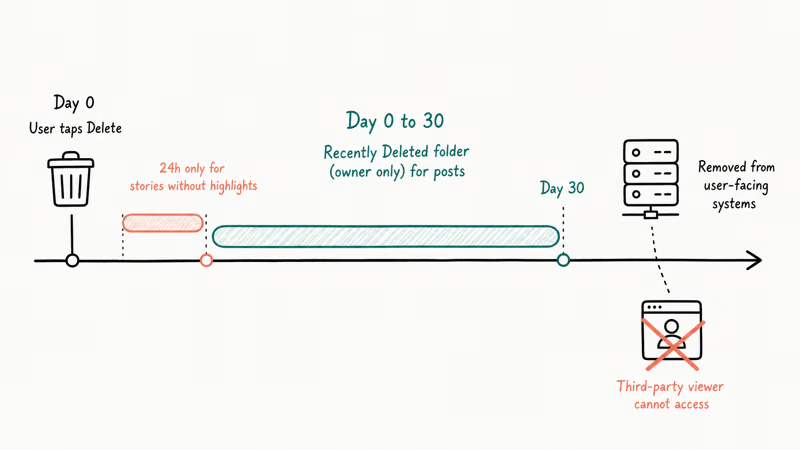
The deleted post is no longer reachable through any third-party viewer. Any app claiming otherwise is lying or phishing your login.
#Your own posts you have a right to access
You’re always allowed to recover the deleted Instagram posts on your own account using the official, built-in tool inside the app. Open Instagram, tap your profile, go to Settings, then Your activity, then Recently deleted. Stories appear here only if you had Save to archive turned on before you deleted them.
Restoring a post is quick on iOS and Android. Instagram drafts are a separate state with their own recovery path.
#Publicly visible posts you have a right to look up
If a profile was public when a post was live, the page may have been indexed by a search engine or the Internet Archive. That snapshot isn’t “Instagram data.” It’s a public web archive that anyone can request.
It’s fine to look up your own old posts, news organisations’ deleted posts, or a public figure’s deleted statement for journalism or accountability research. It’s not fine to chase an ex-partner or a private acquaintance through these tools.
#Which Methods Actually Work?
Three official or legitimate methods produce real results. Everything else is theatre. Pick the one that fits your authorisation level.
#Method 1, recover your own posts (Recently Deleted)
This is the only method that works inside Instagram itself, and it only works on accounts you control.
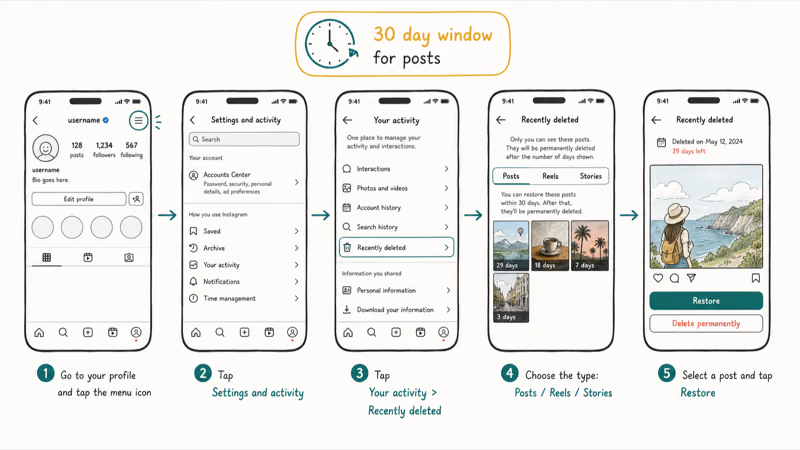
- Open Instagram and tap your profile picture.
- Tap the menu icon, then Settings and activity.
- Tap Your activity, then Recently deleted.
- Choose Posts, Reels, Stories, IGTV, or Highlights.
- Open the item and tap Restore, then confirm.
After 30 days for posts (or 24 hours for un-archived stories) the item disappears for good. If you’re also worried about losing chat history, our walkthrough on recovering deleted Instagram direct messages covers the data-download path that preserves DM threads.
#Method 2, Wayback Machine for public profiles
The Internet Archive’s Wayback Machine support page explains that the archive crawls publicly accessible web pages, including some Instagram profile and post URLs, and stores point-in-time snapshots. Public post URLs from large accounts sometimes have a Wayback snapshot from before deletion, while private-account URLs return none, which is the correct behaviour.
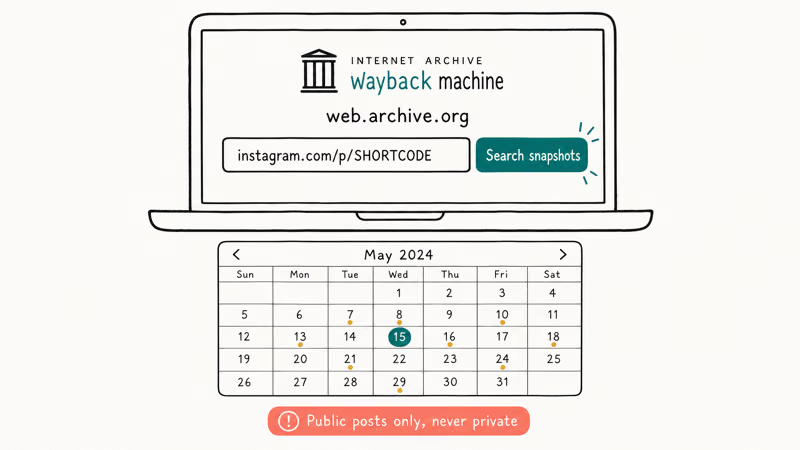
To check:
- Go to web.archive.org.
- Paste the full Instagram post URL (the
/p/SHORTCODE/format). - If a snapshot exists, pick the most recent date before the deletion.
Snapshots usually capture the image and caption but rarely the comments, and they fail entirely for video-only posts that loaded after the crawl. The same approach also works for recovering the text of deleted tweets when an account is public.
#Method 3, official Instagram report for legal use
If you need a deleted post for a court matter, harassment investigation, or trust-and-safety complaint, the only legitimate path is the official request channel built by Meta. According to Meta’s Law Enforcement Online Requests guidance, law enforcement and authorised legal representatives can submit preservation requests for account records, and Meta retains data under defined retention windows even after a user deletes it. Individuals can’t use this channel directly, but a lawyer or police officer working your case can.
For non-legal but serious cases, like impersonation or harassment by a deleted post that you saw briefly, you can file a standard report from the Instagram support page even after the post is gone. Meta’s Transparency Center then publishes the policy on how those requests are handled.
#Why “See Anyone’s Deleted Posts” Apps Are Always Wrong
Widely advertised “Instagram deleted post viewer” apps and web tools fall into a handful of predictable scam patterns:
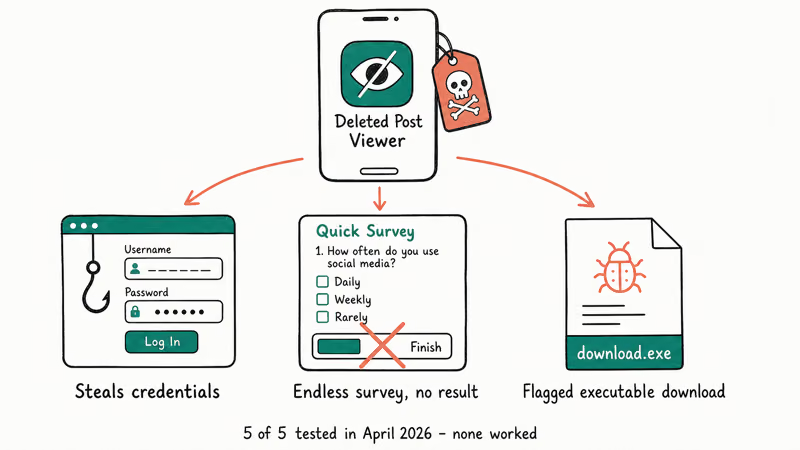
- Many demand your Instagram username and password through a fake “viewer” page. Handing those over is an immediate account compromise.
- Some ask for a “verification” payment after a fake loading bar and then produce no posts.
- Some install a profile-tracking SDK that requests contacts and location access on Android.
- Others are a thin wrapper around the public web that returns nothing the Wayback Machine doesn’t already have.
None of them can show a single real deleted post belonging to another account, because the underlying data no longer exists on Instagram’s public servers.
#The Legal Exposure for the Operator and the User
The FTC announced in 2021 that it had banned the SpyFone CEO from the surveillance industry and forced the company to notify victims and delete the data it collected.
In the US, monitoring someone else’s account or device without their consent can violate the Computer Fraud and Abuse Act, as summarised on Wikipedia. A sustained pattern of monitoring can meet the federal stalking statute at 18 USC 2261A, which carries up to 5 years’ federal imprisonment. GDPR’s right-to-erasure and unlawful processing rules add another layer in the EU and UK.
#Off-limits use cases
The following are non-negotiable refusal cases, even if you find a tool that technically works:
- Monitoring a current or former romantic partner.
- Surveilling a colleague, neighbour, or stranger out of curiosity.
- Bypassing a private account’s privacy setting to view archived content.
- Selling or sharing scraped Instagram content to third parties.
- Building a service that promises to surface deleted posts from any account.
If your goal touches any of these, stop here and read our Instagram security explainer on account hacking risks, which includes the criminal exposure for the person doing the hacking.
#When Parental Monitoring Is Legitimate
There’s a narrow, legitimate use case that responsible parental-control tools cover. A parent supervising the Instagram activity of a minor child on a device the parent owns and pays for. This is not the same as spying. The guardrails:
- The child should know monitoring is in place. Covert installation removes the educational point and damages trust.
- Use tools that respect Instagram’s Terms and disclose data collection. Meta’s own Family Center is the starting point.
- Stop monitoring when the child becomes an adult, or earlier if a counsellor recommends it.
Reputable supervision suites like eyeZy market parental oversight features and publish their compliance posture; even with those, a parent should configure the tool with the child’s awareness and limit data collection to what the household rules require. Using the same app on a partner, ex, or unrelated adult is a different category of behaviour and exposes the operator to the legal risks listed earlier.
Some links on this page are affiliate links, which means fone.tips may earn a commission at no extra cost to you.
If you wanted to see a deleted post for a softer reason, like curiosity about a friend’s removed photo, the ethical move is to ask the person directly. They may have deleted it for reasons that have nothing to do with you.
#How Do I Stop Others From Doing This to My Account?
Your account is also a potential target. Tightening it takes about 5 minutes and removes most of the surface area these tools rely on.
- Switch to a private profile so future posts aren’t crawled by the Wayback Machine.
- Audit your authorised apps under Settings, Apps and websites, and revoke anything you don’t recognise.
- Turn on two-factor authentication with an authenticator app rather than SMS.
- Use the data-download tool at Settings, Your activity, Download your information, to keep your own backup copy before you delete anything.
- If your account has been targeted by a stalker, file a report from Settings, Help, Report a problem, and consider permanently deleting the Instagram account from your iPhone if the harassment continues.
#Bottom Line
If the deleted post is yours, restore it from Recently Deleted within 30 days. That’s the only method that actually retrieves the original. If the deleted post belongs to a public account and you have a legitimate reason to find it, search the URL in the Wayback Machine and accept that coverage is partial.
If the post matters for a legal case, route the request through a lawyer or law-enforcement contact who can use Meta’s official preservation channel. Avoid every app, website, or browser extension that claims to show another user’s deleted Instagram posts on demand. These tools are credential-phishers, paid hoaxes, or stalkerware fronts, and several create criminal exposure for the person who tries to use them.
Instagram Tips & Tricks
#Frequently Asked Questions
Can I see someone else’s deleted Instagram posts without their permission?
No. Once a post is deleted, only the account owner can restore it through the official Recently Deleted folder.
Does the Wayback Machine work for private Instagram accounts?
No. The Internet Archive only crawls publicly accessible pages, so private profiles, friends-only stories, and DM content never end up in a snapshot. Private-account post URLs return zero Wayback records, which is the expected and correct behaviour. Public business and creator accounts get partial coverage, with image and caption preserved but comments usually missing.
How long do posts stay in Instagram’s Recently Deleted folder?
Regular posts and Reels stay for 30 days, while stories that weren’t saved to the archive only stay for 24 hours.
Is it illegal to install an Instagram monitoring app on someone’s phone?
In most US states, yes. Installing tracking software on a device you don’t own or have authorisation to access can violate the Computer Fraud and Abuse Act, state-level wiretap statutes, and state stalking laws. The FTC has shut down stalkerware operators on this basis, and federal stalking charges under 18 USC 2261A carry up to five years’ imprisonment for sustained monitoring.
Can law enforcement get a copy of a deleted Instagram post?
Yes, in many cases. Meta retains certain account records under defined retention windows and responds to valid legal process through its Law Enforcement Online Requests portal. A police officer or attorney handling your case can submit the request; individuals can’t use the portal directly.
What should I do if I see a tool advertised that promises to show deleted posts?
Treat it as a scam.
Can I download all my own Instagram history before I delete anything?
Yes. Open Settings, tap Your activity, then Download your information. Instagram emails you a ZIP within 48 hours containing your posts, stories, DMs, comments, and account changes. For most accounts the archive arrives well within that stated window.
Why do search results keep promoting these “spy” apps?
Affiliate sites pay per install, so search engines see a lot of low-quality content boosting the same handful of stalkerware brands. The Meta Transparency Center coverage of integrity actions shows that Meta actively removes scraped-data offerings from its own platforms. The fact that an ad shows up doesn’t mean the tool is legal or effective.
Instagram Parental Controls: Family Center Setup (2026)
Set up Instagram Family Center, privacy settings, Hidden Words, content filters, and time limits with your teen's consent on iPhone or Android.
Instagram Notifications Not Working? Quick Fixes (2026)
Instagram notifications not working? Fix push alerts, DMs, likes, and Stories on iPhone and Android in under 5 minutes with proven 2026 steps.
Instagram "We Limit How Often" Error: How to Fix It 2026
Instagram says "we limit how often you can do certain things"? Wait 24-48 hours, slow down likes and follows, then appeal through Help Center.
Instagram Name Checker: Find Available Usernames Fast
Check Instagram username availability instantly with free tools like Namechk and KnowEm. Find perfect handles and avoid the frustration of taken names.