How to See Deleted Tweets: 6 Legitimate Methods for 2026
See deleted tweets the right way using the Wayback Machine, Politwoops, and your own X archive. Six legitimate methods and what still works today.
Quick AnswerUse the Wayback Machine to view publicly archived snapshots, or request your own X data archive from Settings to recover tweets you deleted from your account.
If you’ve ever wished you could see deleted tweets, the honest answer in 2026 is “sometimes, and only through specific channels.” Six methods are worth knowing, and most of them apply to your own X account and public profiles. The workable paths come down to public web archives, your own data export, and a few specialist accountability tools.
This guide walks through what works, what quietly stopped working after Twitter became X, and where you should stop because the legal line is closer than people think.
- The Wayback Machine at web.archive.org remains the most reliable free option for recovering public tweets that crawlers captured before deletion.
- Requesting your own X data archive from Settings delivers a ZIP with every tweet you ever posted, including the ones you later deleted.
- Google Cache officially shut down on January 31, 2024, so any guide telling you to click a Cached link is out of date.
- Politwoops, run by ProPublica, tracks deletions from US politicians and remains an active public archive.
- Accessing someone else’s private deleted tweets without authorization can trigger CFAA exposure in the United States and violates X’s Terms of Service.
#Why Some Tweets Are Gone Forever and Others Are Not
A deleted tweet is removed from X’s live feed. Its visibility elsewhere depends on whether a third party crawled the public version before it disappeared. Archives like the Wayback Machine save snapshots of public profiles on a sampled schedule, so a high-profile account may have dozens of captures per week while a small account might have none for years. Private and protected accounts aren’t crawled at all, which is why no legitimate method can recover their deleted content.
That asymmetry is the single most important thing to internalize before you spend any time on a recovery attempt. Spend two minutes confirming the source account was public, then pick the right tool below.
There are three distinct goals people usually pursue when they search for deleted tweets, and they require different tools.
- Recovering your own tweets: the X data archive is the canonical source.
- Researching public figures: Politwoops covers politicians, and the Wayback Machine covers anyone newsworthy.
- Forensic or legal context: a screenshot circulating on another platform is often the strongest surviving evidence.
According to X’s official help on downloading your archive, the file you receive arrives within 24 hours and includes every tweet associated with your account. Deleted posts still appear in that ZIP, which is what makes the archive the reliable route for recovering your own tweets.
#What Counts as Legal and What Crosses the Line?
X’s Terms of Service prohibit scraping and reverse-engineering. The United States Computer Fraud and Abuse Act, summarized on the Wikipedia overview of the CFAA, found that the 1986 statute covers unauthorized account access as a federal offense even when no financial harm occurs.
Legitimate recovery in 2026 looks like this:
- Your own account, your own data.
- Public information that was visible to anyone and got archived by a public web crawler.
- Aggregated accountability projects like Politwoops that operate under research and journalism doctrines.
The line you don’t cross: paying for or installing tools that promise access to another person’s private tweets, DMs, or deleted content. Those tools either fail, expose you to malware, or quietly route credentials through a third party. Such services typically return nothing or ask for full account access to “scan,” which is a credential-harvest pattern.
#1. Using the Wayback Machine for Public Tweet History
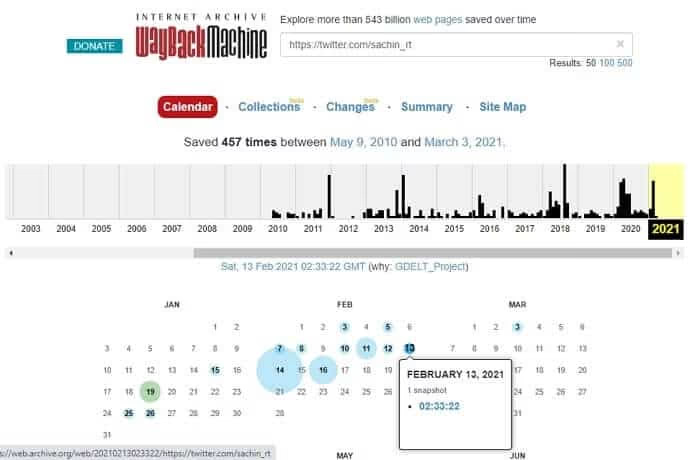
The Wayback Machine, run by the Internet Archive in San Francisco, captures snapshots of public web pages so they remain viewable after the original changes or disappears. For X profiles, archive depth depends on how often the account was crawled before deletion.

Here is the workflow for recovering a sample of public deletions through the archive.
- Visit https://web.archive.org/ in a desktop browser.
- Enter the full profile URL, for example
https://twitter.com/username(the legacy domain often returns richer snapshots thanhttps://x.com/username). - Click into the calendar view and pick a date range that brackets when the tweet was live.
- Click any blue dot on the calendar to open the snapshot.
- Scroll the archived timeline. Snapshots are read-only HTML, so the original tweet appears even if it’s gone from X.
For most high-traffic public accounts, the archive holds enough snapshots to surface deleted tweets fairly quickly. Low-traffic accounts often have very few snapshots on record, so a deleted tweet was simply never captured.
The Wayback Machine works well for public figures, news accounts, and anyone whose profile attracted enough attention to be crawled. It struggles with low-traffic accounts that the crawler skipped. If your tweet existed for under an hour, recovery odds drop sharply because the average gap between captures on a typical news account is several days.
If you are having trouble loading any X page, clearing your Twitter cache often resolves the rendering issues that prevent archived snapshots from displaying correctly.
#2. Google Cache Is Gone, So Stop Looking for It
Most older guides still tell you to click the cached link in Google search results. That feature was discontinued. Search Engine Land reported that Google retired the cache operator on January 31, 2024, calling it a remnant of an era when web pages frequently failed to load.
What this means for tweet recovery is concrete. The cache: prefix returns no results.
The small arrow next to URLs in Google search results no longer shows a Cached option. Third-party “Google cache viewers” simply scrape the live page or fall back to the Wayback Machine. If a tutorial published before 2024 tells you to use Google Cache, it’s out of date. Skip that step and head to the Wayback Machine instead.
#3. Requesting Your Own X Data Archive
For recovering tweets you yourself deleted, this is the canonical method and it’s fully supported by X. The archive contains every tweet ever published from your account, every direct message, every media upload, and your full follower history at the time of export.
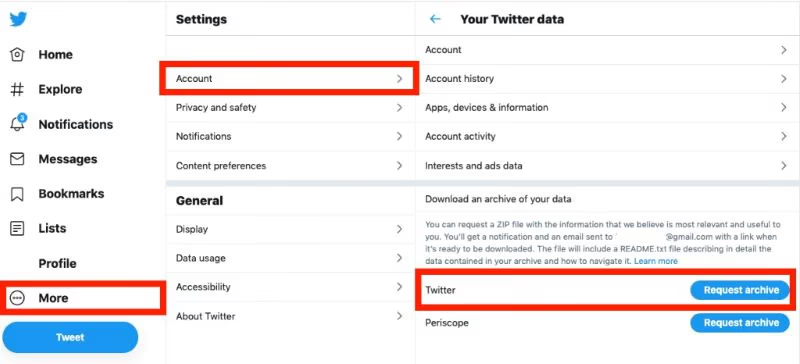
The steps for the current archive request flow:
- Sign in at x.com on desktop.
- Click More in the left navigation, then Settings and privacy.
- Choose Your account, then Download an archive of your data.
- Confirm your password and verify via SMS or authenticator.
- Click Request archive.
- Wait for the in-app and email notification. The archive usually arrives within a day, and X states it can take up to 24 hours.
- Download the ZIP, extract it, and open
Your archive.htmlin any browser.
The HTML interface lets you scroll your full posting history, search by keyword, and view media offline. Every deleted tweet appears in tweets.js inside the data/ folder if you want to grep through the raw JSON.
There’s one limitation worth flagging. If you’ve deleted the account itself, no archive request can be filed because there’s no live account to request from. X retains data for a 30-day grace period after deletion during which you can reactivate and then request the archive, after which the data is gone.
While you’re managing your X presence, you might also want to check who visited your Twitter profile or learn who blocked you on Twitter. Both use indirect signals rather than official APIs.
#4. Politwoops for Politicians and Public Officials
Politwoops, operated by ProPublica, tracks deleted tweets from elected officials and political candidates in the United States and a handful of other countries. It remains the best-known public archive for political deletions when the account is covered by the project.
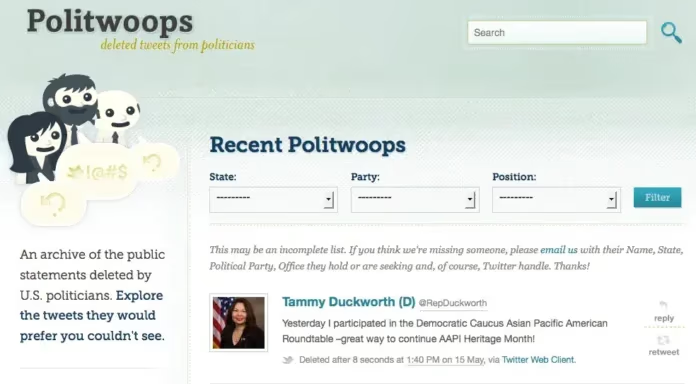
To use it:
- Visit the Politwoops project at ProPublica.
- Browse the front page for the most recently captured deletions.
- Search by politician name, state, or chamber of office.
- Click any tweet to see the original text, the deletion timestamp, and account context.
Politwoops reliably returns results for covered officials, including former federal officials and current state legislators. It does not cover private citizens, journalists, or accounts outside the monitored political list, so don’t expect it to surface deleted tweets from a friend or coworker.
#5. Finding Screenshots of High-Profile Deletions
For tweets that gained significant attention before being removed, screenshots almost always survive on other platforms. This isn’t technically tweet recovery, but it’s often the most practical source of evidence for journalists, researchers, and people trying to verify quotes.
Search workflows that consistently surface these screenshots:
- Run a Google Images search for the account name plus a distinctive phrase from the tweet.
- Search Reddit directly with
site:reddit.com [username] [topic]for community archives. - Check news aggregators like Memeorandum or Techmeme if the tweet was newsworthy.
- Look at fact-checker sites like Snopes and PolitiFact, which screenshot tweets before deletion is likely.
Always verify screenshot authenticity by cross-referencing the date, account avatar, and language. Fabricated tweet screenshots are a well-documented disinformation tactic, and tools like Tweetgen produce convincing fakes in seconds. A single screenshot without independent corroboration isn’t proof.
#6. Specialized Third-Party Tools and Their Real Limits
A handful of paid services claim to surface deleted tweets through cached APIs or crawled archives. Honest assessment in 2026: their coverage is thin, their access depth is limited to public accounts, and their pricing is steep relative to what the Wayback Machine offers for free.
The tools worth knowing about, and what each one actually does:
- Twitonomy offers analytics and historical exports. Works only for accounts you authorize, so it functions like the X archive with a friendlier interface.
- Tweet Binder focuses on hashtag and event analytics with deletion tracking inside its monitored events. It isn’t a general-purpose deleted-tweet search.
- Followerwonk, by Moz, is a follower-analytics tool. It doesn’t surface deleted content for accounts you don’t control.
Twitonomy, used with your own account, pulls the same data X exports. The value add is the dashboard, not new visibility into deleted content.
Avoid the unnamed tools promising “see anyone’s deleted tweets without permission.” They either fail, just redirect to a web-archive tool, or harvest OAuth credentials.
#Authorization Scope: Whose Tweets Are You Allowed to Look At?
This question matters more in 2026 than it did five years ago because enforcement against credential-based scraping has tightened. The Cornell Law overview of the Computer Fraud and Abuse Act confirms that unauthorized access to a protected computer can carry penalties of up to 10 years for repeat offenses. Practically:
- Your own account: full authorization, use any X-supported method.
- Public posts that were archived while public: legal to view because they were captured under the same public-visibility rule the original tweet operated under.
- Another person’s account without explicit permission: not authorized, regardless of method.
- A workplace or family account where you don’t have ownership: authorization needs to come from the account owner, not from you.
For journalists and researchers, the public-archive route is the safer path because it relies on data already crawled under public-visibility terms. For private investigations, subpoena and law-enforcement processes exist for a reason. Extra-legal methods create both legal exposure and chain-of-custody problems that destroy whatever evidence you find.
For preventive hygiene on your own account, our guides on hiding likes on Twitter and finding someone on Twitter by phone number cover visibility controls.
#Habits That Reduce the Need to Delete Tweets Later
The best deletion is the one you never have to make. A few habits worth building into how you use your own account:
- Draft anything sensitive in a notes app first.
- Use the in-app scheduling feature for non-time-critical posts so you read your own draft after a break.
- Periodically export your archive as a personal backup, not just for emergencies.
- Turn off public location tagging, which compounds the regret factor when a tweet circulates.
Request a fresh archive every couple of months. That habit matters whenever X removes UI elements without warning, because your own archive insulates you from each change. The marginal cost is one click and a day-long wait every couple of months, and the upside is a complete, owner-controlled record of your account history that survives any X policy change, deactivation, or hostile takeover scenario you can imagine.
#Bottom Line
For your own tweets: request the X archive. Roughly a day’s turnaround, complete record, no caveats.
For US politicians: Politwoops. For other public figures: the Wayback Machine, when crawler coverage exists.
Skip Google Cache (retired January 2024), skip third-party services that promise access to private accounts, and stay on the right side of X’s Terms of Service and the CFAA by limiting your searches to public archives and your own data.
#Frequently Asked Questions
Can I recover any tweet that has been deleted?
Not always. Recovery only works when a public crawler captured the tweet before deletion, or when the tweet was on your own account. Private accounts and short-lived public tweets often have no archive copy at all, and a tweet that lived for less than an hour on a low-traffic account is almost certainly gone for good. Treat any 100% recovery promise from a third-party service as marketing copy, not a technical capability.
How long does the X data archive take to arrive?
Up to 24 hours, and often a little sooner.
Is using the Wayback Machine to view deleted tweets legal?
Yes for public accounts. The Wayback Machine archives content that was already publicly visible, operating under the same terms as any other public web crawler, and the Internet Archive is a registered nonprofit library. Viewing snapshots is no different from viewing any other archived page.
Can someone see deleted tweets I posted from a private account?
Generally no, because crawlers can’t index protected accounts. The one exception: if you ever switched the account from public to private, anything posted during the public period may have been archived.
Does Google Cache still work for finding deleted tweets?
No, it was retired on January 31, 2024.
What should I do if I accidentally deleted an important tweet?
Request your X data archive immediately. The deleted tweet will appear in the next archive you receive, typically within 24 hours, complete with original text, media, and timestamp. There is no in-app undo for individual tweet deletions on X today.
Are paid services that promise access to anyone’s deleted tweets safe?
No. Such services either fail to deliver or ask for broad OAuth permissions that would compromise the requesting account. Treat any service offering access to private accounts as a credential-harvest risk.
Can I see deleted tweets from a deactivated X account?
Sometimes. The Wayback Machine is your only realistic outside route, and only if the profile was public and archived before deactivation. X itself retains data for 30 days after deactivation, during which the owner (and only the owner) can reactivate and recover the account. After that 30-day window the data is gone from X’s systems, regardless of any subpoena or legal request, so screenshots and archive snapshots are the only surviving evidence.
Google Messages Error 3100: Why RCS Is Broken on Galaxy
Google Messages RCS error 3100 hits Galaxy owners after phone or carrier switches. Google told 9to5Google a fix is coming. Here's what actually helps.

Is This Bank App Real? Spot a Fake App on Your Home Screen
A bank app can land on your home screen from a web page with no install warning. Learn the checks that tell a real banking app from a phishing web app.
Apps Crashing After iOS 27 Update? Fix Order (2026)
Apps crashing after the iOS 27 update? Update the app in the App Store first, then offload and reinstall to clear stale cache, then restart. The fix order.
Do AI Translation Earbuds Work Offline? What to Know
Do AI translation earbuds work offline? A few do with downloaded language packs, but most need the cloud. Here's what works offline and what you give up.