ESO Gold Farming – Top 6 Hacks on How to Make Gold
Master ESO gold farming with the top 6 methods including resource grinding, flipping goods, crafting, and daily quests to earn gold fast in Elder Scrolls.
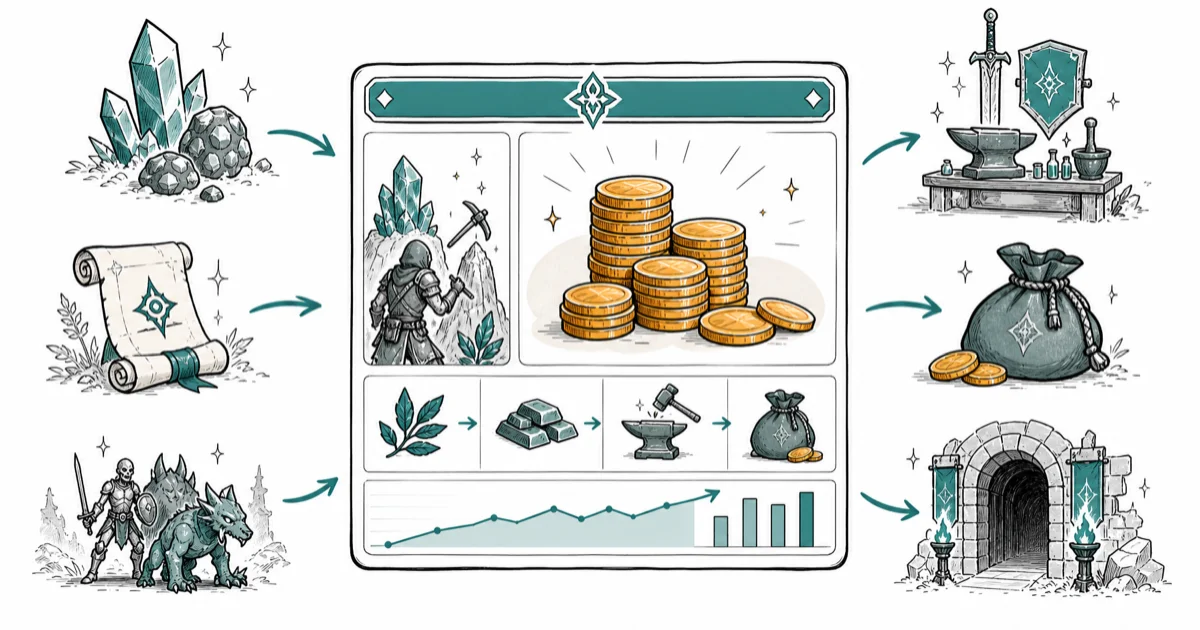
Quick AnswerThe best ESO gold farming methods are resource grinding, flipping goods at guild traders, crafting high-demand items, completing daily quests, stealing and fencing valuables, and farming public dungeons.
ESO gold farming funds housing, gear upgrades, trading, and crafting. These methods focus on repeatable in-game activities.
- A consistent player using the right methods can generate around 10,000 gold per hour in ESO without spending real money.
- Completing all seven crafting writs daily on a single level-50 character earns approximately 4,600 gold per day, scaling up with multiple characters.
- Flipping goods at Guild Traders carries an 8% fee on every sale (1% deposit plus 7% Guild bank charge), which must be factored into profit margins.
- Motifs and Runeboxes are among the most valuable farmable items in ESO, with rare pieces capable of selling for up to 1 million gold.
- The Legerdemain skill line lets you launder and sell up to 140 stolen items per day at 180% of their base value once fully upgraded.
#What Is the Fastest Way to Farm Gold in ESO?
The fastest method depends on your character level and available time. Early-game players get the best return from resource grinding and daily crafting writs, which require minimal gear investment. End-game players generate more gold per hour through Guild Trader flipping and motif farming, but those methods need startup capital and market knowledge.
ESO’s Guild Trader system has no centralized auction house, which creates 500+ independent storefronts. According to Wikipedia, ESO had sold over 15 million units by January 2020. The same entry reported that the game had generated $2 billion in revenue by 2024.
That scale makes its player-driven economy one of the most complex in any MMORPG. Players interact through Guild Traders that create regional price variation, making market knowledge worth more than combat skill for consistent income.
Higher-level characters generally unlock better rewards, crafting access, and farming routes.
#Method 1: Resource Grinding
Resource grinding is the most reliable passive gold method for new players. Load your craft bag through random movement, food collection, treasure hunts, wood foraging, and waterway exploration.
Key skills that maximize resource grinding income:
- Blacksmithing or Metal Extraction III - boosted material drops and Tempering Alloy extraction
- Clothier or Unraveling III - boosted material drops and Dreugh Wax extraction
- Enchanting or Aspect Extraction III - 10% higher chance of Runestone discovery
- Jewelry Crafting or Jewelry Extraction III - boosted material drops and Chromium Grains extraction
- Woodworking or Wood Extraction III - boosted material drops and Rosin extraction
Add HarvestMap to your addon list for spotting and marking resource node locations on the game UI. Add 75 CPs to The Lover constellation for Master Gatherer and Plentiful Harvest to maximize per-node yield.
#Method 2: Flipping Goods at Guild Traders
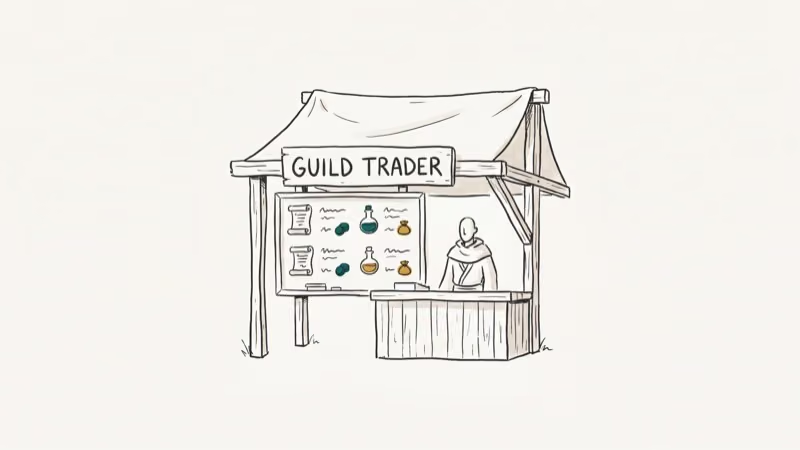
Flipping goods through Guild Traders is the highest-ceiling gold method in ESO, but requires upfront capital and market knowledge. The Tamriel Trade Center addon aggregates item listings and generates global pricing data for every tradeable item.
Use active trading guilds with steady buyers. The Awesome Guild Store addon improves the trading interface.
The key numbers: an 8% fee applies to every sale (1% refundable deposit plus 7% Guild bank charge). Running five Guild Traders simultaneously gives you access to 150 total listings. Never resell items purchased from the same guild - guild operators monitor trade logs and will remove members they catch arbitraging within their own circle.
#Method 3: Daily Crafting Writs
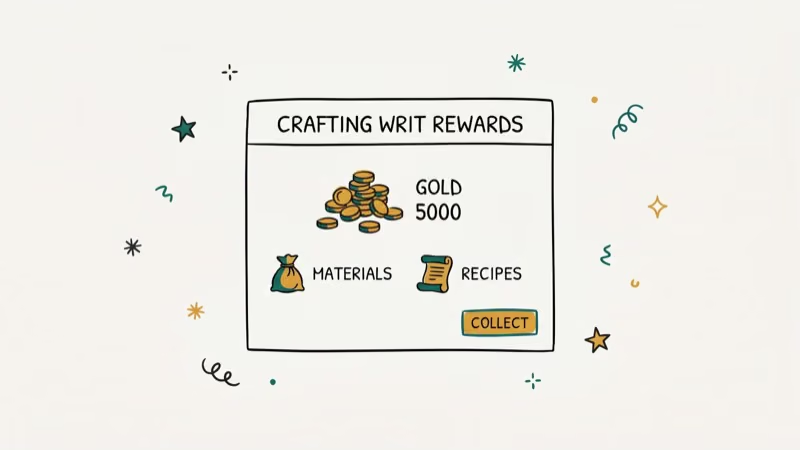
Crafting writs are daily tasks that deliver reliable, predictable gold income. Completing all seven crafting writs per character earns approximately 4,600 gold per day at level 50.
Gold rewards scale with character level, and the multiplier comes from running writs across multiple characters.
Skills that improve crafting writ returns include Alchemy or Chemistry III (produces 16 poisons or 4 potions per crafting attempt), Provisioning or Chef III (4 food items per attempt), and Provisioning or Brewer III (4 drinks per attempt). The Lazy Writ Crafter addon automates crafting writ completion through a single GUI button.
#Why Is Stealing One of the Best Gold Methods?
The crime system in ESO is a complete parallel economy. The Legerdemain skill line allows you to launder and sell up to 140 stolen items per day at 180% of their base value once fully upgraded to Trafficker rank IV. Light Fingers IV boosts NPC pickpocketing success by 50%.
Additional skills for maximizing crime income:
- Legerdemain or Locksmith IV - boosts lockpicking success odds by 70%
- Dark Brotherhood or Scales of Pitiless Justice IV - reduces heat and bounty from assault or murder by 50%
- Thieves Guild or Haggling IV - boosts fence profits by 10%
- Thieves Guild or Swiftly Forgotten IV - reduces bounty at 115 rates and heat at 64 rates every 3 minutes
According to ESO official forums, players reported that combining the full Legerdemain skill line with Dark Brotherhood and Thieves Guild bonuses significantly boosts gold income compared to legitimate activities alone. Always operate in stealth and offload stolen goods at the local Outlaws Refuge fence.
#Method 5: Public Dungeon Mob Farming
Public dungeons offer some of the fastest mob respawn timers and the densest mob clusters in ESO. The result is more loot and gold per minute than equivalent overworld farming.
Public dungeons with Imperial mobs drop higher gold than standard mobs. The three best Imperial mob dungeons are Crimson Cove in Malabal Tor, Razak’s Wheel in Bangkorai, and The Vile Manse in Reaper’s March.
AOE damage skills are essential for mob farming efficiency. Use Volley for sustained arrow damage, Elemental Storm for area control, and Wall of Elements for damage-over-time zones. Champion Point allotment in Spell Erosion and Piercing improves damage output against the dungeon mob resistance profiles.
#Method 6: Hunting Motifs, Runeboxes, and Recipes
Motifs, Runeboxes, and rare recipes are the highest-value individual items in ESO. Rare motif pieces can sell for up to 1 million gold each. Runeboxes drop from special server events and Veteran Trials. Common containers (urns, crates, treasure chests, desks, backpacks, unlooted NPC corpses) are the primary source for motifs and recipes.
Use Master Merchant and Tamriel Trade Center to check market prices before listing.
#Bottom Line
Start with daily crafting writs for reliable baseline income. Layer resource grinding on top for passive material accumulation. Once you have startup capital, enter the Guild Trader market and scale to flipping for maximum gold per hour. Stealth crime farming with the full Legerdemain skill line is the best supplemental method for players who want variety without sacrificing income rate.
For more gaming guides, see our list of the best farming games and best MMORPGs for Android.
If you enjoy crafting-focused gameplay, check our roundup of crafting survival games for PS4 and tips on how to trade on Roblox.
For more strategy-driven titles, browse our picks for the best turn-based RPGs.
#Frequently Asked Questions
Are these gold farming methods suitable for all player levels?
Yes. Resource grinding and crafting writs work from level 6 onward. Guild Trader flipping requires startup capital but no specific character level. Crime farming benefits from Legerdemain skill investment, which players can start building at any level.
Is it necessary to invest real money to farm gold in ESO?
No. All six methods described here use only in-game activities. ESO Plus offers quality-of-life improvements like the bottomless craft bag and double bank space, but it’s not required for effective gold farming.
How long does it take to accumulate a significant amount of gold?
A player running daily crafting writs on three characters earns roughly 13,800 gold per day from writs alone. In about two weeks of consistent play, that generates over 190,000 gold without any additional farming.
Can I combine multiple gold farming methods?
Yes, and that’s the recommended approach. Crafting writs take about 15 minutes per character per day. The remaining session time can go to resource grinding, dungeon farming, or trading, depending on your preference.
Are there any risks to gold farming in ESO?
The methods described here are within ESO’s terms of service. The crime system is a legitimate in-game mechanic. The main practical risk is time investment: Guild Trader flipping and motif hunting require market research and can yield inconsistent returns during slow server periods.
What’s the best method for beginners with no gold to start?
Start with crafting writs to build capital from scratch. While completing writs, harvest every material node you pass to build a sellable resource stockpile. Within a week of consistent play, you’ll have enough startup capital to begin experimenting with Guild Trader flipping.

Fortnite Stuck on the Loading Screen? Fix It in 2026
Fortnite stuck on the loading screen? Check server status, fix the Windows N Media Pack and DirectX 11 on PC, clear the console cache, and verify files.

Minecraft Keeps Crashing? Java and Bedrock Fixes (2026)
Minecraft keeps crashing on startup or mid-game? Update your GPU driver, remove mods on Java, and reinstall Gaming Services on Bedrock. Fixes for both.

Pokemon GO Not Loading? Fix the Loading Screen 2026
Pokemon GO not loading or stuck on the Pokeball? Check server status, fix automatic date and time, grant location permission, clear the cache, and update.

PS5 Controller Not Charging? 9 Fixes That Work (2026)
DualSense not charging? Swap the cable, use a rear port in Rest Mode, clean the USB-C port, and check power settings. 9 fixes for a dead PS5 controller.