Can You Unlock an iPhone With a Picture? Face ID Security
No, a flat photo can't unlock your own iPhone's Face ID. Here's how the TrueDepth camera blocks photo spoofing and how to harden Face ID further.
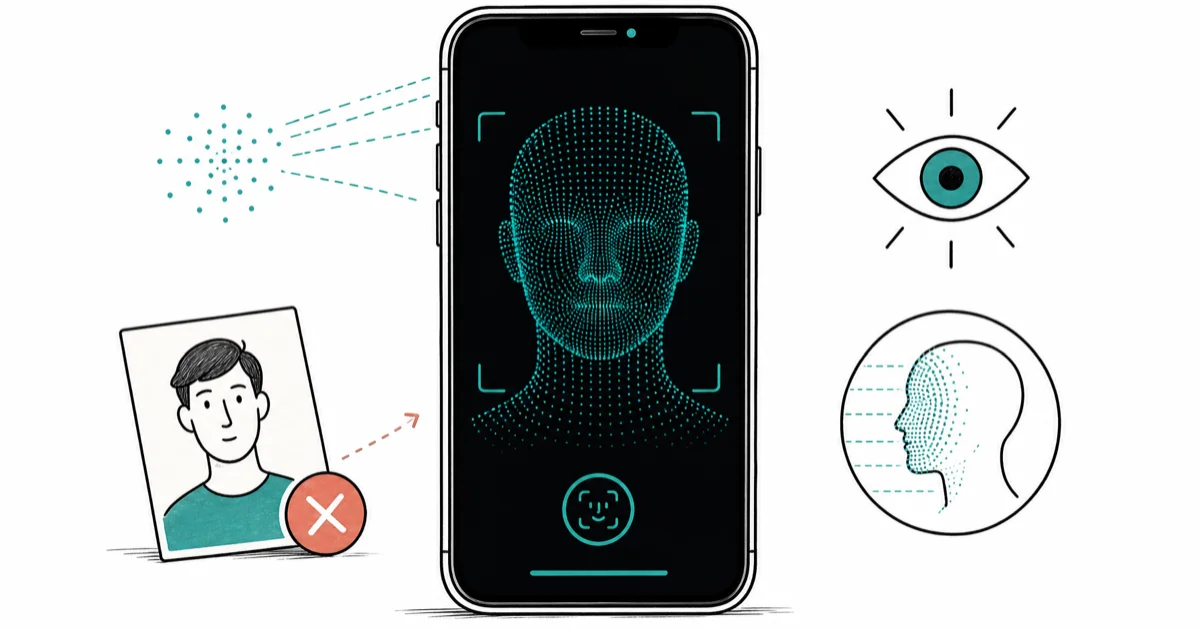
Quick AnswerNo, a flat photograph can't unlock an iPhone with Face ID. The TrueDepth camera projects more than 30,000 infrared dots onto your face to build a 3D depth map, which a 2D image cannot replicate, and Require Attention adds an extra eyes-open check on top.
If you’ve ever wondered whether someone could unlock your iPhone with a printed photo of your face, the short answer is no. This guide explains how Face ID’s 3D depth mapping makes flat-picture spoofing infeasible on your own iPhone, plus the two iOS settings that close the remaining edge cases. We focus on hardening the iPhone you own.
- A 2D photo, printed or on a screen, can’t unlock Face ID because the TrueDepth camera requires a 3D depth map, not just a flat image.
- Face ID’s random false-match rate is roughly 1 in 1,000,000 per Apple’s Face ID security white paper, compared with 1 in 50,000 for Touch ID.
- The only published photo-style spoof against Face ID used a custom 3D mask, and even Bkav’s 2017 prototype required precise facial scans to assemble.
- Turning on Require Attention forces Face ID to confirm your eyes are open and looking at the iPhone, defeating the “scan while sleeping” attack pattern.
- Lockdown Mode and a strong 6-digit-plus passcode close the remaining gaps for journalists, executives, and anyone facing targeted threats.
#How Face ID Actually Works on Your iPhone
Face ID is the biometric authentication system Apple introduced with the iPhone X in 2017, and it runs on a small cluster of sensors known as the TrueDepth camera.
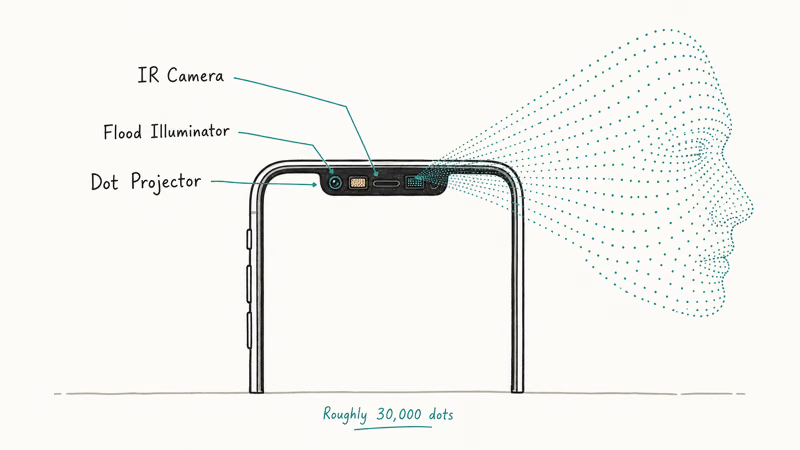
When you glance at the iPhone, the flood illuminator briefly lights your face with infrared light so the system can find you even in the dark. The dot projector then casts more than 30,000 invisible infrared dots across your face, and the infrared camera reads where each dot landed.
The resulting depth map plus a 2D infrared image both feed into the Secure Enclave on the device’s A-series or M-series chip, which converts them into a mathematical representation and compares it against the model you created at setup.
Apple’s Face ID security white paper confirms that the published random false-match rate is approximately 1 in 1,000,000 for a stranger trying to unlock your iPhone. Apple notes the rate is lower for identical twins, close-looking siblings, and children under 13 whose features are still developing.
The comparison happens entirely on-device. The Secure Enclave never sends your face data to Apple, never uploads it to iCloud, and never exposes it to third-party apps.
Held up to a flat photo print, Face ID keeps the screen locked: it never registers a 2D image as a face, and after five consecutive failed attempts iOS switches to passcode entry.
If Face ID won’t activate at all on a newly serviced or restored device, the unable to activate Face ID on this iPhone fix walks through the most common causes.
#Can a Photo Unlock Face ID on iPhone?
No, a flat photograph can’t unlock Face ID on a standard iPhone in its default configuration. The TrueDepth camera authenticates on depth data, not appearance, and a printed page or a photo displayed on another phone is a uniform two-dimensional surface. The infrared dots scatter across a flat plane in a way that the Secure Enclave’s model immediately rejects as “not a real face.”
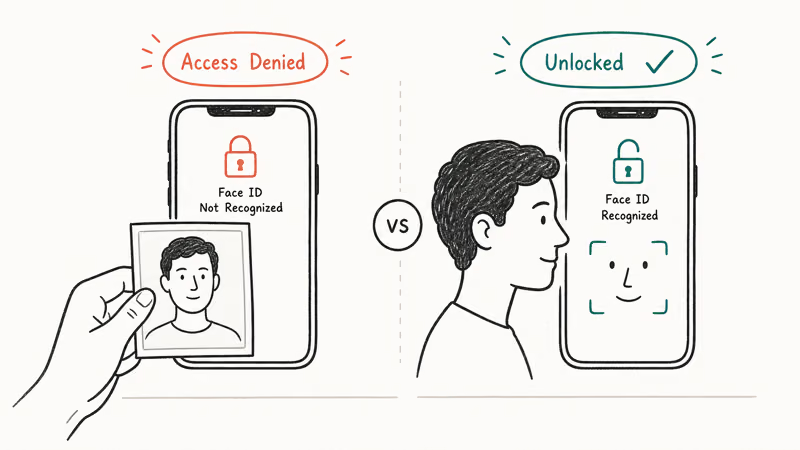
Video doesn’t help either, because the moving frame is still 2D from the TrueDepth camera’s perspective.
According to a Wired report on Face ID spoofing tests, researchers who’ve defeated Face ID always relied on a sculpted 3D object, never a screen or print. Vietnamese security firm Bkav’s 2017 demonstration used a hand-crafted mask combining a 3D-printed frame, silicone nose, and 2D infrared eye images, and Bkav estimated material costs above $150.
Even within Apple’s own Face ID design, the goal is to reject 2D spoof attempts before they reach the matching stage, including attacks that use printed photos or masks of varying sophistication.
If your Face ID is throwing errors when you try to use it normally, the Face ID not working troubleshooting steps cover sensor cleaning, alternate appearance setup, and the iOS resets that resolve most authentication failures.
#What CAN Theoretically Defeat Face ID
The honest answer: a custom 3D mask, built from a high-resolution scan of the target’s face, can occasionally fool Face ID under controlled conditions. Researchers at Tencent’s Zhuque Lab demonstrated this in 2019 using a 3D-printed mask with infrared-absorbing materials, and the Bkav team published a similar result in 2017. None of these attacks scale, none work on a stranger, and all of them are defeated by turning on Require Attention.
Here’s the practical risk landscape for someone unlocking your own iPhone with your face:
- Flat photo or video: defeated by depth mapping, no special settings needed.
- Generic 3D-printed head: rejected because the proportions and texture don’t match your enrolled appearance.
- Custom mask of your face built from professional 3D scans: technically possible but requires close-range scans, days of fabrication, and material costs well into the hundreds of dollars.
- Twin or close sibling: a documented edge case Apple acknowledges in its security white paper; passcode is the answer if this is a concern in your household.
On iPhone models with the TrueDepth camera, flat photos can’t unlock Face ID because the system maps the face’s depth rather than reading a 2D image. Even a generic 3D face model is rejected, because the proportions and texture don’t match the enrolled appearance.
#How Can You Make Face ID More Secure?
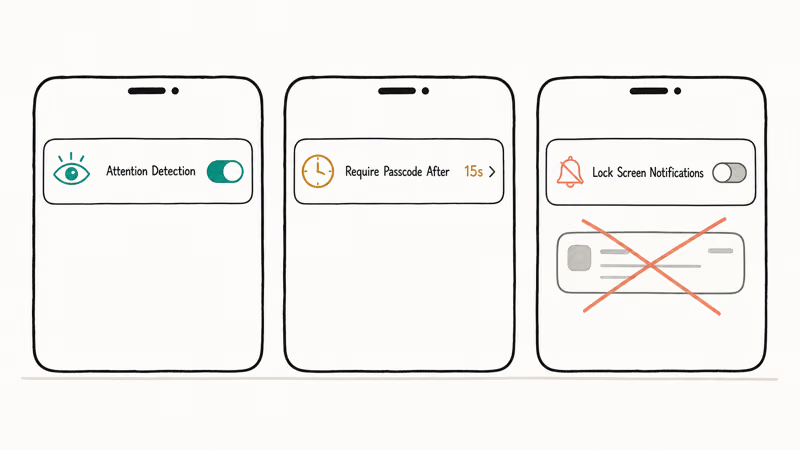
Apple ships Face ID with sensible defaults, and most users don’t need to change anything. If you want belt-and-suspenders protection, three settings move you well beyond the baseline.
#Turn on Require Attention for Face ID
Open Settings > Face ID & Passcode, enter your passcode, and confirm that Require Attention for Face ID is on.
With this enabled, Face ID will refuse to unlock unless your eyes are open and looking directly at the screen. That single toggle defeats the “scan while you’re asleep” scenario and the “someone holds your phone in front of you” scenario, which the EFF’s guide to keeping your data safe flags as common physical-coercion patterns.
#Set a Strong Passcode as the Real Backstop
Face ID is convenient, but the iPhone’s passcode is the underlying cryptographic key. In Settings > Face ID & Passcode > Change Passcode, choose Passcode Options and pick a Custom Alphanumeric Code or at least a 6-digit numeric code. After 10 failed passcode attempts the iPhone optionally erases itself, and after five failed Face ID attempts iOS forces a passcode entry, so a strong passcode is what actually stops a determined attacker.
#Use Lockdown Mode for High-Threat Scenarios
If you are a journalist, activist, executive, or someone facing targeted attacks, turn on Lockdown Mode in Settings > Privacy & Security > Lockdown Mode. According to Apple’s Lockdown Mode overview, it restricts message attachments, blocks most JavaScript on websites, and limits wired connections, all of which raise the cost of any attack that might pair with a biometric bypass.
#A Common Scam Pattern Worth Recognizing
The most realistic threat isn’t someone holding up a printout. It’s the scenario where a thief grabs an unlocked iPhone or shoulder-surfs your passcode in a public space before lifting the device. With your passcode, an attacker can disable Face ID, change your Apple Account password, and lock you out within minutes.
Apple’s Stolen Device Protection feature, introduced in iOS 17.3, blunts this attack pattern significantly. When enabled, sensitive actions like changing the Apple Account password require Face ID with no passcode fallback, plus a one-hour security delay in unfamiliar locations. Turn it on under Settings > Face ID & Passcode > Stolen Device Protection. Pair it with the steps for when you’re locked out of your iPhone so you know the recovery path before you need it.
If your screen ever stops responding and you can’t authenticate, the iPhone unlock methods for a broken screen walk through recovery options that stay within Apple’s official tooling.
#Legal Note: This Guide Is About Your Own iPhone
This article is written for people who want to understand and harden the security of an iPhone they own or have explicit, documented permission to manage. Accessing someone else’s locked iPhone without authorization is a federal offense under the Computer Fraud and Abuse Act (18 USC 1030), and in many cases also violates state computer-trespass and identity-theft statutes. Penalties can include fines and imprisonment.
If you are locked out of your own iPhone, the iPhone passcode reset guide walks through Apple’s official Recovery Mode and iCloud erase paths. If you’ve inherited an iPhone from a deceased family member, Apple’s Digital Legacy program handles authorized access through estate documentation, no spoofing required.
#Bottom Line
A flat picture can’t unlock your iPhone’s Face ID, full stop. The practical action items for your own device take less than two minutes: open Settings > Face ID & Passcode, confirm Require Attention for Face ID is on, set a 6-digit or alphanumeric passcode, and enable Stolen Device Protection if you’re on iOS 17.3 or later.
#Frequently Asked Questions
Can Face ID be unlocked with a photo on another phone’s screen?
No. A screen is still a 2D surface to the TrueDepth camera, and the dot projector returns a flat depth pattern that the Secure Enclave rejects. Photos, videos, and 3D renders displayed on any screen all fail for the same reason.
Will Face ID unlock my iPhone if my eyes are closed?
Not when Require Attention for Face ID is enabled, which is the default setting on a fresh setup. With that setting on, Face ID won’t unlock unless your eyes are open and looking at the screen. If someone has disabled the setting, the iPhone can unlock with closed eyes, so check the toggle under Settings.
Are identical twins a real Face ID risk?
Yes, Apple’s Face ID security white paper acknowledges that identical twins or very close siblings can sometimes unlock each other’s iPhones. If this applies to your household, the cleanest fix is to disable Face ID and rely on a strong passcode, or use Touch ID on a model that supports it.
Has anyone actually broken Face ID with a 3D mask?
A few research teams have. Vietnamese security firm Bkav published a successful prototype in 2017 using a hand-crafted mask with silicone, 3D printing, and infrared materials, and Tencent’s Zhuque Lab repeated similar work in 2019. Every demonstrated attack required precise scans of the target’s face and bespoke fabrication, none scale to opportunistic theft, and all are blocked by Require Attention.
Does iOS update Face ID’s anti-spoofing automatically?
Yes. Apple ships incremental improvements to the Face ID neural network in iOS updates, and the on-device model also adapts as your appearance changes over time. Keeping your iPhone on the latest iOS release is the simplest way to inherit those improvements without changing any settings.
Should I use Touch ID instead of Face ID on supported devices?
Both are statistically secure, but Face ID’s published 1-in-1,000,000 random false-match rate is roughly 20 times stronger than Touch ID’s 1-in-50,000. Touch ID is still a fine choice if you wear masks frequently or prefer not to use facial recognition for personal reasons.
What happens if Face ID is wrong about my face five times in a row?
After five consecutive Face ID failures, iOS automatically switches to passcode entry and disables Face ID until you authenticate with the passcode. That’s the same backstop that fires after a restart, a power-off, or 48 hours of inactivity, which is why a strong passcode matters more than the biometric layer itself.
Apple Siri Settlement: Who Qualifies and How to Claim
Apple's $250 million Siri settlement covers iPhone 15 Pro and iPhone 16 models bought June 2024 to March 2025. See who qualifies and how claims work.
iOS 26.6.1 Security Update: What Apple Fixed and Who Gets It
Apple released iOS 26.6.1 on August 17 with 29 security fixes, including an IPSec interception bug. See what it patches, who gets it, and how to update.
iPhone Adaptive Power: How It Works and When to Use It
Learn how iPhone Adaptive Power works, which models support it, what it changes, and when Low Power Mode is still the better battery-saving choice.
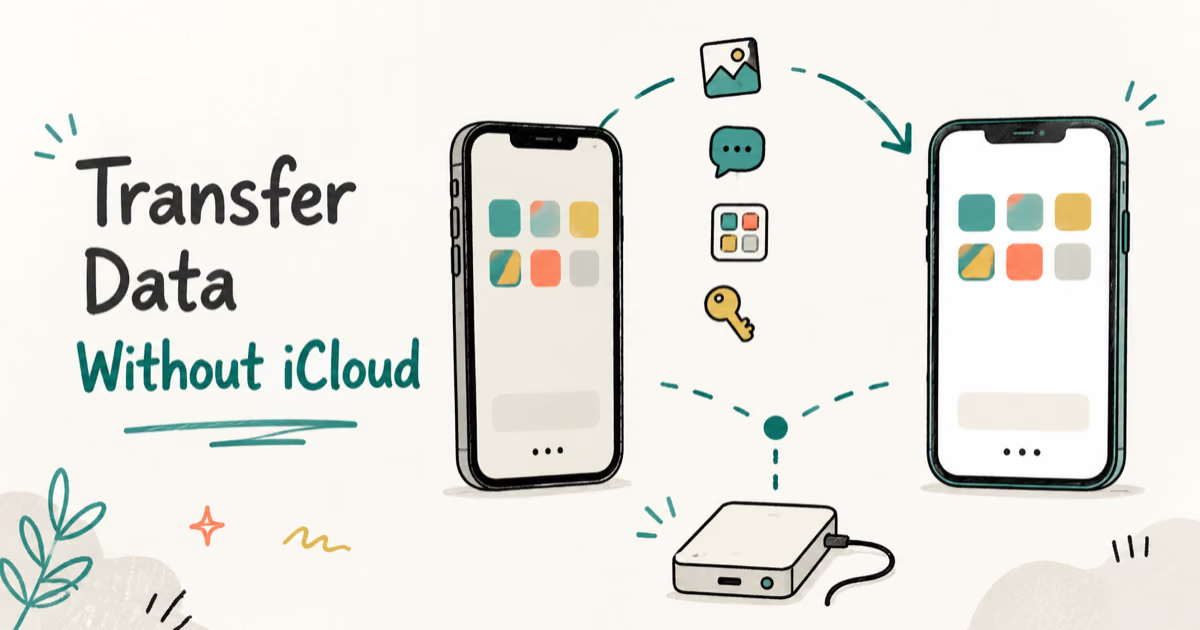
How to Transfer Data to a New iPhone Without iCloud
Move everything to your new iPhone without iCloud: Quick Start device-to-device transfer, wired migration, and encrypted Finder or iTunes backups.