What Does the Arrow Mean on iPhone? Location Icon Guide
Learn what the arrow icon on your iPhone status bar means, what each color indicates, and how to control which apps use Location Services.
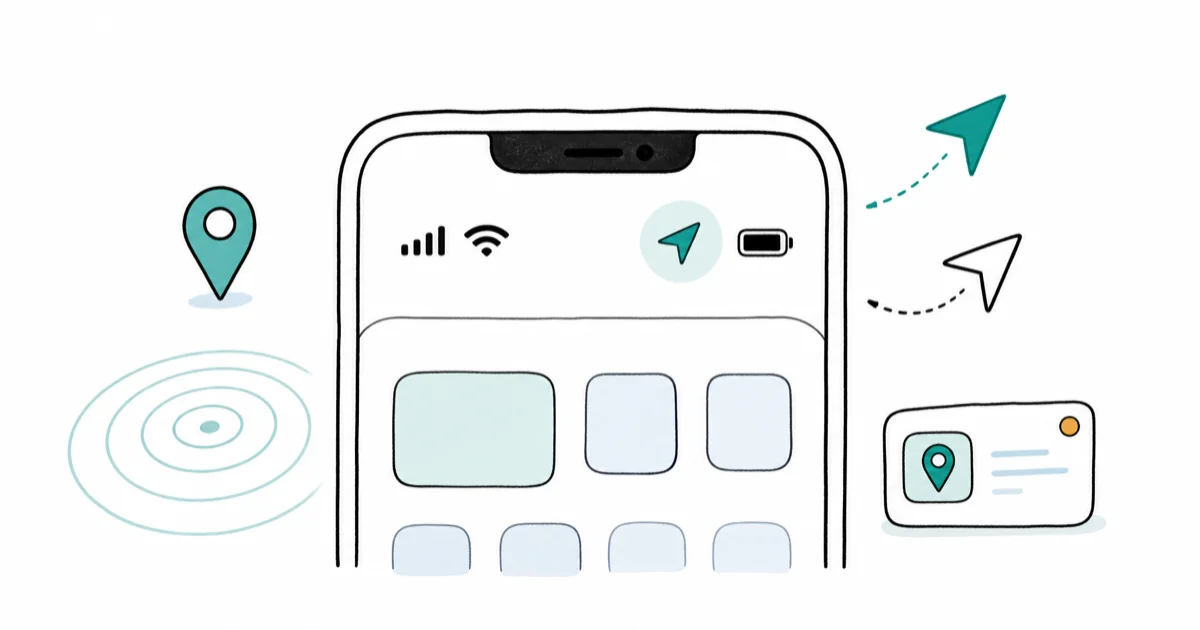
Quick AnswerThe arrow icon on iPhone means an app is using or has recently used Location Services. A hollow arrow shows conditional access, while solid arrows indicate active location tracking.
The arrow icon on your iPhone means an app is accessing Location Services. This guide is for your own device — managing location privacy on someone else’s device without permission could violate their privacy rights.
- A solid arrow means an app is actively using your location right now, while a hollow arrow indicates conditional access based on geofencing or other triggers
- Different colors signal recent usage: purple shows recent access, gray indicates usage within 24 hours, and blue circles mean a website is requesting location permission
- You can control location access per app with four settings: Never, While Using App, Always, or Ask Next Time to balance privacy and functionality
- Disabling Location Services completely stops Find My, Maps navigation, weather updates, and all location-dependent features across your device
- Apple’s Precise Location toggle lets you share approximate rather than exact coordinates while keeping apps functional
#Arrow Color Meanings on iPhone
According to Apple’s official support documentation, the arrow icon appears in different colors and styles to indicate various location usage states. Each color provides specific information about how your location is being accessed, with different visual cues for active usage, recent access, and conditional permissions.
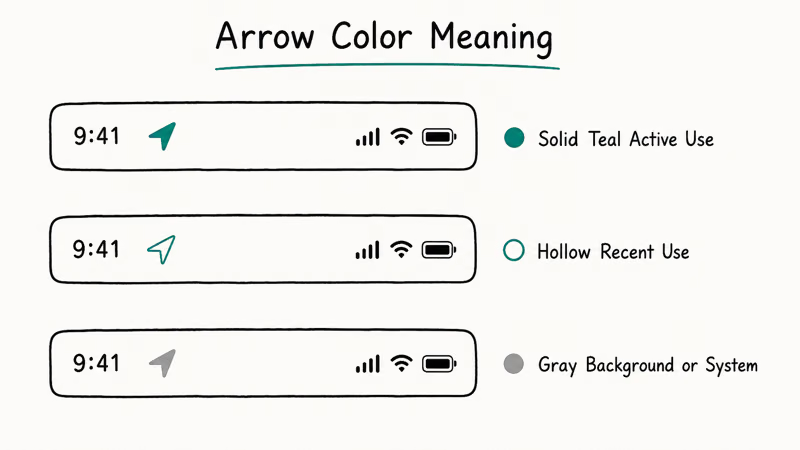
A solid black or white arrow means an app is currently accessing your location. It shows on every recent iPhone running a current version of iOS.
A hollow arrow indicates conditional location access. This appears when apps use geofencing or location-based automation, such as shortcuts that trigger when arriving at specific locations. The hollow arrow shows even when not actively using location services, providing a visual cue for potential background access.
A purple arrow shows recent location usage. It typically appears after closing an app like Maps and stays visible for several minutes, indicating the app recently accessed location data.
A gray arrow means an app accessed your location within the last 24 hours. Apple’s documentation states this helps you track which apps have used location services recently. This provides historical visibility into location access patterns.
A blue circle with white arrow appears when websites request location permission through Safari. This typically shows up when a website asks for your location through the browser, providing a visual distinction between app-based and web-based location requests.
#Understanding Location Services Technology
Location Services combines GPS, Wi-Fi networks, Bluetooth, and cellular towers to determine your position. This multi-source approach is more accurate in dense urban areas than GPS-only positioning, where tall buildings can block satellite signals.
Disabling Location Services completely breaks these essential features:
- Find My iPhone tracking
- Maps navigation and directions
- Weather app location updates
- Automatic time zone changes
- Location-based reminders and notifications
According to Google’s Android documentation, location services underpin a wide range of core app features, which is why disabling them can cause many functions to stop working unexpectedly.
When you disable Location Services entirely, you’ll lose access to emergency SOS features that automatically share your location with first responders. This is a critical safety consideration for complete disabling. If you’re experiencing iPhone connection issues, Location Services may be part of the troubleshooting process.
#Managing App Location Permissions
Go to Settings > Privacy & Security > Location Services to control which apps can access your location. You’ll see four distinct permission levels:
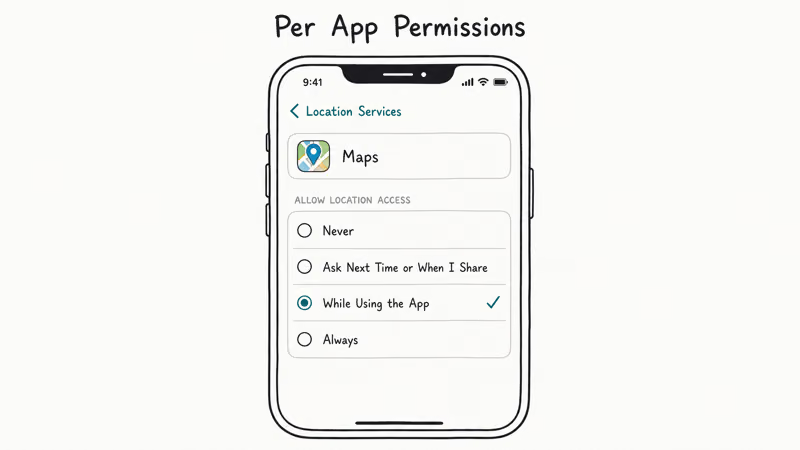
Never: Completely blocks location access for apps that don’t require positioning data.
While Using the App: This setting allows location access only when the app is open on screen, preventing background tracking while maintaining core functionality. It’s the recommended setting for most apps since it provides a good balance between privacy and usability without compromising essential features like real-time navigation or location-based notifications when you’re actively using the app.
Always: Grants continuous location access, even when the app runs in background. Reserve this for essential services like Find My or trusted navigation apps.
Ask Next Time: Triggers a permission prompt each time the app requests location data.
For most apps, “While Using the App” offers the best balance of functionality and privacy protection. Apps with “Always” permission tend to consume noticeably more battery than those limited to “While Using” access.
For iPhone battery optimization, review which apps have “Always” access and change unnecessary ones to “While Using the App.”
#Precise vs Approximate Location Controls
Apple introduced Precise Location controls in iOS 14. Apple’s privacy documentation confirms that toggling off Precise Location limits apps to a general area roughly 10 square miles in size, rather than your exact GPS coordinates.
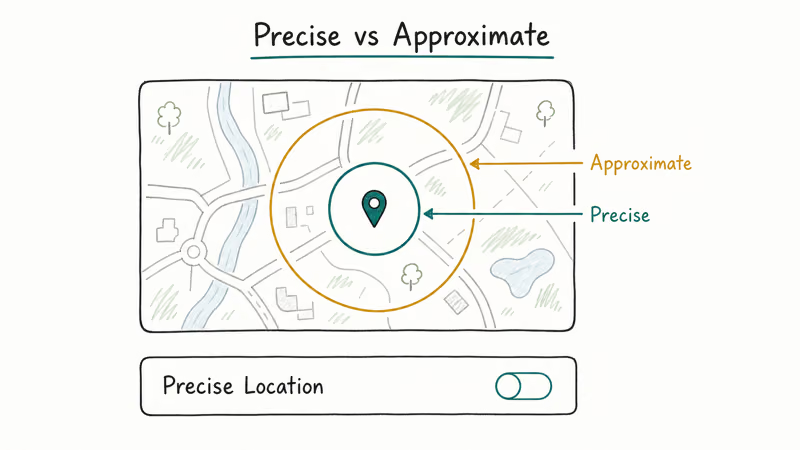
With Precise Location enabled, apps receive your exact coordinates down to about 3-meter accuracy. With it disabled, apps get a general area spanning several city blocks (roughly 1-2 kilometers).
With weather apps, approximate location still provides accurate local forecasts while preventing precise tracking. Food delivery apps, however, often can’t function properly with approximate location since they need exact addresses for delivery routing.
To adjust Precise Location settings:
- Go to
Settings>Privacy & Security>Location Services - Select the specific app
- Toggle “Precise Location” off for approximate sharing
This setting maintains app functionality while providing additional privacy protection against detailed movement tracking. For users wanting to change their iPhone location completely, this feature offers a lighter alternative to full location spoofing.
#Can You Hide the Arrow Icon?
You can’t completely hide the arrow without disabling Location Services entirely. However, you can reduce its visibility for system-level usage.
To hide the arrow for System Services only, open Settings > Privacy & Security > Location Services, scroll to System Services at the bottom, tap System Services, and turn off “Status Bar Icon.”
This affects only system-level usage.
This hides the arrow for system-level location usage but still shows it when apps access your location.
Turning this off noticeably reduces how often the arrow appears during normal daily usage.
#When to Be Concerned About Location Tracking?
Be cautious if the arrow appears constantly without you actively using location-based apps. This could indicate unauthorized background tracking.
Signs of concerning location usage include:
- Arrow appears when phone is idle
- Unfamiliar apps have “Always” permission
- Battery drains faster than usual
- Unknown apps appear in location services list
Reddit discussions frequently highlight that social media apps often request unnecessary location access for targeted advertising purposes. Check which apps have “Always” permission and remove access for apps that don’t actually need continuous location data. This is especially important if you notice Face ID performance issues that might be related to system resource usage.
Consider hiding your location on iPhone for specific apps regularly to ensure you’re comfortable with all location permissions you’ve granted.
#Bottom Line
Start by checking Settings > Privacy & Security > Location Services to see which apps access your location. For most apps, choose “While Using the App” to maintain functionality while limiting background tracking. If you notice constant arrow visibility without active app usage, review which apps have “Always” permission and change unnecessary ones to more restrictive settings.
#Frequently Asked Questions
What does a gray arrow mean on iPhone?
The gray arrow shows that an app accessed your location within the last 24 hours. This helps you track recent location usage even after the active session ends.
How can I turn off the arrow icon completely?
You can turn off the arrow by disabling Location Services in Settings > Privacy & Security > Location Services, but this also disables Find My, Maps, and weather updates.
Does the location arrow drain my iPhone battery?
Yes, location services can reduce battery life by 15-25% depending on usage. Apps with “Always” permission have the biggest impact on battery drain.
What does a purple arrow mean on my status bar?
The purple arrow indicates an app recently used your location services. This appears for about 10 minutes after location access ends.
Why is the location arrow always visible?
A constantly visible arrow usually means an app has “Always” location permission and is tracking in the background. Check your location settings to identify the specific app.
Can websites track my location through Safari?
Websites can request location access through Safari, which shows a blue circle with arrow. Safari asks for your permission before sharing any location data with websites.
What’s the difference between precise and approximate location?
Precise location shares your exact coordinates within 3 meters, while approximate location provides a general area spanning several city blocks for privacy protection.
How do I stop apps from tracking my location in the background?
Change app permissions to “While Using the App” instead of “Always” in Settings > Privacy & Security > Location Services to prevent background location tracking.
Apple Siri Settlement: Who Qualifies and How to Claim
Apple's $250 million Siri settlement covers iPhone 15 Pro and iPhone 16 models bought June 2024 to March 2025. See who qualifies and how claims work.
iOS 26.6.1 Security Update: What Apple Fixed and Who Gets It
Apple released iOS 26.6.1 on August 17 with 29 security fixes, including an IPSec interception bug. See what it patches, who gets it, and how to update.
iPhone Adaptive Power: How It Works and When to Use It
Learn how iPhone Adaptive Power works, which models support it, what it changes, and when Low Power Mode is still the better battery-saving choice.
How to Transfer Data to a New iPhone Without iCloud
Move everything to your new iPhone without iCloud: Quick Start device-to-device transfer, wired migration, and encrypted Finder or iTunes backups.