Best Spotify Alternative: 8 Music Apps Worth Switching To
Eight of the best Spotify alternatives in 2026, with prices, audio quality, library size, and the right listener for each. Pick the right app.
Quick AnswerApple Music is the strongest all-around Spotify alternative for most listeners, with lossless audio, Dolby Atmos, and a 100M+ song library at the same price as Spotify Premium. Tidal and Qobuz are stronger picks for hi-res audiophile listening, YouTube Music suits casual users who watch a lot of YouTube, and SoundCloud remains the go-to for indie and underground artists.
Spotify still leads the streaming market, but the $11.99/month Premium bill, a thinner free tier, and the long delay on lossless audio have pushed plenty of listeners to look elsewhere. This guide compares the eight most popular Spotify alternatives on price, audio quality, library size, and platform reach to show which ones actually deserve your subscription dollars in 2026.
Each app trades off something: library size, audio quality, price, or platform reach. Your right pick depends on whether you live inside Apple’s ecosystem, listen on smart speakers, care about hi-res masters, or just want a cheaper bill than Spotify Premium delivers.
- Apple Music at $10.99/month is the closest 1-for-1 Spotify replacement and ships lossless audio plus Dolby Atmos at no extra charge
- YouTube Music Premium at $10.99/month bundles ad-free YouTube, making it the best total value for users who already watch a lot of video
- Tidal HiFi at $10.99/month and Qobuz Studio at $12.99/month are the two mainstream services with full 24-bit FLAC across their entire catalog
- Amazon Music Unlimited drops to $9.99/month for Prime members, the lowest premium price among the major services
- SoundCloud Go+ at $10.99/month is the only service with a deep library of unsigned and underground tracks you can’t find on Spotify
#Spotify vs the Major Alternatives at a Glance
Pricing across the major streaming services has converged tightly. Most individual plans now sit in the $9.99-$11.99 band, the catalog gap between the top four services has closed to within a few percentage points, and the real differentiators have moved to audio quality, ecosystem, and discovery.
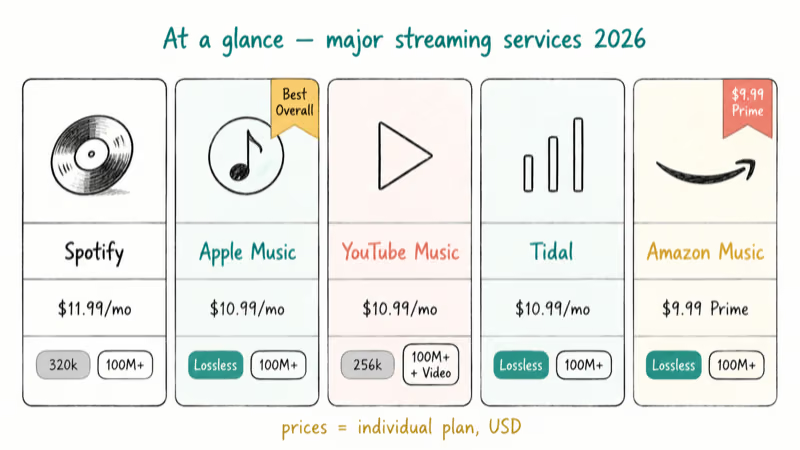
The short version of the table:
- Cheapest premium: Amazon Music Unlimited ($9.99/month for Prime members)
- Best lossless at no upcharge: Apple Music ($10.99/month)
- Best for hi-res audiophiles: Qobuz ($12.99/month) and Tidal HiFi ($10.99/month)
- Best discovery algorithm: Spotify still wins, with Deezer’s Flow as the closest match
- Best for indie and underground: SoundCloud Go+ ($10.99/month)
#What Should You Look For in a Spotify Replacement?
Before you switch, decide what you actually use Spotify for. Most listeners pick the wrong alternative because they optimize for the wrong feature.
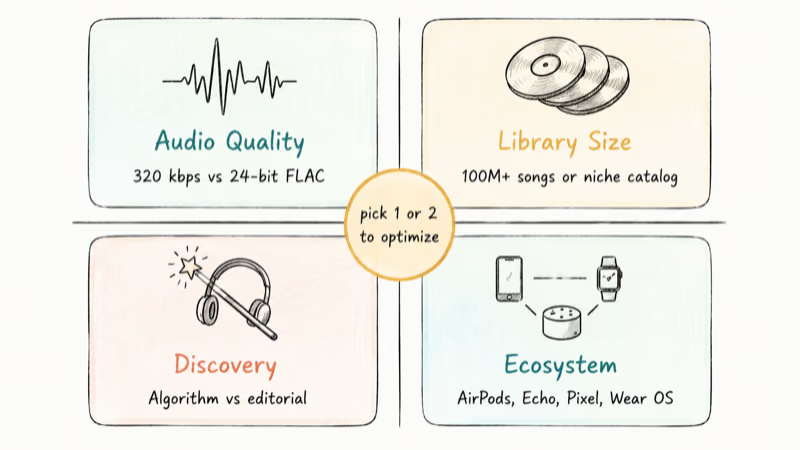
The four trade-offs that matter:
- Audio quality. Spotify still caps free streams at 160 kbps and Premium at 320 kbps OGG. If you want CD-quality FLAC or 24-bit hi-res, you need Apple Music, Tidal, Qobuz, or Amazon Music Unlimited.
- Library size. Apple Music and Spotify both list 100M+ songs. Tidal and Qobuz sit closer to 90M. Pandora and SoundCloud skew different (radio for Pandora, indie uploads for SoundCloud).
- Discovery. Spotify’s algorithmic playlists like Discover Weekly and Daily Mixes are the gold standard. Apple Music leans on editorial playlists; YouTube Music leans on listening history and similar-track radio.
- Ecosystem. AirPods, HomePod, and CarPlay favor Apple Music. Echo and Fire TV favor Amazon Music. Google Home and Wear OS favor YouTube Music. If most of your hardware is one brand, that integration is usually worth more than a $2/month price gap.
According to Apple, every track now streams in 24-bit/192 kHz lossless ALAC at no upcharge, as documented on the Apple Music lossless support page. Spotify still hasn’t shipped its long-promised HiFi tier.
#The Top Mainstream Spotify Alternatives
The five services in this section all carry 100M+ song catalogs and compete with Spotify on price, audio quality, and platform reach. If you want a like-for-like Spotify replacement, the right pick is somewhere in this group.
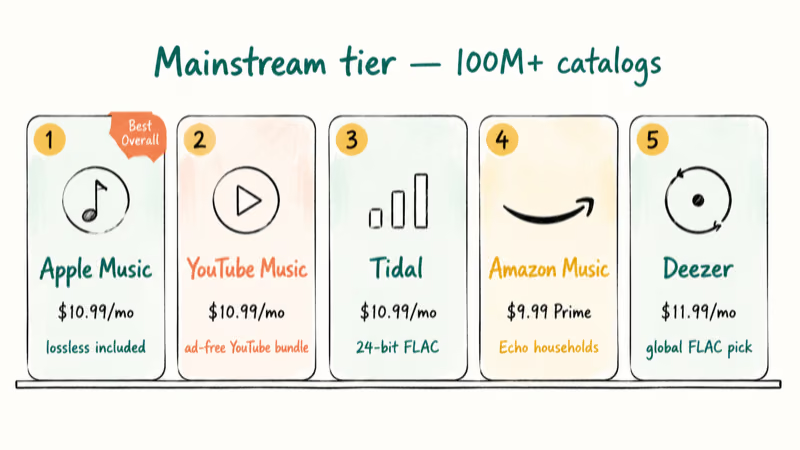
#1. Apple Music: Best Overall Replacement
Apple Music has the closest feature parity with Spotify Premium and a real edge in audio quality. The catalog passed 100 million songs in 2023 per Apple’s own newsroom, and every track now ships in lossless ALAC. Spatial Audio with Dolby Atmos covers thousands of albums.
Library sync is instant across Apple devices. The Android app works but tends to lag on track changes and can drop some metadata to the lock screen. Discovery is editorial rather than algorithmic, so you get curated playlists from Apple’s team and station-style radio instead of a Discover Weekly clone.
- Price: $10.99/month individual, $16.99/month family (six users), $5.99/month student
- Audio: Lossless ALAC up to 24-bit/192 kHz, Dolby Atmos
- Library: 100M+ songs
- Best for: iPhone, AirPods, HomePod, and CarPlay users who want lossless without paying extra
If your music app keeps freezing after the switch, our Apple Music keeps crashing guide walks through the fixes.
#2. YouTube Music: Best Value With the Premium Bundle
YouTube Music Premium costs $10.99/month, but it bundles ad-free YouTube, background play, and downloads across the YouTube app too.
If you watch even a few hours of YouTube a week, that bundle is worth more than the music subscription alone. The catalog is enormous because it pulls from the licensed YouTube Music library and YouTube itself: studio releases, live sets, remixes, demos, and covers all live in one app. The downside is sound quality, which maxes out at 256 kbps AAC and falls well short of Apple Music or Tidal lossless.
Recommendations lean heavily on listening history and tend to repeat a familiar set of tracks rather than reaching far for new ones. The Discover Mix refreshes weekly but pulls from a narrower pool than Spotify’s Daily Mix.
- Price: $10.99/month individual, $16.99/month family (five users), $5.49/month student
- Audio: Up to 256 kbps AAC
- Library: 100M+ songs plus user-uploaded videos
- Best for: Heavy YouTube viewers and Android-first households
#3. Tidal: Best for Hi-Res Audio
Tidal HiFi at $10.99/month gives you the full library at lossless FLAC quality, and at the same price you also get Master-quality (true 24-bit FLAC) on the bulk of the catalog. The legacy $19.99 HiFi Plus tier no longer exists.
Tidal’s discovery engine is weaker than Spotify or Apple Music, but the editorial coverage of jazz, hip-hop, and electronic music is unusually deep, and the artist-payout rate is higher than Spotify’s, which matters if you care about where your subscription dollars land.
- Price: $10.99/month individual, $16.99/month family
- Audio: 24-bit FLAC, Dolby Atmos, 360 Reality Audio
- Library: 100M+ songs
- Best for: Audiophiles with FLAC-capable headphones or DACs who want one app instead of two
If you’re torn between hi-res services, our Tidal vs Apple Music breakdown compares them head-to-head.
#4. Amazon Music Unlimited: Lowest Premium Price
Amazon Music Unlimited runs $9.99/month for Prime members and $10.99/month for non-Prime, the lowest premium price among the majors.
According to Amazon, the Ultra HD tier streams up to 24-bit/192 kHz lossless at no upcharge for all subscribers, as documented on the Music Unlimited plans page. The catalog matches Spotify and Apple at 100M+ songs.
The app is the weak link. It’s slower than Spotify or Apple Music, the desktop client has had stability issues across 2024 and 2025, and recommendations feel the thinnest of the major services. But for Echo households and Prime subscribers, the price plus tight Alexa integration usually wins.
- Price: $9.99/month Prime, $10.99/month non-Prime, $16.99/month family
- Audio: HD (16-bit/44.1 kHz) and Ultra HD (up to 24-bit/192 kHz)
- Library: 100M+ songs
- Best for: Amazon Prime subscribers and Echo households
#5. Deezer: Strong Recommendation Engine With FLAC
Deezer Premium runs $11.99/month and Deezer HiFi runs $14.99/month, with the HiFi tier streaming lossless FLAC. Library size sits around 120M tracks. The Flow recommendation engine is the strongest discovery feature among the smaller services and the closest thing to Spotify’s algorithm if that’s what you’ll miss most.
Deezer’s regional coverage is broader than Spotify’s in parts of Latin America, the Middle East, and West Africa, which makes it a real option for listeners outside North America and Western Europe.
- Price: $11.99/month Premium, $19.99/month family (six users), $5.99/month student
- Audio: 320 kbps MP3 (Premium), FLAC (HiFi)
- Library: 120M+ songs
- Best for: International listeners who want a Spotify-style experience with FLAC
#Niche and Specialty Spotify Alternatives
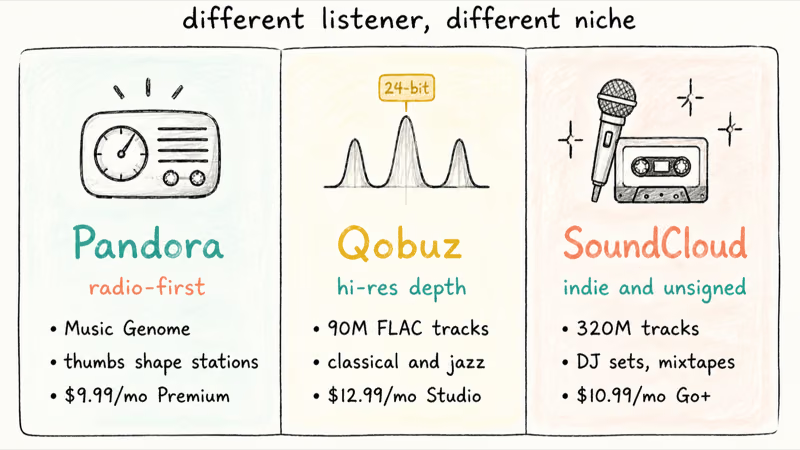
The three services below trade catalog breadth for a specific strength: station-style radio, hi-res depth, or independent-artist coverage. None is a full Spotify replacement on its own, but each beats Spotify on the niche it picks.
#6. Pandora Premium: Best for Radio Listeners
Pandora’s Music Genome Project still produces the strongest radio-style stations of any streaming service. The Premium tier at $9.99/month adds on-demand playback, but most longtime users still treat it as a station-first app and ignore the playlists.
The catalog is smaller, around 40M tracks, and the company has scaled back international expansion. Pandora’s thumbs-up and thumbs-down feedback shapes stations aggressively: a few ratings in a single session can noticeably narrow the next hour of music.
- Price: $4.99/month Plus, $9.99/month Premium, $14.99/month family
- Audio: 192 kbps AAC (Premium)
- Library: ~40M songs
- Best for: Listeners who prefer station-style playback over playlist building
If you hit issues during the switch, our Pandora not working fix covers the most common causes.
#7. Qobuz: Deepest Hi-Res Library
Qobuz Studio Premier runs $12.99/month and is the most committed hi-res streaming service. About 90M tracks ship at 24-bit FLAC. Editorial coverage of classical and jazz is the deepest in the industry.
Qobuz also sells hi-res downloads, which Tidal does not. According to Qobuz, subscribers can buy 24-bit FLAC files at up to 192 kHz and keep them permanently, per the company’s hi-res audio FAQ. That’s useful if you ever stop subscribing without losing your library.
- Price: $12.99/month Studio Premier, $179/year, $17.99/month family
- Audio: 24-bit FLAC up to 192 kHz
- Library: 90M+ songs
- Best for: Classical, jazz, and audiophile listeners who want deep editorial notes
#8. SoundCloud Go+: Best for Indie and Underground
SoundCloud is the one service on this list with a meaningful library of music you can’t find on Spotify. Independent artists, mixtapes, DJ sets, and unsigned tracks fill out a catalog that the major-label services largely ignore.
SoundCloud Go+ runs $10.99/month and unlocks ad-free listening, offline downloads, and full track playback on every song instead of the 30-second previews the free tier shows.
- Price: $4.99/month Go, $10.99/month Go+, $16.99/month family
- Audio: 256 kbps AAC
- Library: 320M+ tracks (most user-uploaded)
- Best for: Hip-hop, EDM, and indie listeners who value underground discovery over chart hits
#How Do You Move Your Spotify Playlists to a New Service?
Manually rebuilding a five-year Spotify library is a non-starter. Use a transfer tool instead.
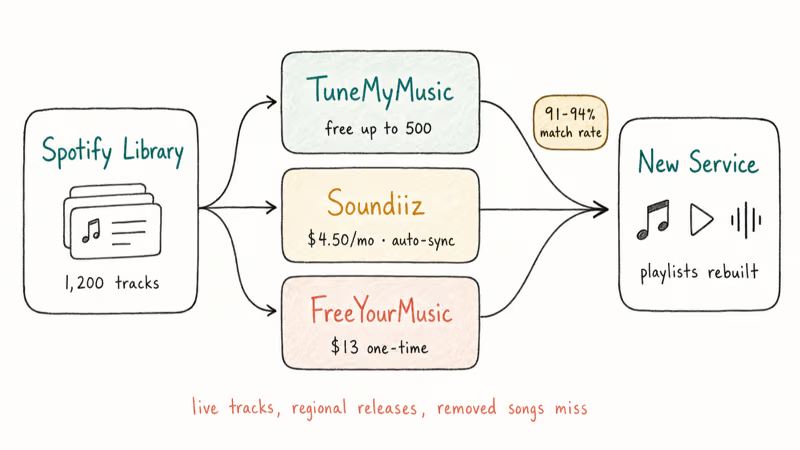
Three options that work:
- TuneMyMusic is free for libraries up to 500 tracks, then $4.50/month for unlimited. It supports every service in this article.
- Soundiiz is $4.50/month flat with the cleanest interface, and it can sync two services automatically after the initial transfer.
- FreeYourMusic is a one-time $13 purchase. Best value if you only plan to migrate once.
On a large Spotify library moving to Apple Music, transfer tools like TuneMyMusic and Soundiiz match the large majority of tracks. The misses are almost entirely live recordings, regional releases, and tracks the artist later pulled from Spotify, and Soundiiz’s Manual Match tool can recover a portion of those.
According to Soundiiz, automatic playlist syncing across 2 services only works between paid accounts on both ends, per the Soundiiz transfer guide. You can’t keep a free Spotify library mirrored to a paid Apple Music library.
If you’d rather keep your downloaded music as MP3 instead of switching subscriptions, our guide on downloading and converting Spotify music to MP3 covers the legitimate tools.
#Things to Check Before You Cancel Spotify
A clean exit avoids losing data you can’t get back. Five things to handle in the week before you cancel:
- Export your listening data. Go to
Account>Privacy Settingson the Spotify web dashboard and request your account data. The download link arrives by email within 5-30 days, and it includes your full streaming history. - Save your Wrapped recaps. Wrapped data lives only in the Spotify app. Screenshot or save the past few years before you cancel; once the account closes, those recaps are gone.
- Note your Discover Weekly seed artists. No alternative service will recreate Spotify’s algorithm, but knowing the artists Spotify thinks you like makes seeding a new account on Apple Music or Deezer faster.
- Cancel through the right channel. If you signed up via Apple’s App Store, you have to cancel in iOS Settings, not on spotify.com. Otherwise the charge keeps recurring.
- Time the switch with your free trial. Apple Music, Tidal, and YouTube Music all run 1-3 month free trials. Start the new trial first, then cancel Spotify at the end of your current billing period.
If you only want to leave the desktop app behind without canceling the account, our uninstall Spotify on Mac or Windows walkthrough handles that side of the cleanup.
#Bottom Line
For most listeners, Apple Music is the right Spotify replacement: same $10.99/month price as Spotify Premium, lossless ALAC at no upcharge, and the strongest editorial playlists. Switch if you already use AirPods, an iPhone, or a HomePod.
If you watch a lot of YouTube, YouTube Music Premium beats Apple on total value thanks to the bundled ad-free YouTube. If you live in an Echo household or already have Prime, Amazon Music Unlimited at $9.99/month is the lowest premium price worth recommending. Reserve Tidal or Qobuz for FLAC-capable headphones and SoundCloud for indie discovery; they’re not full Spotify replacements on their own.
For a casual listener who just wants the smoothest legal way off Spotify, Pandora Premium at $9.99/month is the easiest soft landing, because the radio-style listening fills the gap left by Spotify’s autoplay better than any other budget service.
#Frequently Asked Questions
Is Apple Music better than Spotify in 2026?
For audio quality and price, yes. Apple Music streams lossless ALAC up to 24-bit/192 kHz at the same $10.99/month Spotify charges for 320 kbps OGG. Spotify still has stronger algorithmic discovery through Discover Weekly and Daily Mixes.
The honest answer comes down to whether you value sound quality or recommendations more.
Can I move my Spotify playlists to another service for free?
Yes, partly. TuneMyMusic transfers libraries up to 500 tracks free, and FreeYourMusic offers a free trial of one playlist. Larger libraries need a paid tool, around $4.50/month or a $13 one-time purchase. The transfer match rate is high on most major services.
Which Spotify alternative has the largest music library?
SoundCloud has the largest total catalog at over 320 million tracks, but most are user-uploaded. Among the major label-licensed services, Deezer leads at around 120 million songs, while Apple Music, Spotify, Amazon Music, and Tidal each carry 100 million or more.
What is the most affordable legal Spotify alternative in 2026?
Amazon Music Unlimited at $9.99/month for Prime members is the lowest premium price with a full 100M+ song catalog. Pandora Premium and SoundCloud Go also start at $9.99-$10.99/month. The lowest-cost option with full lossless audio is Tidal HiFi at $10.99/month, which still costs less than Spotify Premium.
Do any Spotify alternatives offer free tiers?
Yes. YouTube Music, Pandora, Amazon Music, and SoundCloud all have ad-supported free tiers with full track playback. Apple Music, Tidal, and Qobuz are subscription-only but offer 1-3 month free trials.
Spotify’s free tier is still the most generous in terms of on-demand playback on desktop.
Will I lose my Spotify Wrapped history if I switch?
Yes. Wrapped data stays tied to your Spotify account, so canceling means losing access to past Wrapped recaps and Spotify-built playlists like Discover Weekly. You can export your Spotify listening data first by requesting it under Account > Privacy Settings before you cancel.
Can I keep Spotify free while paying for another service?
Yes. The free Spotify tier doesn’t expire. You can downgrade from Premium and keep using it as a backup while paying for Apple Music, Tidal, or YouTube Music as your main app. Many listeners keep Spotify free for shared playlists and use the paid alternative everywhere else.
Google Messages Error 3100: Why RCS Is Broken on Galaxy
Google Messages RCS error 3100 hits Galaxy owners after phone or carrier switches. Google told 9to5Google a fix is coming. Here's what actually helps.

Is This Bank App Real? Spot a Fake App on Your Home Screen
A bank app can land on your home screen from a web page with no install warning. Learn the checks that tell a real banking app from a phishing web app.
Apps Crashing After iOS 27 Update? Fix Order (2026)
Apps crashing after the iOS 27 update? Update the app in the App Store first, then offload and reinstall to clear stale cache, then restart. The fix order.
Do AI Translation Earbuds Work Offline? What to Know
Do AI translation earbuds work offline? A few do with downloaded language packs, but most need the cloud. Here's what works offline and what you give up.