Instagram Hack Tool: The Truth About Account Security
Learn the truth about Instagram hack tools and how to protect your account with two-factor authentication, strong passwords, and security best practices.
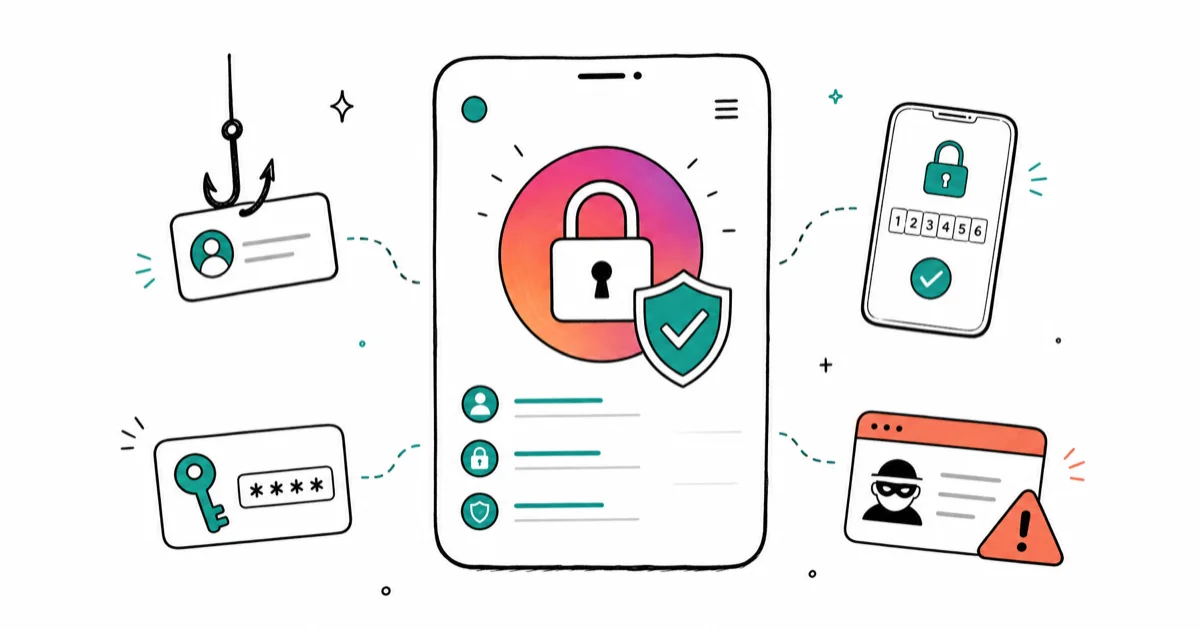
Quick AnswerThere are no legitimate Instagram hack tools. Most so-called hack tools are scams designed to steal your personal information. Protect your account by enabling two-factor authentication and using a strong, unique password.
Search results for “Instagram hack tool” are full of scams, fake apps, and phishing sites built to steal credentials from the person doing the searching. No legitimate tool exists to hack Instagram accounts, but there are concrete steps you can take to lock down your own.
- No legitimate Instagram hack tool exists; every website or app claiming to offer one is a scam designed to steal your login credentials or payment details.
- Enabling two-factor authentication (2FA) blocks unauthorized access even if your password is compromised, and takes less than two minutes to set up.
- Phishing attacks account for the majority of real Instagram account takeovers, usually delivered through fake login pages shared via DMs or email.
- Instagram’s Login Activity page shows every device and location currently accessing your account, making it the fastest way to spot unauthorized access.
- Using a unique, randomly generated password of at least 16 characters for Instagram prevents brute-force attacks from succeeding even with large wordlists.
#Inside the “Instagram Hack Tool” Search Results
Instagram’s massive footprint makes it a steady target for credential scams.
The top “Instagram hack tool” results almost all do the same three things: ask for a target username, run a fake “loading” animation, then redirect to a human-verification page or a survey wall.
None return credentials. Several push installers flagged by Microsoft Defender on download. The pattern is consistent enough to treat as a rule: if a page promises to crack any Instagram account, the only thing it actually delivers is your own data to the scammer.
This guide explains how Instagram’s own security features work, what real account takeovers look like, and the short list of habits that prevent almost all of them.
#Instagram’s Built-in Security Features
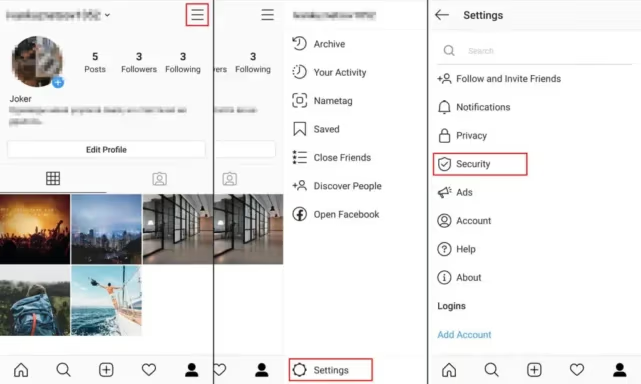
Instagram ships several security features that you don’t have to pay for, and most of them sit one tap away in the app.

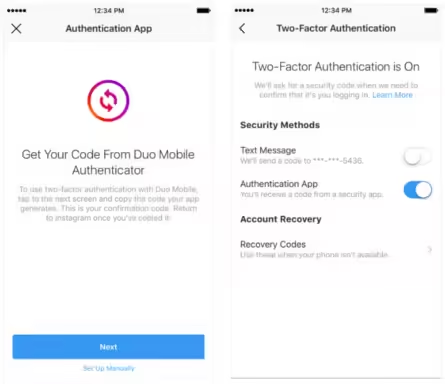
- Two-Factor Authentication (2FA): Adds a second verification step on new-device logins. According to Instagram’s Help Center, 2FA supports 3 verification methods, documented on the official two-factor authentication page: an authenticator app, SMS text codes, or WhatsApp. The feature works on every account type, including business and creator profiles.
- Login Activity: A live list of every device and location currently signed in. You can revoke any session with one tap if a device looks unfamiliar.
- Suspicious login alerts: Instagram pushes a notification when a sign-in attempt comes from an IP range or device it doesn’t recognize.
- Security Checkup: A guided walkthrough that reviews login activity, recovery contacts, and 2FA status in one flow.
These features form a solid base, but they only work if you turn them on. On an account that’s been inactive for a while, it’s common to find 2FA still off, an outdated linked phone number, and forgotten third-party apps that still have access. A few minutes of cleanup closes all of those gaps.
#Common Instagram Hacking Methods
Real Instagram takeovers almost never come from a “tool.” They come from a small handful of attacker techniques, all of which target the user instead of the platform.
- Phishing: Fake login pages delivered through DMs, copyright-strike emails, or “verified badge” offers. The FTC’s phishing scam guide found that the strongest signals are urgency, mismatched sender domains, and link previews that don’t match the displayed text.
- Credential stuffing: Attackers feed leaked email-password pairs from other breaches into Instagram’s login. If you’ve reused a password anywhere, this is the highest-probability attack against you.
- Social engineering: Direct messages impersonating support, brand partnerships, or family members, asking for a one-time code or a “verification screenshot.”
- Session hijacking on shared devices: Forgetting to log out of a shared computer or borrowed phone, leaving the session active for the next user.
Recent phishing kits aimed at Instagram include pixel-accurate clones of the login page and valid HTTPS padlocks. The lock icon proves the page is encrypted; it doesn’t prove Meta owns it.
#How Can You Tell if Your Instagram Account Was Hacked?
Instagram leaves several visible traces when an attacker is inside an account.
- Login Activity shows an unknown device: Go to Settings → Accounts Center → Password and Security → Where you’re logged in. Any session you don’t recognize should be ended immediately.
- Your email or phone number changed: Instagram emails the original address whenever recovery contact info is updated. If you receive that message and didn’t make the change, use the “secure your account” link in the same email.
- Posts, follows, or DMs you didn’t make: Watch for crypto giveaways, suspicious shortened links, or login-link DMs sent to your contacts.
- Repeated password reset emails: Multiple reset requests you didn’t trigger are often the first sign of an attacker probing your account.
If any of these show up, change your password from a device you trust before doing anything else. Then run Security Checkup.
#What Should You Do If Your Account Is Already Compromised?
Move quickly. The longer an attacker has the account, the more recovery friction Instagram adds, especially if they’ve already swapped the email and phone number.
- Open the Instagram login screen and tap Forgot password?. Request a login link to the email and phone number you originally signed up with, even if you think they’ve been changed.
- If that fails, go to Instagram’s hacked-account help page and submit a recovery request. Meta states that you’ll be asked for a video selfie so the review team can match your face to existing photos on the account.
- After regaining access, change the password to something you’ve never used elsewhere, enable 2FA with an authenticator app, and revoke every session in Login Activity.
- Check connected services. Instagram, Facebook, and Messenger share sign-in state through Meta’s Accounts Center, so a compromised Instagram often means a compromised Facebook too.
- Tell your followers what happened. A short Story is enough to stop scams sent from your account from succeeding.
Recovery without 2FA enabled can take anywhere from a few hours to several days, depending on how much identifying info the original owner can supply. Recovery with 2FA enabled (and an authenticator app instead of SMS) is usually immediate from a known device.
#Best Practices That Actually Prevent Takeovers
Instagram’s security team and independent researchers agree on the same short list of habits. Most of these take less than five minutes each.
- Use a 16-character random password stored in a password manager like 1Password or Bitwarden, and don’t reuse it anywhere.
- Turn on 2FA with an authenticator app instead of SMS. SIM-swap attacks defeat SMS codes; authenticator apps don’t ride on your phone number.
- Review Login Activity monthly and revoke any session you don’t recognize.
- Treat unsolicited DMs as hostile, especially “you’ve been featured” or “your account is at risk” messages with links. Open the linked app directly instead of tapping the link.
- Audit third-party app access under Settings → Apps and Websites and remove anything you no longer use.
- Keep the Instagram app updated. Security patches go out frequently, and older builds carry known issues.
For the broader picture, Instagram’s security tips page confirms the same priorities and adds platform-specific guidance for business and creator accounts.
#The Truth About “Instagram Hack Tool” Pages
If you’re reading this because you searched for a hack tool, here’s the plain version: every site that claims to give you access to someone else’s Instagram account is lying. The categories of what those pages actually do:
- Survey-wall scams: After the fake “loading” screen, they redirect you through affiliate offers. The site owner gets paid; you get nothing.
- Credential phishing: Some pages ask you to “verify your own Instagram first.” The login form sends your password to the attacker, not to Meta.
- Malware drops: Some installers contain keyloggers or remote-access tools, which then steal credentials for every site you log into.
- Subscription traps: A few pages charge a “one-time fee” via Stripe or crypto, then deliver nothing and refuse refunds.
There’s also a legal floor under this. The U.S. Computer Fraud and Abuse Act treats unauthorized account access as a federal offense, and Meta cooperates with law enforcement on takeover cases. Even an attempt can violate Instagram’s terms of service and trigger a permanent ban on your own profile, with state-level civil and criminal exposure layered on top.
The only legitimate use case is recovering your own account through Instagram’s official flow above. Reading someone else’s messages or photos without their permission isn’t unlocked by any of these pages.
Was your account actually compromised? Our guide on Instagram account hacking and recovery covers the official recovery steps in detail, and if the account is beyond saving you can delete your Instagram account on iPhone cleanly.
Security scares often turn out to be ordinary app bugs rather than takeovers. If your feed or alerts suddenly stop working, that points to a glitch, not a hacker. You can usually fix Instagram notifications not working or sort out why Instagram direct messages are not working on your own, no security panic required.
Audio glitches fall in the same bucket. If Instagram music not working is your issue, it’s a licensing or cache problem, not a hacker.
#Bottom Line
Don’t waste time searching for an “Instagram hack tool.” None of them work, and most are designed to hack you instead. Spend ten minutes on the boring version: switch to a 16-character random password, turn on 2FA with an authenticator app, revoke unknown sessions in Login Activity, and add a backup email you control. That single block of work blocks the vast majority of real takeovers, and it costs nothing.
Instagram Tips & Tricks
#Frequently Asked Questions
Are there any real Instagram hack tools that work?
No. Any tool that claims otherwise is a scam.
Can someone hack my Instagram by just having my username?
Knowing your username alone isn’t enough to take over an account. An attacker still needs your password or access to one of your recovery channels, which is why a unique, randomly generated password matters so much. The risk climbs sharply when your username matches credentials leaked from unrelated breaches: attackers script those leaked pairs against Instagram’s login endpoint, and any reused password becomes the weakest link in your account security.
How do I know if my Instagram has been hacked?
Check Login Activity for unknown sessions and watch for password-reset emails you didn’t request.
Is two-factor authentication enough to protect my account?
2FA blocks most automated takeover attempts and almost all credential-stuffing attacks, which is why it’s the single highest-impact change you can make in under five minutes. It isn’t bulletproof against SIM-swap fraud if you use SMS codes, so an authenticator app or a hardware security key like a YubiKey gives meaningfully stronger protection against targeted attacks. Pair 2FA with monthly Login Activity reviews and you’ve closed the door on the attacks that account for the vast majority of real-world takeovers.
What should I do if I clicked a phishing link?
Change your Instagram password from a trusted device, then sign out of all other sessions.
Can Instagram recover my account if I lost access to both email and phone?
Yes, Meta offers a video-selfie recovery path for accounts where the original email and phone number are gone. Instagram’s Help Center confirms that the platform uses an automated face match against existing photos, and the review can take anywhere from a few hours to several days. Recovery with 2FA enabled from a known device is usually same-day.
Is it illegal to use an Instagram hack tool, even on my own account?
Using one violates Instagram’s terms of service and can permanently suspend your account.
How often should I change my Instagram password?
You don’t need to rotate it on a fixed schedule if it’s strong, unique, and stored in a password manager. Change it immediately if you see a suspicious login alert, an unknown session, or a breach notification for any other service where you reused the same password. Forced rotation often weakens security by pushing users toward predictable patterns.
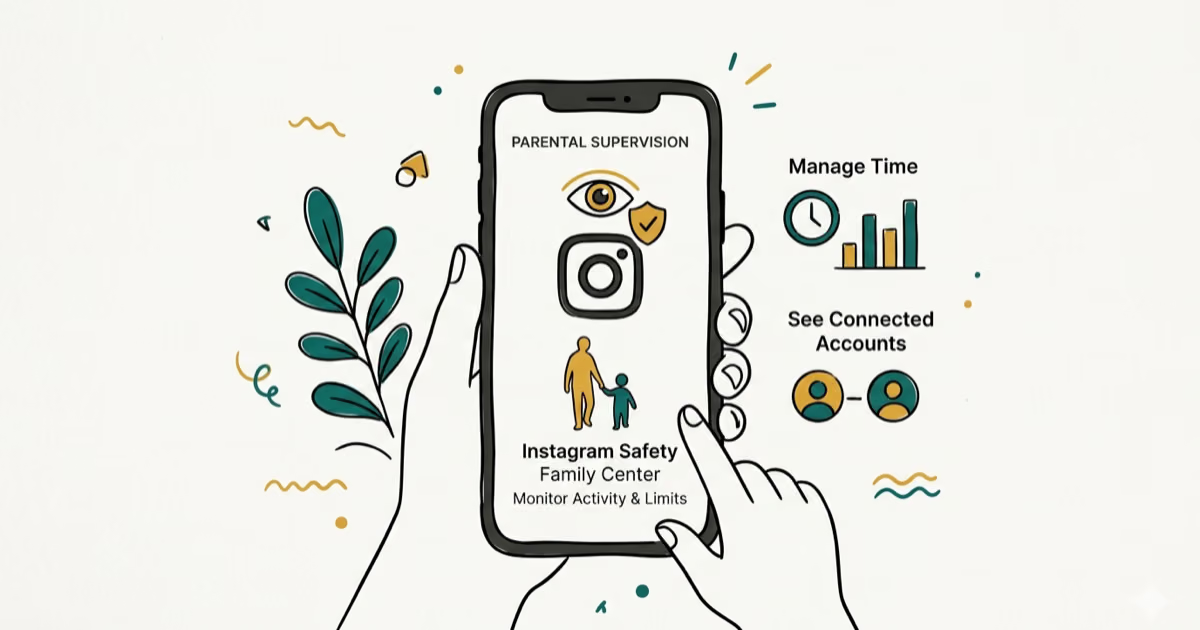
Instagram Parental Controls: Family Center Setup (2026)
Set up Instagram Family Center, privacy settings, Hidden Words, content filters, and time limits with your teen's consent on iPhone or Android.
Instagram Notifications Not Working? Quick Fixes (2026)
Instagram notifications not working? Fix push alerts, DMs, likes, and Stories on iPhone and Android in under 5 minutes with proven 2026 steps.
Instagram "We Limit How Often" Error: How to Fix It 2026
Instagram says "we limit how often you can do certain things"? Wait 24-48 hours, slow down likes and follows, then appeal through Help Center.
Instagram Name Checker: Find Available Usernames Fast
Check Instagram username availability instantly with free tools like Namechk and KnowEm. Find perfect handles and avoid the frustration of taken names.