How to Unlock a Blacklisted Phone: Legal Methods Only
A blacklisted phone can't be 'free unlocked' by software. Learn what CTIA's checker actually reports, when to contact the carrier, and when to walk away.
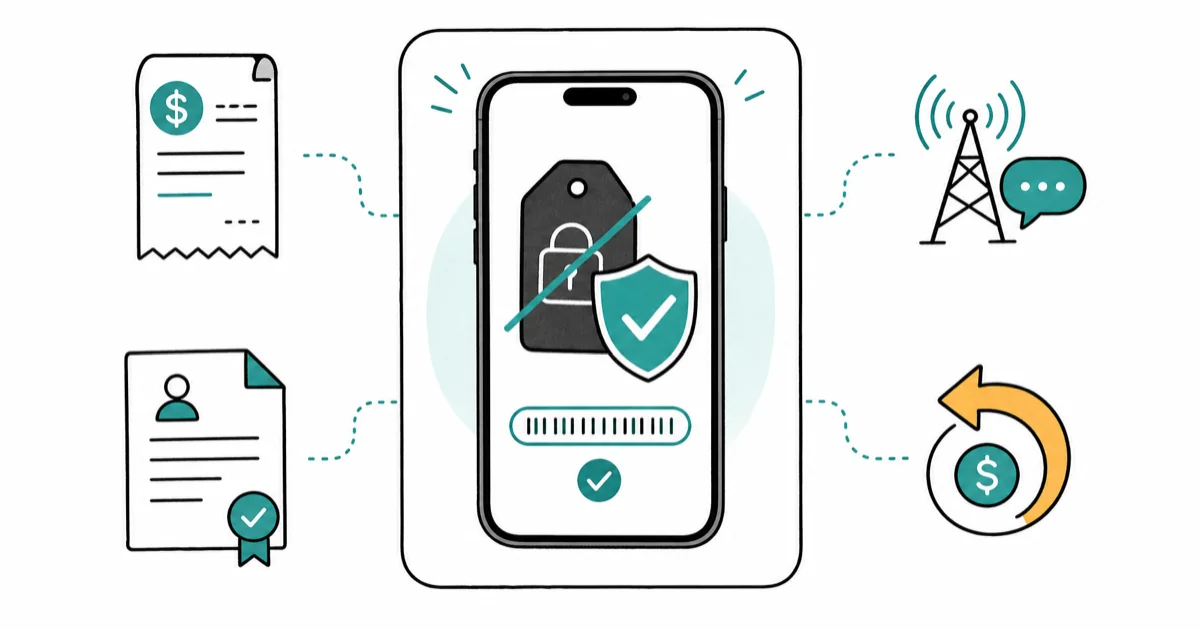
Quick AnswerYou can't clear a blacklist with software. Contact the carrier about the report or account restriction; if CTIA says the phone was lost or stolen and it isn't yours, return it to the seller or law enforcement.
The “free unlock” sites at the top of search results don’t work. A blacklist is a carrier-side flag on the IMEI, not a software lock on the phone. This guide covers the legitimate paths for a phone you own, the CTIA lookup, and the red lines.
Scope. Everything below applies to your own phone with proof of purchase. Clearing a blacklist on someone else’s device is a separate legal matter and nothing here applies to it.
- A blacklist is an IMEI flag in carrier databases, not a software lock. No app or web tool can remove it without the carrier’s cooperation.
- The legitimate path is to resolve an incorrect or outdated flag with the carrier or organization that reported it. CTIA’s Stolen Phone Checker is a lookup, not a consumer dispute channel.
- IMEI tampering can carry criminal consequences. The UK has a specific reprogramming statute; US consequences depend on the conduct, jurisdiction, and laws involved.
- The reporting carrier can block a lost or stolen device; other carriers participating in the CTIA and GSMA Device Check ecosystem may block it too.
- If you bought a phone that turns out to be blacklisted, your best move is usually a refund or chargeback, not a “free unlock” service.
#Why Does a Phone Get Blacklisted in the First Place?
A carrier-side restriction is not one single status. The public CTIA checker documents devices reported lost or stolen; a carrier may separately enforce account, financing, or fraud restrictions under its own policy. The cause determines which organization can review it. Our deeper coverage of a blacklisted iPhone specifically explains the separate Apple Activation Lock check.
Reported lost or stolen. According to CTIA’s current FAQ, the reporting carrier can block the device on its network and other participating carriers may also block it.
Unpaid carrier balance. Ask the carrier whether an account or financing restriction exists; CTIA’s public result doesn’t answer that.
Fraud or chargeback. A carrier may apply a fraud-related restriction after a disputed purchase. If that status is wrong, ask the carrier which records it accepts and what review process applies; don’t assume a universal written path or success rate.
Insurance claim payout. A recovered phone may remain reported lost after an insurance claim. Ask the carrier or insurer shown in the case record which organization supplied the status and can correct it.
Why the cause matters: only the organization responsible for the status can explain its documentation and review path.
#How to Check if a Phone Is Actually Blacklisted
Before you spend any time trying to “unlock” anything, confirm the status with two independent sources. The IMEI identifies the device for the lookup, but it doesn’t prove ownership.
Find the IMEI first. Dial *#06# on the phone keypad, or open Settings > General > About on iPhone, or Settings > About phone > IMEI on Android. The number is 15 digits. If the phone won’t power on, the IMEI is also printed on the SIM tray of older models and on the original retail box.
Then run two checks:
- CTIA Stolen Phone Checker. CTIA confirms that this public US lookup returns a red Reported Lost or Stolen result or a green result meaning the device was not flagged on the GSMA Block List at the time of the query.
- Carrier check. Contact the carrier the phone was last active on and ask it to check any account, financing, fraud, or activation restriction. A carrier-unlock portal is not the same thing as a blacklist dispute.
This is where the two checks diverge: a green CTIA result only answers the lost-or-stolen Block List question at that moment. It does not establish that a carrier will accept the device or that an Apple device is free of Activation Lock.
If the public tool returns Reported Lost or Stolen, stop the process. Return the device to whoever you bought it from, file a chargeback if needed, and contact the carrier or local law enforcement. Continuing past this point is where the legal exposure starts.
#Self-Unlocking a Blacklisted Phone: What Actually Works
If the phone isn’t yours, return it to the seller or report it. Don’t try to change its lost-or-stolen status.
For your own device, the possible path depends on the cause and the carrier’s policy:
| Flag or restriction | Possible path | Who decides the outcome |
|---|---|---|
| Lost or stolen, not yours | Return or report it | Seller, carrier, or local authority |
| Lost or stolen, yours, wrongly reported | Ask for a carrier review | Reporting carrier |
| Unpaid carrier balance, your own account | Resolve the account issue | Carrier under its current policy |
| Unpaid balance, another person’s account | Seek a seller refund | Seller, payment provider, and possibly the carrier |
| Fraud-related restriction | Submit requested evidence | Carrier or reporting organization |
| Recovered device after an insurance claim | Ask who supplied the status | Carrier or insurer |
The pattern is that the organization responsible for the status decides whether it changes. No primary source opened for this audit supports a third-party unlock tool writing to a carrier, CTIA, or GSMA status record.
What about tools advertised on TikTok or YouTube as free IMEI blacklist removers? This audit didn’t verify a current tool that can update the responsible organization’s record. That doesn’t prove every advertised service is fraudulent; it means a scan, payment page, or “submitted” message isn’t evidence that the carrier-side status changed.
People sometimes confuse this with a bad ESN flag on older CDMA-era devices. CTIA’s public checker uses GSMA Device Check for lost-or-stolen status; carrier-specific account and activation restrictions remain separate.
#The Carrier Dispute Process
This is the path that actually works when you own the phone and the flag is wrong. Each carrier’s process varies in detail, but the structure is the same.
What to gather first. Original purchase receipt, government-issued ID, the IMEI number, and any documentation about how you acquired the device (bill of sale for a private purchase, original carrier contract for a finance deal). For a wrongful theft flag, also gather a police report number if one exists, or a notarized statement from the original owner.
Where to start. Contact the organization that supplied the status. Ask it for the reason, case number, and accepted ownership documents.
Note that a blacklist review and a carrier-unlock process are not the same. A carrier unlock concerns eligibility to use another provider; a block concerns whether a network applies the reported device status. Resolve the block first.
According to CTIA’s FAQ, contributors supply the status data; the public checker doesn’t accept consumer appeals.
What to expect. The carrier decides which documentation and review steps apply. If it confirms its flag was wrong, it can update the status; if it confirms the underlying report or restriction, the phone remains blocked. Ask for the case number and the carrier’s own timeline instead of relying on a universal estimate.
There’s no shortcut. There’s no “free” version that bypasses the documentation. The cost is the time you spend documenting, and that’s the price of doing this legitimately.
#When to Walk Away from a Blacklisted Phone
Sometimes the right move is no move. If you bought a used phone and the CTIA result says Reported Lost or Stolen, seek a refund or chargeback instead of trying to change someone else’s carrier record.
Signs to walk away:
- The seller can’t produce an original receipt or carrier account history.
- The CTIA checker returns Reported Lost or Stolen and the seller “didn’t know.”
- The carrier won’t accept your documentation because the original account is in collections.
- The price was suspiciously low for the model.
- A “free unlock” service is the only path being offered.
According to Apple’s Activation Lock documentation, Find My links the device to an Apple Account on Apple’s activation servers. CTIA’s FAQ describes carrier network blocking through a separate GSMA-backed system. A green result in one system therefore doesn’t establish that the device is clear in the other.
For platform-specific checks before you buy a used iPhone, our iPhone IMEI check guide walks through the lookup tools that actually return useful data. For the Activation Lock side specifically, our coverage of removing an iPhone from a previous owner’s iCloud covers what’s reasonable and what isn’t.
#What Happens If You Try to Use a Blacklisted Phone?
Network blocking affects cellular access, not the phone’s local Wi-Fi features. The reporting carrier can reject the device, and other participating carriers may do the same.
On a known-blacklisted iPhone, the device still authenticates to Wi-Fi, runs the App Store, makes FaceTime audio calls, and sends iMessages.
Cellular is the part that breaks. A blocked device may be refused by the reporting carrier and by other participating networks. CTIA reports contributors in more than 45 countries, but participation is not universal and its FAQ does not promise that every foreign carrier applies every report.
There’s no software setting that clears a carrier-side record. The carrier network evaluates device identity during cellular registration, so erasing the operating system doesn’t update that external status.
If a friend told you “just jailbreak it and change the IMEI,” that doesn’t work. Our coverage of whether you can change the IMEI on iPhone explains why.
#Bottom Line
There’s no software-only way to clear a carrier-side block. The legitimate path is to resolve the underlying report or account issue with the responsible carrier or organization. CTIA’s public tool can show lost-or-stolen status, but it can’t change that record.
If you bought a used phone that turns out to be blocked and you can’t resolve the record with the seller or responsible carrier, seek a chargeback or refund instead of paying a third party to “clean” the IMEI. Only the organization responsible for the status can assess and update it.
#Frequently Asked Questions
Can I unlock a blacklisted phone for free?
Only the responsible carrier or reporting organization can assess and possibly clear the cause. CTIA’s public checker and a software unlock tool can’t do that.
Will an IMEI checker tell me if a phone is blacklisted?
The CTIA Stolen Phone Checker answers whether the device was flagged lost or stolen on the GSMA Block List at the time of the query. Ask the carrier separately about account, financing, and activation restrictions.
Is it illegal to use a blacklisted phone on Wi-Fi?
No. A blacklisted phone is blocked from cellular networks, not from Wi-Fi. You can legally use a blacklisted device you own as a Wi-Fi-only tablet, music player, or backup camera. The legal issue starts if you try to modify the IMEI itself.
Can I just change the IMEI to bypass the blacklist?
Don’t try it. IMEI tampering is a criminal offence in the UK under the Mobile Telephones (Re-programming) Act 2002, carrying up to 5 years’ imprisonment. US legal consequences depend on the conduct and laws involved, so get jurisdiction-specific advice instead of treating one criminal label as universal.
Does a factory reset remove the blacklist?
No. The blacklist is a flag on the IMEI in carrier databases, not a file on the phone. A factory reset wipes the operating system and your data, but the IMEI doesn’t change, so the carrier check still fails.
How long does a carrier blacklist dispute take?
There is no single CTIA consumer-appeal timeline. Ask the carrier handling the record for its case number, required documents, and review estimate.
Should I report a found phone or try to unlock it?
Report it to the carrier or local law enforcement and follow their instructions. Procedures for identifying and returning a found device vary, and an IMEI lookup alone doesn’t prove who currently owns it.
Apple Siri Settlement: Who Qualifies and How to Claim
Apple's $250 million Siri settlement covers iPhone 15 Pro and iPhone 16 models bought June 2024 to March 2025. See who qualifies and how claims work.
iOS 26.6.1 Security Update: What Apple Fixed and Who Gets It
Apple released iOS 26.6.1 on August 17 with 29 security fixes, including an IPSec interception bug. See what it patches, who gets it, and how to update.
iPhone Adaptive Power: How It Works and When to Use It
Learn how iPhone Adaptive Power works, which models support it, what it changes, and when Low Power Mode is still the better battery-saving choice.
How to Transfer Data to a New iPhone Without iCloud
Move everything to your new iPhone without iCloud: Quick Start device-to-device transfer, wired migration, and encrypted Finder or iTunes backups.