What Is Freeform on iPhone? Apple's Whiteboard Explained
Freeform is Apple's free whiteboard app for iPhone, iPad, and Mac with an infinite canvas, real-time collaboration, and iCloud sync built in.
Quick AnswerFreeform is Apple's free whiteboard app that ships with iOS 16.2 and later. It gives you an infinite canvas for sketches, sticky notes, and files, plus live collaboration with up to 100 people through iCloud.
Freeform on iPhone is Apple’s free digital whiteboard app, built into iOS 16.2 and later. It pairs an infinite canvas with iCloud sharing, so you can sketch, drop in files, and edit the same board with up to 100 people in real time. Used across a week of planning sessions, it can quietly replace several single-purpose apps on your home screen.
- Freeform ships free with iOS 16.2, iPadOS 16.2, and macOS Ventura 13.1 on any iPhone 8 or newer, with no separate download after the system update.
- Each board is an infinite canvas that holds text, sticky notes, sketches, photos, videos, PDFs, links, scanned documents, and 700+ shapes in one workspace.
- Up to 100 collaborators can edit a board simultaneously when you share it through Messages, Mail, or a direct iCloud link.
- Boards sync through iCloud and are protected by standard AES-128 encryption, with end-to-end encryption available when Advanced Data Protection is on.
- Freeform works best inside the Apple ecosystem; teams that need cross-platform web access usually pair it with Miro, FigJam, or Microsoft Whiteboard.
#What Is Freeform on iPhone?
Freeform is Apple’s whiteboard and collaboration app. Apple’s current Freeform user guide is the live source for how boards, drawing, notes, and sharing work across Apple devices.
It’s, in short, Apple’s answer to Miro.
On iPhone, the app appears in your App Library after you update to iOS 16.2 or later. It uses your existing Apple ID and iCloud account, so no extra signup is required. Every board you create lives in iCloud and syncs across your own devices on the same Apple ID, including iPad and Mac. If iCloud sync stalls on a specific Notes-style document, our guide on iCloud notes not syncing walks through the same fixes that work for Freeform boards.
The infinite canvas grabs headlines, but the real hook is integration. A Freeform board can be shared inside a Messages thread, pinned to the top of that thread, and edited live during a FaceTime call. That makes it more of a shared notebook than a static document. It’s the rare Apple app that quietly removes work from your day instead of adding it.
#How Freeform Works on Your iPhone
The model is simple. Open Freeform, tap the new-board icon in the top right, and start dropping in content. There are no pages, no margins, and no zoom limit, so a single board can hold a four-step roadmap or a sprawling mood collection. The zoom range on iPhone stretches from a wide overview down to fine detail, which is enough to draft a very large diagram and still read each note.
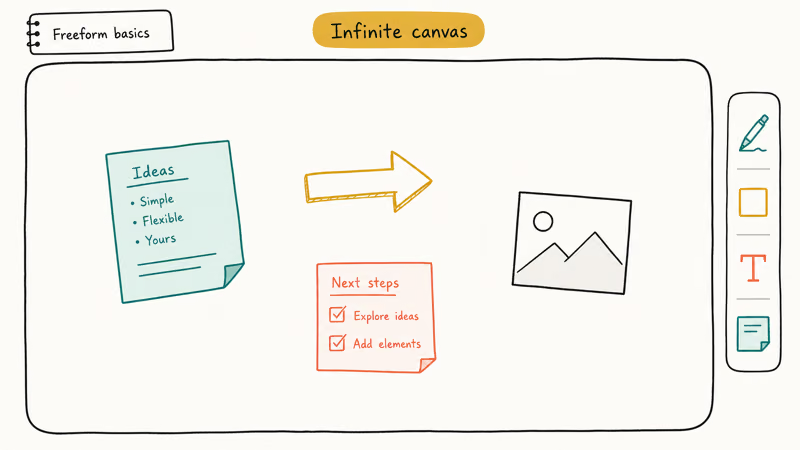
Six insert tools live in the bottom toolbar.
The bar gives you sticky notes, shapes, text boxes, the pen and highlighter, files, and the photo or scanner picker. Pinching with two fingers zooms in and out. A two-finger drag pans the canvas. Long-press a sticky to recolor it without leaving your stream of thought.
Boards sync through iCloud Drive in the background. Apple confirms that iCloud Drive uses 128-bit AES encryption in transit and at rest by default, and supports end-to-end encryption when Advanced Data Protection is enabled (see Apple’s iCloud data security overview). That covers Freeform boards stored under your Apple ID, including boards you create on your own iPhone or iPad.
#What You Can Add to a Board
- Sticky notes in seven colors for quick capture
- Free-form sketches with the pen, pencil, marker, and highlighter
- Photos, videos, and audio from your library or Camera Roll
- Scanned documents using the iPhone camera
- PDFs and any file from the Files app or iCloud Drive
- Web links that preview as rich cards instead of plain URLs
- Over 700 built-in shapes for flowcharts, wireframes, and diagrams
If photos refuse to drop into the canvas from Messages, the fix is usually a stuck share sheet rather than Freeform itself. The walkthrough in our iPhone photo sharing troubleshooter clears it in under a minute.
#Who Freeform on iPhone Fits Best
Freeform fits people already living inside Apple’s apps. If your team uses iMessage, FaceTime, and iCloud daily, the friction of sharing and joining a board is close to zero. Handoff between an iPhone, an iPad with Apple Pencil, and a Mac is smooth, with edits showing up across all three almost immediately on a decent Wi-Fi connection.
Students and educators get a lot from it.
Group projects, study guides, and lab diagrams all work well on a shared board, and there is no subscription to budget for. Apple states that Freeform is included with iOS, iPadOS, and macOS at no extra cost.
The tool’s weaker for fully remote, mixed-platform teams. Freeform doesn’t run in a web browser, which means a Windows or Android collaborator can view a shared board only after it’s exported as a PDF. For that audience, Miro and FigJam remain safer picks. iCloud headroom matters too; once your boards include video clips, you may bump against the free 5 GB tier, and our iCloud storage full guide explains how to clear room before sync stalls.
#Sharing a Freeform Board From iPhone
You share a Freeform board the same way you share most Apple content. Open the board, tap the Share button in the top right, and choose Messages, Mail, or “Copy Link.” Anyone with the link who has Freeform on iOS 16.2, iPadOS 16.2, or macOS 13.1 or later can open the board with their own Apple ID.
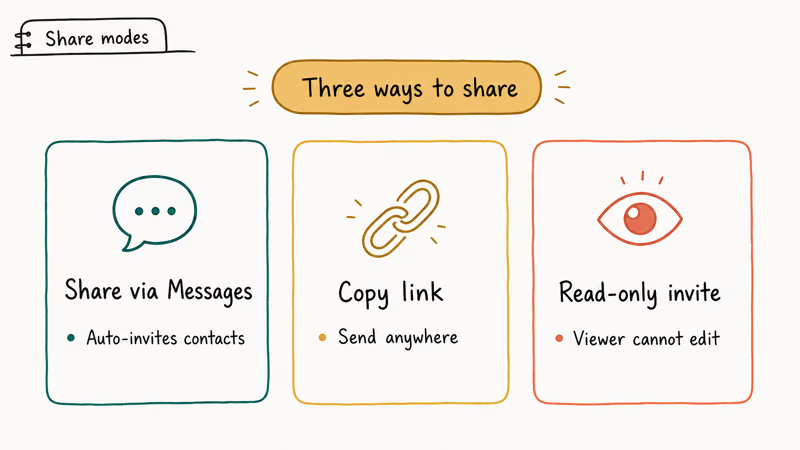
Permissions are set when you share. You pick “Only people you invite” or “Anyone with the link,” then choose “Can make changes” or “View only.” A small avatar stack at the top of the board shows who is currently in the canvas. Tap any avatar to follow that person’s cursor.
If your shared board lives in a Messages thread, it gets pinned at the top of that conversation. New activity, like a comment or a new sticky, shows up in the Messages thread so collaborators don’t have to leave the app to track changes.
Apple recommends starting a SharePlay session during FaceTime when you want to walk through a board live. If FaceTime screen sharing refuses to start, our guide on why screen sharing fails on FaceTime covers the common causes.
When you create a Freeform board, you are the owner. The board sits in your iCloud account, and you control who can view or edit. You can only edit boards you own or boards you have been invited to. This stays inside the same authorization scope as iCloud Drive: shared boards belong to whoever opened them, and access requires an explicit invite or link.
#Privacy and Legal Notes for Shared Boards
Freeform is collaboration software, not a monitoring tool. The privacy model assumes everyone on a board has been invited and knows the board is shared. Three points are worth flagging before you bring sensitive material into a board.
First, anything you paste into a Freeform board is stored in iCloud under your Apple ID. If you have a work or school Apple ID with an IT policy, that policy applies to any board you create on that account.
The next two points matter most for shared boards.
Second, shared boards inherit the access of every collaborator. Apple’s iCloud security overview states that collaborators with edit access can change, copy, or remove board content, so only invite people you trust with the underlying material.
Third, Freeform boards on a personal Apple ID get end-to-end encryption only when Advanced Data Protection is enabled on your devices. Without it, boards are still encrypted in transit and at rest, but Apple holds the keys and can produce them under legal process.
For confidential business data, follow your employer’s official collaboration policy first and use Freeform only on accounts your organization explicitly approves. If you share a personal device with family, revisit your Screen Time passcode so children’s accounts can’t edit work boards by accident.
#How Does Freeform Compare to Miro, FigJam, and Notion?
Freeform’s edge is integration. The trade-off is reach. Here is how it stacks up against the three apps people most often replace with it.
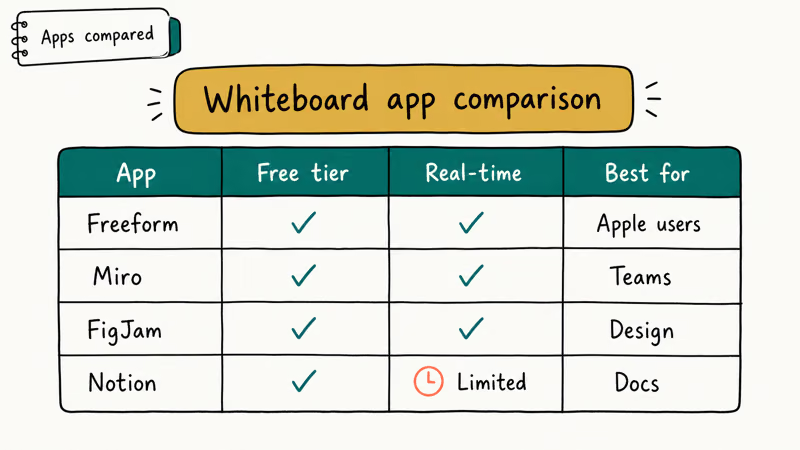
Miro is the most established whiteboard for cross-platform teams. It runs in the browser, on Windows, on Android, and inside Slack and Teams. Miro’s pricing page lists a free plan with 3 editable boards and paid plans for unlimited boards and advanced controls. Freeform is unlimited and free, but Apple-only.
FigJam, from Figma, leans toward product and design teams. It has voting, stamps, and built-in workshop templates that Freeform doesn’t match yet. FigJam runs in the browser, so it’s friendlier for mixed-platform teams, but boards aren’t pinned inside iMessage threads the way Freeform boards are.
Notion isn’t a true whiteboard. It’s a structured workspace that recently added basic drawing and a whiteboard-style canvas. Notion wins for long-lived documentation, while Freeform wins for quick visual thinking. A common pattern is keeping Notion for project pages and using Freeform for the messy, ad-hoc sessions in between.
#Bottom Line for iPhone Users
If you already use an iPhone and at least one other Apple device, open Freeform today and move one ongoing brainstorm into it. The lowest-risk first project is a personal one: a kitchen remodel mood board, a weekend trip plan, or a sketch of a new home network. You’ll see the iCloud sync and Apple Pencil integration without inviting anyone else.
Start small. One board.
For collaborative work, Freeform is the right default when every collaborator is on Apple hardware and you mostly communicate through iMessage and FaceTime. Switch to Miro or FigJam the moment you add a Windows, Android, or web-only teammate, because PDF export is a workaround, not a workflow. Keep Notion as the long-form home for any board that needs to outlive the meeting it was created in.
That split holds up well for mixed teams. A five-person product crew might run Freeform for ideation, Notion for the resulting specs, and a single Miro board for the one consultant on a Windows laptop. With clear homes for each type of work, the recurring “Where does this go?” question fades fast.
#Frequently Asked Questions
Is Freeform free on iPhone?
Completely. Freeform is included free with iOS 16.2 and later. There is no subscription, in-app purchase, or paid tier. The only cost is the iCloud storage your boards consume, and small boards barely register against the free 5 GB iCloud allotment.
Which iPhones support Freeform?
Freeform runs on any iPhone that can install iOS 16.2 or later, which covers iPhone 8 and newer. If your iPhone is already on iOS 16, 17, or 18, you have Freeform. If you can’t find the app, search “Freeform” in Spotlight or reinstall it from the App Store. It doesn’t need to be redownloaded after a system update unless you previously deleted it.
Can I use Freeform offline?
Mostly. You can create and edit boards without an internet connection. Changes are stored locally and sync to iCloud the next time your iPhone is online. Collaborators won’t see your edits until that sync completes, so plan around it during meetings.
Can non-Apple users join my Freeform board?
Not directly. Freeform requires an Apple ID and an Apple device running iOS 16.2, iPadOS 16.2, or macOS Ventura 13.1 or later. For Windows or Android viewers, export the board as a PDF from the Share menu and send that file. There is no web viewer at present.
How secure are my Freeform boards?
Freeform boards sync through iCloud with standard 128-bit AES encryption in transit and at rest. With Advanced Data Protection on, boards under your Apple ID get end-to-end encryption, meaning Apple can’t read their contents. Only invited collaborators or people with an “Anyone with the link” share can open a board, and you can revoke access at any time from the Share menu.
What is the maximum number of collaborators on one board?
Up to 100 people can edit the same board simultaneously. Apple has confirmed this cap since launch, and it holds reliably for typical group sizes. If you need more participants, split the topic into two boards or export the result and share it as a static PDF.
Does Freeform work with Apple Pencil?
On iPad, fully. Apple Pencil 1, 2, and Apple Pencil Pro all work with Freeform, including pressure sensitivity, tilt, and double-tap to switch tools. iPhone doesn’t support Apple Pencil, so on iPhone you draw with your finger. Boards drawn on iPad sync to iPhone immediately, and you can annotate them with your finger from there.
Can I recover a Freeform board I deleted?
Within 30 days, yes. Deleted boards move to the Recently Deleted folder inside Freeform. Open Freeform, tap the sidebar icon, choose Recently Deleted, long-press the board, then pick Recover. After 30 days the board is permanently removed and can’t be restored, even from an iCloud backup.
iPhone Adaptive Power: How It Works and When to Use It
Learn how iPhone Adaptive Power works, which models support it, what it changes, and when Low Power Mode is still the better battery-saving choice.
How to Transfer Data to a New iPhone Without iCloud
Move everything to your new iPhone without iCloud: Quick Start device-to-device transfer, wired migration, and encrypted Finder or iTunes backups.

Group Text Not Working on iPhone? 8 Fixes That Work
Group text not working on iPhone? Turn on MMS Messaging and Group Messaging, check iMessage vs SMS routing, and fix mixed Android group chats fast.
Best Power Bank for iPad in 2026: Pro, Air, and Mini
Best power bank for iPad in 2026. Compare mAh tiers and USB-C PD wattage for iPad Pro, Air, and mini, plus airline Wh math, cables, and travel tips.