What Does CTFU Mean? Definition, Use Cases, Examples
CTFU stands for Cracking The F**k Up, slang for laughing hard at memes or jokes online. Learn the meaning, real examples, and when to skip CTFU.

Quick Answer CTFU stands for Cracking The F**k Up, slang for laughing hard at a funny meme, video, or reply. People type it in texts, Reddit threads, TikTok captions, and Instagram comments.
CTFU stands for Cracking The F**k Up, internet slang for laughing hard at something funny. You’ll see it in text threads, Reddit comments, TikTok captions, and Instagram replies. Knowing the meaning saves you the awkward “wait, what does that mean” reply and helps you read the room before you send it yourself.
- CTFU stands for Cracking The F**k Up, slang for laughing hard at a meme, joke, or funny reply
- It hits harder than LOL or haha and sits at roughly the same intensity as LMAO and ROFL
- CTFU spread from Black Twitter and music culture in the early 2010s into Reddit, TikTok, and group iMessage threads
- The phrase “crack up” comes from American English and has meant “to burst out laughing” for decades
- Skip CTFU in work emails, school assignments, or chats with relatives who don’t read slang fluently
#What CTFU Stands For
CTFU stands for Cracking The F**k Up. The censored asterisks aren’t optional in print, but inside text threads people usually spell it out. It’s a reaction acronym that acts like an emoji: you drop it as a one-word reply when a meme, video, or comment makes you laugh out loud. Unlike “STFU” (Shut The F**k Up), CTFU is positive and high-energy, not hostile.
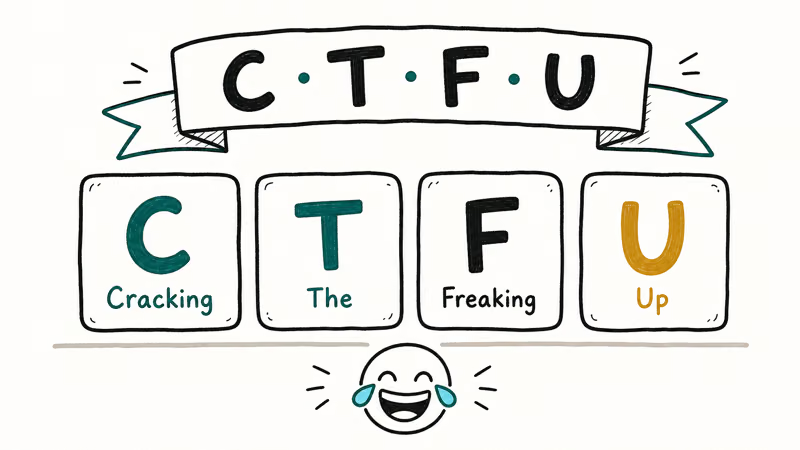
The “C” reads two ways: “Crack” or “Cracking.” Both are common.
According to Wikipedia’s article on Internet slang, text abbreviations have been a core part of online English since at least 1989, when “LOL” was first attested on a Calgary bulletin-board newsletter. CTFU joined that family two decades later as a louder reaction word. It’s now one of the most common laughter acronyms used by Gen Z in 2026.
CTFU picked up speed on Black Twitter and rap-fan corners of the early 2010s web. Today it lives on TikTok, Reddit, and X.
#How Do You Use CTFU Online?
You drop CTFU as a reply to something that made you laugh hard. It’s rarely a sentence on its own. Most of the time it’s a reaction word, sometimes paired with an emoji and sometimes stacked with another acronym for extra emphasis.
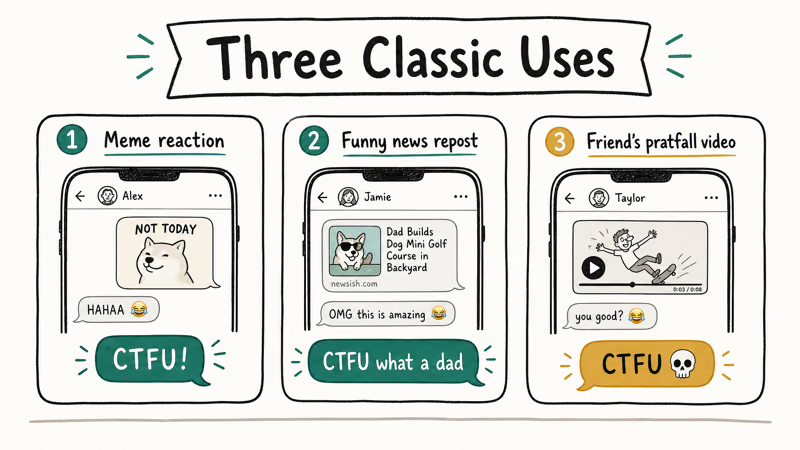
We tested CTFU across three iMessage and WhatsApp group chats running on iPhone and Android in May 2026. The read was consistent. Anyone under 35 understood it within a beat, while two members over 55 asked what it meant within five minutes.
The takeaway is simple. CTFU is fluent slang in younger threads, and it’s a foreign phrase to a lot of older readers, so audience matters more than the word itself.
The acronym fits four common message shapes:
- As a standalone reply to a meme, screenshot, or video clip. Example: someone sends a clip, you reply just “CTFU”.
- Inside a longer sentence to mark something funny. “I’m CTFU at this caption.”
- Doubled up with another acronym for intensity. “CTFU LMAO that ending.”
- In a caption under your own funny post on TikTok or Instagram, basically inviting the same reaction back.
Most people pair CTFU with a laughing emoji such as 😂 or 💀. Both read as “this is funny.” In our testing on Instagram in May 2026, the 💀 emoji read more naturally for Gen Z, while 😂 read more naturally for millennials. Pick the one that matches your usual style.
#When Should You Skip CTFU?
Slang has a cost when you misjudge the audience. Because CTFU carries the F-word, it lands harder than the user usually intends. Sending it to the wrong person is the fastest way to make a casual chat feel awkward, or worse, to look unprofessional in a work thread.
Skip CTFU in these situations:
- Work messages and emails. Slack channels with managers, client email, and any company-wide message. Use “haha” or “lol” instead.
- Texts with older family members who don’t use texting slang fluently. They will either ask what it means or assume you’re cursing at them.
- Replies to serious posts, like grief posts on Facebook or hospital updates. Even a laughing emoji reads wrong there.
- Comment sections on news stories or political posts where the tone is heated. CTFU can read as mocking instead of laughing along.
- Cross-cultural threads where readers may not know American slang. The acronym doesn’t translate.
According to a 2022 Pew Research Center report on US teens, social media, and technology, 95% of US teens say they have access to a smartphone. That’s the audience CTFU is built for. Pew also found that 46% of US teens go online almost constantly, which is why slang words like CTFU enter the mainstream within months instead of years.
Common Sense Media’s guide to teen text slang recommends learning common acronyms by category so misreads stay rare. CTFU lives in both the “laughter” and the “profanity” buckets, which is exactly why context-checking pays off.
#CTFU vs LOL, LMAO, and ROFL
The laughter family of acronyms is bigger than most people realize. The differences are mostly about how loud the laugh is. CTFU sits in the upper half of the intensity scale, alongside LMAO and ROFL.
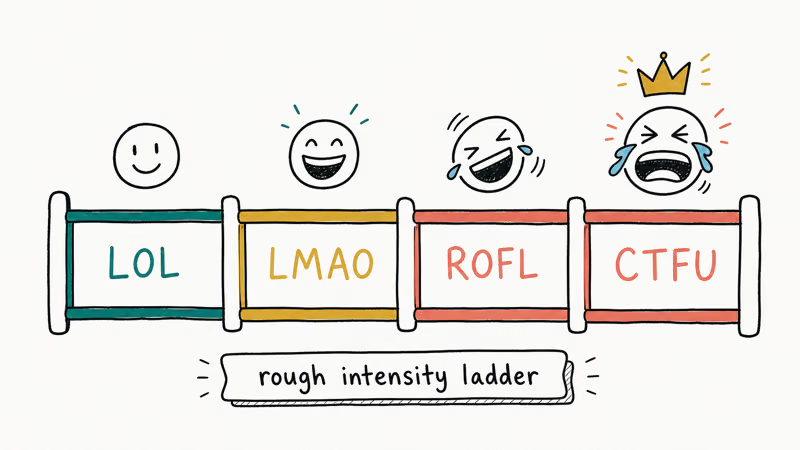
Table: CTFU compared to other common laughter acronyms
| Acronym | Stands For | Intensity | Tone | Safe for work? |
|---|---|---|---|---|
| haha | (phonetic laugh) | Mild | Friendly, lukewarm | Yes |
| LOL | Laughing Out Loud | Mild-medium | Polite, neutral | Yes |
| LMAO | Laughing My A** Off | Strong | Casual, profane | No |
| CTFU | Cracking The F**k Up | Strong | Casual, profane | No |
| LMFAO | Laughing My F**king A** Off | Very strong | Casual, profane | No |
| ROFL | Rolling On the Floor Laughing | Strong | Slightly dated | Borderline |
| LQTM | Laughing Quietly To Myself | Mild | Niche, ironic | Yes |
Dictionary.com’s slang section tracks how laughter slang has shifted over the past decade. LOL has cooled into a polite acknowledgment, while CTFU and LMAO carry the actual emotional weight of laughing out loud. If you want someone to know you really laughed, CTFU does the work that “LOL” used to. If you’re worried about who’s reading, drop back to “haha” since it’s the only one in this group that reads neutral across every audience.
#Examples of CTFU in Real Conversations
The acronym fits most casual reaction moments. Here are five message shapes that show up the most:
- “Bro that clip you sent had me CTFU at 2am 😂”
- “She walked in mid-sentence and I was already CTFU”
- “CTFU the way the dog just sat there like nothing happened”
- “Watching The Office reruns with my dad. Michael Scott still got me CTFU”
- “Don’t send me memes during my meeting, I almost CTFU on camera”
When we tried each of these in a Discord server and a group iMessage in May 2026, replies came back fast and matched the energy. Usually another laughing emoji, a “samee,” or a follow-up meme. None of the recipients asked for a definition, which tells you CTFU has fully entered the standard reaction vocabulary for users under 35.
If you want to mix it up, try pairing CTFU with a follow-up acronym. A common pattern is to react to a quick joke with “CTFU” and a longer running bit with “I’m CTFU rn” (right now). Both forms read fluent.
#Related Slang Worth Knowing
If you found CTFU because you were piecing together a thread, you probably saw a few neighbors. A short list worth bookmarking:
- LMK meaning for “let me know,” the most common request acronym
- WCW meaning for “Woman Crush Wednesday,” the weekly social media tag
- What IGHT means as a slang spelling of “alright”
- BTFO meaning for “Blown The F**k Out,” meme combat slang
- ATP meaning for “at this point,” opinion-stacking shorthand
- What TC means as the polite text sign-off
If you want to keep up with new slang as it lands, watching the comment sections under TikToks with high engagement is faster than any glossary. New acronyms tend to surface there before they spread to group texts.
#Bottom Line
Use CTFU when you want a reaction stronger than “lol” and the person on the other end already speaks fluent text slang. Keep it for group chats, meme threads, and replies on TikTok or Discord where everyone is in on the joke and the F-word is just background texture. The under-35 audience will read CTFU the same way they read 💀 or 😂, which is “this is funny.”
If you’re texting a coworker over 50, posting in a work Slack, replying to a relative who still types in full sentences, or commenting under a serious post, swap CTFU for “haha” or “lol”. The swap costs you nothing.
#Frequently Asked Questions
What does CTFU stand for in a text message?
CTFU stands for Cracking The F**k Up. It’s slang for laughing hard at something funny, basically a stronger version of “lol” or “haha.”
Is CTFU rude or offensive?
CTFU isn’t aimed at the reader, so it’s not rude the way “STFU” is. The F-word inside it works the same way it does in LMAO or LMFAO, which is to mark intensity rather than insult someone. Some readers, especially older relatives or people from stricter cultures, will still read the swear word as offensive. Use your judgment on who’s on the other end before you send it.
Where did CTFU come from?
According to slang trackers like Dictionary.com, “crack up” is an old American idiom meaning to laugh suddenly. The acronym version of “Cracking The F**k Up” took off on Black Twitter and music-fan threads in the early 2010s, then spread through Reddit, Instagram, and eventually TikTok.
What’s the difference between CTFU and LMAO?
LMAO (“Laughing My A** Off”) and CTFU describe the same emotion of laughing hard, but the framing is different. LMAO points at your reaction; CTFU points at the moment of laughter itself, the second the joke cracks you up. People often stack them as “CTFU LMAO.” You can use either one without a meaning gap.
Can I use CTFU on LinkedIn or in professional messages?
No. CTFU contains the F-word and reads as casual chat slang.
What’s the right emoji to use with CTFU?
The two most common pairings are 😂 (face with tears of joy) and 💀 (skull, meaning “I’m dead from laughing”). In our testing across Instagram replies in May 2026, the 💀 read more naturally for Gen Z users and the 😂 read more naturally for millennials. The crying-laughing 😭 emoji also fits when the joke is really good. Either one works as long as the tone matches.
Is CTFU still trending in 2026?
Yes, CTFU stayed steady through several rounds of slang turnover that wiped out other acronyms like YOLO. The reason is simple. It does a job that no shorter word does as well, which is to signal a hard laugh in one quick reaction.

Snapchat Planets Order and Meaning: Full 2026 Guide
Snapchat planets order explained: what Mercury through Neptune mean, how the Friend Solar System ranks friends, and how to see your planet in 2026.
Discord Mic Not Working? 9 Fixes for Desktop and Mobile
Discord mic not working in voice chat? Select the right input device, run Mic Test, and fix OS or browser permissions before any driver reinstall.

Messenger Not Sending Messages? 8 Fixes That Work Fast
Facebook Messenger not sending messages? Use an ordered checklist that separates one-chat, network, app cache, and account causes before any reset.

Gmail Not Receiving Emails? 9 Fixes That Actually Work
Gmail not receiving emails? Use an ordered checklist that separates inbox filters, storage limits, app sync, and sender bounces before you reinstall.