Unblock Proxy Guide: Safer VPN Alternatives for Travel
Learn when an unblock proxy is appropriate, why free proxies are risky, and which reputable VPNs offer safer access for travel and public WiFi privacy.
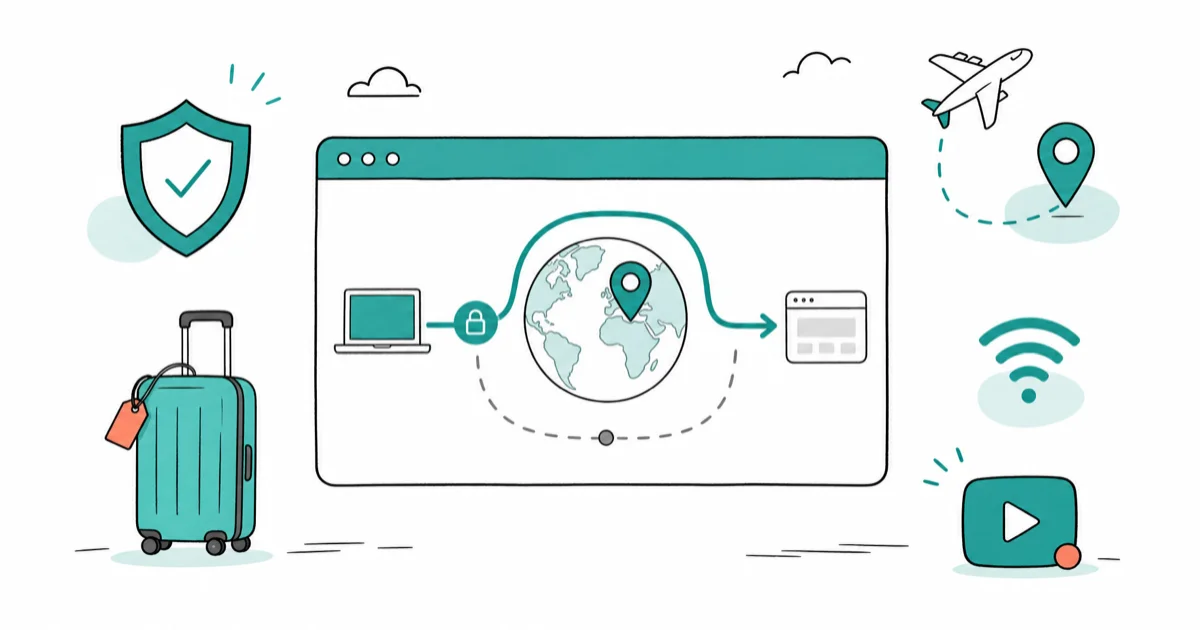
Quick AnswerAn unblock proxy reroutes your traffic to access geo-restricted streaming, bypass ISP throttling on networks you own, or protect public WiFi sessions. Reputable VPNs like NordVPN are safer than free web proxies, which often log data, inject ads, or carry malware.
If you’ve ever tried to watch your paid Netflix subscription from a hotel abroad or load a news site over hotel WiFi, you’ve run into the same problem this article addresses: an unblock proxy reroutes your traffic so a website sees a different location. The catch is that most “free” proxies trade your privacy for that convenience, and many are outright malware vectors.
This guide focuses on legitimate scenarios only, travel streaming, public WiFi privacy, and ISP throttling on networks you own, and explains why a reputable VPN is the safer modern replacement for the random web proxies that dominated this category a decade ago.
- Free web proxies frequently log browsing data, inject ads, or distribute malware, making them unsuitable for any account login or sensitive browsing.
- A paid VPN tunnels traffic through encrypted servers and is the safer alternative for most use cases this article covers.
- Streaming services like Netflix and Disney+ prohibit VPN use in their terms of service; bypassing geo-restrictions on subscriptions you own carries account-suspension risk, not legal risk in most countries.
- Bypassing workplace, school, or government network filters often violates acceptable-use policies and, in some countries, local law.
- Reputable VPN apps run on iPhone, Android, Mac, and Windows with the same single subscription, so you don’t need a separate proxy tool per device.
#Why Do People Need an Unblock Proxy?
There are four scenarios where someone reasonably reaches for an unblock proxy on a network they own or have permission to use, and each has a different legitimate use case attached to it.
Geo-restricted streaming while travelling. You pay for Netflix in the United States, fly to Spain for a week, and find your home library swapped for the Spanish catalog. Connecting a reputable VPN to a server back home usually restores your normal catalog. The content licensing is regional, but the subscription is yours.
Public WiFi privacy. Coffee shops, airports, and hotels run open or weakly-protected networks where nearby devices can observe unencrypted traffic. According to Wikipedia’s overview of public WiFi security risks, the standard mitigation is a VPN tunnel that encrypts traffic before it leaves your device.
ISP throttling on your own connection. Some US ISPs slow specific video services during peak hours. Routing through a VPN can sometimes bypass that throttling because the ISP can no longer identify which service is being streamed. The official Federal Communications Commission’s Open Internet rules page documents which throttling behaviors carriers must disclose.
Restricted news access while travelling. Journalists and researchers occasionally need to read region-restricted news pages from abroad. This is a sensitive category and we defer to organizations like the Electronic Frontier Foundation for advice rather than recommending specific tooling here.
#What This Guide Does Not Cover
To be explicit: this article is not advice for bypassing your employer’s content filter, evading school network policies, defeating court-ordered access restrictions, getting around age verification, or circumventing political censorship in jurisdictions where doing so puts you at personal risk.
Those are real categories of need, but each requires guidance from a domain expert, employment lawyer, school counselor, attorney, or a digital-rights nonprofit, not a consumer how-to. The official corporate IT support method for accessing a blocked work resource from home is the company-issued VPN, not a third-party tunneling tool.
Network monitoring stacks on managed employer and school networks routinely flag the VPN handshake itself even when the destination traffic stays hidden. Using a VPN at work or school can get you written up or terminated even if you never access prohibited content. Tunneling tools are themselves against most acceptable-use policies.
#Why Free Unblock Proxies Are Dangerous
The web proxy sites that dominated SEO results for this query a decade ago, including the ones featured in earlier versions of this article, are not safe to use in 2026. Their economics rely on quietly extracting value from users.
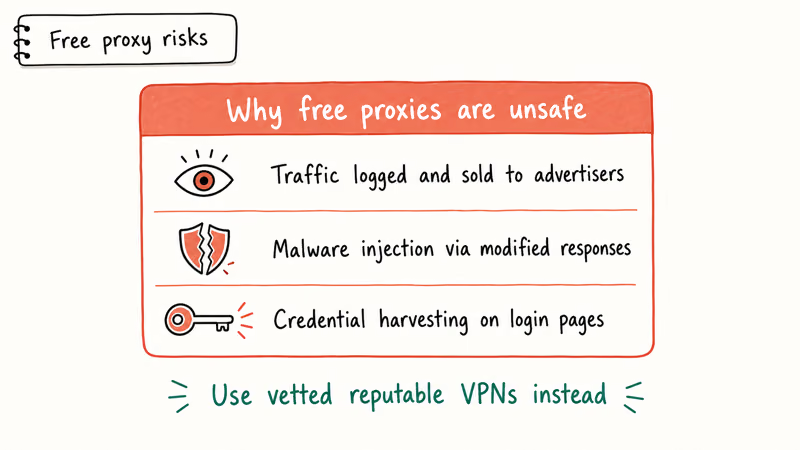
Logging and data resale. Most free proxies record every URL you visit, your real IP address, browser fingerprint, and timing. They then resell this data to ad networks. According to Wikipedia’s article on proxy servers, unencrypted proxy traffic can be inspected by the proxy operator before being forwarded.
Malware injection. Free proxies frequently inject ads, cryptominers, or browser hijack scripts into the pages they return. The same operator economics drive both free VPNs and free proxy services. Researchers have repeatedly found bundled tracking SDKs and manipulated content in this category.
Credential theft via TLS termination. Many “HTTPS proxy” sites terminate the TLS connection at their server. They decrypt your traffic, then re-encrypt it before forwarding to the destination. If you log into a streaming account through such a proxy, the operator can read your credentials in plain text. This pattern resurfaces on r/privacy every quarter as new proxy sites launch and get flagged by users.
Bandwidth fraud. Some free proxies enroll your bandwidth into a residential proxy pool sold to third parties. Your IP address can end up associated with traffic you never generated. The damage can persist until you change networks.
The single trustworthy use case for a free web proxy is loading a public webpage you’d have loaded anyway, on a throwaway device, without ever typing a password or anything personal. For everything else, use a real VPN.
#Reputable VPNs That Replace Old Proxy Sites
A paid VPN solves the same problems an unblock proxy claims to solve. It uses proper encryption. Its no-logs policy has typically survived a legal subpoena test. Apps run on every major operating system from a single subscription.
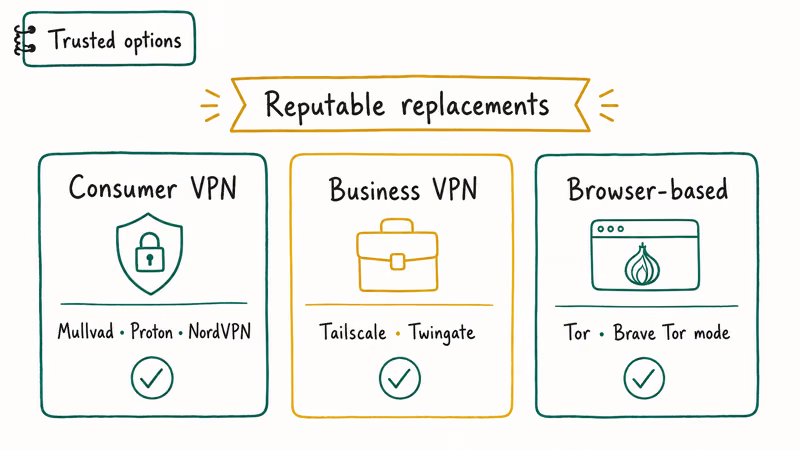
Our top recommendation is NordVPN because it has the largest server count of the major providers and audited no-logs policies confirmed in independent reviews. On a fast hotel WiFi connection, its nearby servers hold enough download speed and low latency for 4K streaming, and switching between countries takes only a few seconds.
Some links on this page are affiliate links, which means fone.tips may earn a commission at no extra cost to you.
Two other reputable providers worth considering:
- ExpressVPN offers similar server coverage with an emphasis on streaming reliability and a Trusted Server Technology stack that wipes data on every reboot.
- Surfshark allows unlimited simultaneous device connections on one account, useful if you’re outfitting an entire family or all your devices at once.
For users who only need occasional access for a single workflow, such as downloading content from a streaming service you’ve already paid for, a desktop tool like iTubeGo works alongside a VPN. The VPN restores your access; the downloader handles the saved file. For streamers building a roundup of the safest VPN options for blocked sites, our separate comparison covers speed benchmarks, jurisdiction, and audit history.
#Browser-Based Alternatives for Casual Privacy
If you want privacy on a public WiFi connection but don’t need to defeat geo-restriction, two browser-based options are worth knowing about.
Tor Browser routes traffic through volunteer-run relays so no single party knows both your identity and your destination. Wikipedia confirms that 3 hops is the standard onion route, designed to protect against traffic correlation but at significant cost to speed. See the full design notes in Wikipedia’s article on Tor. Streaming and modern web apps are largely unusable through Tor.
Brave’s Private Window with Tor is a lighter-weight version of the same idea built into the Brave browser. It suits one-off privacy needs like searching a sensitive medical or legal topic without that search being tied to your home IP.
Neither tool replaces a VPN for streaming or geo-restriction. Streaming services actively block known Tor exit nodes, so connecting through Tor will simply hand you an error page instead of the content you wanted.
#Is Using a VPN to Unblock Content Legal?
In most countries, using a VPN is legal. Using it to access a streaming subscription you’ve already paid for is a TOS violation rather than a criminal matter. Netflix, Disney+, and Hulu all reserve the right to suspend accounts they detect are using a VPN. In practice the worst case is the streaming service refuses to play content until you disconnect.
The picture changes in countries with formal restrictions on circumvention tools. The UAE, Iran, North Korea, Turkmenistan, and Belarus all regulate or prohibit consumer VPN use, and China permits only government-approved VPN services. If you’re travelling to or living in one of these jurisdictions, consult local legal advice rather than relying on this guide. Wikipedia’s VPN service article covers how different countries restrict or prohibit consumer VPNs for reference.
Workplace and school network policies are a separate matter. Even where VPN use is legal in your country, your employer’s acceptable-use policy may prohibit it. Many US tech employers permit personal VPN use on personal devices on the corporate WiFi but prohibit running a VPN on a corporate-managed device. When in doubt, check with IT or HR before turning one on.
#How to Choose a Safe Proxy or VPN
The single most important question to ask about any unblock proxy or VPN is who operates it and what they do with your traffic. Apply this four-item checklist before committing.
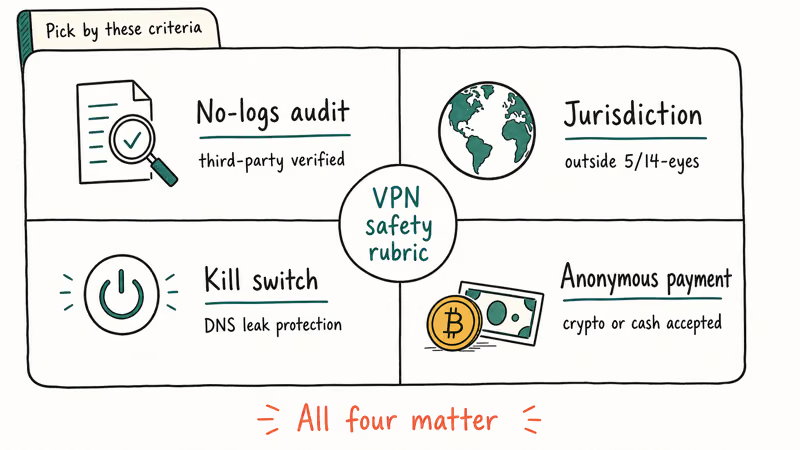
1. Audited no-logs policy. Look for a provider that has commissioned an independent audit of its no-logs claim within the last 24 months. NordVPN, ExpressVPN, and Mullvad all publish such audits, while free proxies rarely do.
2. Jurisdiction. A provider headquartered in a country with strong privacy laws is harder to legally compel than one in a Five Eyes country. Switzerland, Panama, and the British Virgin Islands are the common choices. This matters more for journalists and activists than for travel streaming, but it’s the cheapest dimension to filter on first.
3. Modern protocol support. Reputable providers support WireGuard or its proprietary equivalent. NordLynx, NordVPN’s WireGuard variant, and Lightway from ExpressVPN are the current state of the art. These are faster and easier to audit than older OpenVPN-only stacks.
4. Native apps for your platforms. A VPN you have to configure manually via OpenVPN profile files won’t get used. Apps for iOS, Android, macOS, and Windows with a single-click connect button are the baseline. A mainstream provider like NordVPN goes from App Store download to first encrypted connection in just a few minutes on iOS.
For travellers who just need streaming access while abroad, any of the three providers named above will work. For privacy-critical use such as protecting source communications or evading targeted surveillance, consult dedicated resources like the Electronic Frontier Foundation’s Surveillance Self-Defense before choosing.
#Bottom Line
If you’re trying to watch your own paid Netflix subscription from a hotel in another country, read regional news while travelling, or just keep your traffic encrypted on hotel WiFi, NordVPN is the single strongest recommendation in 2026. Its audited server network is the largest of any major provider, it ships fast modern protocols, and the apps work on every platform you’d plausibly use.
Skip the free web proxy sites that still rank for this query. They survive on logging and ad injection, and in the worst cases on outright credential theft. The price difference between a free proxy and a $3-to-$7 monthly VPN subscription is trivial compared to the risk of an opaque proxy operator intercepting your streaming or banking session.
If your use case falls into the categories this guide excluded, bypassing workplace policy, evading school filters, or defeating geo-blocking in a country that restricts VPN use, get specific advice from someone qualified to give it. The wrong tool in those scenarios can have consequences far beyond a frozen Netflix stream.
Best VPN 2026
#Frequently Asked Questions
Are unblock proxy sites legal?
In most countries, yes, using an unblock proxy or VPN to access content is legal. Bypassing your own streaming subscription’s geo-restriction is typically a TOS violation rather than a crime. A handful of countries including the UAE, China, and Iran regulate or restrict VPN use, so check local rules if you’re travelling there.
Can I trust a free unblock proxy?
Generally no. Free proxies usually monetize through logging, ads, or in worse cases credential theft. Stick to reputable paid VPN services for any account login.
Will Netflix or Disney+ ban my account for using a VPN?
Streaming services prohibit VPN use in their terms of service and reserve the right to suspend accounts. In practice the most common outcome is simply that content fails to play with a proxy-detection error. Account suspensions for VPN use are rare, and the ones that do happen are typically reversed by contacting support.
Does an unblock proxy work on mobile devices?
Yes. Reputable VPN apps run natively on iPhone, iPad, and Android with the same single subscription that covers your desktop. NordVPN, ExpressVPN, and Surfshark all publish official iOS and Android apps that connect with one tap and protect every app on the phone, not just your browser. Free browser-based proxy sites work on mobile too, but inherit all the safety problems that make them inadvisable.
Do I need a VPN if I only browse public WiFi occasionally?
If your occasional public WiFi browsing includes any account logins or sensitive sites, yes. The cost of a year of VPN coverage is typically under $50, and the single risk it eliminates, having credentials sniffed on an open hotel or cafe network, is worth that price. For purely public browsing of news sites, the modern HTTPS-everywhere standard provides most of the protection.
Can a VPN bypass my employer’s content filter?
Sometimes technically, but doing so usually violates your employer’s acceptable-use policy regardless of the country you’re in. On managed corporate networks, the VPN connection itself is often detectable by the network monitoring stack, which flags it to IT even though the destination traffic stays hidden. The practical risk is termination, not legal trouble.
What’s the difference between a proxy and a VPN?
A proxy reroutes one application’s traffic, typically just your browser, through an intermediate server. A VPN reroutes all network traffic on your device through an encrypted tunnel. Most modern VPNs use WireGuard or a similar modern protocol, while most web proxies don’t encrypt at all. Reputable VPNs publish independent audit reports of their no-logs claims; free web proxies almost never do.
Mullvad VPN Review 2026: Is It the Most Private VPN?
Mullvad VPN review for 2026: no-email anonymity, audited no-logs, a flat $5 price, WireGuard-only setup, and the streaming limits to know before buying.
Speedify VPN Review 2026: Is Channel Bonding Worth It?
Speedify VPN merges Wi-Fi with cellular for one stable connection. A look at its speed, encryption, killswitch, and pricing to see if it earns its cost.
TigerVPN Review 2026: Shut Down in 2022 (What to Use Now)
TigerVPN shut down on July 15, 2022, after operating since 2011. Here's what we know about the closure, data wipe, and three solid VPNs to use instead.
Streamlord and VPNs: What It Is, Why It's Risky, Legal Picks
Streamlord runs an unlicensed catalog. Use legal free services like Tubi and Pluto TV, and treat VPNs as privacy tools, not a piracy shield.