Apple Music 'Song Not Available in Your Country' Fix
Apple Music's 'This Song Is Not Currently Available in Your Country or Region' error usually means a licensing change. Here's how to fix it.
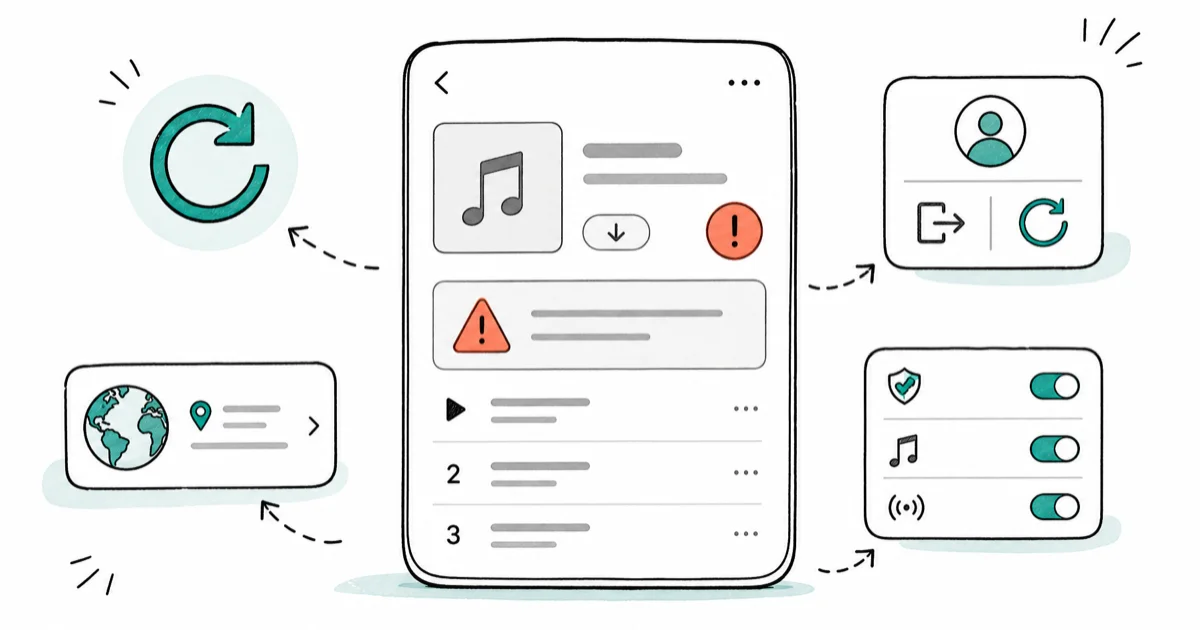
Quick AnswerThe error means Apple Music's licensing for that track does not cover your Apple ID's home country. Reset warnings in the desktop app, sign out and back into your Apple ID, then confirm the song still exists in your region's catalog before considering region changes.
When Apple Music shows “This song is not currently available in your country or region,” the catalog has decided your Apple ID’s home country no longer has streaming rights for that specific track. The error is almost always a licensing signal, not a bug on your phone, but a handful of cache and account fixes do clear it up when the catalog change was a sync glitch instead of a real takedown.
- The error is a licensing flag tied to your Apple ID country, not a hardware fault on your iPhone or Mac.
- Resetting warnings in the desktop Apple Music app and toggling Sync Library clears stale cache states that mimic a real takedown.
- A song removed from your region’s catalog won’t return through troubleshooting, only through a new licensing deal between Apple and the rights holder.
- Changing your Apple ID country is a one-way move that locks you out of your old region’s content and active subscriptions until you change back.
- A VPN keeps your paid home library reachable when you travel, but using one to grab catalog content your country never licensed is a Terms of Service violation.
#Why Does Apple Music Say “Not Currently Available”?
Apple Music negotiates streaming rights one country at a time, so the same track can be live in the United States, missing in Japan, and explicit-only in the United Kingdom. According to Apple’s Media Services Terms, content availability “may vary by country and region” and Apple reserves the right to remove titles “at any time without notice.” When a song falls out of your region’s catalog, the streaming engine surfaces this exact error rather than just hiding the track.
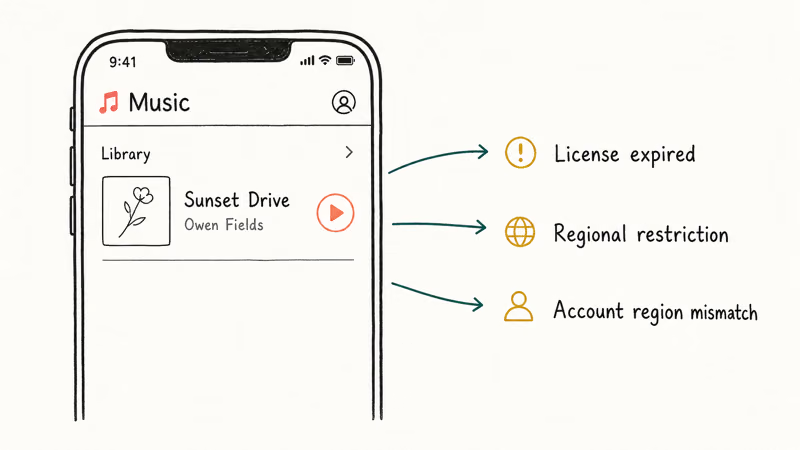
The error fires in three different scenarios, and the fix depends on which one you’re hitting:
- Real catalog change. A label pulled the song from your region. No client-side fix exists; the track is gone until rights are renegotiated.
- Stale cache from a recent sync. The track is still licensed but Apple Music’s local index is showing yesterday’s data.
- Apple ID region mismatch. Your library was built under one Apple ID country and you’ve since moved, or your account was created with the wrong region from day one.
A stale library index can make Apple Music show the country error even when the track is still licensed. Toggling Sync Library forces a fresh account-side sync; if the same track still fails afterward, treat it as a catalog or licensing issue.
#Quick Fixes That Resolve the Error in Minutes
Run these in order before touching your Apple ID region. Most cache-related errors clear inside the first three steps, so resist the urge to skip ahead to a region change just because the song stayed broken after one toggle. The fourth fix below is only worth your time if the first three failed and you have not updated iOS in a few weeks.
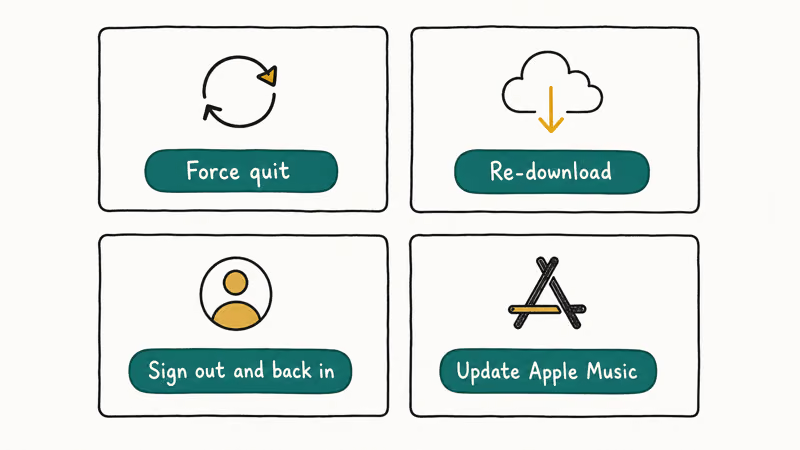
#1. Reset warnings in the desktop app
The desktop Apple Music app caches “unavailable” responses for songs even after the catalog refreshes. Reset the warning store from any Mac or Windows install:
- Open Apple Music (or iTunes on Windows).
- Go to
Music>Settings>Advancedon Mac, orEdit>Preferences>Advancedon Windows. - Click Reset Warnings, then Reset Cache, then OK.
- Quit and relaunch the app, then try the song again from your library.
#2. Toggle Sync Library off and on
Sync Library replays your full library state from Apple’s servers. Forcing a refresh clears mismatched availability flags that linger after a catalog update:
- On iPhone, go to
Settings>Apps>Music. - Toggle Sync Library off and confirm.
- Restart the device with a full power cycle.
- Toggle Sync Library back on and wait for the spinner to finish.
#3. Sign out and back into your Apple ID
Refreshing the account session forces Apple Music to revalidate your country code against the server:
- Go to Settings > [Your Name] >
Media & Purchases>Sign Out. - Restart the device.
- Sign in again with the same Apple ID.
- Open Apple Music and try the track. If you can’t sign in or the option is dimmed, our guide on why Apple ID is grayed out walks through the unlock path.
#4. Update iOS, macOS, and the Music app
Apple ships catalog-handling fixes inside point releases, especially after major iOS launches. Apple’s iOS update support page confirms that running the latest version is the supported state for Apple Music streaming. Check Settings > General > Software Update on iPhone, System Settings > General > Software Update on Mac, and the App Store updates tab on Windows.
#Regional Licensing: The Real Reason Songs Disappear
If the cache fixes don’t work, the song is truly no longer licensed for your country, and no amount of cache-clearing will bring it back. Streaming rights are negotiated separately for each country between Apple and rights holders, and contracts have expiration dates.
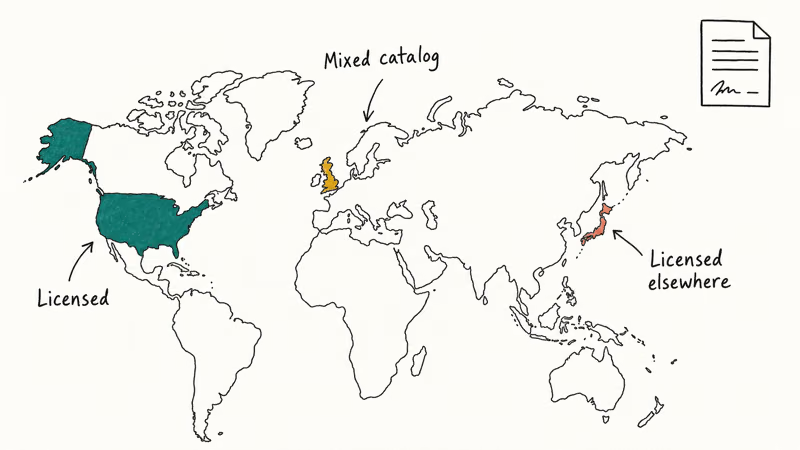
Three things commonly knock a track off your regional catalog:
- Label dispute or label change. When an artist switches labels, the new label may not have a deal with Apple Music in every country yet. Tracks vanish from some regions while staying live in others.
- Re-recorded master. Artists like Taylor Swift have re-recorded older catalog and asked streamers to drop the original masters. The takedown applies country by country as paperwork lands.
- Local content rules. Some countries restrict explicit material, hate speech, or politically sensitive lyrics. Apple geo-fences those tracks rather than refusing to operate in the country.
Apple’s Apple Music product page states that the service hosts more than 100 million songs across its licensed regions, but the published help page on song availability acknowledges that “content available in Apple Music varies by country or region” and that takedowns can happen at any time without warning. A playlist you loved last month can suddenly have grayed-out tracks today.
Hitting the same problem on Spotify? Our Spotify country change guide and location change walkthrough cover it.
#Refresh Your Apple Music Library and System Cache
When the troubleshooting basics fail but you suspect the song is still licensed (a friend in your country can play it, or it shows up in Apple Music search but errors on tap), force a deeper refresh.
#Re-download the track
If the song lives in your library only as offline-cached data, the local file may be referencing an old, now-restricted ID:
- Open the song in your library.
- Tap the more menu (•••), then
Remove>Remove Download. - Tap the cloud icon to redownload from the current catalog.
- If the cloud icon is missing, the track is no longer in your region’s catalog at all.
#Clear the Music app cache (iOS)
iOS doesn’t let you clear an individual app’s cache directly, but offloading the Music app rebuilds it cleanly:
- Go to
Settings>General> iPhone Storage. - Scroll to Music, tap it, then tap Offload App.
- Reinstall it from the App Store. Your library and downloaded music re-sync; previously cached error states don’t.
#Check for an Apple Music outage
Some “not available” errors are platform-side. Visit Apple’s System Status dashboard and look at the Apple Music row. The dashboard tracks more than 50 Apple services in real time and is the only authoritative source for a streaming outage. A yellow or red marker means waiting it out is the fix.
While you wait, our Apple Music keep crashing guide covers app instability, and Apple Music with Chromecast helps if you got here via a casting failure.
#Changing Your Apple ID Region: When It Helps and When It Hurts
Changing your Apple ID country is a real fix for one situation only: you’ve actually moved abroad and your account is still set to the old country. Apple’s official country and region change page recommends this path “only when you have moved to a new country or region permanently.”
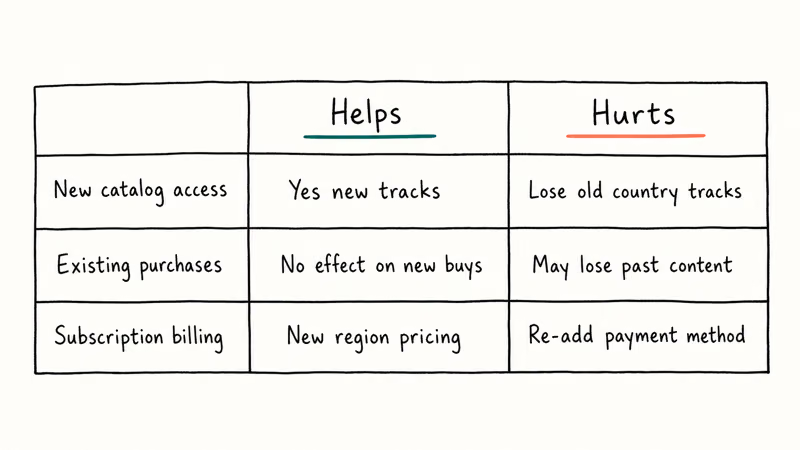
If you live in Toronto and want a track that’s only licensed in Tokyo, this is the wrong tool.
The cost of switching is real:
- You lose access to your current subscriptions until they end or you switch them to the new country’s plan.
- Some purchased content disappears from your library if it isn’t also available in the new region.
- Your payment methods must match the new country. A US credit card can’t fund a Japanese App Store account.
If you’ve actually moved and need to make the change:
- Open Settings > [Your Name] >
Media & Purchases>View Account. - Tap Country/
Region>Change Countryor Region. - Choose your new country, agree to the terms, and add a payment method valid in that country.
A note on the original error: changing the Apple ID country can affect existing subscriptions and force Apple Music to re-index your library. Plan for that refresh when you flip the switch, not in the middle of a commute.
#Are VPNs a Legitimate Workaround?
VPNs have one legitimate Apple Music use case and several illegitimate ones. The honest version is worth spelling out because the wrong choice puts your account at risk.
#When a VPN is the right tool
A VPN is the right tool when you’re traveling outside your home country and want your Apple Music app to keep behaving as if you were home. Apple Music tries to localize on the fly when it detects you’re outside your registered country, which can hide tracks you’ve already paid to access through your home subscription. Connecting to a VPN endpoint in your home country preserves that experience.
For travel use, lean toward privacy-focused providers rather than ad-driven ones:
- ProtonVPN is run by the same Swiss team behind Proton Mail and operates a no-logs policy that has been verified through external audits.
- Mullvad doesn’t require an email address, charges a flat €5 per month, and accepts cash, which is the strictest privacy posture among consumer VPNs.
These two are recommended for travel because they don’t bundle promotional region-shifting marketing into their setup flow. If you’re new to VPNs on iPhone, our explainer on what is VPN on iPhone walks through how the iOS VPN configuration works.
#When a VPN crosses into ToS territory
Using a VPN to access tracks that are not licensed in your country is a Terms of Service violation, regardless of which VPN you use. Apple’s Media Services Terms require subscribers to use the service “only in the geographic location associated with your Apple ID” and warns that misrepresenting your location can result in account suspension.
Three patterns are flagged as misuse:
- Permanently setting your Apple ID region to a country you don’t live in to access a richer catalog.
- Stacking a VPN with a fake billing address to maintain that mismatch.
- Sharing a region-mismatched account across users so multiple people pull from a foreign catalog.
The legal framing is messier than people realize. In most countries, running a VPN is legal, but the streaming use can constitute unauthorized access to copyrighted material that was never licensed in your jurisdiction. That’s a piracy gray area, not a privacy choice. Apple hasn’t pursued individual subscribers in court for this, but it does suspend accounts that show region mismatch patterns, and a suspended Apple ID locks you out of every Apple service, not just Music.
The clean rule: VPN for travel, never for permanent region-shifting. If a track is unavailable in your country and you don’t travel to a country where it’s licensed, the answer is to wait for licensing to change or to buy the track on a different storefront where it’s sold legally.
#Bottom Line
Treat the “not currently available” error as a licensing question first and a device problem second.
Run Reset Warnings, Sync Library toggle, and Apple ID sign-out in that order. These steps cover the common warning-cache, library-sync, and account-session causes before you assume the track is no longer licensed in your country. Changing your Apple ID region is only worth it if you’ve actually moved.
Reach for a VPN for travel only. ProtonVPN and Mullvad are the privacy-respecting picks. Skip the permanent-region-shifting playbook because it risks your entire Apple ID for a few extra tracks.
#Frequently Asked Questions
Why did a song work yesterday but show this error today?
The licensing window for that track ended overnight in your region, or Apple’s catalog refresh dropped the track during a routine sync. Run the Reset Warnings step first; if that fails, the track is truly gone from your country’s catalog.
Will the song come back if I wait?
Sometimes, but the cause determines the timeline. Tracks pulled because of a label dispute can return once the renewed contract is signed and Apple’s catalog ingests the update. Tracks pulled because of artist takedowns or local content restrictions rarely come back unless the underlying legal or commercial situation actually changes.
Is changing my Apple ID region worth it for one missing song?
No. Changing your country forfeits active subscriptions, can erase parts of your purchased library, and requires a payment method valid in the new country. The cost-to-benefit ratio only makes sense if you’ve physically moved.
Does a VPN actually unlock the missing song?
Not reliably. A VPN alone usually isn’t enough because Apple Music checks your Apple ID country, billing address, and SIM card alongside your IP. Stacking workarounds to defeat all three is what tips the use case from “travel” into “ToS violation.”
Can I use a free VPN for this?
Free VPNs typically log your traffic, sell bandwidth to third parties, or fail to spoof location reliably. For the legitimate travel use case, a paid privacy-focused VPN is worth the small monthly cost. Mullvad runs €5 a month flat with no tier-up upsells, and ProtonVPN’s paid Plus tier sits around $10 a month.
Is using a VPN to access region-restricted music illegal?
Running a VPN is legal in most countries, including the US, UK, Canada, Australia, the EU, and Japan. Streaming content the VPN unlocks but your jurisdiction never licensed is a different question: it’s a Terms of Service violation with Apple Music, and depending on local copyright law it can also expose you to civil liability if a rights holder pursues it. In practice the consequence almost everyone hits is account-level: Apple suspends IDs that show repeated region-mismatch patterns.
Why does this error appear on a song I purchased outright in iTunes?
Purchased tracks are tied to the Apple ID region in effect when you bought them. If you changed your country since the purchase, the track may no longer match your current region’s catalog. Switch back to the old country temporarily to redownload, or check the Hidden Purchases list to confirm the track is still associated with your account.
What if I can’t sign out of my Apple ID to refresh the session?
A grayed-out sign-out button usually means a profile or restriction is locking the account. Walk through our Apple ID grayed out guide for the sequence that unlocks it without a full reset.
Apple Siri Settlement: Who Qualifies and How to Claim
Apple's $250 million Siri settlement covers iPhone 15 Pro and iPhone 16 models bought June 2024 to March 2025. See who qualifies and how claims work.
iOS 26.6.1 Security Update: What Apple Fixed and Who Gets It
Apple released iOS 26.6.1 on August 17 with 29 security fixes, including an IPSec interception bug. See what it patches, who gets it, and how to update.
iPhone Adaptive Power: How It Works and When to Use It
Learn how iPhone Adaptive Power works, which models support it, what it changes, and when Low Power Mode is still the better battery-saving choice.
How to Transfer Data to a New iPhone Without iCloud
Move everything to your new iPhone without iCloud: Quick Start device-to-device transfer, wired migration, and encrypted Finder or iTunes backups.