How to Miracast iPhone to Philips TV: 4 Methods (2026)
iPhones don't support Miracast, but you can mirror to a Philips TV using AirPlay 2, MirrorMeister, AirDroid Cast, or a Lightning HDMI adapter.
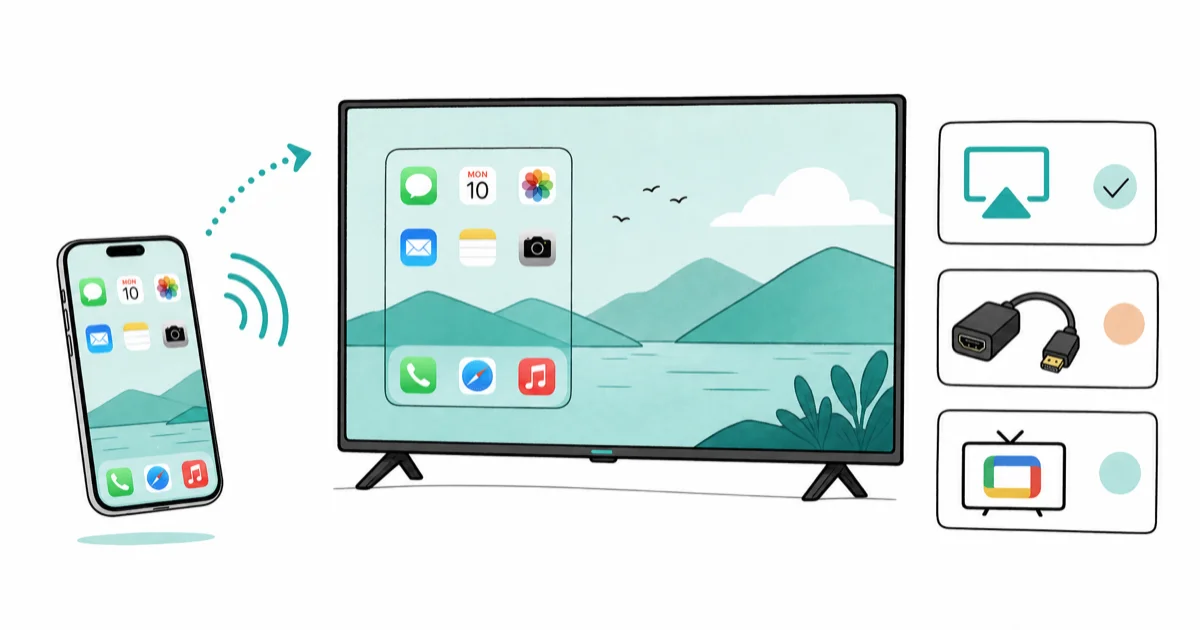
Quick AnsweriPhones don't support Miracast. Use AirPlay 2 on Philips Roku TVs, MirrorMeister or AirDroid Cast on Philips Android and Google TVs, or a Lightning to HDMI adapter for any Philips TV with an HDMI port.
Trying to Miracast your iPhone to a Philips TV runs into a protocol mismatch. iPhones use Apple AirPlay, not Miracast, so some Philips models accept your iPhone directly while others need a third-party app or a wired adapter. This guide maps the practical options by Philips TV platform.
- iPhones use AirPlay, not Miracast, so wireless mirroring to a Philips TV either needs an AirPlay 2-compatible model or a third-party app.
- Philips Roku TVs running Roku OS 9.4 or later support AirPlay 2 natively. You connect through Control Center and Screen Mirroring with no extra app.
- For Philips Android TVs and Google TVs, MirrorMeister and AirDroid Cast give you wireless mirroring at around 720p without modifying the TV.
- A Lightning to HDMI adapter mirrors any Philips TV with an HDMI port at up to 1080p, with no Wi-Fi required.
- Both devices must sit on the same 5 GHz Wi-Fi network for AirPlay 2 to discover the TV. Guest networks and 2.4 GHz often block the handshake.
#Why iPhones Don’t Use Miracast on Philips TVs
Miracast is a wireless display standard built into Android, Windows, and Fire OS devices through the Wi-Fi Alliance. iPhones never adopted it. Apple maintains AirPlay as a separate protocol, and AirPlay handles screen mirroring, audio, and multi-room speaker output in a single stack. Miracast and AirPlay are not interoperable, which is why a Miracast button on a Philips TV remote does nothing for an iPhone.
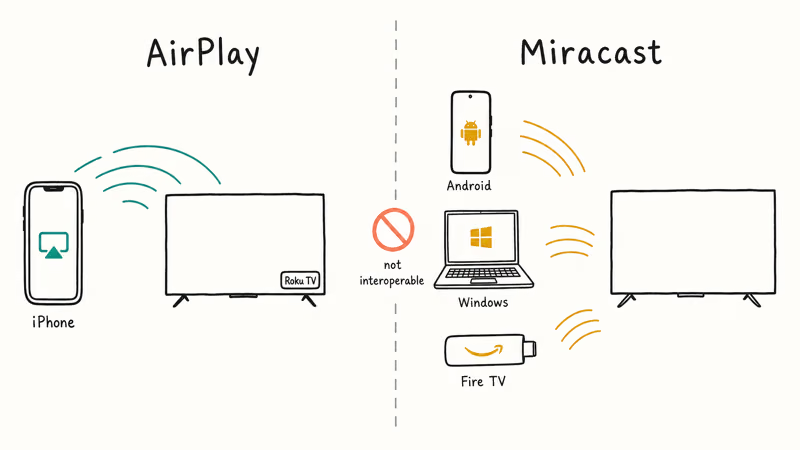
According to Apple’s AirPlay support page, AirPlay 2-compatible TVs from Roku, Samsung, LG, Sony, and other partners let you stream video and screen-share directly from any iPhone running iOS 12.3 or later. Philips lands on that list through its Roku TV partnership.
So here’s the rule.
If your Philips TV runs Roku OS, AirPlay works without extra software. Anything else, including Philips Android TV, Google TV, and the older Linux-based Smart TV generations, needs a different path. For a sense of how the Miracast flow looks on Android, see our Samsung S10 screen mirroring guide.
#How Does AirPlay 2 Work on Philips Roku TVs?
If you bought a Philips Roku TV (50PUL, 55PUL, 65PUL series, sold mostly in North America), you already have AirPlay 2 baked in. Roku’s AirPlay 2 support page states that AirPlay 2 requires Roku OS 9.4 or higher, which Roku rolled out as a free over-the-air update in 2020 to most 4K Roku TVs.
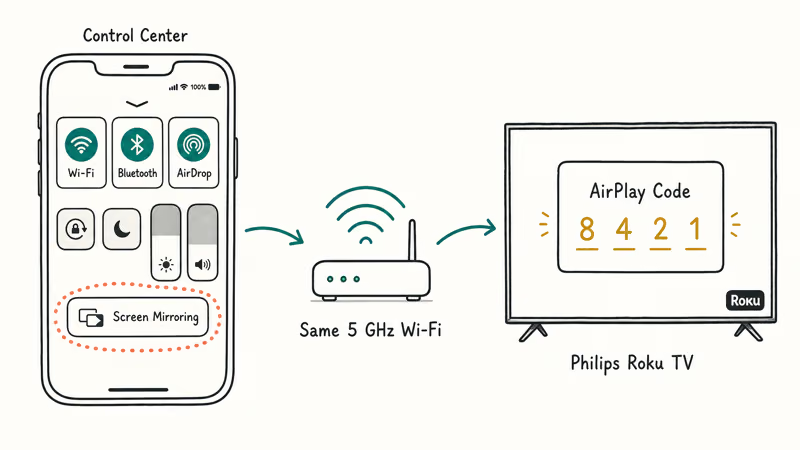
On supported Philips Roku TVs, AirPlay 2 uses the same Screen Mirroring flow built into iOS. The TV shows a passcode on first connection.
To set it up:
- Make sure both devices are on the same 5 GHz Wi-Fi network
- On the Philips Roku TV, go to
Settings>Apple AirPlay and HomeKit>AirPlayand turn it on - On the iPhone, swipe down from the top-right corner to open Control Center
- Tap Screen Mirroring, then select your Philips Roku TV
- Type the passcode shown on the TV (you can switch this to “First time only” later)
If the TV doesn’t appear, Wi-Fi isolation or a guest network is usually the cause. The same fix that resolves iPhone screen mirroring not working on other AirPlay TVs applies here.
#Mirroring to Philips Android and Google TV Models
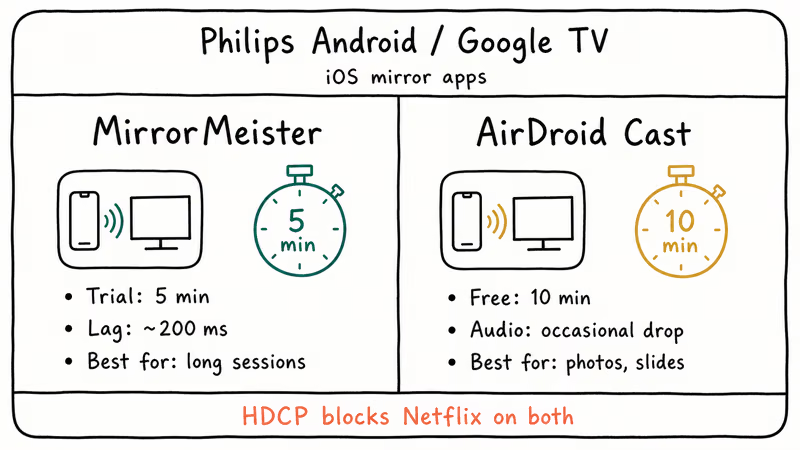
Philips Android TVs (PUS7506, PUS7607, PUS8108) and the newer Google TV variants don’t accept AirPlay. You install a mirroring app on the iPhone that ships with a matching receiver app from the Philips TV’s app store, then pair them over Wi-Fi. Two practical options are available today.
#MirrorMeister
MirrorMeister supports Philips Android TVs and Philips Smart TVs from 2014 onward. Setup is three steps: install MirrorMeister on the iPhone, install the matching receiver app on the TV from Google Play, and pair both over the same Wi-Fi. The free trial gives you about 5 minutes per session before the picture freezes, so plan to test it once before paying for the subscription if you want longer sessions.
MirrorMeister is best for basic screen sharing, photos, documents, and presentations. Streaming Netflix and Disney+ through a wireless mirror can fail.
The block is HDCP, which is normal for any wireless mirroring app on iOS.
#AirDroid Cast
AirDroid Cast covers Philips Android and Google TV models. The free tier limits you to 10 minutes per session over the same Wi-Fi network, and you need a paid plan for longer sessions or for casting over a different network with a connection code.
For static apps such as photos and presentations, AirDroid Cast is a better fit than protected streaming apps or latency-sensitive calls.
For broader options, see our roundup of the best screen mirroring apps for iPhone.
#Wired Mirroring With a Lightning to HDMI Adapter
Wireless mirroring depends on the TV’s Wi-Fi chip and your router. A wired adapter sidesteps both. Apple’s Lightning Digital AV Adapter page says it mirrors an iPhone or iPad screen to a compatible HDMI-equipped display in up to 1080p HD.
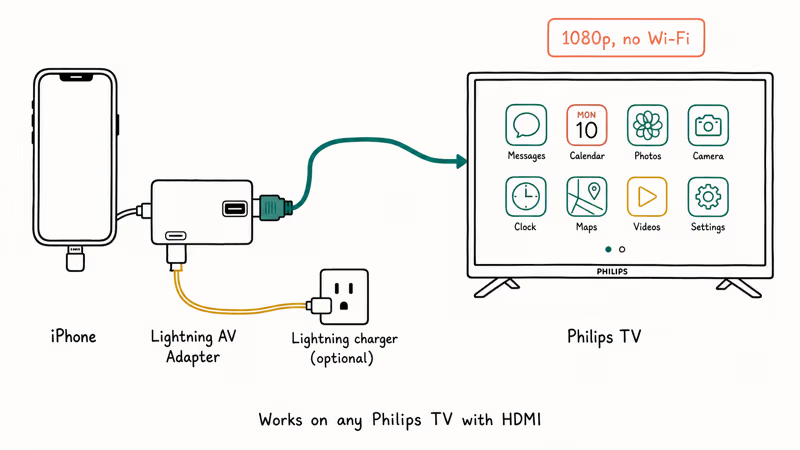
Steps:
- Plug an Apple-certified Lightning to HDMI adapter into the iPhone’s Lightning port
- Run an HDMI cable from the adapter to a free HDMI input on the Philips TV
- (Optional) Plug a Lightning charger into the adapter so the iPhone keeps charging
- On the Philips TV, switch the input to the matching HDMI source
- Your iPhone screen mirrors automatically. No app, no Wi-Fi handshake.
As an Amazon Associate, fone.tips earns from qualifying purchases. Some links on this page are affiliate links.
The wired path is the only method that works for protected video apps (Netflix, HBO Max, Apple TV+) at full resolution because it bypasses the HDCP block that wireless mirroring triggers. It’s also the workaround we cover in our screen mirroring without Wi-Fi guide.
If your iPhone has a USB-C port (iPhone 15 and later), use a USB-C to HDMI adapter instead. Apple’s USB-C Digital AV Adapter, or any MFi-certified equivalent, works the same way and supports HDR pass-through up to 4K SDR or 1080p HDR. Avoid no-name USB-C dongles. They sometimes negotiate USB 2.0 only and the iPhone refuses to mirror because the bandwidth is too low for an HDMI display.
#Why Isn’t My Philips TV Showing in Screen Mirroring?
Two devices on different networks can’t see each other. That’s the most common cause of AirPlay discovery failures. The rest break down like this:
- AirPlay disabled on the TV. Some Philips Roku TVs ship with AirPlay turned off. Go to
Settings>Apple AirPlay and HomeKit>AirPlayand confirm it’s set to On. - Guest Wi-Fi or AP isolation. Many home routers isolate guest networks so devices can’t see each other. Move both the iPhone and TV to the main 5 GHz SSID.
- TV not on the latest Roku OS or Android TV update. AirPlay 2 needs Roku OS 9.4 or higher. Open
Settings>System>Systemupdate and install pending updates. - Bluetooth turned off on the iPhone. AirPlay discovery uses Bluetooth Low Energy on recent iOS. If Bluetooth is off, turn it back on.
- VPN active. Disconnect any iPhone VPN before mirroring.
If the issue persists after that, our broader AirPlay without Wi-Fi guide covers peer-to-peer fallback for situations where the home Wi-Fi itself is the problem.
#Tips for Smoother Mirroring on Philips TVs
- Use 5 GHz Wi-Fi, not 2.4 GHz. Mirroring at 1080p needs strong, low-congestion bandwidth. 2.4 GHz gets crowded fast in apartments.
- Sit the iPhone within 15 feet of the router. AirPlay’s stutter threshold drops sharply past that distance on most consumer routers.
- Close background apps that stream. Spotify, podcasts, or video downloads on the iPhone share the same Wi-Fi pipe and cause lag.
- For Netflix or Disney+, use the TV’s native app. AirPlay and third-party mirrors hit HDCP errors or downscale to 480p. Casting through the streaming app is always smoother.
- Restart the TV’s Wi-Fi if mirroring fails twice in a row. Power-cycling the TV (unplug for 30 seconds) clears stale AirPlay state more often than restarting the iPhone does.
- Pair a mirror app for phone instead of full mirroring if you mostly need photos, slides, or documents. Casting individual content uses less bandwidth than mirroring the whole display.
#Bottom Line
If your Philips TV is a Roku model, set up AirPlay 2 once and forget about it. If it’s a Philips Android or Google TV, AirDroid Cast handles short sessions and MirrorMeister covers longer ones for a small subscription. For everything else, including older Linux-based Philips Smart TVs, an Apple-certified Lightning to HDMI adapter is the cheapest reliable answer at around $40.
iPhone tips & tricks
#Frequently Asked Questions
Can my iPhone use Miracast directly with any Philips TV?
No. iPhones don’t include a Miracast transmitter at the hardware or OS level, and Apple uses AirPlay as the only built-in mirroring protocol. Even Philips TVs that advertise Miracast support can’t pair with iPhones natively. You need AirPlay, a third-party app, or a wired adapter.
Which Philips TV models support AirPlay 2?
Philips Roku TVs running Roku OS 9.4 or higher support AirPlay 2. This includes most 4K Philips Roku TVs sold in North America from the 5000 series upward. The Philips PUS Android TVs sold in Europe don’t include AirPlay 2.
Do I need a smart TV at all to mirror an iPhone to a Philips TV?
No. A Lightning to HDMI adapter plugs into any Philips TV’s HDMI port and works on the most basic Philips models from a decade ago.
Why does AirPlay drop the connection after a few minutes?
The most common cause is the iPhone’s screen turning off, which suspends AirPlay. Set the iPhone to Settings then Display and Brightness then Auto-Lock to “Never” while you’re mirroring. Wi-Fi roaming between bands also breaks the session, so disable “Auto Wi-Fi” on the iPhone and stay on a single 5 GHz SSID.
Can I mirror Netflix from my iPhone to a Philips TV?
Wireless mirroring of Netflix is blocked by HDCP, so AirPlay and third-party apps either show a black screen or downscale heavily. Use the Netflix app installed on the Philips TV directly. If you need to play from the iPhone, only the wired Lightning to HDMI adapter shows full-quality Netflix.
Is MirrorMeister or AirDroid Cast better for Philips Android TV?
It depends on session length. AirDroid Cast wins for short casts. MirrorMeister wins past 10 minutes.
Why does my iPhone screen look stretched on the Philips TV?
The aspect ratios don’t match: iPhones mirror at 19.5
while most TVs are 16, so the picture letterboxes by default. Some apps like YouTube and Apple TV detect this and switch to full-screen on playback, while for other apps you rotate the iPhone to landscape so the picture fills the TV. If the picture looks distorted instead of letterboxed, change the Philips TV picture mode to “Auto” or “Normal” so it stops stretching.
How to Transfer Data to a New iPhone Without iCloud
Move everything to your new iPhone without iCloud: Quick Start device-to-device transfer, wired migration, and encrypted Finder or iTunes backups.
Best Wireless Earbuds for iPhone in 2026: USB-C Era Picks
Best wireless earbuds for iPhone in 2026, comparing AirPods Pro 3, Sony WF-1000XM6, Bose QC Ultra, and Anker Liberty 4 NC on the USB-C iPhone lineup.
iPhone Keyboard Lag? 7 Proven Fixes for iOS 26 (2026)
Fix iPhone keyboard lag with 7 proven fixes for iOS 26. Covers restart, storage, predictive text, third-party keyboards, and dictionary reset.
How to Block Porn on an iPhone: A Guide for Parents
Learn how to block porn on iPhone using Screen Time, DNS filtering, and safe browsers. Step-by-step guide for parents to protect kids' devices.