How to Text Someone Who Blocked You: What Really Works
Texting someone who blocked you on iPhone or Android: what blocking actually does, how to confirm it, and three respectful ways to reach out again.
Quick AnswerYou can't send a normal text to someone who blocked your number, because the message leaves your phone but never reaches theirs. The legitimate options are confirming the block with a few quiet signals, giving the relationship time, and asking a mutual friend to relay one short message if there is a real reason to reconnect.
Trying to text someone who blocked you on an iPhone or Android phone almost always ends the same way: the message leaves your outbox and never reaches their phone. Blocking is a deliberate choice to stop contact, and modern messaging apps respect that choice by silently dropping outbound texts, calls, and FaceTime invites.
This guide explains what blocking actually does at the network level, how to confirm a block, and the respectful ways to reach someone when there’s a real reason to talk.
- Blocked numbers can’t deliver SMS, RCS, iMessage, or FaceTime invites, so the recipient sees nothing and you get no Delivered label.
- Apple doesn’t send a block notification, so the safest confirmation is three signals together: missing Delivered, calls routing to voicemail after one ring, and FaceTime never ringing on their end.
- Spoofing apps, burner SIMs, and duplicate social accounts used to evade a block can violate FCC consumer-protection rules and most state harassment statutes.
- A mutual friend relaying one short, respectful message is the only widely accepted way to communicate after a block.
- Unblocking is controlled entirely by the person who set the block, with no remote override from your side.
#What Happens When Someone Blocks Your Number?
A block is a one-sided filter that runs on the recipient’s device, not on the carrier. When they add your number to their block list, their phone tells the messaging app to discard anything arriving from you. Your phone keeps acting normal because nothing on your side has changed.
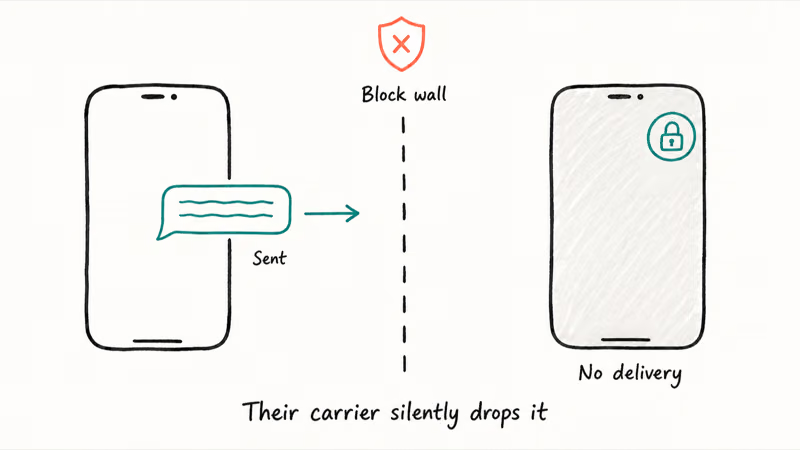
According to Apple’s support page on blocked contacts, blocked iPhone numbers don’t get a “you have been blocked” notice. The system simply stops calls, FaceTime invites, and iMessages from showing up. Your iPhone still sends the message and may keep the blue bubble, but the iMessage server quietly drops it before the recipient sees a banner.
Green-bubble SMS gets filtered the same way at the recipient’s device.
Android behaves similarly. Google’s Messages help center recommends blocking through the conversation menu, and outgoing texts from a blocked number sit on Google’s RCS servers, dropped at delivery time, never surfacing in the Messages inbox.
The result is consistent on both platforms: outbound messages over a multi-day window simply fail to deliver. iMessages stay blue with no Delivered tag, and SMS bubbles leave the phone with no error at all.
So the practical answer to “will my text get there” is no, regardless of platform.
The block sits at the messaging layer, and your phone has no way to override it.
#How Do You Confirm You’ve Actually Been Blocked?
Single signals lie. A missing Delivered label can mean the other person turned off iMessage, has no signal, or is on a flight in airplane mode. To get reliable confirmation, look for three behaviors that line up over a 24-hour window.
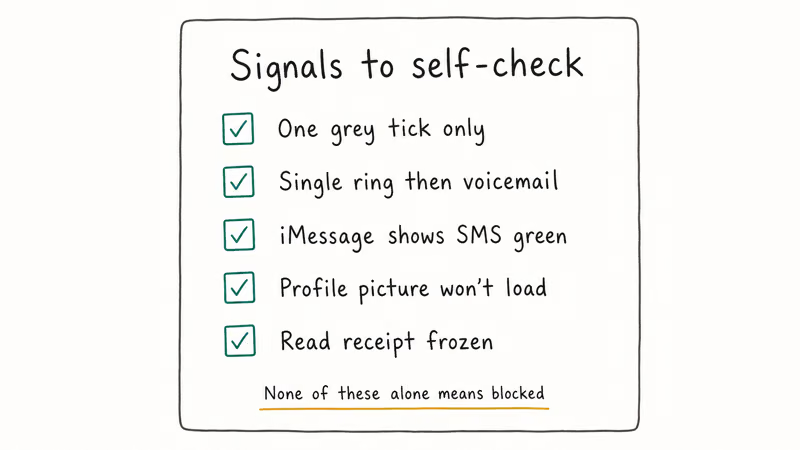
Start with the message status. On iMessage, the bubble stays blue but no Delivered text appears under it. Our guide on what iMessage doesn’t say Delivered actually means walks through the seven non-block reasons that cause the same symptom, which is why this signal alone isn’t enough. On Android, RCS sits on Sent without ever flipping to Delivered, and SMS fallback leaves no error but also no reply.
Next, check the call pattern.
Place a normal call from your number. If it rings once and drops to voicemail every time, then rings a full cycle from a different number, that asymmetry is a strong block indicator. Calls to a phone that’s off or out of service drop straight to voicemail with no ring at all, so the single-ring behavior is the giveaway. Our guide on how to tell if someone blocked your number on Android covers the caller-ID hiding test as well.
Finally, look at FaceTime or app-specific behavior. FaceTime invites to a blocked Apple ID never show “Connecting” on the other side. On Discord, the Clyde bot error and reaction removal pattern is a near-definitive indicator. On Messenger, the sent-but-not-delivered status can mean either a block or a request that landed in the Message Requests folder.
When all three signals line up across a full day, the block is real. If only one does, wait longer before drawing conclusions.
#Why Trying to Bypass a Block Backfires
A block is a consent boundary. Most countries treat repeated attempts to get around one as harassment, not communication. The FCC reported that unwanted text contact is one of the top consumer complaint categories under the Telephone Consumer Protection Act, and the same body of law that targets spam texts also covers spoofed-number messages sent to a recipient who has expressed they don’t want contact.
Practically, the workarounds people Google for fail on their own terms.
Spoofing apps that fake a sending number rarely reach modern carriers. Both Verizon and T-Mobile screen inbound SMS through STIR/SHAKEN attestation, which flags numbers whose caller ID doesn’t match the originating carrier. Even when the message arrives, the recipient sees an unfamiliar number and reads it as a stranger, not a reconciliation.
Burner SIMs and prepaid second lines reach the phone, but the message lands from an unknown number.
The recipient now has clear evidence that you used a second line to evade their block.
In most US states this is exactly what restraining order language describes as “third-party contact,” and judges treat it as a violation. The National Domestic Violence Hotline states that pattern repetition (the same person sending similar messages from different numbers) is the single strongest evidence used in protective-order hearings.
Duplicate social accounts cause the same problem on the social side. Instagram and Snapchat treat alt-account contact after a block as ban-evasion and can suspend both accounts.
The honest answer: no technical method gets you past a block in a way the recipient experiences as legitimate.
They see the workaround. They remember it. The relationship gets harder to repair, not easier.
#Three Respectful Ways to Reach Someone Who Blocked You
If you have a real, specific reason to communicate (a shared possession, a coordination issue with a child, a formal matter), three paths almost everyone accepts:
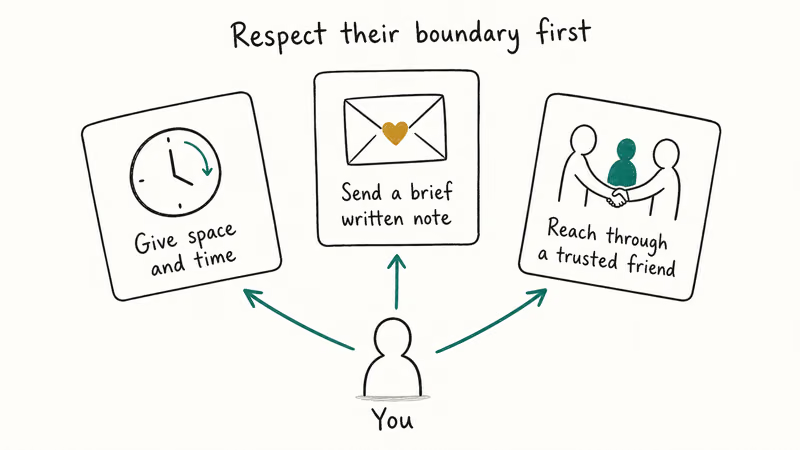
Patience first. Relationships that recover after a block are usually the ones where the blocker re-initiates contact themselves after at least two weeks of total silence.
A block is often issued in the middle of a strong emotional moment, and the person who set it sometimes lifts it on their own once the moment passes. Doing nothing isn’t just acceptable; it’s statistically the most effective option.
A mutual friend, used once. Pick one person who knows both of you and who you trust to deliver a message verbatim. Ask them in advance if they’re willing, and write one short, specific message: the reason, an apology if one is appropriate, and a single question. Don’t send follow-ups through the same friend. This channel only works once.
A formal channel for formal matters. If the contact is about returning property, coordinating around a shared child, or resolving a financial obligation, use email to a non-blocked address, certified mail, or a third-party platform such as a co-parenting app like OurFamilyWizard. The form of the channel signals you’re treating this as a logistics matter, not an attempt to reopen the relationship.
If none of those three paths apply to your situation, the block is doing its intended job and the right move is to stop trying.
#How Blocking Works Across Common Messaging Apps
Each app handles blocking slightly differently, and the differences explain why generic advice fails.
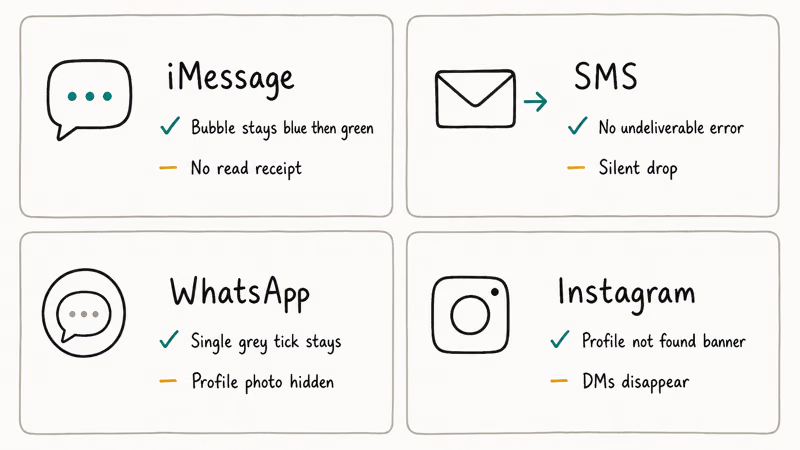
#iMessage and SMS
iMessage drops the message at Apple’s server.
SMS is filtered at the recipient’s device, so your carrier still bills you for the message even though it never displays. The bubble color (blue or green) doesn’t tell you about the block, only about the protocol. If your messages were blue and turn green after a block, see our guide on how to change a text message to iMessage to understand the activation chain.
WhatsApp’s FAQ confirms that a blocked contact sees a single check mark next to outbound messages forever, never the second check, and won’t see profile photo updates or last-seen. Voice calls don’t connect.
WhatsApp doesn’t tell the blocker that you tried; the silence is the entire feedback channel.
#Instagram and Snapchat
Both platforms remove the blocked user from search, hide all profile content, and reject direct messages with no error notice. Creating a new account to send a message to someone who blocked your main account is ban-evasion under both platforms’ Community Standards and risks both accounts.
#Discord
Discord blocks are bidirectional in shared servers: messages from the blocker collapse to a placeholder for you, and your messages to them collapse on their side. The Clyde bot error on direct messages is the cleanest single-app indicator that a block is in place.
#Facebook Messenger
A Messenger block prevents direct messages and voice calls, while you stay visible on Facebook itself because the platform separates social-graph blocking from messaging block.
Messages sent before the block remain in the thread on both sides.
#When You Should Stop Trying and Move On
Sometimes the right answer isn’t “find a better channel.” It’s “stop.”
If you set up the contact, sent a respectful message through a mutual friend, and got no response within two to four weeks, the silence is itself the answer. The same is true if the block followed a conversation about safety, harassment, or abuse: those blocks exist to protect the person who set them. Re-establishing contact happens only with their consent, not workarounds, and bypassing the block is harm rather than communication.
Use the time to decide what you actually want from the relationship. Most people who try repeatedly to text past a block discover later that they weren’t trying to communicate but trying to avoid sitting with the discomfort of the block itself.
#Bottom Line
Treat a Message Not Delivered notice as a clear signal: stop trying to text directly.
Wait at least two weeks of total silence, then decide if there’s something specific enough to ask a mutual friend to relay.
If you ever want to walk it back from your own side, our guide on how to unblock someone on iPhone covers the Settings path. If there’s no specific reason worth a mutual friend’s time, the block is working as intended and the relationship needs space, not workarounds.
#Frequently Asked Questions
Can I text someone who blocked me from a different number?
The text reaches the recipient because the new number isn’t on their block list, but they see an unknown sender and almost always read the message as evasion. In many US states, using a second line to evade a block is treated as third-party contact under harassment statutes. The technical answer is yes, the legal and relational answer is no.
Will my old messages reappear if they unblock me?
No. Messages sent during the block are dropped at the server (iMessage, WhatsApp, RCS) or filtered at the device (SMS) and aren’t stored for later delivery. Unblocking restores future communication only.
Does WhatsApp tell the other person I tried to message them?
WhatsApp doesn’t send a “you tried to message a blocked contact” notification. Your outbound messages sit at one check mark on your end, while their app shows nothing at all.
Can I tell if I was blocked on iMessage or just had a bad signal?
You can’t tell from a single message. The reliable test is to compare three signals over 24 hours: missing Delivered on iMessage, calls going to voicemail after one ring, and FaceTime invites that never show “Connecting.” If a Wi-Fi or cellular issue is the cause, all three recover within a day. A block won’t.
Is it illegal to use a spoofing app to text someone who blocked me?
In the United States, the Truth in Caller ID Act prohibits transmitting misleading caller-ID information with intent to defraud, cause harm, or wrongfully obtain anything of value. Sending text messages with a spoofed number to someone who has blocked you is exactly the use case the law targets, and FCC enforcement actions have resulted in multimillion-dollar fines.
Why does my message say “Delivered” but they never reply?
Delivered just means the message reached the recipient’s device or messaging server. It says nothing about whether they read it or want to respond. A Delivered label with no reply is their choice, not a technical failure.
How long should I wait before reaching out through a mutual friend?
Two weeks of total silence is a reasonable minimum. Anything shorter feels like pressure, and pressure is what got the block in the first place. If the block was issued in the middle of a fight, four weeks gives the situation enough room to cool down.
What should I do if I accidentally text someone who blocked me?
Stop sending. The first message will be filtered silently, but anything that looks like a pattern of repeated contact escalates the situation. If you honestly thought the block was lifted and sent a message in good faith, leave it at that single message and let the silence do its work.
Mac mini M6 vs M5 Pro: Which Model Should You Buy?
Mac mini M6 vs M5 Pro compared on price, memory, ports, displays, and real workloads. Find the better 2026 Mac mini for your desk and budget.
Apple Siri Settlement: Who Qualifies and How to Claim
Apple's $250 million Siri settlement covers iPhone 15 Pro and iPhone 16 models bought June 2024 to March 2025. See who qualifies and how claims work.
iOS 26.6.1 Security Update: What Apple Fixed and Who Gets It
Apple released iOS 26.6.1 on August 17 with 29 security fixes, including an IPSec interception bug. See what it patches, who gets it, and how to update.
iPhone Adaptive Power: How It Works and When to Use It
Learn how iPhone Adaptive Power works, which models support it, what it changes, and when Low Power Mode is still the better battery-saving choice.