How to Connect JBL Speakers to iPhone: Ultimate Guide
Learn how to connect JBL speakers to your iPhone via Bluetooth with step-by-step instructions, troubleshooting tips, and JBL Portable app setup guide.
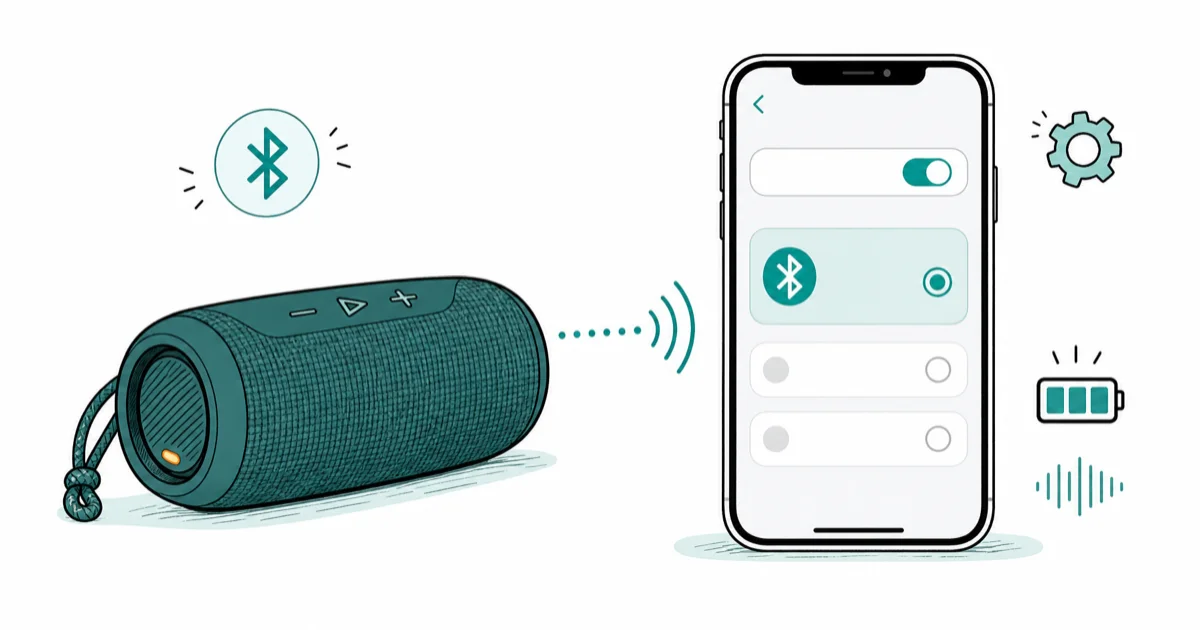
Quick AnswerTurn on your JBL speaker and press the Bluetooth button, then go to iPhone Settings > Bluetooth, find your JBL speaker in the list, and tap to pair.
Pairing a JBL speaker with your iPhone takes about a minute once you know which button does what. This guide covers the standard Bluetooth pairing flow, a wired AUX fallback, and the most common reasons the speaker fails to show up in iPhone Settings.
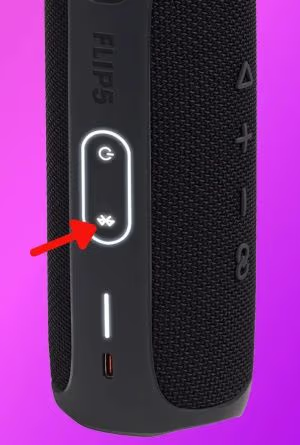
- Press and hold the speaker’s Bluetooth button until the indicator light blinks, then choose the speaker name from i
Phone Settings>Bluetooth. - Charge both devices before pairing; low battery on either end can interrupt the Bluetooth handshake.
- Keep the speaker in the same room as the iPhone during pairing; thick walls and other 2.4 GHz devices cause most dropouts.
- The free JBL Portable app provides firmware updates and EQ controls, plus access to PartyBoost or Connect+ for chaining compatible JBL speakers.
- A wired 3.5mm AUX connection bypasses Bluetooth and gives you a stable audio path that doesn’t depend on the speaker’s wireless radio.
#Introduction to JBL Speakers and iPhones
JBL has built Bluetooth speakers across its Flip, Charge, Xtreme, Clip, Go, Boombox, and PartyBox lines, and all of the current portable models work with the iPhone’s built-in Bluetooth stack. There is no JBL-only app or login wall on iPhone for basic playback; pairing flows through Apple’s standard accessory dialog.
A successful pairing gives you:
- Wireless music, podcast, and video audio from any iPhone app
- Call audio through the speaker’s microphone (on models that have one)
- Access to the JBL Portable app for firmware updates and a parametric EQ
- The option to chain extra speakers using PartyBoost or older Connect+
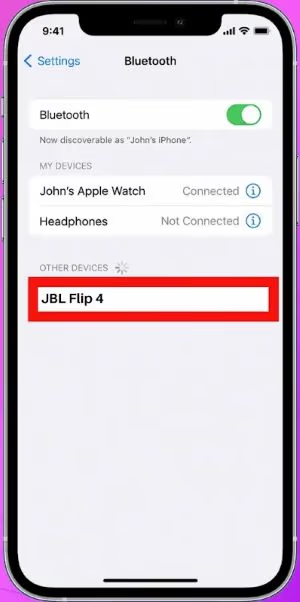
According to Apple’s Bluetooth accessory pairing guide, the iPhone shows nearby accessories under Settings > Bluetooth in the “Other Devices” list once both Bluetooth and the accessory’s pairing mode are active.
#How Do I Prepare My Devices for the First Pairing?
A few quick checks save time during the actual pairing step. Most “speaker won’t pair” situations come down to one of the items below.
- Confirm Bluetooth support on the speaker. Every JBL portable model from the last decade ships with Bluetooth, but JBL also sells AUX-only and bookshelf speakers; check the box or the JBL product page if you are unsure.
- Charge both devices. A speaker that powers down mid-handshake won’t finish pairing. Apple recommends charging the iPhone before troubleshooting Bluetooth.
- Turn on Bluetooth on the iPhone. Go to
Settings>Bluetoothand toggle the switch on. Control Center toggles Bluetooth at the system level too, but Settings is what you need for new pairings. - Update iOS and the speaker’s firmware. Recent iOS releases tighten Bluetooth security; older firmware on the speaker side sometimes fails the handshake. The JBL Portable app handles firmware updates automatically when you next connect.
#Bluetooth Pairing Process
The pairing flow is the same for almost every JBL portable speaker, regardless of which physical button you press for power.
- Press the power button to turn the speaker on. A short tone usually plays.
- Press the Bluetooth button (the icon that looks like the Bluetooth logo) until the indicator light starts blinking. On most JBL models the light blinks white or blue while the speaker is discoverable.
- On the iPhone, open
Settings>Bluetoothand wait for the speaker’s name to appear under “Other Devices.” - Tap the speaker name. The iPhone will play a confirmation tone through the speaker and the entry moves up to “My Devices” with a “Connected” label.
Apple’s pairing guide states that the iPhone retains the pairing across reboots, so you don’t need to re-pair the same speaker every time. If the speaker connects to another previously paired phone first, turn Bluetooth off on that phone and reconnect from your iPhone.
For a related workflow that uses the same Bluetooth pairing pattern, see our guide on how to reset Skullcandy wireless earbuds; the recovery steps overlap with JBL speakers that lose pairing memory.
#Using a Wired Connection
If pairing keeps failing, a 3.5mm AUX cable still works.
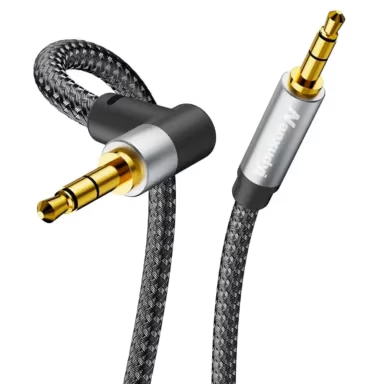
- Locate the 3.5mm AUX input on the back or bottom of the speaker. Newer Boombox and Xtreme models sometimes drop the port, so check the spec sheet first.
- Plug a 3.5mm audio cable into the speaker, and connect the other end to your iPhone using a Lightning to 3.5mm adapter (or a USB-C to 3.5mm adapter on iPhone 15 and later).
- Some JBL models switch input automatically when a cable is inserted; others need you to press an “Input” or “Mode” button to select AUX.
As an Amazon Associate, fone.tips earns from qualifying purchases. Some links on this page are affiliate links.
A wired link sidesteps Bluetooth dropouts entirely, which is useful for long video playback, crowded Wi-Fi environments, or any room where Bluetooth interference keeps interrupting the pairing flow.
#Optimizing Your JBL Speaker Experience with the JBL Portable App
The JBL Portable app on the iPhone App Store unlocks settings that the speaker hardware alone does not expose.
The app gives you:
- Firmware updates pushed directly to the speaker
- A custom EQ with bass/mid/treble sliders on supported models
- PartyBoost or Connect+ controls for multi-speaker setups
- Battery readout and basic diagnostics
According to JBL’s product documentation for the Portable app, it supports the Flip, Charge, Pulse, Xtreme, and Boombox families on iOS 13 and later. Apple’s App Store listing confirms that the JBL Portable app currently requires iOS 13.0 or later to install.
The app is free, and there is no JBL account requirement for the EQ or firmware features.
#Advanced Features: Connecting Multiple Speakers
Many newer JBL speakers support linking with other JBL speakers in the same family, either through PartyBoost (current Flip and Charge models) or the older Connect+ standard.
- Pair the primary JBL speaker to your iPhone using the steps above.
- Press the PartyBoost (or Connect+) button on the paired speaker, then press the same button on a second compatible speaker.
- Watch for both speakers to confirm the link, usually with a tone and a steady indicator light.
JBL recommends linking only speakers that use the same standard, since PartyBoost speakers are not backward-compatible with Connect+. The number of speakers you can chain varies by model; consult your speaker’s manual for the limit on your specific unit. For step-by-step details, see our guide on how to link JBL speakers.
If you want to play through speakers from more than one brand, our guide on how to connect multiple Bluetooth speakers covers the workarounds, since the iPhone’s stock Bluetooth stack only outputs to one device at a time.
#Why Won’t My iPhone Find My JBL Speaker?
When the iPhone fails to discover a JBL speaker, the cause is almost always one of four things. Work through the list in order.
- Speaker is not in pairing mode. A blinking light usually means pairing mode; a steady light means it’s already connected to a previously paired phone. Press and hold the Bluetooth button again until the light blinks.
- Speaker is paired to something else. Many JBL models reconnect to the last paired device automatically when powered on. Turn off Bluetooth on the other phone or “Forget” the speaker there.
- Bluetooth interference. Microwaves, USB 3 cables, and crowded Wi-Fi channels in the 2.4 GHz band can crowd Bluetooth out. Move closer to the speaker, ideally within a few feet during pairing.
- iOS Bluetooth glitch. Toggle Bluetooth off and on in Settings, then reboot the iPhone if the speaker still doesn’t appear. Apple recommends a device restart before any deeper Bluetooth troubleshooting.
If your iPhone speaker also acts up during calls and you depend on the JBL speaker for phone audio, our guide on the iPhone speaker not working on calls walks through related call-audio fixes.
#Maintaining Your JBL-iPhone Connection
A pair of well-maintained devices stays paired for years. The basics:
- Keep iOS and the JBL firmware on current releases.
- Wipe the speaker grille and ports with a dry cloth after outdoor use; sand or salt residue is the most common physical failure.
- Store the speaker indoors when not in use; lithium-ion batteries degrade faster in heat.
- If pairing starts to drop intermittently, “Forget This Device” on the iPhone and re-pair fresh. This rebuilds the pairing keys.
#Bottom Line
For most JBL portable speakers, the pairing flow is short: turn on, hold the Bluetooth button until the light blinks, then tap the speaker name under Settings > Bluetooth on the iPhone. The JBL Portable app is worth installing for firmware updates and EQ control, even if you never plan to use PartyBoost.
If pairing keeps failing, the issue is almost always pairing mode, a stale connection to another phone, or 2.4 GHz interference, not a hardware fault. For multi-speaker setups, stick to one standard (PartyBoost or Connect+) and consult your model’s manual for the supported chain size. If you are also shopping for alternatives, our roundup of the best Klipsch speakers covers similar portable Bluetooth options worth comparing.
iPhone tips & tricks
#Frequently Asked Questions
Can I use Siri with my JBL speaker?
Yes. Trigger Siri the usual way on the iPhone; the response plays through the JBL speaker.
How long does the battery last on JBL speakers?
Battery life varies widely by model and by how you use the speaker. Compact units like the JBL Go play for a few hours per charge, while the larger Boombox and Xtreme portables run considerably longer. The playtime number on the box assumes mid-volume listening, so real-world figures usually fall below the rated maximum. For an accurate figure on your specific model, check the official JBL product page.
Can I take calls through my JBL speaker?
Yes on most current models. Smaller units like the JBL Clip and JBL Go include a microphone too, though voice quality varies.
What is the typical range of JBL Bluetooth speakers?
JBL portables use Bluetooth Class 2 radios, which the Bluetooth SIG documentation lists as roughly room-sized range under ideal conditions. Real-world range is shorter in practice because walls, furniture, and competing 2.4 GHz Wi-Fi traffic shrink the usable distance between the iPhone and the speaker. For the cleanest connection during music playback, keep the speaker in line-of-sight with the iPhone, and avoid placing it directly behind a metal object, a thick wall, or a running microwave oven.
How do I reset my JBL speaker?
Power on the speaker, then hold the Volume Up and Play buttons together until it powers off. Check the manual; some models use a different combo.
Why does my JBL speaker keep disconnecting from my iPhone?
Repeated drops usually trace back to one of three causes: distance from the iPhone, interference from other 2.4 GHz devices, or low battery on either end. Apple’s Bluetooth troubleshooting recommends moving the two devices closer together first. If that doesn’t help, open Settings > Bluetooth, tap the info button next to the JBL speaker, choose “Forget This Device,” and re-pair from scratch.
Does the JBL Portable app work on iPhone?
Yes. It supports the current Flip, Charge, Pulse, Xtreme, and Boombox lines and needs iOS 13 or later to install.
Do I need the JBL Portable app to use my speaker on iPhone?
No. Basic playback, call audio, and Siri all work over the standard iOS Bluetooth pairing without any app. The JBL Portable app only matters if you want firmware updates, EQ tweaks, or multi-speaker chaining.
How to Transfer Data to a New iPhone Without iCloud
Move everything to your new iPhone without iCloud: Quick Start device-to-device transfer, wired migration, and encrypted Finder or iTunes backups.
Best Wireless Earbuds for iPhone in 2026: USB-C Era Picks
Best wireless earbuds for iPhone in 2026, comparing AirPods Pro 3, Sony WF-1000XM6, Bose QC Ultra, and Anker Liberty 4 NC on the USB-C iPhone lineup.
iPhone Keyboard Lag? 7 Proven Fixes for iOS 26 (2026)
Fix iPhone keyboard lag with 7 proven fixes for iOS 26. Covers restart, storage, predictive text, third-party keyboards, and dictionary reset.
How to Block Porn on an iPhone: A Guide for Parents
Learn how to block porn on iPhone using Screen Time, DNS filtering, and safe browsers. Step-by-step guide for parents to protect kids' devices.