Fake Location on WhatsApp: What to Know Before You Spoof GPS
How WhatsApp location sharing works, the legitimate privacy controls you already have, and what GPS spoofing tools on your own device actually do.
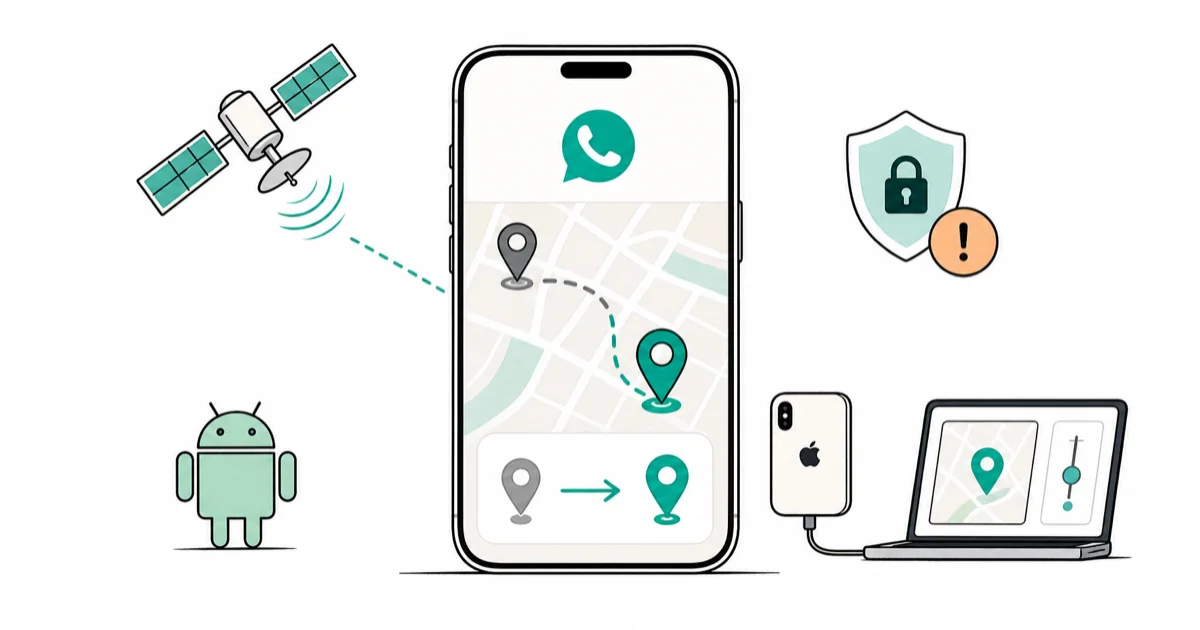
Quick AnswerWhatsApp itself has no built-in fake location feature. On your own Android device, a mock location app plus Developer Options can override system GPS before you share a location; on your own iPhone, a desktop tool like iAnyGo can spoof GPS over USB. Spoofing violates WhatsApp Terms of Service and using it to deceive contacts can carry legal risk, so most users are better off using WhatsApp privacy controls instead.
People search for a fake location on WhatsApp for a lot of reasons, and not all of them are the same. This guide covers what actually works on your own device, why WhatsApp’s built-in privacy controls solve most of the problem, and where GPS spoofing crosses a line you should not cross.
This guide walks through the two most cited iOS and Android workflows and describes what each one actually does, not the marketing copy.
- WhatsApp has no fake location toggle; spoofing happens at the OS GPS level.
- Spoofing to deceive a contact can violate Terms of Service and stalking or fraud laws.
- Three no-install fixes cover most cases: stop Live Location, tighten Privacy, or revoke OS location permission.
- Android spoofing uses Developer Options plus a mock location app; iPhone needs a desktop tool over USB.
- Sudden city jumps and never-drifting Live pins are the tells contacts notice first.
#Does WhatsApp Have a Built-In Fake Location Feature?
No. WhatsApp reads your coordinates from the operating system’s location service, so the app has no “fake location” toggle of its own. On both iOS and Android, the attachment menu only exposes two options, Send your current location and Share live location. Both draw directly from the system GPS, which is why every guide you have read approaches the problem from the OS side.
According to WhatsApp’s Help Center page on sharing location, Live Location shows your real-time position to selected contacts for 15 minutes, 1 hour, or 8 hours before it stops automatically. If you’re trying to avoid a nosy group chat, stopping that timer (or never starting it) is the simplest fix. You don’t need to install anything to stop sharing.
The legal piece matters too. WhatsApp’s Terms of Service state that using the service to mislead others or to circumvent platform measures is prohibited.
Spoofing your GPS on your own device isn’t inherently illegal in most places. Using the result to deceive another person, especially in cases involving custody, employment, or harassment, can attract civil or criminal consequences. This article assumes you’re only spoofing your own phone for privacy, developer testing, or games that allow it, and that any location you share is understood to be fake by the recipient or not directed at a specific individual at all.
#Legitimate Privacy Controls Inside WhatsApp
Before you install anything, check whether WhatsApp’s built-in tools solve your problem. These options are on your account, on your own device, and don’t violate any terms.
#Turn off Live Location and Never Start It
Open any chat, tap the attachment icon, choose Location, and if a Live Location session is running you’ll see a Stop sharing button at the top of the chat. Tapping it ends the stream almost immediately on the recipient side. If you never tap Share live location in the first place, WhatsApp never streams your position to anyone.
#Send a Location You Pick, Not Where You Are
In the same Location picker, WhatsApp shows nearby places and a search bar. Selecting a place card attaches that venue’s coordinates to the message rather than your actual GPS. This is a legitimate feature: you’re sharing a point of interest, not your live position, and it’s often all that a casual “where are you?” question needs.
#Lock Down Who Can See Your Profile Signals
Go to Settings > Privacy and review Last seen and online, Profile photo, About, and Groups. Setting Last seen to My contacts or Nobody stops acquaintances from inferring when you are at work or home based on activity timestamps. This is a privacy win that no spoofing app gives you.
#Revoke Location Permission at the OS Level
On iPhone, go to Settings > Privacy & Security > Location Services > WhatsApp and set access to Never. On Android, go to Settings > Apps > WhatsApp > Permissions > Location and choose Don’t allow. Once revoked, the Location picker still shows nearby places you can share, but WhatsApp can’t read your GPS at all. After revoking the permission, WhatsApp simply greys out the Send your current location option.
If one of these four controls solves your problem, stop here. You don’t need to spoof GPS.
#When Would You Legitimately Spoof GPS on Your Own Device?
GPS spoofing on a device you own has a few narrow legitimate uses. Developers building location-aware apps need to test how an app behaves in Tokyo or São Paulo without flying there. Journalists and activists in hostile environments sometimes need to obscure their home region from metadata leaks.
Games are a different category. Pokémon GO and other location-game communities have long argued over whether in-game spoofing counts as cheating. Niantic’s Trainer Guidelines state that GPS spoofing violates the guidelines and can result in account warnings, temporary suspensions, or termination. If you spoof for a game, know the risk you’re taking.
If you want to change your iPhone’s GPS coordinates for one of these reasons, our change iPhone location without jailbreak walkthrough covers the desktop-tool approach in detail. For Android mock location steps, the allow mock locations guide walks through the Developer Options toggle.
Bumble, Tinder, and Hinge users travelling abroad should read bumble location wrong first, because dating apps have different spoof detection than WhatsApp. Same framing across all those guides: spoof on hardware you own, for a purpose you can justify.
What a fake location does not give you: immunity from the consequences if you use it to trick a specific person. If the recipient relied on the location to make a decision and suffered harm, “I spoofed my GPS” isn’t a legal defense.
#How GPS Spoofing Works on Android (Your Own Phone)
Android is the friendlier platform because Google kept the mock location developer hook alive. You need Developer Options, one app from the Play Store, and about five minutes.
- Open
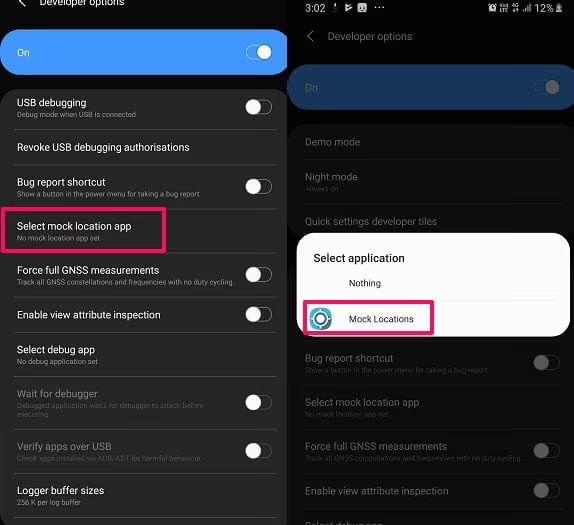
Settings>Aboutphone, scroll to Build number, and tap it seven times. Enter your lock-screen PIN when prompted. Android confirms with a toast that you are now a developer. - Install a mock location app from the Play Store. Mock Locations is the most commonly cited free option and has clear permission scopes.
- Go to
Settings>System>Developeroptions > Select mock location app and choose the app you just installed. Until you pick one here, the app can’t override GPS. - Open the mock location app, search or drop a pin, and tap Play (or the green checkmark, depending on the app) to push that coordinate to the system location service.
- Open WhatsApp, attach Location, and tap Send your current location. The coordinates WhatsApp picks up are now the mock ones.
To go back, open the mock location app and tap Stop, or reopen Developer Options and set Select mock location app back to none. Reboot if the system GPS cache is stubborn.
Two honest caveats. First, games like Pokémon GO use additional checks beyond mock location and will still flag you. Second, some banking and identity apps refuse to run while a mock location app is selected, so pick a phone that isn’t your primary banking device if you do this regularly.
#How GPS Spoofing Works on iPhone (Your Own Phone)
Apple never shipped an iOS equivalent of Android’s Developer Options mock location toggle. As a result, every iOS spoofing workflow runs a desktop app that feeds coordinates to your iPhone over USB. The two tools people ask about most are Tenorshare iAnyGo and Wondershare Dr.Fone Virtual Location.
#Tenorshare iAnyGo
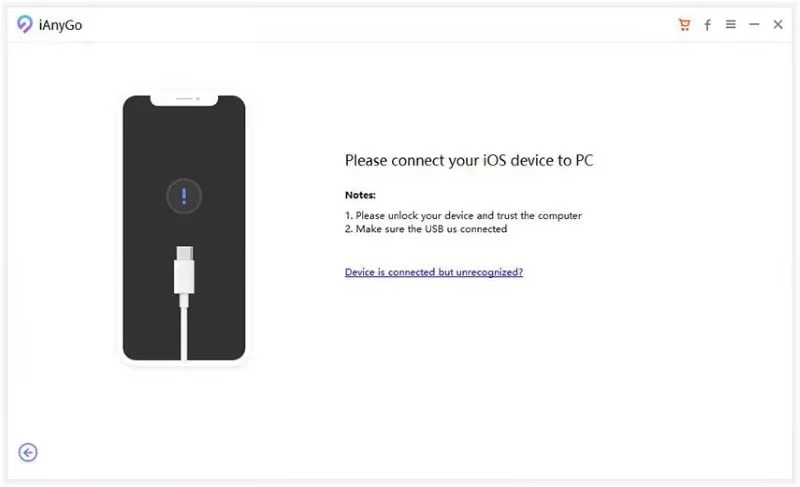
Tenorshare iAnyGo is a desktop utility for macOS and Windows that spoofs iPhone GPS without jailbreaking. The sequence is straightforward:
Some links on this page are affiliate links, which means fone.tips may earn a commission at no extra cost to you.
- Install iAnyGo on your Mac or Windows PC and connect your iPhone using the original Lightning or USB-C cable. Tap Trust this computer and enter your passcode.
- Click Change Location, type a destination (for example, “Shibuya Crossing, Tokyo”), and confirm the coordinates in the preview.
- Click Start to Modify. The iPhone’s Maps, Weather, and every other location-aware app reads the new coordinates until you disconnect or click Stop.
- Open WhatsApp, attach Location, and tap Send your current location. WhatsApp sends the spoofed point.
iAnyGo also has a Multi-Spot Movement mode that simulates a route between waypoints at a chosen speed. This is useful for apps that expect realistic motion, not teleportation. Tenorshare has a free trial with limited sessions; the full version is a paid license.
#Dr.Fone Virtual Location
Dr.Fone Virtual Location is Wondershare’s equivalent and lives inside the broader Dr.Fone toolkit. The workflow is nearly identical: connect the iPhone, launch the Virtual Location module, search for a destination, and click Move Here. Wondershare’s documentation recommends keeping the cable connected for the duration of the session, since disconnecting the phone reverts the coordinates within about half a minute.
Two things to weigh. First, some older write-ups claim Dr.Fone wipes the device. That’s a confusion with the Dr.Fone Data Eraser module, which is a separate product. Virtual Location doesn’t wipe anything, but always back up with iCloud or Finder before running unfamiliar desktop software. Second, iOS version support lags real-world iPhone updates; confirm compatibility on the vendor page before paying.
#What the iPhone Sees After You Disconnect
The spoofed GPS persists only as long as the desktop tool is running and the USB cable is attached. Unplug, reboot, or close the desktop app, and iOS rebuilds the GPS lock from the real antennas within about a minute. This is different from Android, where a running mock location app continues to override GPS even if the phone leaves your desk.
#How WhatsApp Contacts Actually Notice You Faked a Location
Three giveaways stand out.
Impossible movement. If you were pinging “London” at 9
AM and “Tokyo” at 9, any contact who reads the chat timestamps will know. WhatsApp doesn’t display a travel-time warning, but humans spot it immediately.Nearby places mismatch. When you open the Location picker inside WhatsApp, it lists nearby venues based on the OS coordinates. A spoofed coordinate in downtown Paris showing “Starbucks, Seattle, WA” near the top is a tell. Real users rarely see venue lists that feel geographically wrong.
Live Location vs. Current Location mismatch. Live Location streams can’t be convincingly faked for long because the spoofed point doesn’t drift like real GPS does. A contact watching Live Location sees a perfectly still pin for an hour; real phones drift a few meters even when stationary. This is the tell that catches most family disputes around Life360-style expectations imported into WhatsApp.
#Legal and Ethical Guardrails (Read Before Acting)
The policy line most people cross without realizing is consent itself. Spoofing your own iPhone in your own apartment for a game is one kind of act. Sending a spoofed location to a specific individual to make them believe something untrue about where you are is a different kind of act, and in relationship, employment, custody, and commercial contexts it can cross into fraud, stalking, or breach of contract depending on jurisdiction.
The US Federal Trade Commission’s stalking resource warns that location-based deception directed at an intimate partner or family member is a recognized pattern in stalking cases. The Electronic Frontier Foundation confirms that electronic impersonation and location fraud are covered by various state statutes in the US.
Three rules keep you on the right side of all of this:
- Only spoof on hardware registered to you, signed into your own Apple ID or Google account.
- Don’t send a spoofed location to a specific person who would rely on it to make a decision.
- If you use a spoofing tool for a game or developer work, read the platform’s rules first. Niantic, Bumble, and Tinder all enforce bans for spoofing.
#Bottom Line
WhatsApp doesn’t have a fake location button, and the workflows that do exist solve a narrow problem that, for most people asking about it, is better solved by the privacy controls WhatsApp already ships. Before you install iAnyGo, Dr.Fone, or a mock location app on your own phone, turn off Live Location, revoke WhatsApp’s OS-level location permission, and share a picked venue instead of your current GPS. If you still need to spoof for legitimate developer testing on your own Pixel 7 or iPhone 14, or for a location-based game that allows it, Android’s Developer Options plus a Play Store mock app is the cleanest path; on iPhone the only non-jailbreak option is a desktop tool like iAnyGo connected over USB. Either way, never direct a spoofed location at a specific person relying on it, because that is where “I was just messing around” turns into a legal problem.
#Frequently Asked Questions
Is it illegal to fake my location on WhatsApp?
Spoofing GPS on a device you own isn’t inherently illegal in most jurisdictions. Using a spoofed location to deceive another person, especially in custody, employment, stalking, or fraud contexts, can be illegal and has been prosecuted. WhatsApp’s Terms of Service also prohibit using the service to mislead others.
Will WhatsApp detect that I faked my location?
WhatsApp doesn’t currently display a “spoofed” badge on shared locations. Contacts notice through human pattern-matching: impossible jumps between cities, Live Location pins that never drift, or the nearby-places list not matching the claimed coordinates. Automated moderation is more of a concern on linked services like Business catalog and Payments than on standard chat.
Can I use a fake location without installing any app?
On iPhone, no. iOS doesn’t accept mock location apps from the App Store, so you need either a jailbreak (not recommended) or a desktop tool like iAnyGo connected over USB. On Android, you need a Play Store app plus Developer Options enabled. However, WhatsApp itself lets you share any nearby place from the Location picker, which isn’t your real GPS and requires no installation.
Does faking WhatsApp location require jailbreak or root?
Not for the mainstream tools. Tenorshare iAnyGo and Dr.Fone Virtual Location spoof iPhone GPS over USB without jailbreaking. On Android, Developer Options mock location works on stock phones without rooting. Some advanced use cases still require root for system-level GPS overrides that bypass anti-spoof detection, but for standard WhatsApp location sharing, neither jailbreak nor root is needed.
Will banking or government apps still work while spoofing?
Often no. Banking, insurance, and many government apps refuse to run when a mock location app is selected on Android, and some do the same if they detect USB-connected desktop spoofing on iPhone. If you plan to spoof regularly, do it on a secondary phone and keep your primary phone clean for financial apps.
Can I spoof Live Location or only “Current Location”?
Both reflect the underlying OS GPS, so both can be spoofed by the same tools. Live Location is where spoofing falls apart, though, because the pin sits perfectly still for 15 minutes to 8 hours while real phones drift and snap between towers. A contact actively watching a Live Location session will usually suspect something within a few minutes.
How do I go back to my real location after spoofing?
On Android, open the mock location app and tap Stop, then set Select mock location app back to none in Developer Options. Reboot if the cache doesn’t clear. On iPhone, disconnect the USB cable or click Stop inside the desktop spoofing tool; iOS rebuilds the GPS lock from real satellites within about a minute.
Is there any way to check if someone else is faking their location on WhatsApp?
You can’t confirm it from inside WhatsApp, but three patterns are strong evidence: instant jumps between distant cities, a Live Location pin that never drifts, and a claimed location that doesn’t match time-zone cues in the chat (late-night messages from someone who says they’re at work in a different time zone). For situations where the answer matters, ask for a video call instead of relying on location sharing.
Apple Siri Settlement: Who Qualifies and How to Claim
Apple's $250 million Siri settlement covers iPhone 15 Pro and iPhone 16 models bought June 2024 to March 2025. See who qualifies and how claims work.
iOS 26.6.1 Security Update: What Apple Fixed and Who Gets It
Apple released iOS 26.6.1 on August 17 with 29 security fixes, including an IPSec interception bug. See what it patches, who gets it, and how to update.
iPhone Adaptive Power: How It Works and When to Use It
Learn how iPhone Adaptive Power works, which models support it, what it changes, and when Low Power Mode is still the better battery-saving choice.
How to Transfer Data to a New iPhone Without iCloud
Move everything to your new iPhone without iCloud: Quick Start device-to-device transfer, wired migration, and encrypted Finder or iTunes backups.