Best AI Noise Cancelling Earbuds: What Is Real in 2026
The best AI noise cancelling earbuds use real machine learning to adapt their ANC. We sort genuine AI from adaptive marketing across Sony, Bose, and Apple.
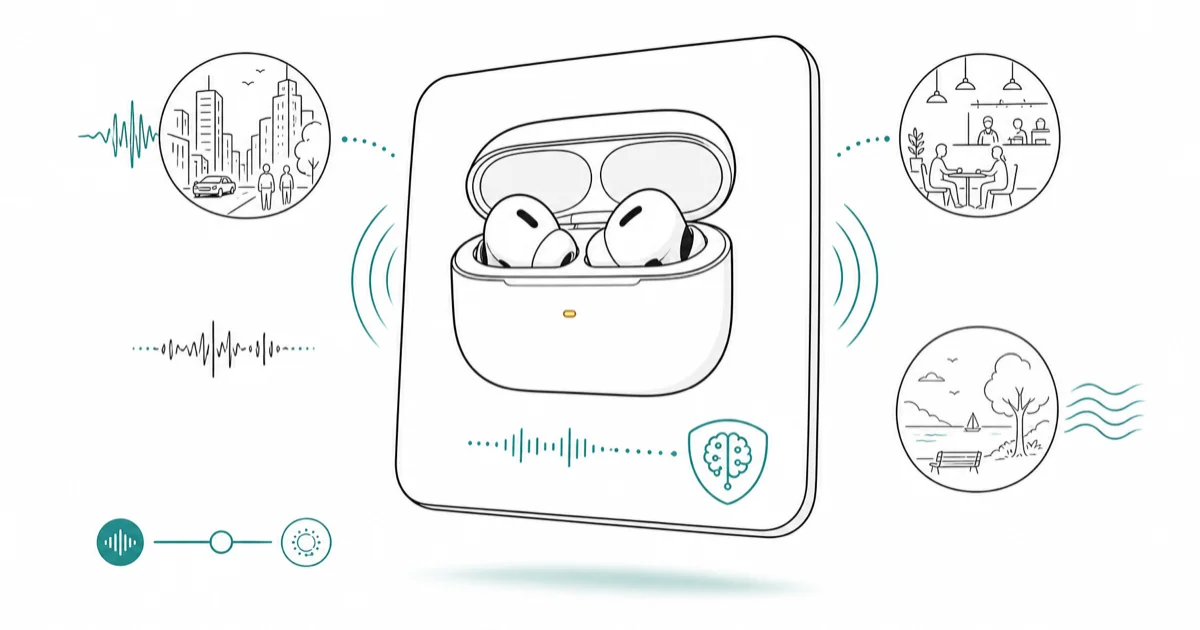
Quick AnswerThe Sony WF-1000XM6 and Bose QuietComfort Ultra Earbuds use genuine AI for their noise cancellation, with processors that adjust ANC in real time. The AirPods Pro 3 add Adaptive Audio that blends ANC and transparency by environment.
The best AI noise cancelling earbuds use real machine learning to adapt their ANC, not just a marketing label. The Sony WF-1000XM6, Bose QuietComfort Ultra Earbuds, and AirPods Pro 3 each take a different approach to changing noise. This guide separates the truly AI-driven cancellation from the “adaptive” branding that gets stuck on every pair of earbuds.
- Sony’s WF-1000XM6 uses the QN3e processor, which Sony says is 3x faster than the QN2e in the previous model.
- Bose officially states its 2nd Gen QC Ultra Earbuds use an AI algorithm for adaptive ANC control.
- AirPods Pro 3 remove up to 2x more noise than the Pro 2, per Apple, with Adaptive Audio blending modes.
- Much “adaptive ANC” is rule-based, not machine learning, so the AI label is often loose.
- For pure quiet, all three are top-tier; the AI mostly helps with sudden noise spikes and calls.
#What Makes Noise Cancellation Actually “AI”?
Genuine AI noise cancellation uses a trained model to predict and adapt the cancellation signal, usually on a dedicated processor. It learns from the sound profile around you and your ear fit, then adjusts faster than a fixed filter could. That’s different from plain ANC, which just generates an opposing wave to a steady drone.
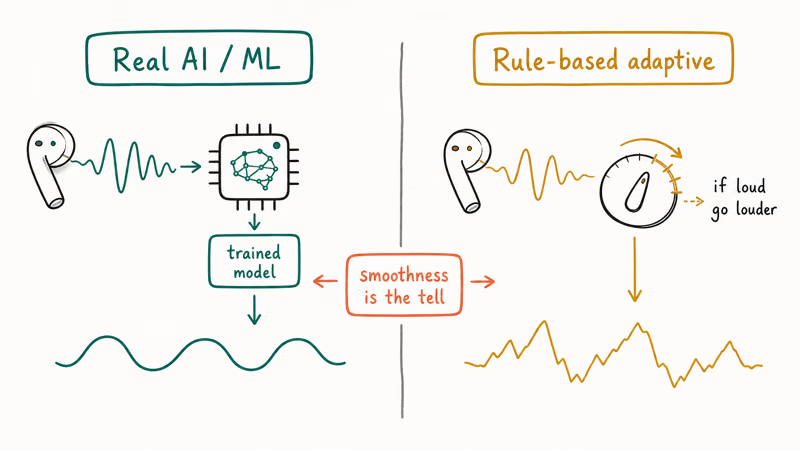
The looser term is “adaptive.” Most flagship earbuds claim adaptive ANC, and a lot of that is just rule-based logic: if the noise is loud, turn cancellation up. That’s smart, but it isn’t always machine learning.
Here’s the honest read. The line between a clever algorithm and “AI” is blurry, and brands lean on the AI label because it sells, but what actually matters for your ears is whether the buds react quickly and smoothly to a slamming door or a passing bus, holding the cancellation steady through the spike instead of letting the noise punch through before the filter catches up.
What matters most is how cleanly each pair handles sudden noise peaks. Steady cancellation is solved. The intelligence shows up in the transitions.
#Sony WF-1000XM6: The Strongest AI Processing Case
Sony makes the clearest real-AI claim of the three. According to Sony’s WF-1000XM6 launch announcement, the new HD Noise Cancelling Processor QN3e is 3x faster than the QN2e in the WF-1000XM5, paired with an Adaptive Noise Canceling Optimizer that analyzes external noise and your wearing conditions in real time.
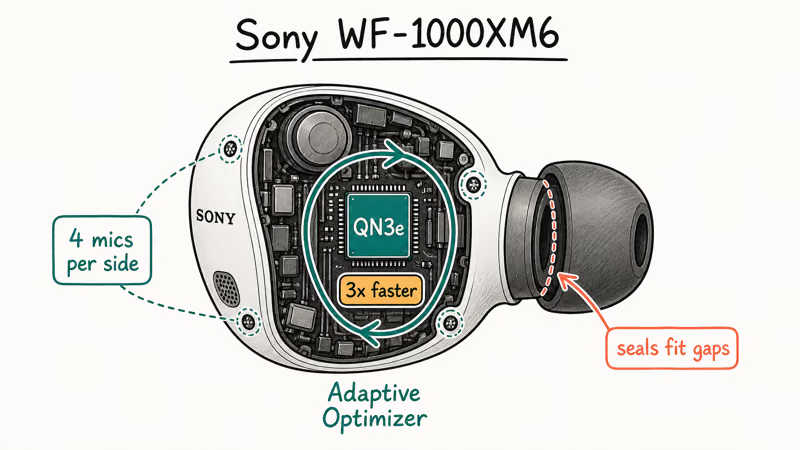
That real-time analysis is the AI part. The optimizer adapts cancellation to your ear shape and fit, reducing sound that leaks through gaps between the tips and your ear canal. Sony puts four microphones on each earbud and claims a 25% noise reduction improvement over the XM5.
The AI shows up most on calls. The WF-1000XM6’s AI call processing is designed to keep your voice clear in wind and crowds, where cheaper buds let more background noise through.
Sony keeps its older smart features too, like Speak-to-Chat and Adaptive Sound Control. The newer SoundGuys review confirms that the optimizer adapted quickly moving from a quiet office to a noisy subway platform. For raw ANC plus credible AI processing, this is the pick.

- Best-in-class ANC for flights and open-plan offices
- 12-hour bud life is unusually long at the flagship tier
- Multipoint pairs to phone + laptop simultaneously
Last updated on Jul 3, 2026
As an Amazon Associate fone.tips earns from qualifying purchases. Prices and availability on Amazon are accurate as of the date above and subject to change.
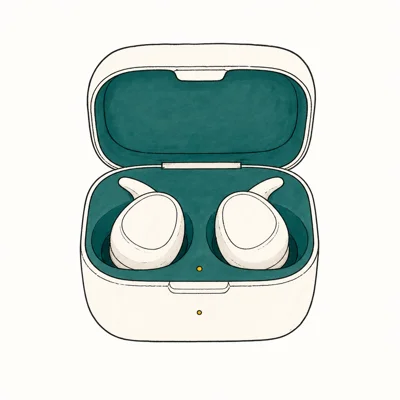
#Bose QuietComfort Ultra Earbuds: AI for Smoother ANC
Bose is unusually direct about the AI in its 2nd Gen earbuds. The company states the latest QuietComfort Ultra Earbuds use an AI algorithm for adaptive ANC control, as noted on its official product page, designed to suppress sudden noise peaks more smoothly than the first generation.
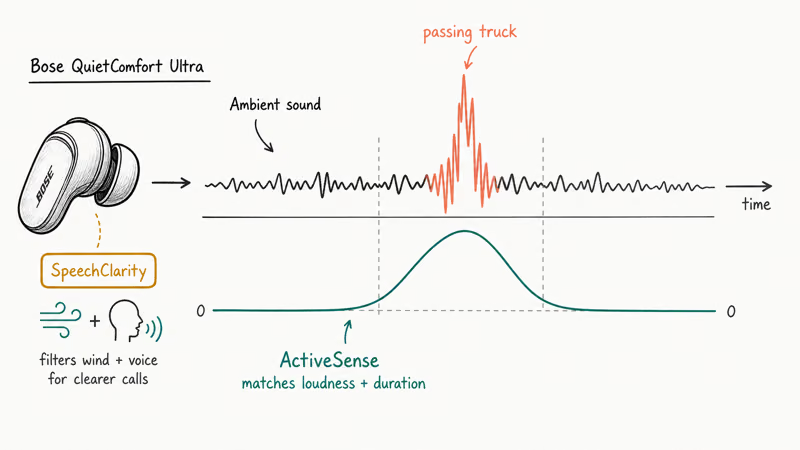
The feature is called ActiveSense. It listens for loud environmental sounds and applies cancellation matched to both the loudness and duration of what it hears, so a coffee grinder or a passing truck doesn’t drown your music. This generation makes the level changes less noticeable, so the whole thing feels less twitchy than before, and that smoothness is the single most convincing argument for calling Bose’s adaptive control truly intelligent rather than a marketing flourish.
There’s a second AI layer for calls. Bose added SpeechClarity, which it describes as using hearing-aid-inspired AI algorithms to filter wind and surroundings. That’s the headline upgrade over the original.
Be realistic about scope, though. The core ANC hardware and CustomTune personalization carry over from the first generation, and the call improvement is modest rather than dramatic, so the AI here refines an already excellent ANC platform rather than reinventing it, which is exactly what you’d expect from a mid-cycle hardware update rather than a clean-sheet redesign of the whole earbud.
- ANC matches Sony XM6 in cabin / subway use
- Immersive Audio mode beats Apple's spatial implementation
- Stability bands ship in the box — secure fit for running
Last updated on Jul 3, 2026
As an Amazon Associate fone.tips earns from qualifying purchases. Prices and availability on Amazon are accurate as of the date above and subject to change.
#Are the AirPods Pro 3 AI Noise Cancelling?
Apple uses “Adaptive Audio” rather than a hard AI claim, and that’s the more honest framing. According to Apple’s AirPods Pro 3 newsroom post, the buds deliver the best in-ear ANC Apple has shipped, removing up to 2x more noise than the Pro 2 and 4x more than the original AirPods Pro.
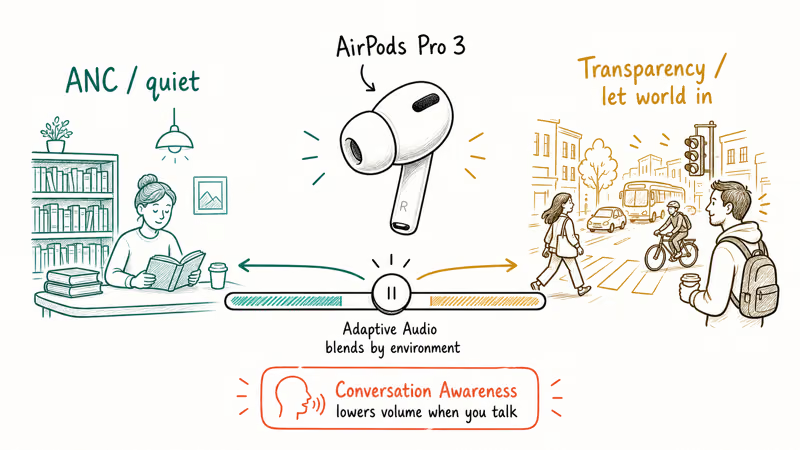
Adaptive Audio is the intelligent layer. It blends ANC and Transparency based on your environment, and Conversation Awareness lowers your volume when you start talking. The buds decide how much of the world to let in without you tapping anything.
The newer model also leans on computational audio for its Live Translation feature, which uses ANC to lower the other speaker’s volume so the translated speech is easier to follow. It’s a clearer example of processing doing real work in your ears than the broad ANC label alone, because you can hear the system actively reshaping the soundstage around the voice it wants you to focus on rather than just dampening everything equally.
For iPhone users, this is the easy pick. The cancellation is class-leading, the adaptive behavior is smooth, and it ties into the rest of the Apple system. Just know that Apple’s restraint with the word “AI” doesn’t mean the buds are less capable, it means the marketing is more careful than Sony’s or Bose’s.

- Tightest iPhone / Apple Watch / Mac handoff of any earbuds
- Heart rate sensor doubles as a workout tracker
- Live Translation runs on-device — no Pro subscription required
Last updated on Jul 3, 2026
As an Amazon Associate fone.tips earns from qualifying purchases. Prices and availability on Amazon are accurate as of the date above and subject to change.
#Adaptive ANC vs Real Machine Learning
This is the distinction the marketing blurs. Adaptive ANC adjusts cancellation based on simple triggers, like ramping up when noise gets loud. It’s reactive and rule-based.
Machine-learning ANC, by contrast, runs a trained model that predicts the right cancellation for the specific sound and your specific ear, often on a dedicated chip. Sony’s QN3e and Bose’s stated AI algorithm sit closer to this end. The difference you can hear is smoothness: ML systems tend to transition between noise levels without the audible “pumping” that older adaptive modes produced when a bus rolled past.
For most buyers it doesn’t change the shopping decision, because all three top pairs are excellent. But it does mean you should treat “AI” on a cheap pair of earbuds with suspicion. A real ML pipeline needs the silicon to run it, and budget buds rarely have it.
#How to Choose Without Falling for the Marketing
Ignore the AI badge and judge the behavior. Every flagship here cancels steady noise well. The real test is how fast and how smoothly the buds react when noise spikes, and whether your voice survives on a call in wind. Those are the things you’ll actually notice on a commute.
Match the buds to your phone too. The AirPods Pro 3 only show their full hand on an iPhone, while Sony and Bose work the same on Android or iOS.
Then think about what else you do with them. If gaming or low-latency audio matters, Sony’s LE Audio support is the edge, and our guide to the best wireless gaming headset covers full-size options if earbuds aren’t your thing and you’d rather have a boom mic, bigger drivers, and a dedicated dongle for your console or PC.
Budget changes the math. The best Bluetooth headphones under 100 roundup has solid ANC for far less, just without the top-tier AI processing, and the best cheap wireless earbuds guide goes even lower.
Want the hands-free assistant side too? Our roundup of the best earbuds with an AI assistant covers Gemini, Siri, and Galaxy AI.
One last note for the AI-curious. The intelligence in these earbuds runs on small dedicated chips and your phone, not a large model like the ones you’d use for work. If that side of AI interests you, our breakdown of the best AI for coding covers the heavier tools.
#Bottom Line
Buy the Sony WF-1000XM6 for the strongest case for real AI processing, the cleanest call quality in wind, and top ANC on any phone. Pick the Bose QuietComfort Ultra Earbuds for Bose’s signature comfort plus a smoother, AI-tuned ActiveSense that handles sudden noise without the twitchiness. Choose the AirPods Pro 3 if you own an iPhone and want class-leading cancellation with Adaptive Audio.
All three are excellent. The AI mostly decides how gracefully they handle the chaos, not whether they go quiet.
#Frequently Asked Questions
Is AI noise cancellation better than regular ANC?
Sometimes. AI systems react faster to sudden noise spikes and adjust to your ear fit, but for a steady drone like a plane cabin, ordinary ANC already does the job.
Which earbuds have the most genuine AI noise cancellation?
Among these three, Sony and Bose make the most concrete claims. Sony cites a QN3e processor that analyzes noise and fit in real time. Bose explicitly says its 2nd Gen earbuds use an AI algorithm for adaptive ANC, which is rare candor from a brand. Apple uses “Adaptive Audio” instead of an AI label, but the underlying processing is similar in effect, so the difference is more about marketing language than capability.
Does AI noise cancellation drain the battery?
Yes, a little. The processing and extra mic work pull more power than plain playback, but the hit is modest and all three pairs last several hours of ANC listening per charge.
Do these AI earbuds need an app to work?
The core ANC works out of the box, but the apps unlock the adaptive features. Sony’s Sound Connect app controls Adaptive Sound Control and Speak-to-Chat, while Bose’s app manages ActiveSense. You can run the earbuds app-free, but you’d be leaving the smarter behavior switched off, and on the Sony pair you’d also miss the EQ and Scene-Based Listening tuning that make the buds feel personalized.
Will AI noise cancellation work on phone calls?
That’s where it helps most. Sony uses AI-powered noise reduction with beamforming mics, and Bose’s SpeechClarity isolates your voice with hearing-aid-inspired algorithms.
Are AirPods Pro 3 good for Android users?
They work on Android for basic playback and ANC, but you lose the features that make them special. Adaptive Audio, Conversation Awareness, and Live Translation are all tied to the iPhone and Apple Intelligence. If you’re on Android and want top AI-driven cancellation, the Sony or Bose pairs are the better buy, since both behave identically regardless of which phone you connect them to.
Can noise cancelling earbuds completely block all sound?
No. ANC is strongest against low, constant noise and weaker against sudden high-pitched sounds like voices. Even the best AI cancellation reduces rather than erases the world, and a snug ear tip seal does as much of the heavy lifting as the chip inside.
Pixel 11 vs Pixel 10: What Changed and Who Should Upgrade
Pixel 11 vs Pixel 10: same screen and camera resolution, new Tensor G6, 25W wireless, and Gemini Intelligence. Here is who should actually upgrade.
Best Power Bank for iPad in 2026: Pro, Air, and Mini
Best power bank for iPad in 2026. Compare mAh tiers and USB-C PD wattage for iPad Pro, Air, and mini, plus airline Wh math, cables, and travel tips.
Best Power Bank With Built-In Cable: Top 2026 Picks
Best power bank with built-in cable picks for 2026. Compare single USB-C, multi-connector, and retractable laptop banks, plus airline Wh math.
Best Apple Watch Band for Working Out: Proven Picks
The best Apple Watch band for working out handles sweat and stays put on your wrist. Compare silicone, nylon, and titanium picks for runs and lifts.