How to Transfer WhatsApp from Xiaomi to Huawei (2026 Guide)
Transfer WhatsApp from Xiaomi to Huawei using Google Drive backup, iCareFone Transfer, or local storage methods to keep all your chats safe.
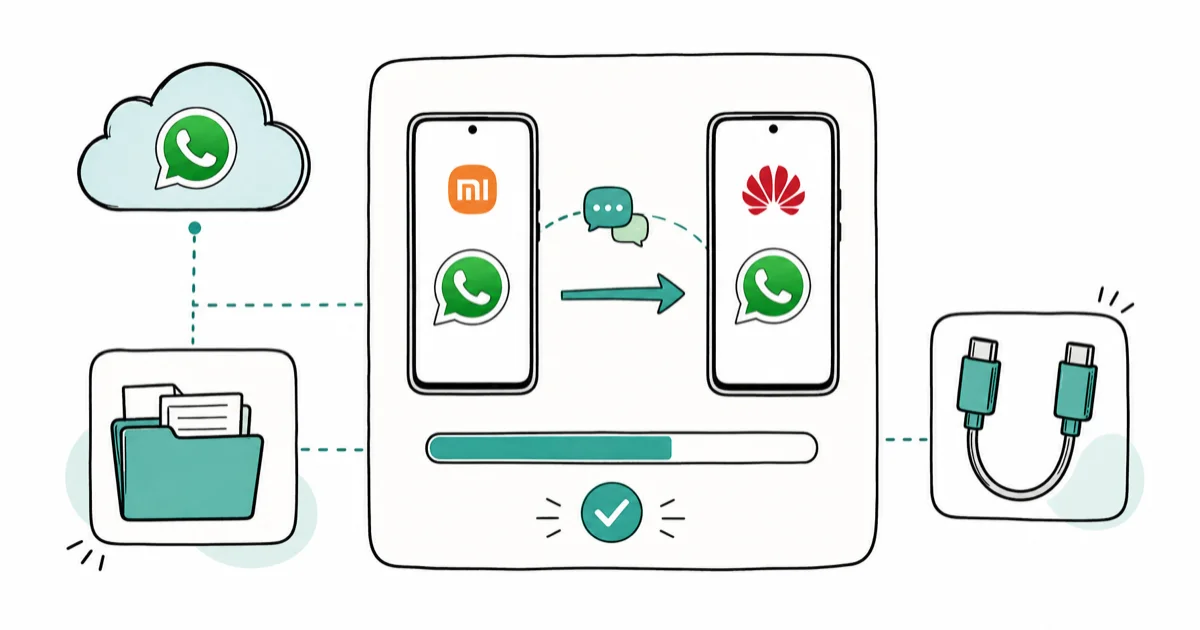
Quick AnswerUse Google Drive backup to restore WhatsApp on your Huawei, or use iCareFone Transfer for a direct device-to-device WhatsApp migration from Xiaomi.
Switching from a Xiaomi handset to a Huawei phone usually means rebuilding your WhatsApp history on the new device, because Android doesn’t sync chats to the cloud automatically. This guide walks through every official path, plus one paid tool, for moving WhatsApp between Xiaomi and Huawei phones.
Everything below assumes you’re moving your own WhatsApp account between phones you personally own. Restoring someone else’s account without their consent would violate WhatsApp’s Terms of Service and most privacy laws.
- Google Drive backup is the free built-in method: back up on Xiaomi, restore on Huawei using the same Google account and phone number.
- iCareFone Transfer offers the most reliable direct device-to-device transfer and handles all WhatsApp data types.
- Phone Clone, Huawei’s official app, can move WhatsApp wirelessly without a computer or cloud account.
- Fully charge both phones and keep them on Wi-Fi before starting any transfer to avoid mid-migration interruptions.
- Media files including photos and videos transfer alongside chats with all three main methods.
#Why Is Transferring Your WhatsApp Data So Important?
WhatsApp stores your chat history locally by default on Android, so a fresh install on a new Huawei phone starts empty unless you migrate the data yourself. According to WhatsApp’s chat backup help, restoring a Google Drive backup requires the same phone number and Google account used to create it. That makes preparation, not improvisation, the key step before you wipe or trade in the old Xiaomi.
Three practical reasons make a clean transfer worth the effort:
- Personal history. Years of family threads, voice notes, and photos sit only in your WhatsApp database, and losing them is permanent.
- Business continuity. Many small operators run sales and support through WhatsApp; missing context costs sales and trust.
- Legal paper trail. Chat history is often the only record of an informal agreement, and you have the legal right to keep your own data when changing devices.
Across the three free methods, text messages transfer reliably between Xiaomi and Huawei phones. Media handling is less consistent: voice notes are the most likely to drop, surviving most dependably on the USB and local ZIP paths.
#Method 1: Using iCareFone Transfer (Recommended)
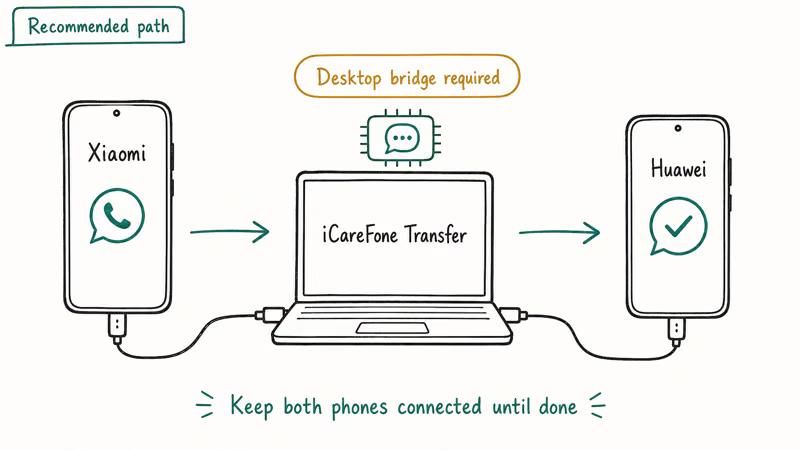
iCareFone Transfer is a desktop tool from Tenorshare that performs direct device-to-device WhatsApp migration, including across brands like Xiaomi and Huawei. It bypasses Google Drive entirely.
Some links on this page are affiliate links, which means fone.tips may earn a commission at no extra cost to you.
#What it does
iCareFone Transfer reads the WhatsApp database from the source phone over USB, packages chats and media, and writes them straight to the WhatsApp install on the destination handset. Tenorshare reports high success rates on cross-brand Android moves because the tool doesn’t rely on cloud quotas or vendor-specific cloud APIs.
#Step-by-step
- Download and install iCareFone Transfer on your computer.
- Connect both your Xiaomi and Huawei phones to the computer using USB cables.
- Launch iCareFone Transfer and select “WhatsApp” from the main interface.
- Select your Xiaomi as the source device and Huawei as the destination.
- Click “Transfer” and wait for the process to complete.
Over a USB 3.0 connection, even a few gigabytes of chats and media usually transfer without a long wait.
#Pros and Cons
Pros:
- Fast and reliable transfer
- User-friendly interface
- Supports transfer of all WhatsApp data types
Cons:
- Requires a computer
- Paid software (though it offers a free trial)
#Method 2: Transferring via Google Drive Backup
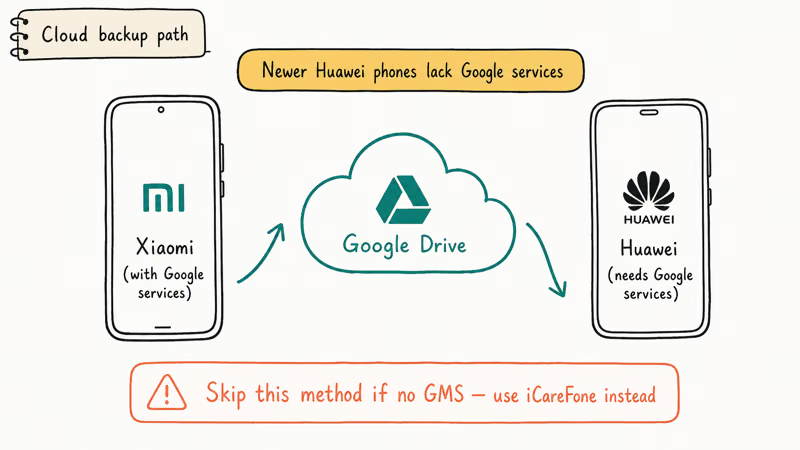
This method uses WhatsApp’s built-in backup feature with Google Drive, the only fully free path that works without a computer. It’s the route WhatsApp’s own documentation recommends for most users.
#Creating a Google Drive backup on Xiaomi
- Open WhatsApp on your Xiaomi phone.
- Go to
Settings>Chats>Chatbackup. - Tap “Back up to Google Drive” and select your preferred backup frequency.
- Choose the Google account you want to use for the backup.
- Tap “Back up” to start the process.
If you encounter any issues during the backup process, refer to our guide on troubleshooting WhatsApp backup not working.
#Restoring the backup on Huawei
Huawei phones manufactured after May 2019 ship without Google Mobile Services in many markets, so this method works best on Huawei devices that still have Play Services installed or that side-load them through a recognised method. Without GMS, the Restore prompt never appears.
- Install WhatsApp on your Huawei phone.
- Verify your phone number (use the same number as on your Xiaomi).
- When prompted, tap “Restore” to retrieve your chat history from Google Drive.
- Wait for the restoration process to complete.
#Pros and cons
Pros:
- Free method
- No need for third-party software
Cons:
- Requires a stable internet connection
- Won’t work on Huawei models without Google Mobile Services
#Method 3: Using the Local ZIP Method
This manual route compresses WhatsApp’s /sdcard/WhatsApp/ folder on Xiaomi and restores it on the new Huawei phone. It’s the only option that works fully offline.
#Compressing WhatsApp data on Xiaomi
- Download a file compression app (like RAR) on your Xiaomi phone.
- Use the app to locate and compress the WhatsApp folder in your phone’s internal storage.
- Save the compressed file.
#Transferring and extracting on Huawei
- Transfer the compressed file to your Huawei phone (via USB, cloud storage, etc.).
- Install the same compression app on your Huawei phone.
- Use the app to extract the WhatsApp data to the appropriate folder on your Huawei.
- Install WhatsApp and verify your number.
- WhatsApp should detect the extracted files and offer to restore them.
#Pros and cons
Pros:
- Works without internet once files are copied across
- Gives you full control over which subfolders move
Cons:
- More complex and time-consuming
- Higher risk of user error or partial restores
#Method 4: Transferring with Phone Clone
Phone Clone is Huawei’s official cross-device migration app. Huawei’s product page confirms that Phone Clone moves contacts, messages, photos, videos, and apps wirelessly between Android phones, with no cable or cloud account required.
#What Phone Clone does
Phone Clone creates a peer-to-peer local wireless link between the two phones and ships data directly. Because the transfer behaves like a nearby-device Wi-Fi Direct session rather than a cloud upload, speed depends on radio quality and physical distance.
#Steps
- Install Phone Clone on both your Xiaomi and Huawei devices.
- Open the app on both phones and select the appropriate options (old phone/new phone).
- Use your Huawei to scan the QR code displayed on your Xiaomi.
- Select WhatsApp data for transfer.
- Wait for the transfer to complete.
The same flow is described in our companion guide on transferring WhatsApp from Samsung to Huawei, helpful if you have a second source device.
#Pros and cons
Pros:
- Official Huawei app
- Can transfer other data types alongside WhatsApp
Cons:
- May not transfer all WhatsApp data types
- Requires both phones to have good battery life and be close to each other
#Tips for a Successful WhatsApp Transfer
A few preparation steps cut the failure rate sharply.
- Fully charge both phones before starting.
- Confirm you have enough free storage on your Huawei phone, ideally at least double the size of your WhatsApp folder.
- Keep both phones connected to a stable Wi-Fi network for cloud-based methods.
- Avoid using either phone during the transfer process.
- Back up your WhatsApp contacts separately so the new device can rebuild your address book even if something fails.
If a transfer stalls or fails halfway, restart both phones first, then try again with the same method before switching tools. Switching methods mid-flow tends to leave half-restored databases behind, which then block clean retries.
#Which Method Should You Choose?
Pick by what matters most to you on the day of the move.
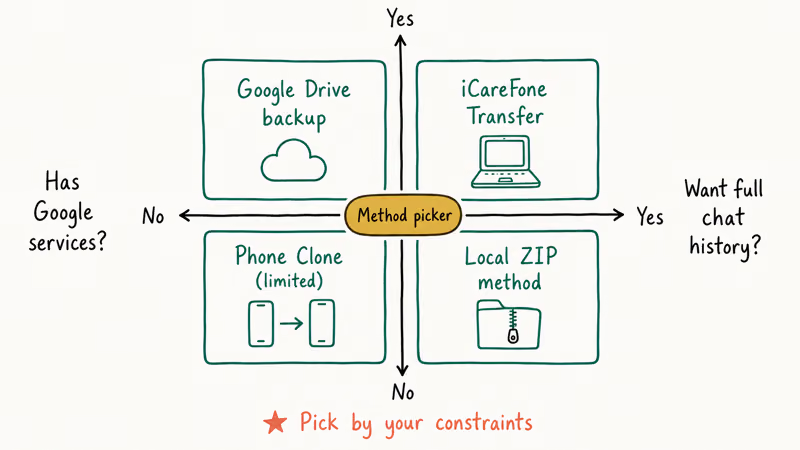
- Want zero setup and a free path? Use Google Drive backup, as long as your Huawei model supports Google Mobile Services.
- Have a non-GMS Huawei (post-2019 EMUI / HarmonyOS)? Go with iCareFone Transfer or the local ZIP method, because Google Drive restore won’t surface on those phones.
- Want everything in one move (apps, photos, WhatsApp) without a computer? Phone Clone is the simplest path, although it sometimes drops voice notes.
- Need the highest fidelity and you have a PC? iCareFone Transfer tends to preserve the most data types, including voice messages and stickers.
#Bottom Line
For most readers in 2026, try Google Drive backup first if your Huawei supports Google Mobile Services, since it’s free and officially blessed by WhatsApp. If you own a HarmonyOS Huawei or any post-2019 Huawei sold without GMS, skip straight to iCareFone Transfer — its USB-based path is the most reliable route for restoring voice notes and reactions on those handsets.
Keep the original Xiaomi powered on with WhatsApp installed for at least 48 hours after the move, in case you need to rescue a single chat thread.
#Frequently Asked Questions
Can I transfer WhatsApp from Xiaomi to Huawei without using any third-party apps?
Yes. The Google Drive backup method and Huawei’s Phone Clone app are both official routes that work without paid tools, provided your Huawei device supports the required services.
Will my WhatsApp groups transfer to the new Huawei phone?
Yes.
Is it possible to transfer WhatsApp from Xiaomi to Huawei without losing media files?
Generally yes, but media handling is the most fragile part. Google Drive restores attachments tied to recent backups but tends to drop voice notes older than a few weeks. iCareFone Transfer moves the full media library because it copies the raw database and Media folder over USB, which is why it tends to win on completeness. The local ZIP method depends on you copying the Media subfolder correctly.
How long does it typically take to transfer WhatsApp data between phones?
The range is wide: a small Google Drive restore of a few hundred megabytes finishes quickly, while a multi-gigabyte transfer over USB takes longer. Larger archives over slow Wi-Fi can stretch past an hour.
Can I transfer WhatsApp data if the two phones run different Android or EMUI versions?
Yes. WhatsApp’s restore process is version-agnostic on Android as long as both phones run a current supported build. The main blocker is missing Google Mobile Services on some Huawei models, not the Android version itself.
Does this work if my Huawei phone doesn’t have Google Mobile Services?
Not for the Google Drive route — use iCareFone Transfer, Phone Clone, or the local ZIP method instead.
Will transferring WhatsApp move my account verification to the new phone?
Verification is tied to your phone number, not the device. When you install WhatsApp on the Huawei and enter the same number, WhatsApp will send a one-time code; once you confirm, the account automatically activates on the new phone and deactivates on the old one.
Is it legal to transfer someone else’s WhatsApp data to my phone?
No. Restoring another person’s WhatsApp account on your own device without their explicit consent violates WhatsApp’s Terms of Service and may break computer-misuse or privacy laws in many jurisdictions. The methods in this guide are intended only for moving your own WhatsApp account between phones you personally own.
For those interested in transferring WhatsApp from other devices, we also have guides on transferring WhatsApp Business from iPhone to Android and transferring WhatsApp from iPhone to Huawei.
Pixel 11 vs Pixel 10: What Changed and Who Should Upgrade
Pixel 11 vs Pixel 10: same screen and camera resolution, new Tensor G6, 25W wireless, and Gemini Intelligence. Here is who should actually upgrade.

Verizon Not Receiving Texts? How to Fix It in 9 Steps
Verizon not receiving texts? Fix it in 9 steps: check Message Blocking in My Verizon, reset network settings, deregister iMessage, and call support.
Pixel Battery Drain: What Google's July Fix Really Covers
Google marked the Pixel idle battery drain bug fixed in July, but only some phones got the patch. Here is who is covered, who is not, and what to try.
iPhone Stuck on EDGE? How to Get 5G or LTE Back (2026)
iPhone stuck on EDGE with crawling data? Here's why the E icon appears, which settings force 5G or LTE back, and when the problem is your carrier.