View Private Browsing History on iPhone: Parent Guide
Honest 2026 guide to viewing Safari Private Browsing on your own iPhone or a minor child's device, using Apple Screen Time, DNS cache, and router logs.
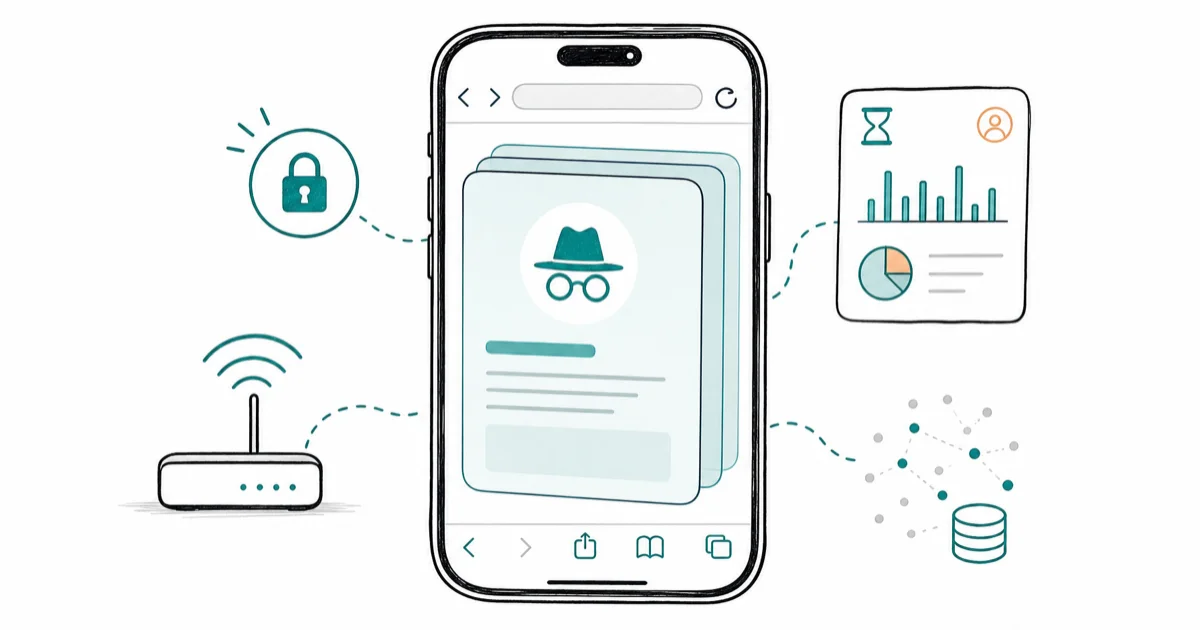
Quick AnswerSafari deletes Private Browsing history the moment the tab closes, but a parent supervising a minor child can use Apple Screen Time, Family Sharing reports, or the home router log to see what was visited, and you can recover traces of your own session in Settings > Safari > Advanced > Website Data.
If you searched “how to view private browsing history on iPhone,” this guide draws a clear line. We cover two scenarios only: a parent supervising a minor child on a device the parent owns, and recovering traces from your own iPhone. Snooping on a spouse, partner, or other adult is illegal under wiretapping and computer-misuse statutes, so we won’t show methods aimed at that.
- Safari’s Private Browsing leaves no readable history log on the device after the tab is closed, because Apple’s privacy design deliberately wipes the session.
- Apple Screen Time on iOS 17 and later can block Private Browsing entirely on a child’s iPhone, which removes the problem at the source.
- Family Sharing’s weekly Screen Time report shows website categories visited across all Safari sessions, including time spent on adult content categories.
- Your home router’s DNS log records every domain queried by the iPhone, even during Private Browsing, and most consumer routers expose this under “Logs” or “Parental Controls.”
- Federal wiretapping law (18 USC 2511) treats secret monitoring of another adult’s device as a felony, with civil damages on top, so the only safe scope is your own device or a minor child you have legal authority over.
#Who This Guide Is For (and Who It Isn’t)
This article assumes one of two things about you. Either you are a parent or legal guardian looking at a phone you bought for a minor child, or you are trying to retrace your own browsing on your own iPhone. Both cases are legitimate and supported by Apple’s own tooling.
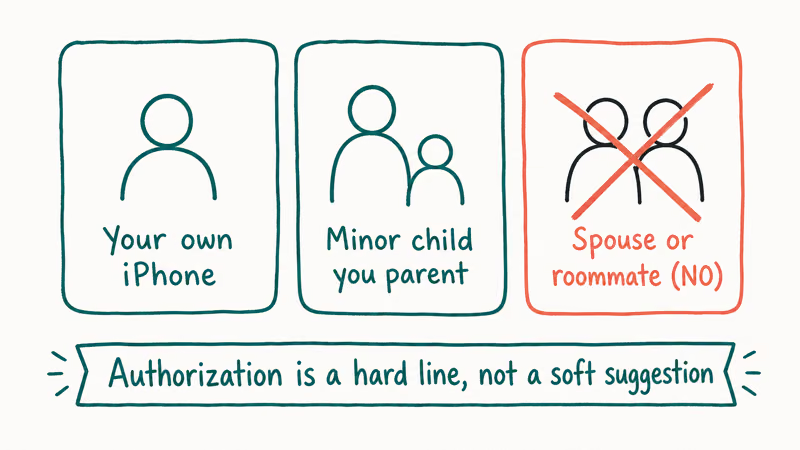
If you’re an adult trying to inspect another adult’s Private Browsing without their knowledge, stop reading. According to the Department of Justice’s prosecutor manual, the Computer Fraud and Abuse Act covers unauthorized access to any “protected computer,” with first-offense penalties of up to 5 years in prison and civil damages stacked on top.
No browser trick is worth that.
Every method below applies to a current iPhone on iOS 18 and a typical home Wi-Fi network, and this guide flags where Apple’s privacy hardening has closed the door on what older guides still claim works.
#Why Does Safari Private Browsing Leave No Local History?
Private Browsing in Safari does what its name promises: it doesn’t write to the visible history list, doesn’t save cookies between tabs, and doesn’t autofill from those sessions. According to Apple’s Safari user guide, Private Browsing tabs are isolated from your normal session, and Apple lists 4 categories of removed data: browsing history, search history, AutoFill information, and tab state.
The regular History view in Safari will never show a private session.
What survives is thinner than most blogs claim. The DNS resolver cache may keep recently visited domains for a short window, certain favicons persist briefly, and any file actively downloaded during the session still lands in the Files app. Beyond that, Apple’s design wipes the slate when the tab closes.
#How Can a Parent See What a Child Visited in Private Browsing?
For supervising a minor child, Apple’s official answer is Screen Time, not third-party recovery software. The cleanest setup is to block Private Browsing so the question never comes up, then read the weekly Screen Time report for everything else.
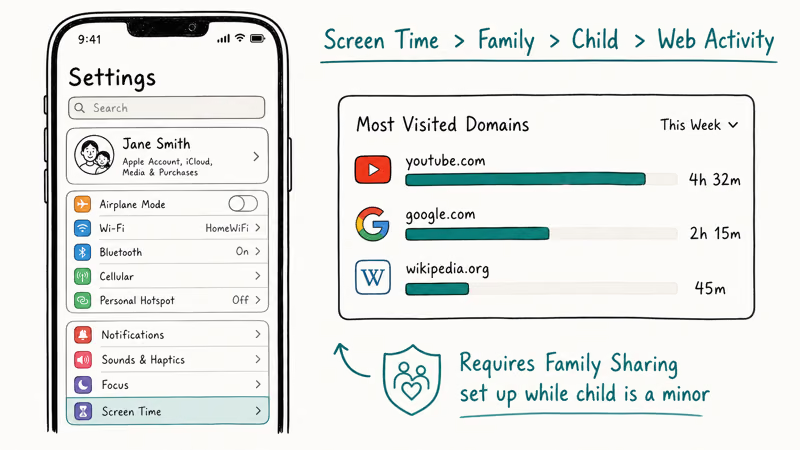
To block Private Browsing on a child’s iPhone, open Settings > Screen Time > Content & Privacy Restrictions > Content Restrictions > Web Content, then choose Limit Adult Websites. Apple’s Screen Time setup guide states that 1 toggle removes the Private tab option from Safari, so future browsing logs to the normal history attached to the child’s Apple ID.
Enable Family Sharing’s Screen Time too. The weekly report on the parent device shows 6 category summaries: social networking, entertainment, productivity, creativity, education, and “other” (which buckets adult content). That’s enough to spot a pattern.
For stronger guardrails than Screen Time alone, we cover hardware-level filtering in our review of the best parental control router and an iOS-specific walkthrough in how to block porn on iPhone.
#Recover Your Own Browsing With DNS Cache and Settings
If you’re the device owner trying to reconstruct your own Private Browsing session, a few traces survive long enough to help.
The DNS cache is the first place to look. Open Settings > Safari > Advanced > Website Data, and you’ll see domains the browser recently queried, including some from private sessions if you check soon after closing the tab. Apple doesn’t document this as an audit log, so treat it as a recovery hint, not a complete record.
The Files app shows anything you actively downloaded during a private session, since downloads are saved by design. Settings > Safari > Downloads lets you confirm the destination folder. Check there first.
If the iPhone was backed up to a Mac or PC through Finder or iTunes before the session, you can restore that backup to a spare device and inspect what was current at backup time. This won’t recover data created after the most recent backup, and it overwrites the spare device, so reserve it for serious cases.
#Read the Router Log for Family Network Visibility
Your home router is the most under-used parental tool in the house. Every device on Wi-Fi sends DNS queries to the router, and Private Browsing doesn’t hide that traffic because DNS happens below the browser layer.
Many mainstream routers, such as Netgear Nighthawk and ASUS RT models, expose a per-device log of queried domains under their parental control panels, with hostnames visible even when the iPhone is using Private Browsing.
Two caveats matter. If the child’s iPhone has a VPN profile installed, the router only sees encrypted traffic to the VPN endpoint. If iCloud Private Relay is on, Apple proxies DNS through its own infrastructure and the router log becomes far less useful.
For US households on major carriers, Verizon’s Smart Family and similar carrier products extend visibility to cellular data, which the home router can’t see.
#Third-Party Tools That Stay Inside the Law
A small set of paid utilities can help you reach data on a device you legally control. We list them with their actual scope, not the inflated claims you’ll see on review-bait pages.
Tenorshare UltData iPhone Data Recovery scans an iPhone or its iTunes backup for fragments of deleted data, including some Safari history entries. It can’t retrieve closed Private Browsing sessions because that data never lands in the recoverable store, but it can rebuild a partial timeline of normal browsing that was cleared.
Some links on this page are affiliate links, which means fone.tips may earn a commission at no extra cost to you.
dr.fone iOS Data Recovery offers a similar deleted-data scan with the same limit: it works on what Safari wrote to disk, not on Private Browsing sessions that were never written. Helpful for recovering a normal-mode history that was wiped, not for private mode.
Both tools require physical access to the device or to a computer that holds an unencrypted backup. They won’t pull data remotely from someone else’s phone, and any product that claims to is a scam.
#What Older Guides Got Wrong About iOS Private Browsing
Several methods that worked on iOS 9 or 10 have been closed since. Apple confirms that recent Safari versions deliberately scrub the Website Data list after a private session, so the “open Website Data after the fact” trick promoted by older blogs is much less reliable than it once was.
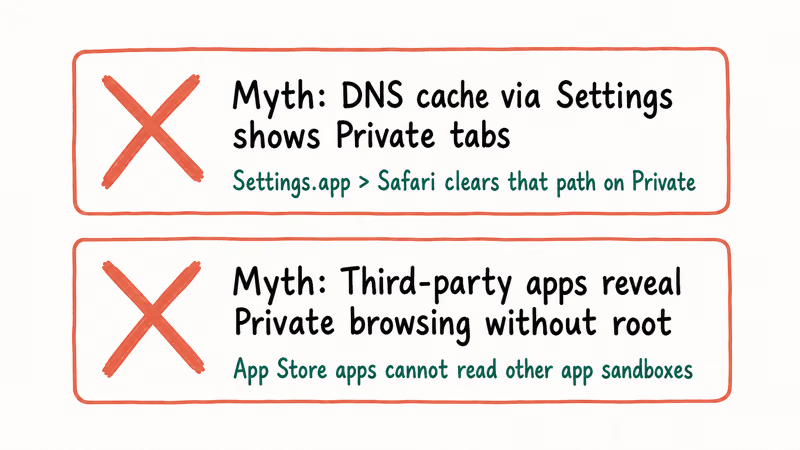
Restoring from an iCloud or iTunes backup also doesn’t recover Private Browsing the way some guides claim. Apple’s iCloud backup overview lists 14 data types included in iCloud Backup, and Private Browsing session data isn’t on that list because it was never persisted in the first place.
Walk away if an older page asks you to install a configuration profile, MDM payload, or untrusted enterprise app to “unlock” private history. That’s the path attackers use to plant spyware, and it won’t produce real Private Browsing data anyway.
#Bottom Line
Use Apple Screen Time to block Private Browsing on a minor child’s iPhone, then read the Family Sharing weekly report and the router DNS log for week-over-week visibility. That stack is free and stays inside US law. For your own device, check Settings > Safari > Advanced > Website Data soon after a session and rely on the Files app for downloads. Don’t pay for apps claiming to retrieve another adult’s Private Browsing, because the data isn’t there to retrieve.
#Frequently Asked Questions
Can I view someone else’s private browsing history on their iPhone?
No, and the attempt is illegal in most US states. Federal wiretapping law (18 USC 2511) and the Computer Fraud and Abuse Act both apply to unauthorized access to another adult’s device.
Does iCloud sync save my Safari private browsing history?
No. Apple states that Private Browsing sessions don’t sync to iCloud Tabs or iCloud History because the data is never written to disk in a syncable form. It’s a design choice, not a bug, and there’s no toggle to change it.
Will Screen Time show every URL my child visited?
Screen Time shows category-level summaries by default, such as social networking or “other” (which buckets adult content), plus app-level time spent. It doesn’t surface a full URL list. For per-URL visibility, the home router DNS log or a parental control router is the next step, and the Family Sharing setup guide walks through how to link the report to the parent’s device.
Can a VPN hide private browsing from my router?
Yes. A VPN encrypts all traffic from the device to the VPN provider, so the router only sees a single encrypted tunnel rather than individual DNS queries. If a child has a VPN profile installed, block VPN apps in Screen Time under Content & Privacy Restrictions before relying on router logs.
Are third-party data recovery apps safe to use?
The two we link, dr.fone and Tenorshare UltData, are mainstream products from established vendors that scan local data and iTunes backups. We treat them as safe for the recovery cases they actually handle, which is normal-mode Safari history that was cleared. Any tool advertising remote retrieval of someone else’s private browsing is a scam.
What if my child uses Chrome or Firefox instead of Safari?
The Safari-specific tips don’t apply, but the network-level methods still do. The home router DNS log captures all browsers equally, since DNS happens before the browser layer. You can also restrict which browsers are installable through Screen Time’s App Limits and the iTunes & App Store Purchases setting.
How do I see Incognito or InPrivate browsing history on other devices?
For desktop browsers, our guide on how to check computer history covers the equivalent recovery paths. For Android, the how to block porn on Android walkthrough includes a section on browser-level supervision tools that apply to incognito sessions too.
iOS 26.6.1 Security Update: What Apple Fixed and Who Gets It
Apple released iOS 26.6.1 on August 17 with 29 security fixes, including an IPSec interception bug. See what it patches, who gets it, and how to update.
iPhone Adaptive Power: How It Works and When to Use It
Learn how iPhone Adaptive Power works, which models support it, what it changes, and when Low Power Mode is still the better battery-saving choice.
How to Transfer Data to a New iPhone Without iCloud
Move everything to your new iPhone without iCloud: Quick Start device-to-device transfer, wired migration, and encrypted Finder or iTunes backups.

Group Text Not Working on iPhone? 8 Fixes That Work
Group text not working on iPhone? Turn on MMS Messaging and Group Messaging, check iMessage vs SMS routing, and fix mixed Android group chats fast.