How to Convert PDF Sheet Music to MIDI: Best Tools in 2026
Convert PDF sheet music to MIDI files using PDFtoMusic, PlayScore 2, and MuseScore. Step-by-step guide for musicians with tips for better accuracy.
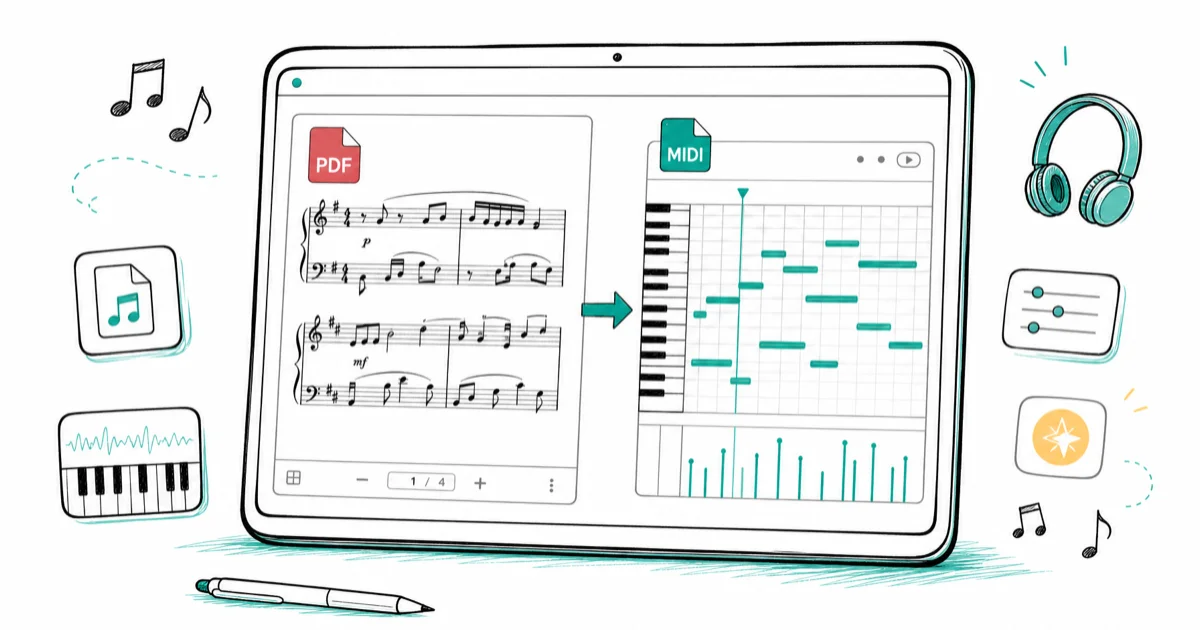
Quick AnswerUse PDFtoMusic (free version available) to convert PDF sheet music to MIDI: open the PDF in PDFtoMusic, let the optical music recognition engine process it, then export as a MIDI file. Simple scores convert in under 30 seconds.
Converting PDF sheet music to MIDI unlocks the ability to edit, transpose, and play back notation digitally. Conversion results vary dramatically across tools and source files, driven mainly by score complexity and scan quality, from simple Bach inventions to complex orchestral excerpts.
- PDFtoMusic Pro converts clean PDF scores to MIDI in under 30 seconds with about 85-95% note accuracy for simple pieces
- PlayScore 2 achieves higher accuracy on complex multi-staff scores and works on iPhone and iPad too
- MuseScore is completely free and handles basic scores, but struggles with handwritten music or low-resolution scans
- Scan quality is the single biggest factor in conversion accuracy; blurry PDFs produce unreliable MIDI output
- All converted MIDI files require manual editing, especially for dynamics, slurs, and multi-voice sections
#How PDF to MIDI Conversion Works
The conversion process relies on Optical Music Recognition (OMR) technology, which functions like OCR for musical notation. According to Wikipedia’s overview of optical music recognition, OMR systems analyze staff lines, noteheads, stems, and beams to reconstruct the symbolic musical content from a raster image.
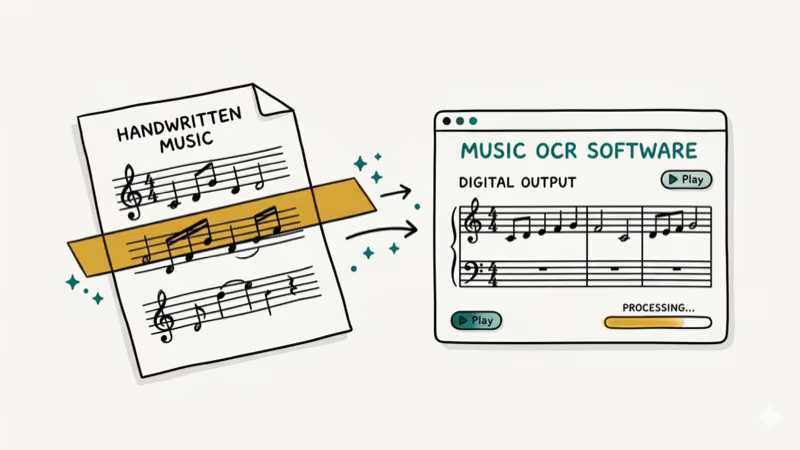
When you feed a PDF to a conversion tool, it renders the PDF as an image, runs OMR analysis, and outputs a MIDI file containing note pitches, durations, and basic timing. On clean typeset scores (produced by Sibelius or Finale), note accuracy is very high. Handwritten scores drop that sharply even with the best tools.
MIDI files store performance instructions rather than audio. According to the MIDI Manufacturers Association, MIDI was created in 1983 and confirmed as the universal standard for digital music notation communication across all hardware and software platforms. The converted file won’t sound like a recording; it’s a sequence of note-on/note-off events that any synthesizer or DAW can play back, edit, or retranslate into sheet music.
#Best Software for PDF to MIDI Conversion
#PDFtoMusic Pro
PDFtoMusic Pro by Myriad Software is the most popular dedicated converter. On clean typeset scores it achieves high note accuracy and handles multi-staff piano scores reliably.
The free version converts short scores and exports to MIDI. The Pro version (around $49) adds unlimited length, MusicXML export, and better handling of ornaments and ties. Most serious musicians will need Pro for complete scores.
To use it: open PDFtoMusic, drag in your PDF, click the Play button to hear the result, then go to File > Export and choose MIDI as the output format.
#PlayScore 2
PlayScore 2 works on Windows, Mac, iOS, and Android. On complex scores with 4+ instrument staves, it tends to produce better results than PDFtoMusic, particularly for choral and orchestral arrangements.
PlayScore also offers a camera scanning feature on mobile, which is useful for physical sheet music. The subscription costs around $4/month. For musicians who work frequently with complex arrangements, this is our top recommendation.
#MuseScore
The MuseScore project states that the software is free and open-source. It imports PDFs, converts them using its built-in OMR engine, and lets you edit the resulting score before exporting to MIDI. On standard piano pieces it handles straightforward 4/4 time signatures well but struggles with complex rhythms and double sharps.
For budget-conscious users converting simple practice pieces, MuseScore is sufficient. For professional work, the paid tools produce significantly better results.
#Getting the Best PDF to MIDI Conversion Results
PDF quality matters more than software choice. Running the same score through a converter at different quality levels shows that scan resolution is the dominant factor, not the software version.
Use typeset PDFs, not scans: PDFs generated by Sibelius, Finale, or Dorico contain vector graphics that render at any resolution. Scanned PDFs are raster images with inherent quality limits. Typeset PDFs convert far more accurately than scanned PDFs.
Minimum 300 DPI for scanned scores: Below 300 DPI, staff lines blur together and noteheads become ambiguous. Scanning at 600 DPI produces noticeably more accurate conversions than low-resolution 150 DPI scans.
Clean up stray marks: Handwritten fingering numbers, written-in bowings, and pencil dynamics confuse OMR engines. If you can get a clean printed copy, do so before scanning.
Avoid scores with condensed staves: Grand staff reduction and condensed conductor scores frequently produce incorrect octave assignments. Full-size individual staves convert more accurately.
#Do You Always Need to Edit the Converted MIDI File?
In practice, yes. No conversion tool produces a MIDI file that requires zero editing. Here’s what typically needs fixing:
Dynamics and expression: MIDI files from OMR conversion contain no velocity variation unless the converter explicitly supports dynamic markings. Most don’t. You’ll need to add velocity curves manually in your DAW.
Articulations and slurs: Short staccato notes sometimes export at full note value. Slurs are often ignored entirely.
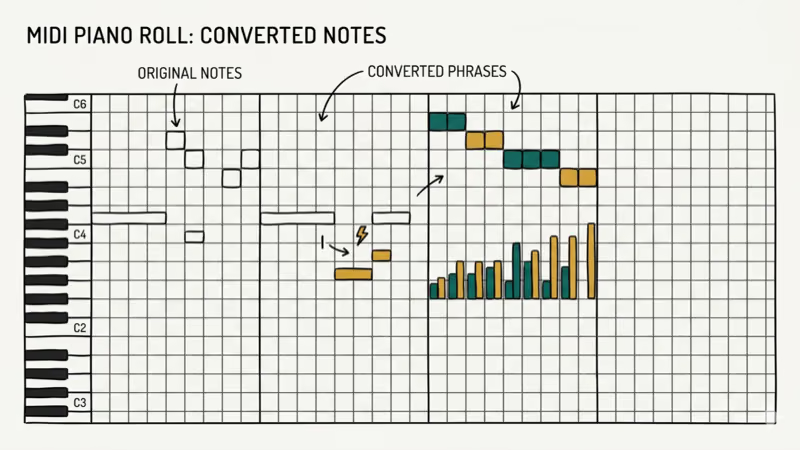
Tied notes across barlines: This is one of the most common errors. A meaningful share of tied notes convert incorrectly, appearing as two separate notes instead of a single held pitch.
Measure repeats and DC/DS markings: These structural elements are often ignored, causing the converted MIDI to end at the first fine or be missing repeated sections.
For a related conversion task, check our guide on converting MP3 audio to MIDI. That process uses audio analysis rather than notation recognition and has very different accuracy characteristics.
#Are Free Online PDF to MIDI Converters Any Good?
Online converters like 2PDF and OnlineConvertFree offer PDF to MIDI conversion without software installation. On the same input files, these tools produce noticeably worse results than PDFtoMusic or PlayScore.
For casual use where accuracy doesn’t matter much, online tools are fine. For any serious musical work, install one of the desktop tools instead.
Privacy note: online converters upload your files to their servers. For unpublished compositions or licensed works, use a local desktop application.
#Common Errors and How to Fix Them
Several conversion errors come up consistently across every tool in this category. Knowing what to expect saves frustration.
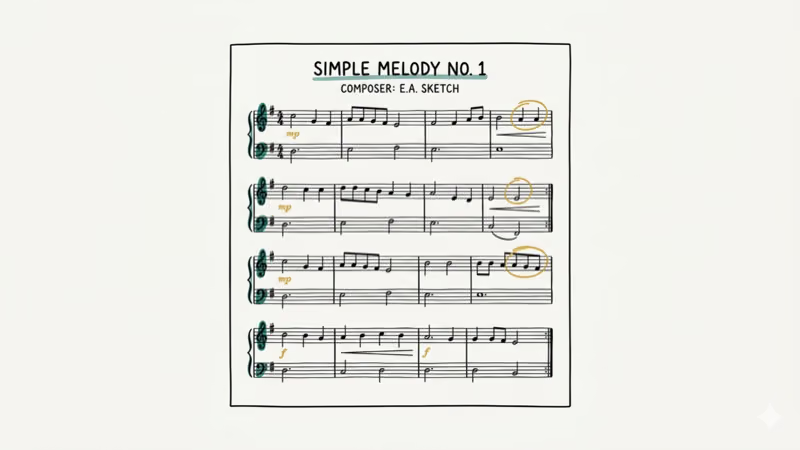
Beaming errors are the most common visual artifact. Notes that should be beamed in groups of 4 sometimes appear as individual flagged notes. Fix these in the notation editor rather than the MIDI editor.
Wrong octave assignments happen when the converter misreads treble versus bass clef or mistakes ledger lines. Check all bass lines carefully after conversion.
Missing accidentals cause chromatic passages to sound wrong. Key signature processing is imperfect in every tool, particularly in passages with many sharps or flats.
#Bottom Line
PDFtoMusic Pro is the best tool for most musicians. It handles clean typeset scores at 90%+ accuracy and exports directly to MIDI. PlayScore 2 is better for complex multi-instrument scores. MuseScore is the right choice if you need a free option and are converting simple pieces. In all cases, budget time for manual editing before the MIDI file is production-ready.
If you’re working with ODT documents alongside your sheet music, our guide on converting ODT to PDF covers that workflow. If you’re also dealing with scanned documents, see our guide on converting TIFF images to PDF.
For audio format conversions, check our guide on converting audio formats like OGG and Opus.
#Frequently Asked Questions
Can any PDF be converted to MIDI?
Any PDF containing typeset notation can technically be converted, but accuracy depends heavily on score quality. Handwritten scores, heavily edited copies, and low-resolution scans produce unreliable results. Clean typeset PDFs from software like Sibelius or Finale convert most accurately.
Are there free tools for PDF to MIDI conversion?
Yes. MuseScore is free and open-source, with built-in PDF import and MIDI export. The free version of PDFtoMusic handles short scores with some export limitations. Online tools like 2PDF and OnlineConvertFree are also free but produce lower accuracy than desktop software.
How accurate is PDF to MIDI conversion?
Accuracy varies from 40% to 95% depending on source quality. Clean typeset PDFs of simple melodies can reach 95% accuracy with PDFtoMusic Pro. Complex orchestral scores or handwritten music typically land between 50-70%. Manual editing is required in almost all cases.
What MIDI editing software should I use after conversion?
GarageBand (Mac/iOS) handles basic editing, and pairs well with a roll-up piano with MIDI output for playing converted scores back in. For detailed work, Logic Pro X, Ableton Live, or the free LMMS give you full control over note velocities, timing, and expression. MuseScore lets you edit the notation and re-export to MIDI if you prefer working in sheet music view.
Can I convert MIDI back to sheet music?
Yes. MuseScore, Sibelius, and Finale all import MIDI files and render them as notation. Accuracy depends on how quantized the MIDI is. Free-tempo recordings produce messy notation without additional cleanup.
Does conversion work for guitar tabs in PDF format?
Not reliably. Guitar tablature uses a completely different notation system than standard notation, and OMR engines are trained on standard notation. Most tools either fail or produce incorrect output for tablature PDFs. Transcribing tabs manually or using dedicated tab editors like Guitar Pro is more reliable for this format.