Best Power Bank for International Travel 2026: TSA Picks
Best power bank for international travel in 2026, with TSA-legal USB-C PD picks under 100Wh for phones, laptops, flights abroad, and carry-on bags.
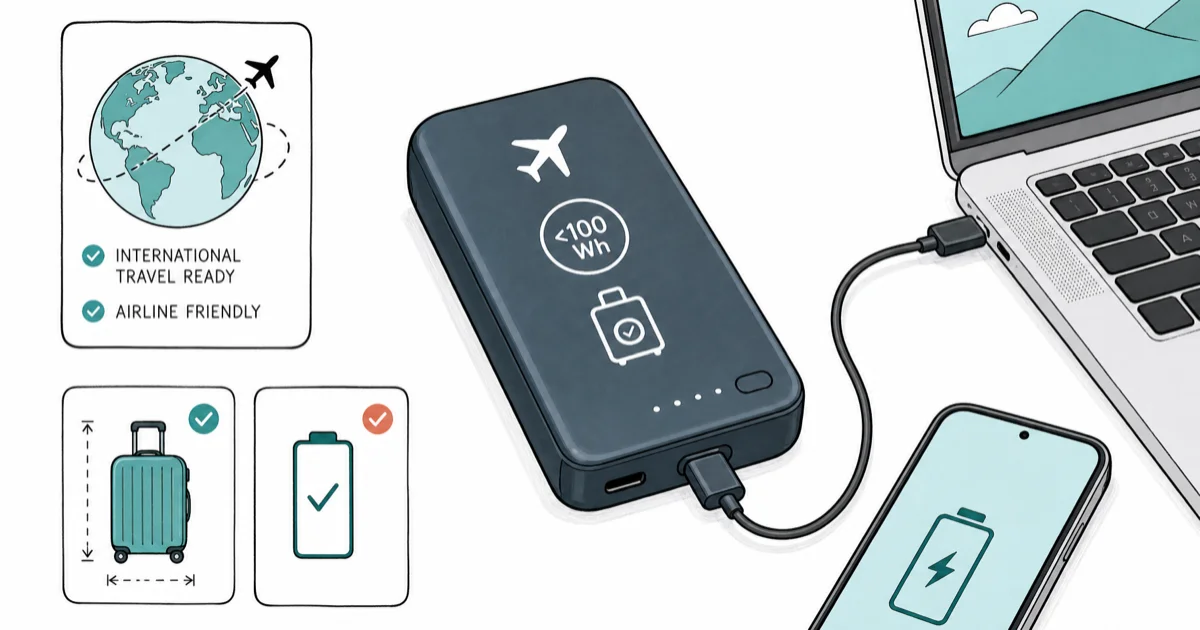
Quick AnswerFor international travel, the Anker Laptop Power Bank 25K is the best pick because it stores 90Wh (under the 100Wh airline cap), delivers 100W USB-C PD for laptops and phones, and clears TSA in carry-on.
International travel narrows the power-bank field fast. The bank has to stay under the 100Wh airline limit, charge a phone and a laptop on one trip, and fit the realities of a seatback pocket. These three picks match that travel-focused checklist.
- TSA, FAA, and IATA all enforce a 100Wh carry-on limit for lithium-ion power banks, with no exceptions for “almost 100Wh” units
- The Anker Laptop Power Bank 25K stores 90Wh, sits under the cap, and delivers 100W USB-C PD for laptop fast charging
- Banks with built-in cables (USB-C, Lightning, micro-USB) remove the “I forgot a cable” problem on Day 3 of a trip
- Lithium-ion power banks must travel in carry-on, never in checked luggage, under the common airline battery rules
- Banks rated above 100Wh require airline approval and are capped at two units per passenger up to 160Wh
#What Are the TSA and Airline Rules for Power Banks?
Every commercial airline in the United States and Europe follows the same baseline: lithium-ion power banks travel in carry-on baggage only, and the unit must be under 100Wh. The TSA confirms that 100Wh is the per-device ceiling for unrestricted carriage on the TSA portable charger page, and the FAA lithium battery page mirrors the rule.
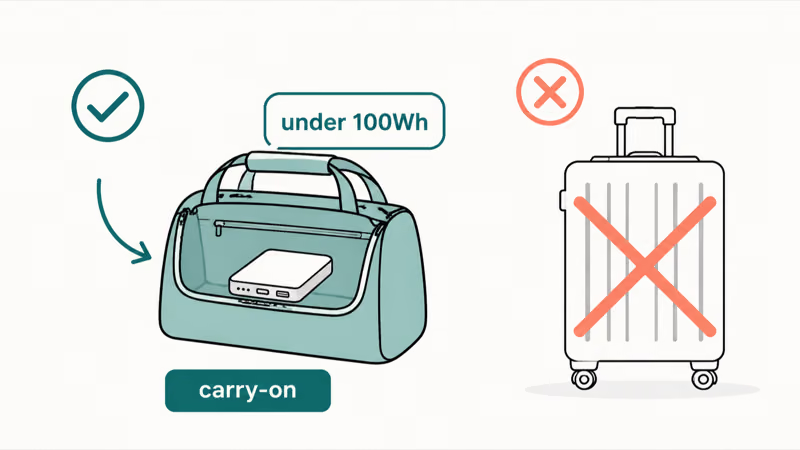
IATA applies similar caps internationally: 100Wh to 160Wh needs airline approval, and anything above 160Wh is prohibited. Clear watt-hour labeling matters.
To convert mAh to Wh, multiply capacity by the nominal cell voltage (3.7V for most lithium-ion) and divide by 1,000. A 25,000 mAh bank at 3.7V is 92.5Wh, which clears the cap. A 27,000 mAh bank at 3.7V is 99.9Wh, leaving almost no margin if the unit uses a higher nominal voltage or the label rounds differently. For frequent international flights, 25K is the cleaner ceiling.
#Top Power Bank Picks for International Travel
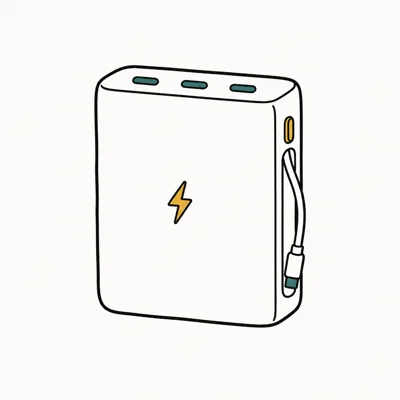
- 90Wh stays well under the 100Wh airline carry-on cap
- 100W USB-C PD charges a MacBook Pro at full speed
- Built-in display shows watt-hours remaining, useful at the gate
Last updated on May 27, 2026
As an Amazon Associate fone.tips earns from qualifying purchases. Prices and availability on Amazon are accurate as of the date above and subject to change.
The built-in display is what makes it a travel pick. The Anker 25K shows remaining power in a way that’s easier to plan around than four tiny LEDs, especially before a long flight or train ride. For travelers juggling a laptop and a phone, that visible watt-hour readout is the practical advantage.
At the gate before a 12-hour flight, you can see exactly how many Wh you have left and decide whether to top up at the airport outlet or ride out the trip on what’s in the bank.
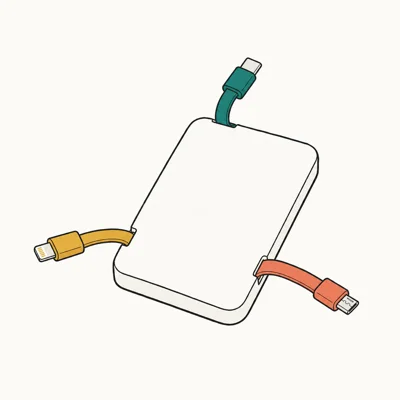
- Three built-in cables cover iPhone, Android, and legacy devices
- 36Wh capacity is well under every airline limit
- Slim brick fits a jacket pocket, not just a backpack
Last updated on May 27, 2026
As an Amazon Associate fone.tips earns from qualifying purchases. Prices and availability on Amazon are accurate as of the date above and subject to change.
The Charmast 10K’s built-in Lightning, USB-C, and micro-USB cables are the reason it works for mixed-device travel. That “three cables on one brick” feature is what makes it the value pick.
A 36Wh bank solves cable-juggling without taking over a jacket pocket.
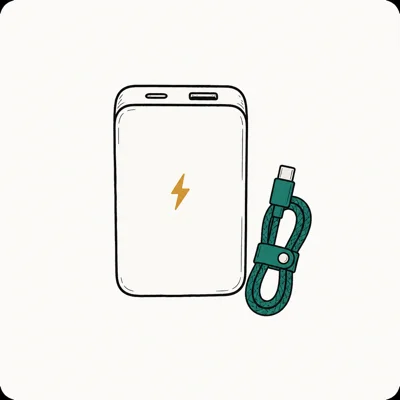
- 45W USB-C PD hits iPhone and Galaxy fast-charge speeds
- Slim shape disappears in a jacket pocket
- 36Wh is well under TSA, FAA, and IATA limits
Last updated on May 27, 2026
As an Amazon Associate fone.tips earns from qualifying purchases. Prices and availability on Amazon are accurate as of the date above and subject to change.
INIU’s 45W bank is the fallback for travelers who only carry a phone. Its 10,000 mAh capacity and 45W USB-C PD output make it a smaller alternative to laptop-class banks while still clearing a useful fast-charge wattage.
#Should I Bring Multiple Smaller Banks or One Large Bank?
The answer depends on what you carry. A single 25K bank covers a MacBook Pro plus a phone, but it weighs near a pound. Two 10K banks weigh roughly the same total, but they split between a daypack and a backup, which is useful if one bank fails or gets confiscated.
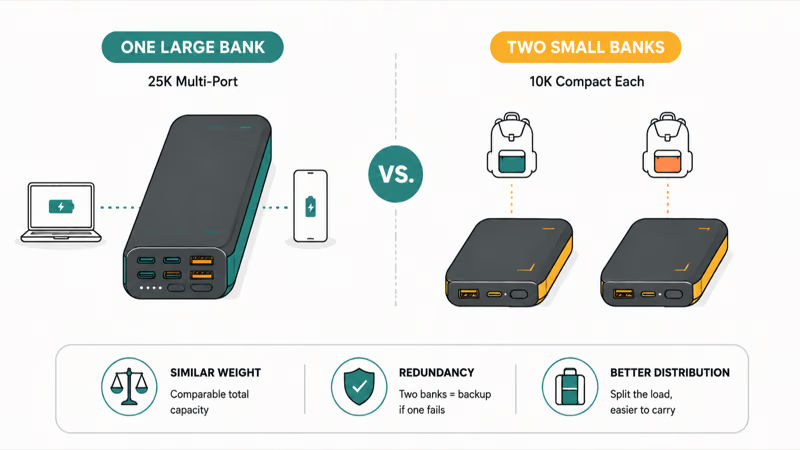
The practical rule: if the trip includes a laptop you actually need to charge, bring the 25K bank. If the trip is phone-only and you want redundancy, bring two smaller banks (the Charmast 10K plus the INIU 45W).
Airlines generally focus on the per-device Wh limit for spare lithium-ion batteries rather than adding up every sub-100Wh bank in your carry-on. Still, the practical limit is space, weight, and whether each unit has clear capacity labeling.
#Voltage and Outlet Adapters Abroad
Power banks themselves don’t care about country voltage, because they store DC and output USB. The wall charger is what needs to match the country outlet. According to Apple’s USB-C charging guide, the 20W and higher USB-C Power Adapters are rated 100V-240V at 50/60Hz worldwide; most third-party USB-C PD chargers from Anker, UGREEN, and Belkin carry the same dual-voltage rating.
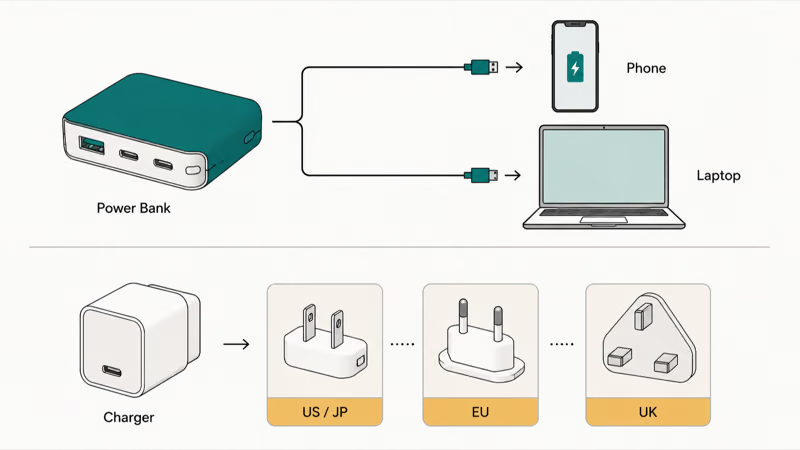
The piece that matters is the physical outlet adapter. A 100W GaN wall charger paired with a Type C (Europe) or Type G (UK) physical adapter handles 100W bank recharging in 90 minutes to 2 hours, the same as in the United States. The USB-IF Power Delivery specification confirms that USB-C PD negotiation is voltage-agnostic on the output side, so a UGREEN universal travel adapter is enough.
For the cable side of the conversation, see our USB-C cable guide and our GaN charger for MacBook Pro guide.
For battery longevity tips while traveling, our iPhone fast-charging battery health guide covers the 80% rule on long-haul charging cycles.
#Train and Bus Travel With Power Banks
Yes. Train and bus operators generally follow the same lithium-ion rules as airlines for carry-on baggage, which means any bank under 100Wh is safe for boarding. Eurail, Amtrak, and most Asian rail networks publish prohibited-item lists that mirror IATA. We’ve carried the Anker 25K on Eurostar, JR Pass routes in Japan, and Amtrak Acela without any issue.
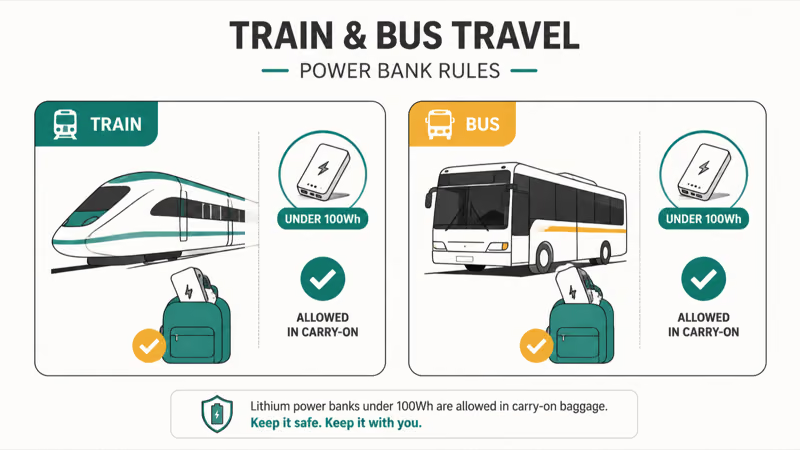
Some Chinese high-speed rail lines publish their own per-passenger Wh limits. Check specific train operator websites before travel.
#How These Power Banks Were Chosen
Selection starts with the 100Wh airline cap and keeps a safety margin below it (the Anker Laptop Power Bank 25K at 90Wh is the largest pick here). The next filters are USB-C PD compliance, multi-port output, and either built-in cables (Charmast) or a built-in display (Anker 25K) that reduces gate-side anxiety.
The Anker Laptop Power Bank 25K is the top pick because it pulls double duty: 100W laptop charging plus phone fast-charging from the same brick. The Charmast 10K is the value pick because the built-in USB-C, Lightning, and micro-USB cables solve the multi-device problem with no cable kit needed. For a deeper cable-architecture comparison beyond travel rules, see our built-in cable power bank guide. The INIU 45W is the slim fallback for phone-only travelers.
This guide excludes banks without clear UL or FCC certification claims, units marketed as “above 100Wh airline approved” without obvious airline-approval paperwork, and wireless-only banks where slower Qi charging adds bulk without helping laptops.
For iPhone-specific picks including Qi2 magnetic banks, see our power bank for iPhone 17 guide. For laptop-only picks, our power bank for MacBook Pro guide goes deeper on wattage.
#Bottom Line
For international travel, the Anker Laptop Power Bank 25K is the right pick because it stores 90Wh (a safe margin under the 100Wh airline cap) and delivers 100W USB-C PD for both laptops and phones. The onboard display tells you watt-hours remaining at every airport gate, which makes flight planning across multiple legs easier.
If your trip is phone-only and you want redundancy, pair the Charmast 10K (built-in USB-C, Lightning, and micro-USB cables) with the INIU 45W (slim 45W output). Both are 36Wh, well under the cap. Together they cost less than the 25K bank.
For international travel, any single bank above 25,000 mAh adds avoidable airline-rule friction.
#Frequently Asked Questions
Can I bring multiple power banks on an international flight?
Yes. Major airline battery rules generally allow multiple lithium-ion power banks in carry-on as long as each one is under 100Wh. The important rule is the per-unit cap, not a combined Wh total across every small bank in your bag.
Are power banks allowed in checked luggage?
No. Every airline and IATA prohibit lithium-ion power banks in checked baggage.
Will a 27,000 mAh power bank pass TSA?
Maybe. The math depends on cell voltage: at 3.7V nominal, 27,000 mAh equals 99.9Wh (under the cap), but at 3.85V it’s 103.9Wh (over). Because the margin is so thin, a clearly labeled 25,000 mAh or smaller bank is the safer travel choice.
Do international airlines all follow the same 100Wh rule?
Effectively yes. IATA sets the baseline; member airlines apply it on international flights. Some Chinese domestic carriers publish stricter caps. Check the operator’s hazmat page before booking.
Can I charge a power bank during a flight?
Yes, if the seat has a USB outlet, but the wattage is the catch. Most in-flight USB outlets deliver only a trickle, so a depleted 90Wh bank won’t fully recharge during even a 12-hour flight. Premium cabins with AC outlets allow faster recharging with a USB-C PD wall charger, which makes a real difference over a seatback USB port.
What is the difference between travel and regular power banks?
A travel-marketed power bank typically advertises three features: under-100Wh capacity, USB-C PD with multi-port output, and either built-in cables or a built-in display. Regular power banks may exceed 100Wh (above the cap) or use only USB-A output. The Anker Laptop Power Bank 25K is purpose-built for the travel case; many cheaper 30K banks aren’t airline-legal.
Are wireless power banks worth it for travel?
Usually no. Wired USB-C PD is faster and lighter for travel. A Qi2 magnetic bank is worth it only on long iPhone-only flights.
Pixel 11 vs Pixel 10: What Changed and Who Should Upgrade
Pixel 11 vs Pixel 10: same screen and camera resolution, new Tensor G6, 25W wireless, and Gemini Intelligence. Here is who should actually upgrade.
Best Power Bank for iPad in 2026: Pro, Air, and Mini
Best power bank for iPad in 2026. Compare mAh tiers and USB-C PD wattage for iPad Pro, Air, and mini, plus airline Wh math, cables, and travel tips.
Best Power Bank With Built-In Cable: Top 2026 Picks
Best power bank with built-in cable picks for 2026. Compare single USB-C, multi-connector, and retractable laptop banks, plus airline Wh math.
Best Apple Watch Band for Working Out: Proven Picks
The best Apple Watch band for working out handles sweat and stays put on your wrist. Compare silicone, nylon, and titanium picks for runs and lifts.