Best CPU 2026: Top Picks for Gaming and Productivity
Best CPU picks for 2026: AMD X3D versus Intel Core Ultra, cores versus clock speed, and how to match a processor to your graphics card and workload.
Quick AnswerFor pure gaming the Ryzen 7 9800X3D is the chip to buy, full stop. If you also do heavy multi-threaded work, the Ryzen 9 9950X3D does it all, while Intel Core Ultra 200S is the smarter mid-range pick for mixed gaming and creator workloads.
The best CPU in 2026 depends on whether you game, create, or do both. AMD’s X3D chips own the gaming crown, while Intel’s Core Ultra line fights hard for mixed workloads. The right pick is the one that matches your graphics card and your budget.
- The Ryzen 7 9800X3D is the best gaming CPU by a wide margin, with 8 cores, 16 threads, and 96MB of 3D V-Cache L3.
- For gaming plus heavy productivity, the Ryzen 9 9950X3D is the do-it-all flagship, at a premium.
- Intel Core Ultra 200S trails AMD in pure gaming but stays competitive for mixed creator work around $200 to $300.
- The Ryzen 5 9600X is the budget sweet spot: 6 Zen 5 cores clocked at 5.4GHz, a fine partner for a mid-range GPU.
- AMD’s AM5 socket has confirmed support through at least 2027, so a board you buy now will accept future chips.
#Which CPU Should You Buy in 2026?
Start with how you use the machine, not with the spec sheet. A processor that wins benchmarks for video rendering can lose to a cheaper chip in actual games, because games care far more about cache and latency than raw core count, and that single insight saves most buyers from spending heavily on cores they will never put to work in a single play session.
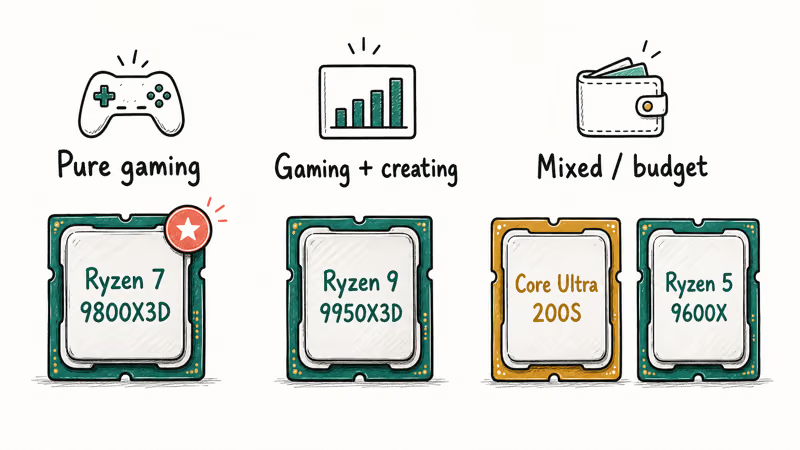
For most gamers, the answer is short. The Ryzen 7 9800X3D is the chip to buy.
A 9800X3D-class gaming CPU should push the bottleneck to the graphics card in most modern titles. The point is simple: the processor stays out of the way and lets the GPU do its job, even in cache-heavy open-world games where weaker chips choke.
If your day includes Blender, code compiles, or 4K timelines, the math changes. The Ryzen 9 9950X3D delivers chart-topping gaming and productivity at once, and Intel’s Core Ultra chips claw back ground in heavily threaded apps where extra cores finally get used.
#How AMD X3D and Intel Core Ultra Differ
The two brands solve the speed problem differently. The architecture that wins frames is not the one that wins a render queue.
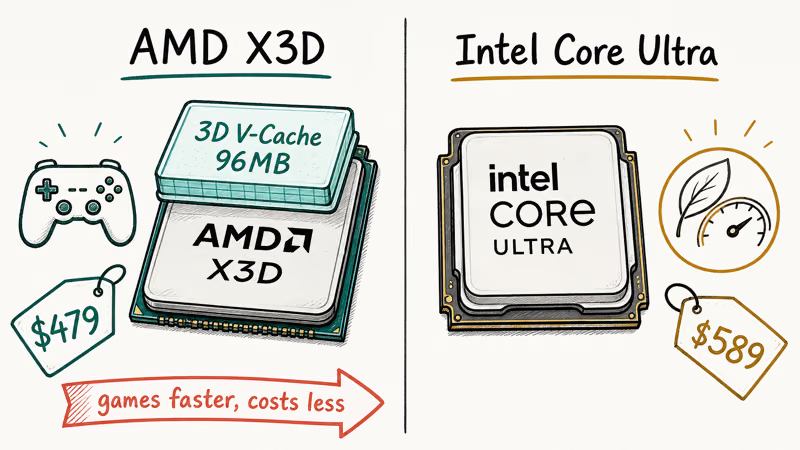
AMD’s edge is 3D V-Cache. AMD states that the 9800X3D ships with 96MB of L3 cache, stacking a 3D SRAM chiplet under the die to keep game data close to the cores. According to PCMag’s processor picks, the X3D family is the recommended choice for cache-hungry open-world titles.
Intel’s strength is efficiency. For a creator who games on the side, that trade can make sense.
Pricing tilts the decision too. The Core Ultra 9 285K launched at $589 while the 9800X3D launched at $479, so AMD asks less and games faster. Intel still earns a place lower down the stack, where its mid-range chips deliver strong multi-threading near $200 to $300, which is the bracket where a hybrid work-and-play build extracts the most value per dollar.
#Do You Need More Cores or a Higher Clock Speed?
This is where buyers overspend. More cores help only if your software actually uses them, and most games don’t scale past six to eight threads.
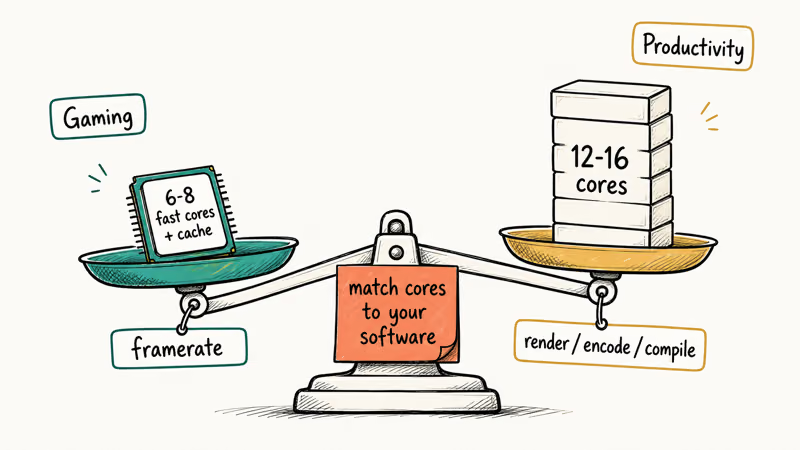
For gaming, six fast cores with good cache beat sixteen slower ones. A 6-core 9800X3D-class chip outruns a 16-core part in framerates because cache and clock, not headcount, drive game performance once you are past the threshold a modern engine can keep busy.
For productivity, cores win. Rendering, encoding, and compiling spread across every thread, so a 12 or 16-core chip finishes faster, a point CNET’s computing coverage makes for creators.
Most people land in the middle. A 6 to 8-core chip handles gaming, browser tabs, light editing, and background tasks without breaking a sweat, which is why the Ryzen 5 9600X and Ryzen 7 9800X3D anchor so many balanced builds across nearly every price bracket you can name today.
#Matching Your CPU to Your Graphics Card
A balanced build spends the right share on each part so neither component starves the other.
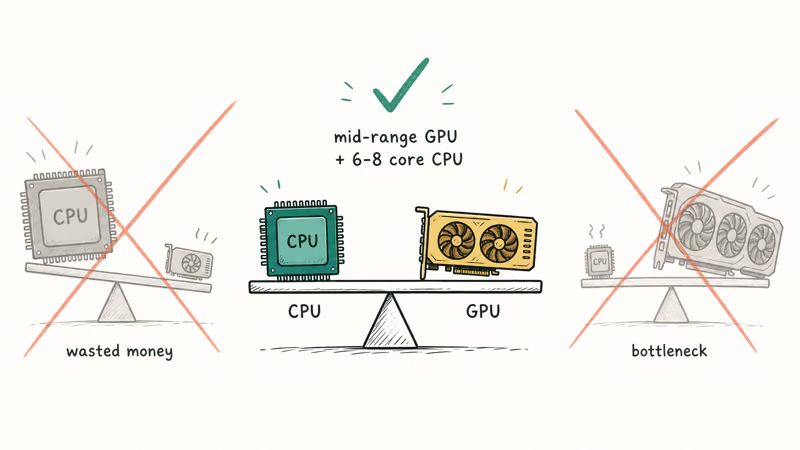
Pairing a flagship CPU with a weak GPU wastes money, and the reverse creates a bottleneck that no clock speed can fix. A mid-range gaming GPU pairs well with a 6 to 8-core chip, which is the combination that keeps both parts working at full tilt instead of waiting on each other.
If you are building around a specific card, our best CPU for the RTX 5070 guide walks through the right match for that tier.
Older cards have different needs. A last-gen GPU does not demand a current flagship to stay fed, as the best CPU for the RTX 3070 and the best CPU for the RTX 3080 Ti breakdowns both explain in detail.
#Cooling Your Processor Without Overspending
Cooling is part of the pairing, and it’s where AMD quietly saves you money.
X3D chips run cooler than Intel’s flagships, so they need less expensive cooling. Every CPU still wants a competent heatsink, though. For Ryzen owners on a budget, our best CPU coolers for the Ryzen 5 3600 picks show the right thermal headroom without overspending on an oversized tower.
Skipping cooling to save cash is a false economy. A throttling chip loses the performance you paid for, and on a flagship that loss can erase the gap you spent extra to get.
#Platform Longevity and Full Builds
Longevity favors AMD. The company has confirmed AM5 platform support through at least 2027, so a B650 or B850 board bought today should accept a future X3D generation, while Intel’s latest LGA 1851 chips are likely the last for that socket, a real factor if you plan to upgrade the chip later without swapping the board and starting your platform over from scratch.
Building a complete rig rather than swapping one part? Our budget gaming PC build for 2026 lays out a full parts list that keeps CPU and GPU spending in balance.
#Bottom Line
If gaming is your main use in 2026, buy the Ryzen 7 9800X3D and don’t second-guess it. Its 3D V-Cache gives it a framerate lead nothing else matches at the price, and the AM5 socket protects your upgrade path through 2027. Pair it with a mid-range GPU and the chip will disappear into the background where a gaming CPU belongs.
Step up to the 9950X3D only if you render, encode, or compile for a living and still want top gaming numbers. Choose Intel’s Core Ultra 200S mid-range parts when your work is threaded and your gaming is casual, since that’s where Intel’s pricing and multi-threading actually win. On the entry tier, the Ryzen 5 9600X is the value pick that leaves room for a stronger graphics card.
#Frequently Asked Questions
Is the Ryzen 7 9800X3D worth it for gaming in 2026?
Yes. It’s the clear best buy for gaming. It leads every other consumer chip in framerates by a wide margin thanks to its 96MB of 3D V-Cache, and it launched at $479, which undercuts Intel’s flagship while gaming faster.
Is Intel still competitive against AMD this year?
Intel is competitive in the mid-range and in productivity, just not at the top of pure gaming. Its Core Ultra 200S chips improved efficiency and offer strong multi-threaded performance around $200 to $300, so for mixed gaming and creator work an Intel mid-range chip can be the smarter buy.
How many cores do I need for gaming?
Six to eight fast cores are plenty. Most games don’t benefit from more, and cache and clock speed matter more than core count. Spend the savings on a better graphics card instead.
What is 3D V-Cache and why does it matter?
3D V-Cache is AMD’s technique of stacking extra L3 cache directly on the CPU die. It keeps game data close to the cores and cuts memory latency, which boosts framerates in cache-hungry games. It’s the main reason X3D chips dominate gaming, and it’s why a cheaper X3D part can beat a pricier rival in frames.
Will my AM5 motherboard support future CPUs?
AMD has confirmed AM5 platform support through at least 2027. A B650 or B850 board you buy today should accept the next generation of Ryzen chips, so you can upgrade the processor without replacing the board.
What is the best budget CPU right now?
The Ryzen 5 9600X is the budget sweet spot. It has six Zen 5 cores clocked at 5.4GHz and handles gaming well, especially after its price dropped from launch. It pairs nicely with a mid-range GPU and leaves headroom in the budget for a better card.
Do I need an expensive cooler for these chips?
No. X3D chips run cooler than Intel’s flagships, so a solid mid-range air or liquid cooler is enough. Intel’s high-end parts draw more power and want beefier cooling.
Should I prioritize the CPU or the GPU in my budget?
Prioritize the GPU in a gaming build. The graphics card has the biggest single effect on framerates, so a mid-range CPU paired with a stronger GPU usually delivers a better experience than the reverse.

Best Laptop for Running LLMs in 2026: Memory Comes First
The best laptop for running LLMs is a memory purchase first. Compare MacBook unified memory against NVIDIA laptop VRAM, and see what each tier really runs.

Pixel 11 vs Pixel 10: What Changed and Who Should Upgrade
Pixel 11 vs Pixel 10: same screen and camera resolution, new Tensor G6, 25W wireless, and Gemini Intelligence. Here is who should actually upgrade.

Best Power Bank for iPad in 2026: Pro, Air, and Mini
Best power bank for iPad in 2026. Compare mAh tiers and USB-C PD wattage for iPad Pro, Air, and mini, plus airline Wh math, cables, and travel tips.

Best Power Bank With Built-In Cable: Top 2026 Picks
Best power bank with built-in cable picks for 2026. Compare single USB-C, multi-connector, and retractable laptop banks, plus airline Wh math.